

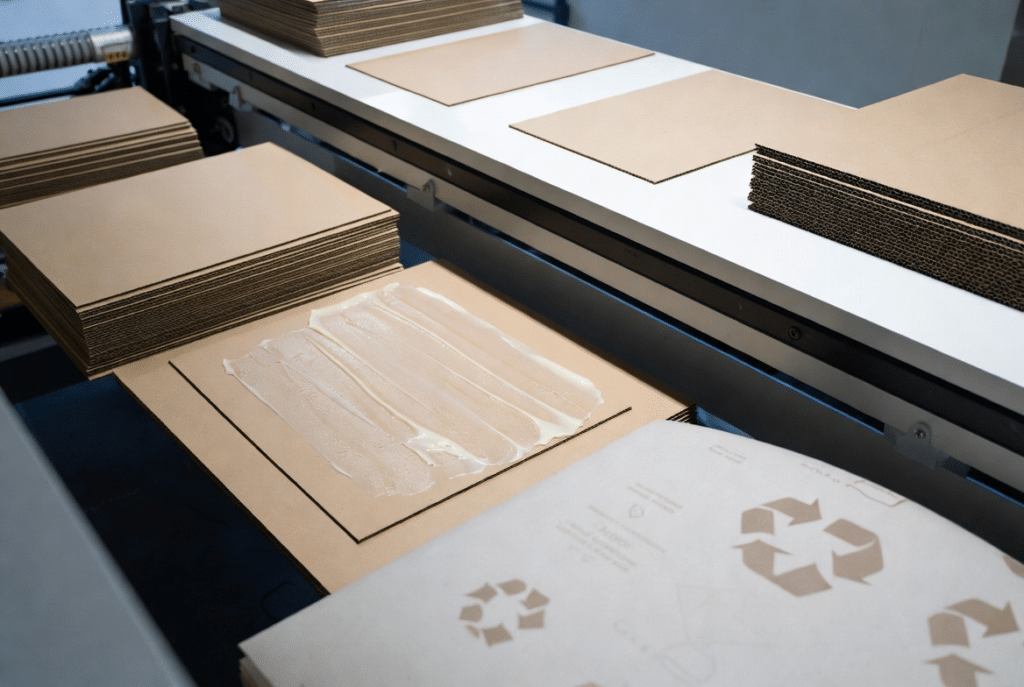
The best paperboard lamination adhesive is not the one that is “greendy,” just that way. It should establish a solid bond between the actual paper and board surfaces that you are running and maintain its integrity at your machine speed and application conditions; not have any defects that inhibit downstream converting and have a recyclability and documentation capability for the finished package. Judging recyclability is done at the full packaging system level, which involves the type and amount of adhesive, coatings and inks, film grade, board grade and the actual recycling stream. Manufacturers recommend using a glue which is easily removed or handled during the normal paper recycling process and only using enough glue to make the bond. The EU Packaging and Packaging Waste Regulation comes into effect on 12 August 2026, and the EU builds on this regulation, introducing the concept of design for recycling and the target to recycle at scale by 2035; retailers often add their own materials and evidence requirements on top of this.
What Makes an Adhesive Suitable for Paperboard Lamination?
Factors of suitability include production performance and end-of-life behavior. The adhesive should be able to wet and bond the desired surfaces, exhibit uniform flow during the lamination process and not cause defects or recycling problems that are disproportionate to its utility. Recyclable adhesive is not a stand-alone technology category. Buyers should question the characteristics of the particular product in the paper-mill process, in the coat weight & conditions to which you are applying it, and in the total packing construction you are shipping.
Bond Strength on Real Paper and Board Surfaces
Factors that influence bond strength include paper porosity, surface coating, ink coverage, board density, moisture content, and adhesive solids, application weight, pressure, and drying conditions. It is important to realize that a good formulation on an uncoated liner may not work on coated art paper, heavy varnish or dense greyboard. Always test on the actual upper sheet/bottom board/printed surface/coating combination in your own circumstances. A general data sheet provided by a supplier is a good beginning, but it’s not the end—the end is application testing for finished stock.
Wet Tack, Open Time, and Dry Bond
The adhesive’s wet tack refers to its tendency to stick the sheets together until the final bond is formed. Open time is the time period where positioning and contact are feasible. The properties determine the sheet Registration, Press length, Line speed and After press handling. The strength of the dry-bond may continue to increase during the conditioning process; know when the laminated board will be die-cutt, folded, stacked, or evaluated and test accordingly.
Adhesive Application Weight and Coverage
Increase in adhesive does not necessarily lead to a better or more durable package. Too much coat causes longer drying times, curl, squeeze out, problem roller contamination, odor issues and results in unnecessary non-fiber material that needs to be dealt with by later recycling systems. Use a controlled application window–apply only enough glue to get the bond and fiber tear needed, but not more.
Compatibility with Laminating-Machine Components
The selection of the glue is an integral part of the glue roller, metering system, pump, reservoir, belt, sensor and cleaning system. Formulations that have too fast a drying rate, harden, or react poorly with machine materials decrease production stability and downtime. Check the viscosity range, operating temperature, cleaning procedure, storage time and machine parameters with both the adhesive supplier and machine manufacturer.
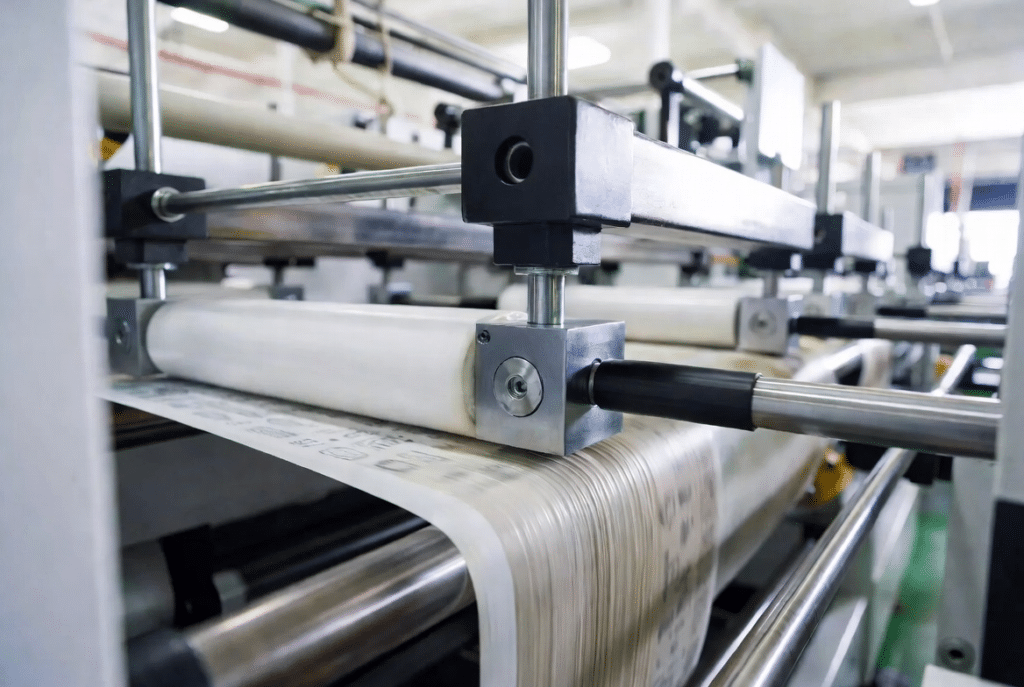
There is no best chemistry. It will depend on the paperboard construction, surface treatments, machine design, production speed, end-use applications, recycling option, and documentation for the target market.
Water-Based Adhesives for Paperboard Lamination
For paper and board, water-based systems are popular, because they can be applied to a highly absorbent substrate and provide good coverage by making use of controlled systems of rollers or other metering systems. Solids content, viscosity, drying demand and surface energy are still variables in performance. Too much moisture can be transferred to the board in high application weight or high humidity, which can result in the board curling. Printable surfaces such as coated or heavily printed surfaces may need different formulations or primers. Never rely on laboratory data alone to validate, always use line speed and plant climate conditions.
Starch-Based and Dextrin Adhesives
Starch- and dextrin-based adhesives are commonly used in corrugated and paper applications and can be used in fiber-based packaging provided they are properly formulated and applied. They still rely on board grade, machine speed, drying capacity and total package construction. It is not a requirement that something is “natural” or bio-based to be recyclable or suitable for production. Verify bonding performance and residue handling characteristics in the target recycling process and chemical documentation prior to approval.
Synthetic Polymer and Specialty Adhesives
Synthetic adhesives are commonly used on difficult surfaces, for increased wet strength, for higher line speeds, for moisture resistance, or for special packaging applications. The suitability depends on the chemistry, amount of use, film forming properties, and behavior of the wastes in the paper mill to which they are to be applied. Ask for technical and recycling information instead of looking at just the term “synthetic.”
Hot-Melt and Reactive Systems
A selection of constructions may be suitable for hot-melt or reactive adhesives but the application temperature, equipment design, cooling or curing time, stringing and residue removability must be carefully considered. Assessment of these systems should be based on a supplier’s internal threshold or on paper-recycling guidance/scorecards as applicable.
How Adhesives Affect Paper and Board Recyclability
Recyclability is defined as the ability to be collected, sorted, processed and used as a useful recycled fiber in a practical system, not just the presence of paper. Although there is no prohibition on the use of paper packaging, industry guidance considers the selection and use of adhesives, as well as the weight of adhesive used, to take account of the possibility of residues or stickies during recycling.
Repulpability, Adhesive Removal, and Stickies
Repulpability is the term used for a paper based package that can be pulped and recycled without unacceptable contamination. If not managed properly, adhesive residue can present as “stickies” in the recycled sheet, which may lead to screening issues, deposits, or issues with the stickies. Failure does not occur for all residues; this is dependent on the chemistry, amount, particle size behavior, package construction, and mill process.
Adhesive Quantity Matters
The application weight and distribution have an impact on the production quality and recycling performance. Too much glue adds more non-fibrous material that requires screening or control, and can increase chances of processing issues. Apply the lowest level practical application, consistent with bonding and product performance requirements, and validate using appropriate testing.
The Complete Package Must Be Evaluated
Coatings/varnishes, inks, plastic films and windows, tapes, labels, barrier layers and specialty papers are inseparable from adhesive performance. Even a construction that adopts a recycling friendly adhesive can cause troubles due to another component. Don’t approve the package design without judging the whole package design.
Recyclability Depends on the Local Recycling System
There are variations in the acceptance criteria and processing methods of paper packaging from region to region, collection system to collection system, and even paper mill to paper mill. Construction with a good performance in one recycling system could require extra testing in another one. Get recycling and packaging-recyclability guidelines from the market.
EU Packaging Requirements and What They Mean for Laminated Paperboard
The Packaging and Packaging Waste Regulation (EU) 2025/40 comes into force 12 August 2026. It sets a clear long-term trajectory for packaging to be recyclable by 2030, and recycled at scale by 2035. Design for recycling guidelines and actions are still evolving. Adhesive selection is just one part of a packaging design responsibility. Check requirements for the market, packaging type, date of application, and the responsible economic operator, instead of assuming any individual adhesive claim meets the requirements.
Design for Recycling by 2030
The framework takes into account packaging that can be designed for recycling. The fiber content, as well as coatings, inks, films, closures, labels, quantity of adhesive and separation behavior must all be taken into account. No one adhesive guarantees compliance.
Recycling at Scale and Real Collection Systems
While the term “recyclable” in theory doesn’t mean “recycled at scale.” To support higher claims to recyclability, a packaging construction needs to be collected, sorted and processed in a defined packaging system. When asking questions, ask about the location where it is collected, which paper stream it ends up in, how the mill deals with any residue of glue, and provide evidence of any claim you make.
Packaging Documentation and Technical Evidence
Helpful evidence the buyer might request might be the adhesive technical data sheet, safety data sheet, recommended coat weight, substrate compatibility data, recycling or repulpability test results, food-contact documentation, if applicable, and statements of regulatory compliance. Supplier declarations may be useful but not a substitute for independent testing or retailer approval.
Food-Contact and Other Special Applications
If packaging is for direct contact or indirect contact with food, extra consideration of adhesive selection, migration and documentation may be required. Discuss the intended use at the beginning and validate requirements with the adhesive supplier, packaging converter, brand owner and appropriate regulatory expert. There is no overall approval for food contact for all buildings.
What Retailers and Brand Owners May Ask Packaging Suppliers to Prove
Retailers or brand owners often include more detailed or stricter specifications or more market specific than the minimum legal requirement. Be careful not to overlook legally required information, required documentation by the customer, and preferred evidence by the business.
Material Composition and Packaging Design
Customers can ask for the composition of paperboard, adhesive, coating, ink, film, label, etc., as well as information on content of fibers, recycled content, chemical restrictions or packaging weight. Keep the specification of the materials under control and if the specification of the adhesive or coating changes, consult it before production.
Recyclability and Design-for-Recycling Evidence
This can be evidence such as a recyclability assessment, mill trial, repulpability test, industry scorecard, design for recyclability statement, material declaration or third party evaluation. Do not presume that there’s a single test method, threshold, laboratory, or document format that everyone uses and accepts.
Restricted Substances and Chemical Documentation
Retailers can ask for safety information, restricted-substance lists, chemical composition data and conformance with their packaging policies on inks, coatings, adhesives and processing aids. Look at the specification of the retailer, not at the general “non-toxic” or “environmentally friendly” reference.
Supply-Chain and Change-Control Requirements
Some common expectations include traceability, supplier approval, batch records, notification of material changes, and consistent production controls. The bond strength, recyclability, food contact and customer acceptability of an adhesive substitution can all be impacted. Document adhesive, product code, batch, application settings and approval status.
Control Adhesive Application on an Automatic Laminating Machine
Even if the adhesive is used correctly, it can cause trouble if it is used in excessive amounts, not enough, or unevenly. The production quality and the quantity of non-fiber material, later to be processed by recycling systems, is directly affected by process control.
Roller Condition and Coating Uniformity
Coating consistency depends on the state of the roller surface, metering gap, alignment, wear, cleanliness and viscosity of the glue. The uneven application results in poor bonding in certain areas and over adhesive in other areas. Check center to end coverage, uniformity with machine speed, and roller cleanliness and glue lines.
Viscosity, Temperature, and Storage Control
Viscosity may vary based on temperature, storage time, dilution, contamination, or agitation. All of these changes are related to the change in pump behavior, transfer from rollers, glue weight, bonding and drying. Store and prepare the adhesive according to the manufacturer’s directions and document the conditions under which it has been used in a successful trial.
Speed, Pressure, and Contact Time
More speed may result in less contact time, more pressure may result in better contact, but can also squeeze out or deform the board. Confirm adhesive conditions not just on a slow set up run, but at the desired sustainable manufacturing speed.
Cleaning, Waste, and Operator Training
The cleaning frequency, adhesive waste, roller maintenance, spill control and operator discipline impact both environmental performance and cost. The machine, process settings, maintenance schedule and the operator practices all help to reduce waste, and no adhesive can do this on its own.
Testing Adhesives Before Approving Them for Production
Test the glue on the actual paper, board, print finish, machine, production speed and downstream process. A bond test alone is helpful but usually not conclusive.
Laboratory and Bench Testing
Typical starting tests include wet tack, dry bond, fiber tear, peel and delamination under test conditions, drying time, surface staining and handling resistance tests on representative materials and conditioning. Lab results can aid in narrowing down choices but cannot predict the complete production under different machine application and drying conditions.
Machine Trial at Production Conditions
Operate the adhesive on the proposed laminating machine on the actual upper sheet, bottom board, print finish, glue system, pressure, speed and delivery conditions. Note the viscosity, application setting, ambient conditions, production speed, quality of output, defects, cleaning requirements and conditioning time of the sample.
Downstream Converting and Finished-Package Testing
Test laminated products following die cutting, creasing, folding, gluing, wrapping or box making. Inspect for edge lifting, cracking, curl, delamination, glue contamination and surface damage. Consider package specifications like stacking, compression, handling or retail performance.
Recycling or Repulpability Testing
The recycling test should be based upon the intended route for paper recycling and the assessment method. This can include an industry scorecard, laboratory assessment, mill trial or method approved by retailers, depending on the package and type of market. Be clear about test method, sample construction, application weight of adhesive, and interpretation. One result is not the proof of recyclability in all markets.
Choosing an Adhesive Based Only on an “Eco” Label
The use of terms like “green”, “bio-based”, “natural” or “recyclable” does not give sufficient technical detail. Back up bond performance, application conditions, chemical documentation and recycling back to a specific evidence.
Using Too Much Adhesive to Compensate for Poor Bonding
Sealing a surface-compatibility or process defect with too much glue can temporary solve the problem, however it can cause problems such as curl, drying delay, squeeze-out, contamination, waste and recycling. Before optimizing the amount being used, determine the compatibility of the substrate, the adhesive, viscosity, pressure applied, contact time and machine settings.
Testing on Plain Paper Instead of Finished Printed Stock
Changes in bonding and recyclability occur with coatings, varnish, ink coverage, foil, embossing and surface treatments. The result of a plain-sheet trial may be misleading. Test with the completed or sample-printed building.
Approving the Adhesive Without Testing the Complete Package
A package can clear the bond test and fail during die-cut, fold, wrap, stacking, shipping or recycling evaluation. Engage production, quality suppliers, adhesive suppliers, sustainability, compliance and brand or retailer if applicable.
Making Broad Recyclability Claims
Claims for “recyclability” should include details of packaging design, market, collection system, and supporting evidence. The fact that a paperboard package has a water-based or starch-based adhesive does not make it recyclable to the tune of universal recyclability. Employ qualified and specific terminology in keeping with EU legislation, retailer guidelines, and known recycling guidance.
A Practical Checklist for Selecting Sustainable Laminating Adhesives
Material and Application Checks
- Upper-sheet material and surface finish
- Bottom-board type and density
- Coated, printed, varnished, embossed, or foil-finished surfaces
- Adhesive chemistry and solids content
- Viscosity range and recommended application weight
- Open time and drying requirements
- Machine roller or coating system compatibility
- Required bond strength and fiber-tear performance
- Downstream conversion processes
Approval must be based on the actual construction, not a generic paperboard description.
Recycling and Sustainability Checks
- Evidence of repulpability or removability.
- Residue behavior data (Stickies).
- Test method, laboratory and construction of samples
- The amount of adhesive in the test
- Able to work with the target paper stream
- Involvement with other items of the package
- Local recycling pathway
- Documentation requirements by the EU or retailers.
- Change-control procedure
Check for evidence on the entire package or on the adhesive alone.
Production and Quality Checks
- Glue coverage uniformity
- Curl and board flatness
- The strength of the bond, after conditioning.
- Cleanliness at the surface and squeeze-out.
- The production speed drying time.
- Machine speed stability
- The number of times the cleaner cleans and the waste generated.
- The operator receives training and there are process records.Operator training and process records exist.
- The ability to track batches and lots.
Environmental objectives and stable production should go hand-in-hand. If the use of an adhesive results in poor bonding and formation of too much scrap, it is not beneficial to reduce its use.
Claims and Documentation Checks
- The current technical data sheet is available.
- Safety data sheet
- Use of food contact documentation as appropriate.
- Restricted-substance declaration
- Recyclability or repulpability statement:
- Retailer approval status
- Regulatory references
- Information regarding product code and
Documentation must be up-to-date and match the adhesive used.
Final Recommendation for Paperboard Packaging Producers
Choose adhesives using a co-production / recycling / compliance process. The right adhesive should be able to provide a reliable bond between the actual paper and board, process efficiently on the laminating machine, facilitate downstream conversion and meet the requirements for paper recycling and documentation of the target market. Sustainable packaging is a system decision: all factors of the packaging, such as chemistry of the adhesives, quantity applied, paperboard, coatings, inks, films, package design, machine settings and recycling infrastructure, should all be taken into account.
Create representative print materials, establish target market and retailer specifications, conduct a machine trial under production conditions, test the full production package (print, paper, and adhesive) for converting performance and end-of-life characteristics, and document the specific application settings, print, and paper parameters before being approved for production. For help in determining which adhesives are compatible with your paperboard constructions and laminating equipment, ask for a controlled application trial using the papers you use.