
ML Series Platen Creasing Machine
ML750 Platen Creasing and Die Cutting Machine
The DSPM ML750 is a platen machine for creasing and die cutting work in printing, packaging and converting environments. Its 750 × 520 mm frame, rated working speed of 28 ± 2 cycles per minute and 2.2 kW motor provide a clear technical basis for evaluating the machine against a specific material, tooling layout and production requirement.
- Frame Size
- 750 × 520 mm
- Working Speed
- 28 ± 2 cycles/min
- Motor and Voltage
- 2.2 kW / 380 V
Creasing and Die Cutting on a Single Platen Machine
The ML750 applies pressure through a platen and compatible tooling to crease, cut or shape suitable sheet materials. Depending on the die, cutting rules and production setup, the machine can be used for creasing as well as full-cut and half-cut operations.
This combination allows a converter to use one machine for different forming requirements without describing every job as the same process. A folding line, a complete cut and a partial cut each place different demands on the die layout, cutting depth and material. These factors should therefore be reviewed together rather than judged only by the machine model.
The ML750 is a dedicated model within DSPM’s range of platen creasing machines. Buyers comparing different ML-series models should consider the required frame size, material, tooling arrangement, production volume and available installation space before selecting a machine.
Materials and Converting Applications
The ML750 technical information identifies several material groups that may be evaluated for creasing or die cutting. Actual suitability depends on the material thickness, rigidity, surface condition, die design and required finished result.
Paper and Paperboard
The machine may be considered for suitable printed paper, paperboard and other sheet-based converting work. Typical requirements can include folding lines, shaped components and complete or partial cuts.
Corrugated and Packaging Materials
Corrugated board and packaging board may also be evaluated when their construction, thickness and tooling requirements fall within the confirmed operating scope of the machine. For a broader view of related production processes, buyers can review DSPM’s guidance for paperboard converting workflows.
Sheet and Adhesive Materials
The supplied technical document also identifies plastic sheets, leather, cork, self-adhesive materials, EVA and double-sided adhesive materials as potential applications. A material name alone does not confirm suitability. Buyers should provide the exact material specification, thickness, sheet dimensions and expected cutting or creasing result before the tooling and machine configuration are finalized.
Construction Designed for Stable Platen Operation
Annealed HT250 Cast Components
The machine body, pressure frame and other cast components are described as HT250 gray cast iron parts that undergo annealing treatment. This treatment is intended to support structural stability and reduce the risk of deformation or cracking during normal operation.
Heat-Treated Main Shaft and Gears
The main shaft and major transmission gears are described as heat-treated components. The treatment is used to support the strength, rigidity and hardness required by the platen transmission system.
Nitrided Guide Plates
The guide liners are identified as 38CrMoAl components with nitriding treatment. Their surface treatment is intended to improve hardness and wear resistance while supporting consistent upper and lower platen pressure over continued use.
Transmission Links and Bushings
The transmission connecting rods are described as ductile cast iron components selected for strength and toughness. Composite bushings are used in transmission positions, while powder-metallurgy bushings are used in the connecting-rod system to support movement and lubrication.
The precise material grades, bearing brands and component scope should be checked against the confirmed machine configuration before an order is finalized.
Transport and Site Readiness
The ML750 has an overall machine size of 1500 × 1300 × 1600 mm and a stated net weight of 1800 kg. These values should be considered when planning the access route, unloading method and final machine position.
Before shipment, the buyer should check:
- Factory entrance and doorway dimensions
- Internal aisle width and turning space
- Availability of suitable unloading and lifting equipment
- Floor and placement conditions
- Operating clearance around the machine
- Access required for cleaning and maintenance
- Local electrical supply
- Destination and delivery conditions
The supplied document lists a gross weight of 2000 kg. However, the final packing dimensions, packing method, lifting arrangement, container plan, freight cost and unloading responsibilities must be confirmed in the quotation, packing information and sales contract.
The stated electrical supply is 380 V. Phase, frequency, connection requirements and any market-specific electrical configuration should be verified before production and shipment.
Manufactured by DAIS Printing Machinery
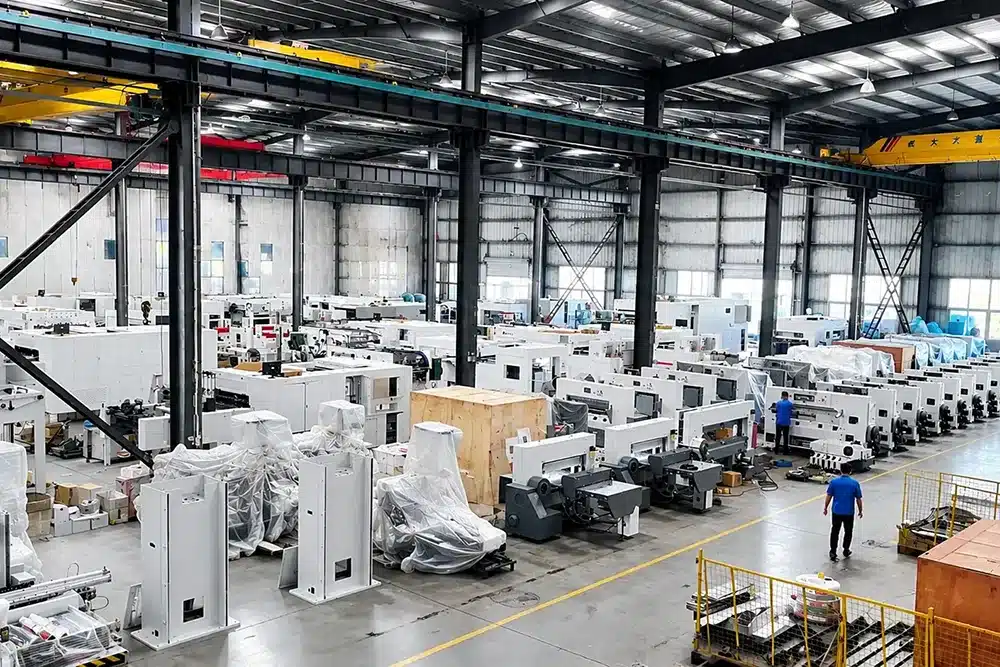
DAIS Printing Machinery, also presented internationally as DSPM Machine, was established in 1993 and operates from a 50,000-square-meter manufacturing site in Zhejiang, China.
The company designs and manufactures printing, packaging and post-press equipment for paper converters, packaging manufacturers and commercial printing businesses. Its manufacturing resources include more than 100 sets of CNC equipment, including machining centers and robotic plasma-cutting equipment.
DAIS has participated in more than 260 international exhibitions and has supplied machinery to customers in more than 50 countries and regions.
Model selection, configuration and acceptance requirements are confirmed according to the buyer’s material, process and order specifications.