

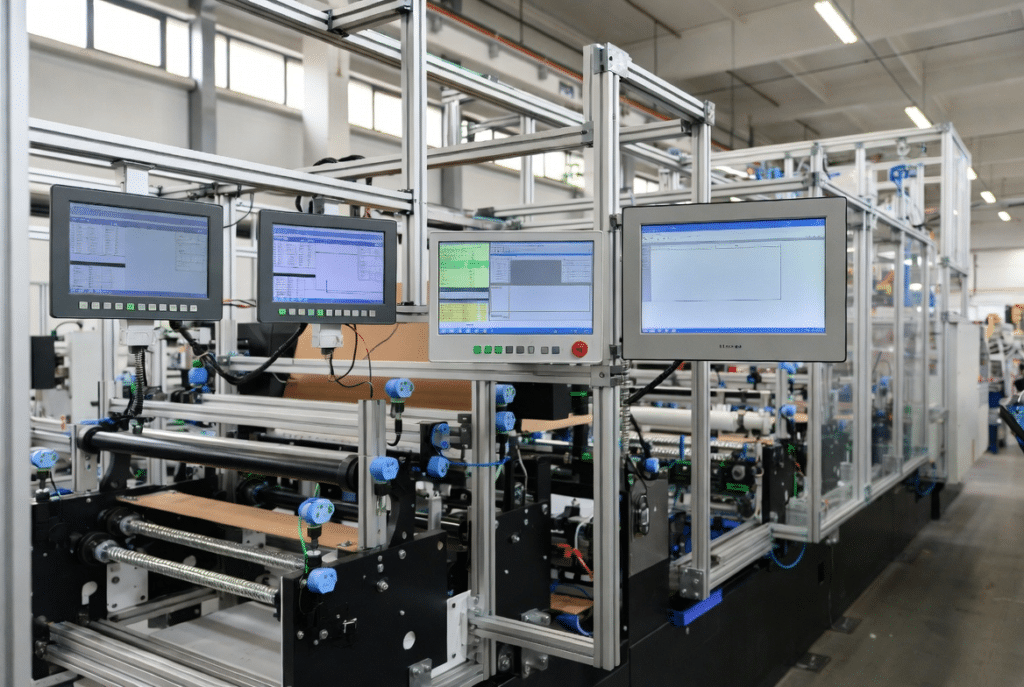
For packaging converting, Industry 4.0 allows for improved management of laminating lines, providing a better view for production and machine maintenance teams on machine condition, output, alarms, energy consumption and the most frequent causes of downtime. The value of IoT sensors and remote monitoring is only added when data is used to take some action; such as changing a feeder, booking a bearing for replacement, addressing glue issues or sending an engineer with the appropriate part. Just adding a laminator to a dashboard is not enough to make a smart factory. Proper sensors, data, ownership, maintenance, cyber security, and people who know what to do are all still needed.
In this article, he discusses the implications of Industry 4.0 for packaging converting, the actual conditions that should be monitored, how real-time data and predictive maintenance help to make better decisions, the remote service and system integration, and how a plant can start without taking too many risks.
What Industry 4.0 Means for Packaging Converting
In packaging converting, Industry 4.0 is a marriage of connected machines, sensors, industrial networks, production software, analytics and people, all for the betterment of decision making. It’s not one product a plant can buy in a single purchase. The aim is not to gather information for the sake of information gathering. The aim is to know the performance of the machine, minimise unnecessary losses, optimise maintenance timing, assist in quality and link up production information throughout the plant.
From Standalone Laminator to Connected Production Asset
A stand alone laminator relies on the operator to read off the local alarms and record production manually. A machine that is connected can send status, speed, alarm, downtime reasons and selected condition data to authorized systems. A feeder fault may be indicated on a local HMI. A connected system will also offer details on when the fault occurred, how many times it occurred on that shift, the board grade being run and if that fault is seen on other machines. The difference lies in the capability to shift from individual actions to patterns that can be acted upon.
IoT Monitoring, Automation, and Predictive Maintenance Are Different
Monitoring reveals what is occurring. A process can be adjusted and/or controlled through automation. Analytics discovers trends over time or machines. Predictive maintenance determines if there is a measured condition that could cause a failure when it is not addressed. The functions are similar but not identical. The most useful claim that a supplier can make about predictive maintenance is that the plant knows what information from which sensors is used in the model, what thresholds are used, how they are validated, and what maintenance action is taken. The additional value of the label for operation is minimal without that chain.
Why Data Quality Matters More Than Dashboard Design
But all the pretty dashboard in the world won’t save the day if the sensors are not accurate, if the time stamps are missing, if the machine is not in the right state, if the downtime code is wrong, if the operator is not trained. With the machine in “running” state while waiting for material, OEE and utilization data are not accurate. The plant needs to establish the meaning of each signal and how it will be applied before spending money on visualization.
Which Laminating-Line Conditions Should Be Monitored?
From the point of view of production, quality, maintenance, energy and safety, the plant should monitor conditions. Do not place sensors in all places. The helpful way is to prioritize failure modes based on the frequency, consequence, and detectability of the failure, and then choose signals to address a clear operational question.
Feeder and Sheet-Handling Data
Useful signals include feeder status, suction pressure, sheet-count errors, double-feed events, motor current, speed and stop frequency. These data enable the detection of trends associated with warped board, not separating sheets, belt wear, nozzle blockage or improper setup. No monitoring can be used in lieu of material inspection and operator judgment. It can, however, indicate if there are more interruptions in the feeder network during shifts as a result of humidity or board grade.
Registration and Positioning Data
Registration information can include servo position, correction frequency, front/ side-lay behavior, alarm events and measured alignment (if supported by the machine). It is important for the buyer to be able to tell the difference between a machine position signal and finished sheet accuracy. The data should be based on the actual laminated output rather than the machine’s correction commands.
Glue-System Data
Signals that are relevant may be glue temperature (if applicable), pump operation, roller speed, glue level, application settings, cleaning intervals and alerts relating to glue. They are useful in detecting uneven coverage, dried adhesive, and are useful in identifying excessive consumption or coating instability after long idle periods. The quality of the final bond cannot be validated by an IoT sensor alone. Testing of finished samples still needs to be carried out.
Pressure, Drive, and Mechanical-Condition Data
Motors, drives, bearings, belts, rollers, pressure systems, vibration sensors and temperature sensors and current monitoring can detect abnormal friction, alignment issues, overload or progressive wear. Inspection may be required if there is an increase in the vibration trend or motor current change. Does not identify the specific failed part. Still to be physically verified.
Energy and Environmental Data
Idle running, inefficient changeovers, abnormal load and environmental causes for material problems are given in context by power consumption, peak demand, compressed-air use (if applicable), ambient temperature and humidity. Humidity and temperature data are used to describe and explain paper handling, adhesive behavior, paper curl and board flatness. Just monitoring is not enough to control the environment.
How Real-Time Monitoring Improves Laminating-Line Management
Machine data data is best used in conjunction with material, job, operator, quality and downtime data. The value is in the workflow but not in the display itself.
Monitoring Production Status and Output
State definitions (e.g. running, stopped, setup, waiting for material, alarm, maintenance, changeover) must be consistent. Where data is reliable plants should record – sheets processed, productive time, waste, changeover time, planned versus unplanned downtime. Without consistent coding, it becomes meaningless to compare the results between shifts and machines.
Identifying Repeated Downtime Causes
Recurring events like feeder jamming on a specific board grade, glue alarm after a long idle time, registration fault during certain format changes can be revealed by historical data. Correct Downtime Coding makes anecdotal troubleshooting into evidence-based improvement. When it comes to coding, however, there is no such thing as half measures.
Improving Changeover Management
Machine data can be used to measure set up time, guide adjustment, glue cleaning, recipe loading, pressure changes, first good sheet time and restart losses. The intent is not to point a finger at operators. The information should highlight challenging settings, tools that are not available, unclear work instructions or machine design that lengthens changeovers.
Supporting Quality Decisions
The correlation of job records with the machine settings, material used, speeds, glue conditions, registration results and defect reports enable the plant to compare a successful job with a failed job. Process data correlation does not imply proof of causation. Another controlled trials and quality inspection is still needed to verify the cause of a defect.
Predictive Maintenance for Automatic Laminating Machines
Predictive maintenance is a condition monitoring technique which monitors equipment information and maintenance history to detect abnormal trends in advance of failure. Although sensor data will aid in prior intervention, the effectiveness will rely on the quality of baseline data, the accuracy of thresholds and a set maintenance response.
Reactive, Preventive, and Predictive Maintenance
Reactive maintenance repairs after failure. Preventive maintenance services according to time, cycles or operating hours. Predictive maintenance inspects or services based on measured condition and trend. On a laminating machine, examples include replacing a belt by schedule, repairing a failed bearing after a breakdown, or inspecting a bearing because vibration and motor-current trends have changed.
Components Suitable for Condition Monitoring
Bearings, motors, gearboxes, rollers, pumps, belts, servo drives, fans, electrical cabinets and glue systems are common candidates. Priority should go to components whose failure causes major downtime or whose condition can be measured reliably. Sensors should not be added without first ranking failure modes by frequency, consequence, detectability and maintenance cost.
Building Baselines and Alert Thresholds
Normal operating data must be collected for each machine, material, speed and operating mode. A vibration or current value that is normal during startup may be abnormal during steady production. Warning and critical thresholds should be verified through physical inspection. One universal threshold rarely works for every machine.
From Alert to Maintenance Work Order
The operational chain is straightforward: the sensor detects a change, the system creates an alert, maintenance reviews the trend, a technician inspects the equipment, a work order is scheduled, the repair is completed and the result is recorded. An alert without an owner, response time, spare-parts plan or escalation process does not create predictive maintenance.

Limits of Predictive Analytics
Sensor data may not detect every failure, especially sudden faults, software issues, material problems, operator errors or failures without a measurable precursor. Predictive analytics is an additional decision tool, not a replacement for preventive maintenance, operator checks, lubrication, safety inspections and engineering judgment.
Authorized remote access allows a machinery manufacturer to review alarms, machine states, parameter history, software diagnostics and operating conditions without immediately sending an engineer to the plant. The benefits must be balanced with access control, data privacy, network segmentation, customer approval and clear responsibility for any changes made remotely.
Faster Diagnosis of Machine Alarms
Remote engineers can review alarm history, HMI information, drive status, sensor signals and recent parameter changes. This helps distinguish a feeder setup problem from a sensor fault or mechanical issue. Remote diagnosis is not the same as remote repair. Many faults still require a trained technician, physical inspection or a replacement part.
Remote Commissioning and Operator Support
Secure video support, parameter review, digital manuals and remote assistance can help during commissioning, changeover and troubleshooting. Plants should clarify what remote support includes, which data is shared, who authorizes access, how sessions are recorded and how urgent issues are escalated.
Remote Software and Parameter Changes
Remote changes to PLC logic, HMI settings, servo parameters, recipes or safety-related controls can create production or safety risks. Any change should be authorized, documented, backed up, tested and reversible. Unrestricted remote access is not appropriate. Role-based permissions, approval workflows, change logs and customer control are essential.
Remote Monitoring Across Multiple Plants
Groups with several plants can compare machine utilization, alarms, downtime, maintenance events and quality trends across locations. Standardized machine states and data definitions are necessary for meaningful comparison. Different materials, products, operators and production environments can make direct ranking misleading.
Connecting Laminating Machines to MES, ERP, and Plant Systems
Machine-level data, SCADA or visualization, MES production management, ERP business systems and cloud analytics serve different purposes. The plant should define the decision it wants to improve before choosing an integration architecture. OPC UA is one industrial interoperability framework designed to support information exchange from machine to enterprise systems. It is a possible communication approach, not a mandatory solution for every laminating line.
Machine Data and MES Integration
An MES can be supplied with job number, machine state, production count, speed, downtime reason, waste, quality result, operator and maintenance status. Data mapping and having uniform definitions are more important than just putting the cable in place. The meanings of “stopped”, “idle”, “setup” and “fault” are exactly the same in different systems.
ERP, Scheduling, and Material Traceability
Traceability can determine which jobs have been run with a specific batch of boards, lot of adhesive or machine setting. Direct ERP connectivity isn’t necessary for all laminating machines. The level is dependent on plant size, complexity of production and business needs.
Data Standards and Interoperability
The use of vendor neutral interfaces and documented data models decreases vendor lock-in. Implementation quality is still dependent not only on the equipment, but also on the integrator. The purchaser should ask for a tag list, data dictionary, protocol info, API document, terms of ownership and integration restrictions.
Cloud Dashboards and Local Control
If the internet connection fails, local systems will continue to function. Multi-site visibility and remote analysis can be enabled by cloud services. The production control and safety operations should never rely on an external cloud link. Offline behaviour, data retention, export and service continuity should be specified for the buyer.
Cybersecurity and Data Governance for Connected Laminating Lines
Putting a laminating machine on a plant network or remotely available enables access, data and availability risks. The NIST IoT cybersecurity guidance focuses on managing access–whether local or remote–and safeguarding data when stored and when sent from one place to another. The roles of machine supplier, integrator and plant are shared on these responsibilities.
Control Remote Access
Basic controls are named user accounts, role based access, multi factor authentication where applicable, time limited access, approval before connection and logging of access followed by immediate revocation upon termination of support. Permanent passwords should not be shared and all incoming traffic from the Internet should be restricted.
Separate IT and OT Networks
Production equipment should not be on the same network with office equipment. Compromised devices have limited impact through segmentation, firewalls, secure gateways and controlled data flows. The plant’s IT/OT security team or qualified integrator should be involved in decisions about the network architecture.
Protect Data in Transit and at Rest
Confidentiality, protected procedures, backups, storage rights and durations are important. The plant should have an understanding of the information provided to the supplier or cloud platform, and how long the information is kept. Production data may contain customer jobs, volumes, material usage, operating patterns or proprietary production process information.
Patch, Backup, and Recovery Planning
There must be a process for updating firmware and operating system, as well as HMI, PLC, drive and gateway for connected machines. Updates, where possible, should be testable, schedulable, documented and reversible. It is critical to have backups of PLC programs, HMI applications, recipes, parameters, machine configurations, and integration settings. The plant should also be able to operate safely if the monitoring platform is not available.
Define Responsibilities in the Supplier Contract
Consumers should ask who owns the data, who can access it, who’s accountable for any cyber security updates, and who’s in charge of credentials, and what will happen when remote support ceases. Vulnerability reporting, incident response, service availability and data export and decommissioning should also be covered in the contract.
Implement Industry 4.0 in Stages
A pragmatic way to get going is to begin with a specific production or maintenance challenge, instead of embarking on a full digital transformation. Value can be built up over time.
Stage One: Establish a Reliable Data Baseline
Start off with inventory of machines, existing control systems, existing signals, downtime categories, maintenance history, production counts and quality records and network constraints. From baseline data it is known if the actual principal problem is sensor shortages, poor data definitions, poor maintenance discipline, or an unresolved machine-design problem.
Stage Two: Monitor a Small Number of High-Value Signals
Choose signals associated with significant drops – feeder fault, motor current, bearing vibration, glue system alarms, registration corrections/duration of changeover. Each signal should have a “clear” owner and a planned response. Hundreds of values collected, no one looks at, is noise and not insight.
Stage Three: Add Maintenance and Production Workflows
Alerts should link to maintenance work orders, spare parts planning, operator instructions, quality checks and shift reviews. Assess if the system is able to decrease response time, repeat faults, unplanned downtime, scrap or diagnostic visits.
Stage Four: Integrate Machines and Business Systems
Once machine data is reliable, connect selected data to MES, ERP, quality, scheduling or multi-site dashboards. The business problem that is being solved through integration should be known – e.g. traceability, schedule accuracy or cross-site maintenance planning.
Stage Five: Evaluate Advanced Analytics
Once these data and workflows are reliable, the plant can begin to evaluate predictive models, anomaly detection or machine-learning recommendations. There is a need to validate models with real failures and maintenance outcomes. But, advanced analytics is no replacement for clean data, domain expertise, and clear responsibility.
What Buyers Should Ask Laminating-Machine Suppliers
Connectivity should not be found after the machine is delivered.
Sensor and Data Questions
What are the common sensors/signals? Which are optional? What is the number of samples per second? Are readings time-stamped? Does the system have the ability to log alarm history and downtime history? Is it possible to export production data? Do sensors need to be calibrated and can they be replaced? Does the system recognize the production, setup and idle and fault states? Ask for a complete list of tags and a data dictionary.
Integration and Interoperability Questions
Inquire about PLC and HMI architecture, communication protocols, OPC UA or other interfaces, APIs, MES compatibility, data formats, local storage versus cloud storage and storage and integration responsibility. Ensure that an independent integrator can be used or if the supplier needs proprietary.
Remote-Support Questions
What is the method of remote access, the process of approving and who can approve, how long can it be accessed, what permissions are granted and how is it logged? What does “remote diagnosis” involve? If the plant cannot be accessed from the outside or it has no Internet connection, what happens? The machine must be safe and operable with the machine designed local controls.
Cybersecurity and Data-Ownership Questions
Who’s responsible for machine and production data? Where and how is this located and protected? Who can access it? What is the procedure for managing and updating credentials? Discuss backup, vulnerability notification, incident response, data export, service end and decommissioning.
ROI and Proof-of-Value Questions
Inquire with the supplier what the operational issue the system will address is, and what is considered a successful outcome (diagnostic time, repeat fault, downtime, changeover time, scrap, maintenance response). Percentages of support unsupported should be used with caution. Request references, baseline assumptions and a proposed pilot plan.
Common Mistakes When Digitizing a Laminating Line
Installing Sensors Without a Maintenance Strategy
If nobody reads the data, or takes any action when an alarm is triggered, sensors are worthless. Define the failure mode, signal, threshold, responsible person, inspection method and maintenance action before installing the sensor. If no spare bearing or work-order is available for an alarm that is vibrating, it is just noise.
Buying a Dashboard Instead of Solving a Problem
If a dashboard doesn’t drive any change in setup, maintenance, quality or scheduling, it’s probably not going to enhance production. Start with one or two measurable problems and check to see if the dashboard can help make those decisions.
Treating Every Alarm as a Predictive Warning
An operational alarm, a condition trend, an anomaly and a validated failure prediction are different. Too many false alerts lead to operators ignoring the system. Evaluate false positive and false negative issues and thresholds.
Ignoring Data Definitions and Downtime Coding
Comparisons are not valid because of the varying definitions of state. A single shift can classify a feeder jamming as a “mechanical fault” and another as a “material problem.” It is important to use a controlled downtime dictionary, operator training and periodic data-quality audits are required.
Leaving Remote Access Permanently Open
The increased risk of cyber or operational issues when there is no restriction on remote access. Access support should be controlled, authenticated, approved, time limited, logged and turned off when it’s not necessary.
Assuming IoT Can Correct Poor Machine Design or Material Control
There are several data possibilities which can be used to identify feeder, glue, pressure or material issues. It can’t compensate automatically for an inappropriate machine, poor board quality, improper storage or incorrect operator setup! Fixing physical process causes is still required.
A Practical Industry 4.0 Checklist for Laminating Lines
Machine and Sensor Checklist
Verify existing sensors, important machine signals, sampling and timestamps, alarm archiving, production counters, downtime states, and condition monitoring, calibration and replacement, local operation in case of connectivity failure, and electrical and control system documentation. Identify standard features and optional features.
Data and Integration Checklist
Ask for tag list, data dictionary, communication protocols, OPC UA or API support (if applicable), ability to integrate with MES or ERP, data export, cloud or local data storage, data ownership terms, retention policy, multi-site access, and independent-integrator support. It’s not just about “Industry 4.0 ready”—interoperability and documented interfaces are more important.
Maintenance and Production Checklist
Monitor failure modes; set up alert thresholds; determine maintenance response; integrate work order; plan spares; measure changeover; correlate quality; train operators; code downtime; define KPIs and pilot success criteria. Each and every important signal must have a clear use and responsible owner.
Cybersecurity and Supplier-Support Checklist
Verify that remote access is approved, role-based permissions, authentication, logging of sessions, network segmentation, encryption, backup/recovery, patch management, vulnerability reporting, incident response, data export at contract end and service availability. Consult with IT/OT security personnel prior to the machine being connected to the plant network.
Final Recommendation for Packaging Plants
Start Industry 4.0 implementation on a specific laminating-line problem, with reliable baseline information, limited number of high-value signals and a clearly defined response workflow. Only start to expand into predictive analytics, MES integration and multi-site monitoring once the plant is confident in the data and can act upon it. The use of IoT is not intended to replace best practice machine design, preventative maintenance, operator training, material control, quality checking or cyber security.
Request a list of sensors, data dictionary, connectivity architecture, remote-access policy, cyber security responsibilities, and a pilot plan with measurable production or maintenance results from the machine supplier. The next logical step for any packaging plant considering the connected laminating equipment is the conversation.