

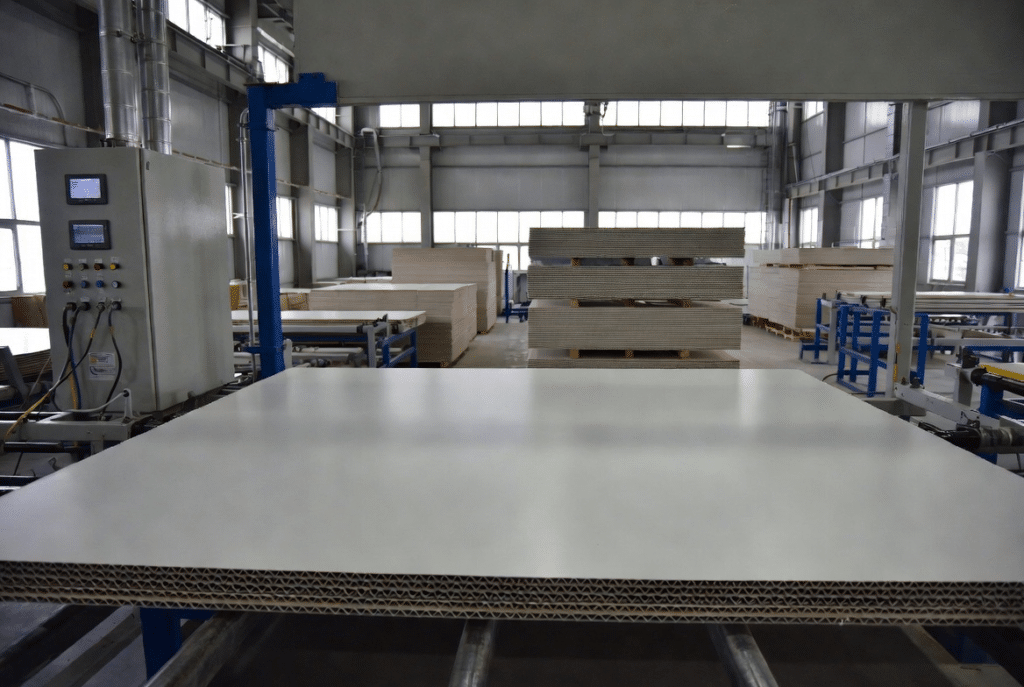
Rarely does warp of corrugated board start at the laminator! Humidity control during lamination of plants has to be effective if all the moisture levels, storage, temperature changes, water content of the adhesive, machine settings and stacking after lamination are coordinated as a whole. Printed upper sheet, liners, fluting and adhesive must reach an appropriate level of moisture balance with the surrounding air or the sheet will curl, bow or twist.
The guide explains the most common warp patterns, board and plant climate control, laminator preparation and adhesive preparation, finished sheet conditioning, and identifies the source of the problem rather than just the machine.
Why Humidity Causes Corrugated Board to Warp
When moisture content changes in the paper, its dimension changes. Due to the different rate of response of the various layers in a corrugated sheet, a moisture imbalance will cause differential expansion or contraction. Relative humidity refers to the moisture in the air surrounding the paper or board while moisture content refers to water that is contained within the paper or board. Both are important for the diagnosis of warp.
Paper and Board Are Hygroscopic Materials
All linerboard, fluting, printed paper and paperboard give up and absorb moisture from the surrounding air. They absorb water in wet weather and give it off in dry weather. The material is in interaction with its environment and this interaction towards an equilibrium does not occur at the same rate depending on the grade and the layer. ISO 187:2022 offers standard atmospheres and methods for conditioning and testing paper, board and pulp. The “standard” laboratory environment is roughly 23 °C and 50 %RH, but this is a testing reference, and not necessarily a standard production target. Storage and processing conditions should be decided on a plant by plant basis considering the board grade, adhesive and local climate and machine performance.
Moisture Imbalance Between Board Components
If the top liner, bottom liner, fluting and the laminated printed sheet are different moisture levels, the top side or bottom side will expand/contract more. Depending on construction and process history, the sheet will tend to bend to the more dimensionally stable/drier side. One common example is a printed upper sheet that is laminated to a more moist corrugated board, and as the layers bond, moisture is exchanged and the final sheet is found to be curved or bowed.
Temperature Changes Also Affect Moisture Behavior
Changes in temperature affect relative humidity, increase or decrease the potential for dew point, increase or decrease drying rates of adhesives and increase or decrease rates of moisture exchange. If a cold pallet is introduced into a warm and humid production room, surface condensation or a high moisture gradient can occur from outwards to inwards. If the fish are transported across the sea, stored in winter or in an air-conditioned store, these sudden changes are lessened through gradual acclimatization.
Why Large Sheets Show Warp More Clearly
Small moisture, caliper, edge condition and flatness variations are magnified in large format sheets. A small blank that has a slight dimensional difference is not noticeable but on a furniture carton, a pop display panel, or large corrugated sheet, it becomes obvious to the eye as a bow or twist. This same difference impacts the stability of the feeders, feeder registration, uniformity of pressure, die-cutting accuracy, and final box geometry.
Recognize the Main Types of Corrugated-Board Warp
If the defect is known to be a certain shape, the investigations are narrowed. Various patterns may indicate a variety of moisture, adhesive, storage, or mechanical causes. Shape is never sufficient means of diagnosis.
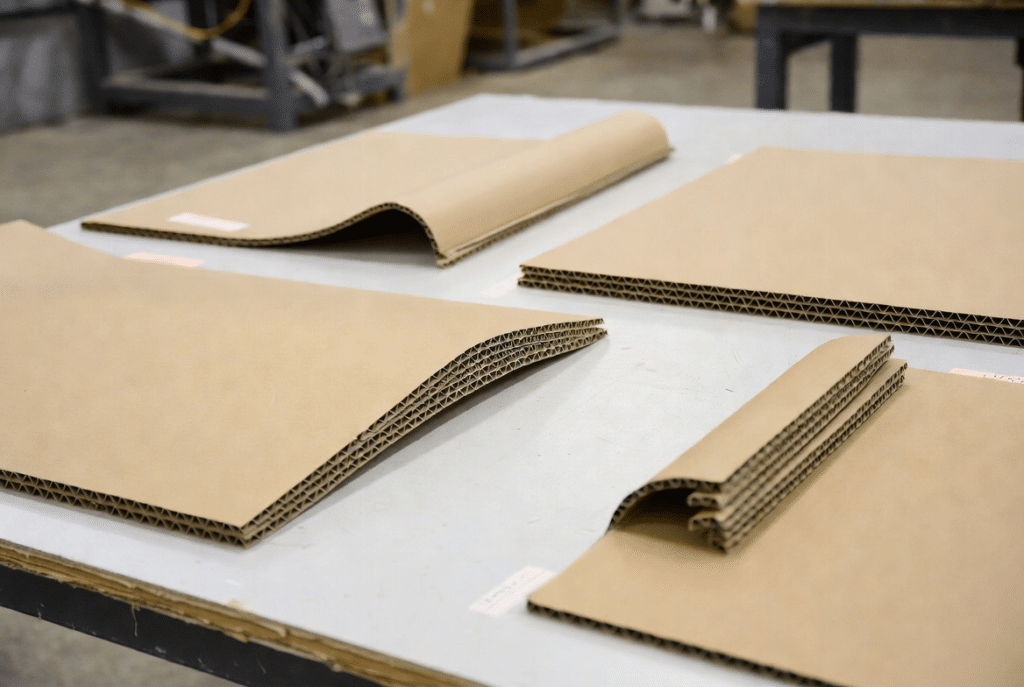
The sheet is bent in such a way that one of its surfaces is concave. This is typically due to moisture or tension differences between the two sides. Examine the concave surface of the liner or laminated surface and compare the moisture content and adhesion on both sides of the liner.
Cross-Machine Warp
There is a curve from a side edge to the other. This may be due to moisture differences in the original web, irregular adhesive or heat application, roll condition or unequal exposure to storage conditions. Defects include feeder contact, side guides, registration sensors, stacking, and die cutting accuracy.
S-Warp and Twist
The page is bent into an S-shape or twists. Common sources include unequal moisture content within a sheet, variability in the liners, mechanical misalignment, or sheet width differences. There is a single variable (humidity); other variables (board construction, corrugator history, storage and laminator alignment) need to be checked.
Edge Curl and Localized Deformation
Edges rise, corners rise, or waves are seen in certain regions. Common sources are exposed edges, uneven edges, differences in roller pressure, drying variation, contact with damp floors or walls, pallet compression or contact with damp floors or walls. Check the edge of the stack, pattern glued, condition of the roller and storage support.
Control Incoming Board and Paper Before Lamination
Best time to avoid warp is before the sheet gets to the laminating line. All incoming material must be inspected, protected and conditioned based on predetermined moisture, flatness, board grade, packaging and storage history acceptance criteria.
Inspect Moisture and Flatness at Receiving
Inspect pallets for dropped corners, broken wrapping, condensation, wet packaging, exposed edges and bowing. Use a calibrated instrument to measure moisture; sample in a consistent manner, within more than one convenient location. A handheld moisture meter can be only useful if it is calibrated for the particular paper or board grade.
Compare the Top and Bottom of the Pallet
Humidity exposure is not the same for the outer sheets of a pallet compared to the center. Note the location, grade of material, batch, moisture reading, temperature, relative humidity, and flatness as observed. These data indicate if the issue was with transport or storage.
Verify Board Grade and Construction
Verify liner type, flute profile, caliper, grammage and supplier requirements. The pressure setting, glue absorption and registration, stiffness, and performance in finished packaging are affected by different constructions when exposed to the same humidity.
Inspect Printed Upper Sheets
The sheets have their own moisture content, coatings, varnishes, ink coverage and curl. If possible, condition the top paper and bottom board in the same production area. Don’t combine material from two completely opposite sets of storage conditions.
Design Storage and Conditioning Areas for Moisture Stability
Paper and board should be shielded against sudden fluctuations in the environment, water, unsealed loading areas, and wet floors or walls. Any specific absolute number is not as important as the conditions are stable.
Maintain Stable Relative Humidity and Temperature
Large variations are more of a problem than a steady value in a reasonable operating range. Define the target range based on recommendations from material suppliers, product specifications, machine performance, local climate and relevant guidance. The Fibre Box Association points out that temperatures and humidities outside its recommended limits can impact the runnability of corrugated-board machines, physical performance, warp and equipment operation.
Protect Pallets from Direct Moisture
Ensure that pallets are not in direct contact with the floor, external walls, open doors, water pipes, condensation sources or air discharge. Employ appropriate dunnage and protective coverages and provide controlled acclimatization. Properly wrapping a cold and damp pallet will create moisture traps, and protecting the pallet must always be complemented by inspection and measured conditioning.
Allow Material to Acclimatize Before Production
Board must be allowed to reach a stable condition after transportation or board moving between warehouses and production rooms. It will take a certain amount of time, depending on the size of the pallets, wrapping, difference in temperature, material, and environment. Use measured temperature, relative humidity, and moisture stability instead of a 24 or 48 hour test.
Avoid Direct Airflow and Uneven Conditioning
Local moisture differences occur in a pallet or stack due to the presence of heaters, air-conditioners, humidifier outlets, dehumidifier discharge, fans and open doors. Use a number of sensors to map the room and avoid material in strong local airflow.
Use First-In, First-Out Material Control
Exposure to changing conditions with longer storage times and batch-to-batch differences. FIFO minimizes aging, unchecked moisture transfer and pallets that are left behind. Traceability is also facilitated when defects occur, through inventory control.
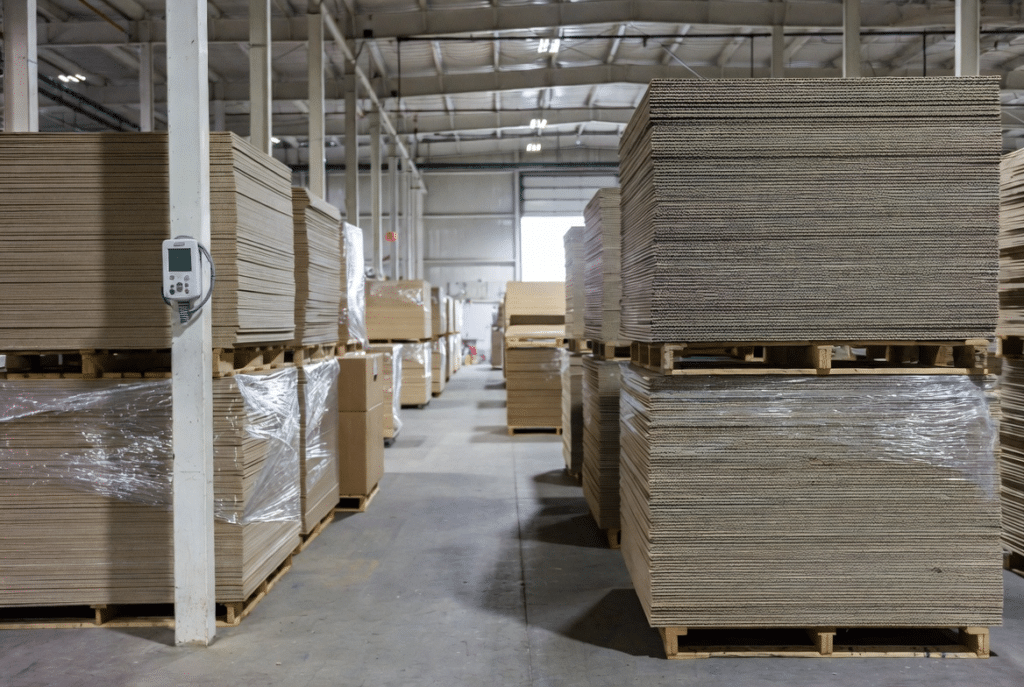
Feeding, glueing, bonding, drying, inspection and stacking should be possible in the production environment. Keep track of conditions where the process actually happens and not just one sensor that is far away.
Place Sensors at Relevant Locations
Monitor temperature and relative humidity at raw-material area, at laminating line, near adhesive station, finished-stack area, loading or dispatch points. Additional sensors might be required in the vicinity of doors, external walls or HVAC outlets in large plants. Note the date and the place of each reading; the average of the plants may disguise an injurious local condition.
Control Seasonal and Daily Fluctuations
During production, the behavior of materials will change before or during the production process due to summer humidity, winter heating, night shutdowns, weekend conditions, and door openings. The same machine setting can yield varying results in the morning as well as in the afternoon. Check the climate records along with warps, glues, registration and downtime.
Humidification and Dehumidification
Humidification may reduce the amount of drying in a heated or cold room, and dehumidification can reduce moisture uptake in a humid climate. Adjust equipment size and control according to the requirements of the actual room volume, heat load, air exchange, and process requirements. Never choose a system or target without plant specific data.
Condensation and Dew-Point Risk
Condensation is the result of the encounter of warm, moist air and a cold surface or pallet. Surface wetness robs paper of strength, affects board strength, creates glue problems and causes localized warpage. Consider checking temperature of incoming pallets; proceed slowly when unwrapping or processing.
Climate Control Is Also a Quality-Control Tool
Poor machine setup cannot be overcome by using climate control. When it has reached stability, the laminator needs to be set for the thickness, stiffness, residual warp, paper surface, adhesive and laminating speed that the material will need.
Prepare the Laminating Machine for Moisture-Sensitive Board
Position suction nozzle, separate sheets, adjust feeder angle, adjust support, adjust belt suction and guides. Warped sheets require extra careful support as compared to flat ones. Feed boards beyond the practical range of the feeder – quarantine or correct the material before feeding.
Feeder Settings for Warped or Variable Sheets
Warp and edge variation impact the following photoelectric sensors, front and side lays, servo compensation, and sheet-to-sheet registration. Positioning alarm can occur if the actual cause is unstable incoming board. Compare finished registration to sheet flatness, moisture, speed, and job conditions on a run.
Positioning and Registration
The use of water-based adhesive adds moisture to the laminated structure. If too much or too little is used, or the same amount is used on a single side and not on the other, a moisture differential is created between the printed sheet and corrugated board. Adjust viscosity, amount, condition of the roller, speed, pressure, drying/pressing conditions. Do not use more glue because the surface is not compatible.
Glue Application and Moisture Addition
The formation of bonds, board compression, uniformity of moisture and flatness are affected by pressure and contact time. Too much pressure will crush flutes or drive adhesive out, too little pressure will not provide enough contact for good bonding. Take care to develop settings by material combination, and check the output after the material has been conditioned, no only in the delivery section.
Pressure and Contact Time
The flatness after lamination is influenced by delivery alignment, jogging, stack height, support, cooling and restraint. A poorly supported stack can leave a moisture gradient or a curl that can become permanent. Do not stack on unstable platforms, overhang excessive edges, place on floors before they are cool and dry, or wrap before they are cool and dry.
Delivery and Stacking
One of the most important process variables, apart from material and environment, is adhesive. There is no single adhesive that can be used for every job; it depends on paper and board type, coating, production speed, machine and end use.
Control Adhesive Moisture and Lamination Conditions
Water is added to the board based on solids content, viscosity, temperature, mixing and application weight. Low solids or over-applied adhesive increases drying time and prolongs the risk of curling. Adhere to the technical range of the adhesive supplier and test actual application conditions on the machine.
Adhesive Solids, Viscosity, and Application Amount
Local moisture differences, weak bonding, glue lines or localized curl are caused by uneven glue coverage. Uniformity is affected by speed change, contamination, misalignment, roller wear and incorrect metering. Examine center to edge cover, bond quality and flatness following conditioning.
Uniform Coating Across the Sheet
The bonding of the adhesive prior to stacking the sheet is dependent on open time and contact conditions. Failing to stack at an appropriate speed and/or pressure leaves moisture unevenly distributed. Check adhesive and machine settings at a desired sustainable production rate.
Open Time, Pressing, and Drying
Never change adhesive, change dilution or change application weight without reassessment of the warps, drying, bond strength, and quality of the downstream. A new adhesive might work well in the laboratory, but not in the plant environment due to the temperatures, relative humidity, board grade, and stacking conditions.
Adhesive Changes Require New Climate and Warp Trials
The process doesn’t stop once the laminated sheet is out of the machine. Moisture redistribution occurs during stacking, cooling, storage, die-cutting and transportation. In the treatment of the output, it is handled in such a way that it will stabilize without causing new deformations.
Prevent Warp After Lamination
Ensure stacks are kept properly aligned, supported, and to a height that can be controlled. Ensure dunnage is appropriately used and the stack is not exposed to direct air or floor moisture. The thickness of a stack, size of a sheet, moisture content of the adhesive, the production temperature, and the conditioning time that is expected are all parameters that must be taken into consideration when designing the stack.
Stack Laminated Sheets Flat and Evenly
It is common that laminated sheets require a certain amount of time to equilibrate before die cutting or final inspection. The correct period will vary based on adhesive, board, paper, ambient temperature/conditions, and production speed. Use moisture, flatness, bond and downstream-conversion tests to define a conditioning protocol, not a fixed time.
Allow Post-Lamination Conditioning
When warm or moist laminated sheets are moved into an extremely dry, cold, humid or air-conditioned building, one surface will react quicker than the other. Store completed stacks in stable conditions until next process is ready to be fed.
Avoid Rapid Environmental Transitions
Warp has an influence on the following aspects of production: die-cutting registration, creasing depth, folding, gluing, stack alignment and final box geometry. Assess material in the condition in which it will be used in downstream conversion and document condition and environmental conditions as part of the production specification.
Condition Before Die-Cutting and Folding
Warp has an influence on the following aspects of production: die-cutting registration, creasing depth, folding, gluing, stack alignment and final box geometry. Assess material in the condition in which it will be used in downstream conversion and document condition and environmental conditions as part of the production specification.
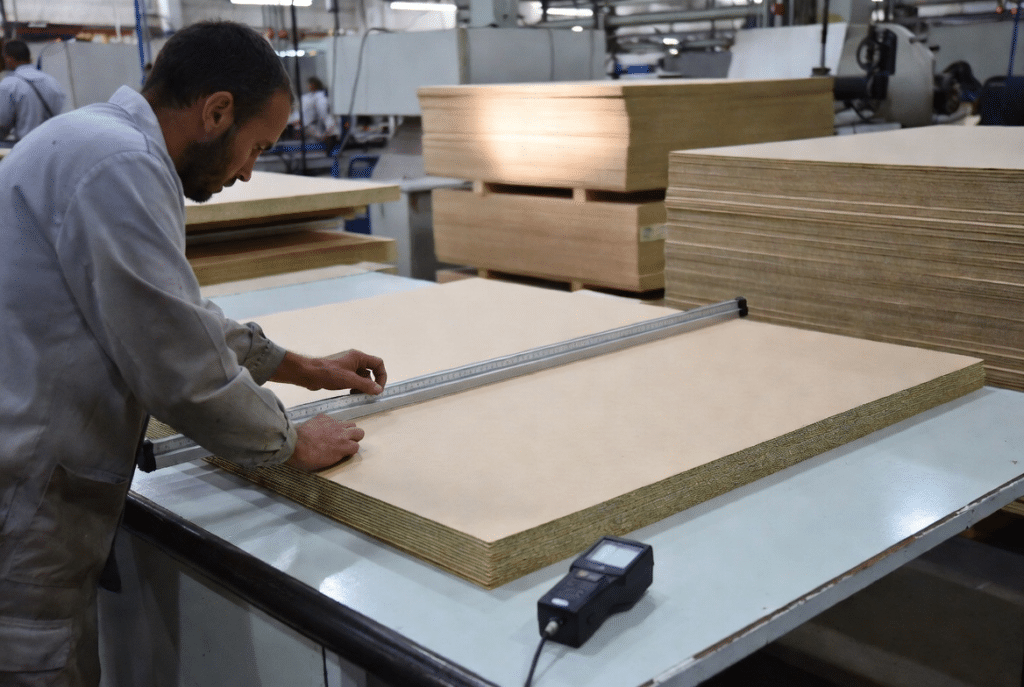
Gather data on material characteristics, environment, adhesive, machine, stacking, and timing. Systematic vs disconnected fixes.
Determine When the Warp Appeared
When was the board warped (at receiving, in storage, in laminating room, right after lamination, right after stacking, after overnight conditioning)? It is when time narrows that we get a look into the investigation. Defects include material, and storage defects; post-lamination defects include adhesive, pressure, machine, and stacking defects.
Before and After Lamination comparison of materials.
Compare Materials Before and After Lamination
Re-check laminated sheets and after conditioning. Take samples from the top and bottom of the stack, and from one end of the sheet to the other instead of taking samples from the middle of the sheet.
Check the Adhesive and Machine Variables
Inspect adhesive product, batch, viscosity, solids, temperature, application setting, roller condition, pressure, speed, contact time and cleaning history. If possible, vary only one variable at a time so as to be able to observe the effect.
Separate Material, Climate, and Mechanical Causes
Symptoms of moisture related warp can be caused by mechanical misalignment, uneven pressure, roller runout, belt problems, and feeder skew. Assess machine alignment and condition, as well as climate and moisture.
Use a Controlled Trial Plan
Perform a trial matrix using stable material (two or more environmental conditions, as applicable), controlled adhesive conditions, and specific measurements of flatness, registration, bond, and downstream performance. The aim is to find good operational windows, not one miraculous setting.
Common Climate-Control and Warp-Prevention Mistakes
Controlling Room Temperature but Ignoring Relative Humidity
There is no absolute temperature for comfortable papers. Other factors such as relative humidity, dew point, airflow and material temperature also need to be taken into account. Install calibrated sensors close to the material and machine, and not just in the building management display.
Using One Humidity Reading for the Entire Plant
Different levels of humidity can be present in the warehouse, laminating line, glue area, finished-goods area, loading door, and exterior wall. One sensor may not capture local conditions which impact on the board. Draw a sketch of the plant, and document site-specific information.
Unwrapping Cold Pallets Immediately
Exposed cold board may condense or have a fast moisture gradient when exposed to warm humid air. This leads to feeding, bonding, flatness and surface issues. Make sure to check the temperature of the pallets and let them acclimatize naturally before unwrap them.
Adding More Glue to Fix Weak Bonding
Too much glue can create good initial contact but creates more moisture, curl, drying time, squeeze out and contamination. Determine the coating, surface compatibility, viscosity, pressure, contact time and uniformity of application first.
Stacking Output While It Is Still Warm or Wet
Moisture will become trapped in premature stacking and cooling or drying will be uneven. A stack that appears to be acceptable at the delivery point can warp afterwards. Outline a handling/conditioning procedure as a function of measured output condition.
Blaming the Laminator for Incoming Board Problems
If a machine is properly functioning, but the boards are not flat, the moisture is not even, boards are damaged during storage, or there is construction variation, it can appear as if the machine is unstable. Prior to making changes to major machine settings, inspect incoming material and compare it to machine output.
A Practical Humidity and Warp-Control Checklist
Incoming Material Checks
- Pallets are categorized according to the condition and covering of the pallets.
- Moisture in various places
- Material temperature
- Flatness and warps (or bowing) are visible.
- Board grade, caliper and construction.
- Printed-sheet surface, coating and curl.
- A history of transport and storage.
- Condensation risk
- The batch or lot numbers are shown.The batch or lot numbers are indicated.
Establish clear acceptance and quarantine process for material that is not within agreed range.
Storage and Conditioning Checks
- The temperature and relative humidity conditions in the warehouses
- Laminating, relative humidity and temperature of room.
- Sensor calibration status
- Floor and wall protection
- The design should include the location of outlets for air flow and HVAC.
- The process of acclimatization and the stability obtained.
- FIFO material handling
Confirm the range of operation for the real board, adhesive, climate and machine.
Machine and Adhesive Checks
- The stability of feeder and the support of sheet.
- Sensor cleanliness
- The viscosity of the glue is not a property and needs to be controlled, as is the solids content and the temperature.
- The amount and uniformity of the application.
- Roller condition
- Pressure setting
- The speed of the machine and the amount of time of contact.
- Cleaning and maintenance records are required.Records of cleaning and maintaining are required.
Connect each check to the corresponding warp, curl, registration or bonding symptom.
Post-Lamination and Finished-Product Checks
- Ensure that the stack is stacked properly and well supported.
- Output temperature
- Conditioning time
- Flatness after cooling
- Moisture after conditioning
- Bond strength
- Registration
- The ability to die-cut and fold performance
- Transport and final storage conditions.
Write down good and bad production run conditions.
Final Recommendation for Laminating Plants
Consider Warp Prevention a controlled system from material moisture to storage, to climate to adhesive to laminator setup to stacking to downstream conversion. First measure before and after lamination defect, and measure when the defect will occur. Good humidity is important but not enough. The quality of the board, acclimatization, adhesive application, pressure, machine alignment and post-lamination handling should also be controlled.
Measure calibrated temperature and relative-humidity at critical material and process locations. Develop a written material-conditioning procedure. Measure moisture and flatness at receiving, prior to lamination and after conditioning. Test on a controlled trial prior to machine set-up changes or adhesive modifications. These steps provide the necessary information to the operators and engineers to help maintain flatness on corrugated board during the entire lamination process.