

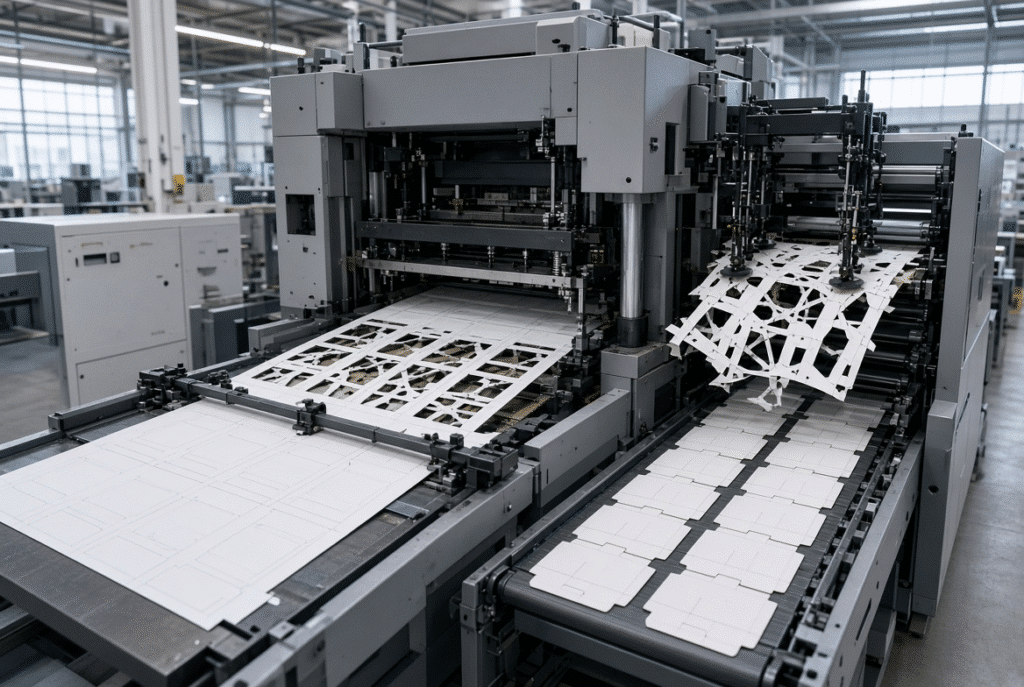
Waste stripping is the process of removing unwanted paperboard, corrugated board or other substrate material that is left over and around finished products after the die cutting and creasing process. A sheet may be cut to the correct shape and have a clean edge from the die-cutting press, but still have material left over by the edge of the sheet, window pieces inside, or material between the cut-out blanks. The blanks cannot flow efficiently to folding, gluing, inspection or packing until the waste is removed.
The difference is important in packaging production. The shape is formed by die cutting and the usable product is removed from the sheet by waste stripping. A clear example is a folding carton with a die-cut window – the outer contour might be flawless, but the window waste and outer skeleton must be removed prior to the next process in order to get the blank ready.
What Is Waste Stripping in Die Cutting?
Waste stripping is the operation performed after die cutting that eliminates unwanted areas of substrate from finished blanks. Waste is only the waste that is not part of the final product – outer skeleton, internal cut-outs and inter-blank strips – not defective cartons.
Die Cutting, Creasing, and Waste Removal Are Different Steps
Die cutting cuts out the contour of the product and any holes inside it. Compress folds are made to help the blank fold evenly. The unwanted material is then removed from the finished blanks by waste stripping. The process is finished by the delivery and stacking, which place the removed blanks in a convenient and correct sequence for the next process. It is not yet a blank sheet for a folder-gluer when the waste is attached to a die-cut sheet.
What Types of Waste Are Removed?
There are four types of packaging sheets that are common:
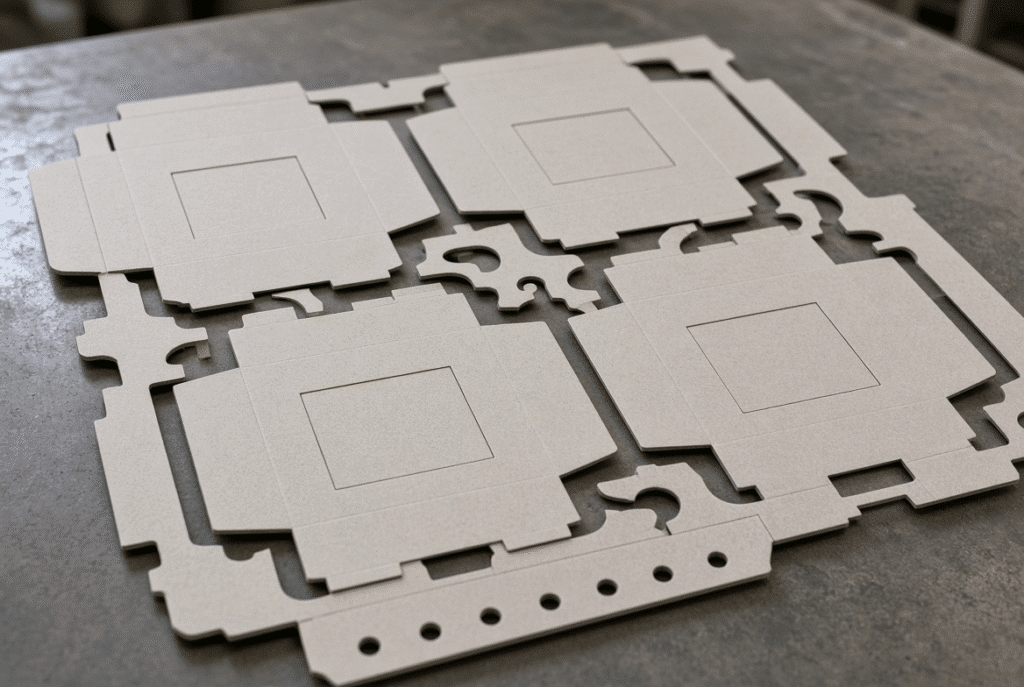
- Outer waste or waste skeleton—the framework of material which is surrounding the entire product layout.
- Internal waste – items cut from windows and handle openings, vents and decorative holes.
- Nested products to separate multiple blanks on a multi-up sheet of paper.
- Small particles which are still lightly attached at nicks or waste bridges.
The exact pattern will depend on product geometry, die layout, design of the waste bridges, substrate thickness, and the type of stripping method used for the job.
How Does Waste Stripping Work?
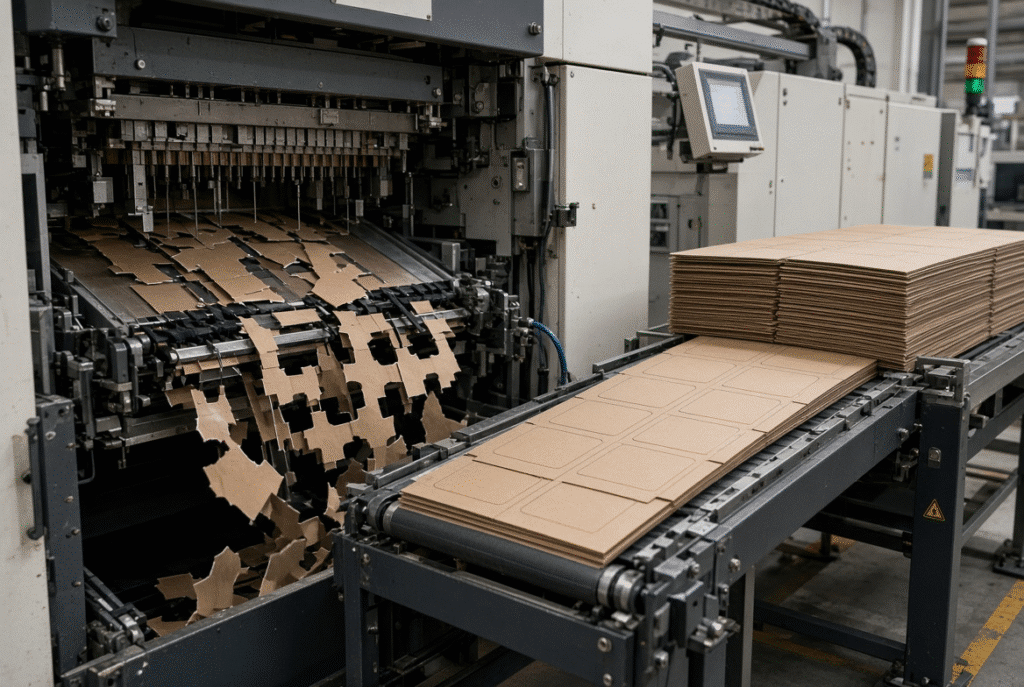
Once the sheet is die-cut and creased it is moved into the stripping section. There it is registered, held and separated using a tooling system that corresponds to the die layout. The exact mechanism depends on machine design and type of stripping used, substrate and product specifications.
Sheet Positioning Before Stripping
It is critical to register accurately for front lay and side lay. Gripper bars or transfer systems should always position the sheet in the same position on each cycle. Arrival and sheet stability are monitored using sensors. The sheet may slightly overlap or miss the intended area of waste or come into contact with finished product edges when the sheet is slightly skewed.
Stripping Frames and Tool Alignment
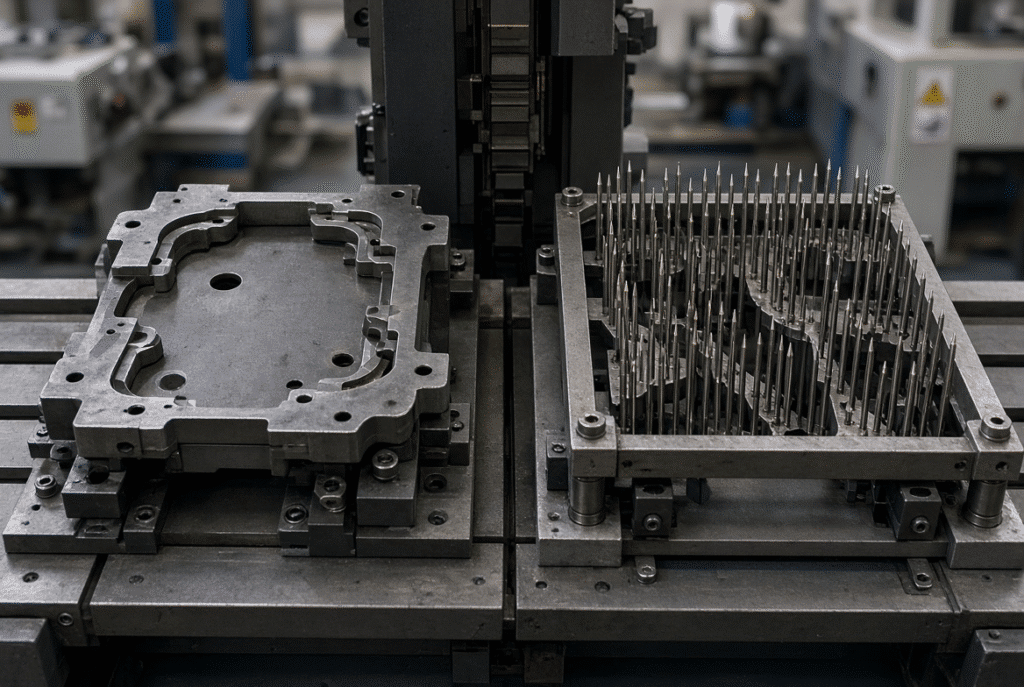
The removal of frames, plates, needles and support parts are ready to be stripped according to the die layout. Only the waste areas are acted upon. The success or failure of separating waste is due to the installation, alignment and fine adjustment. It should be remembered that to achieve success with a stripping unit the tooling must be properly prepared for that particular die.
Separation, Collection, and Delivery
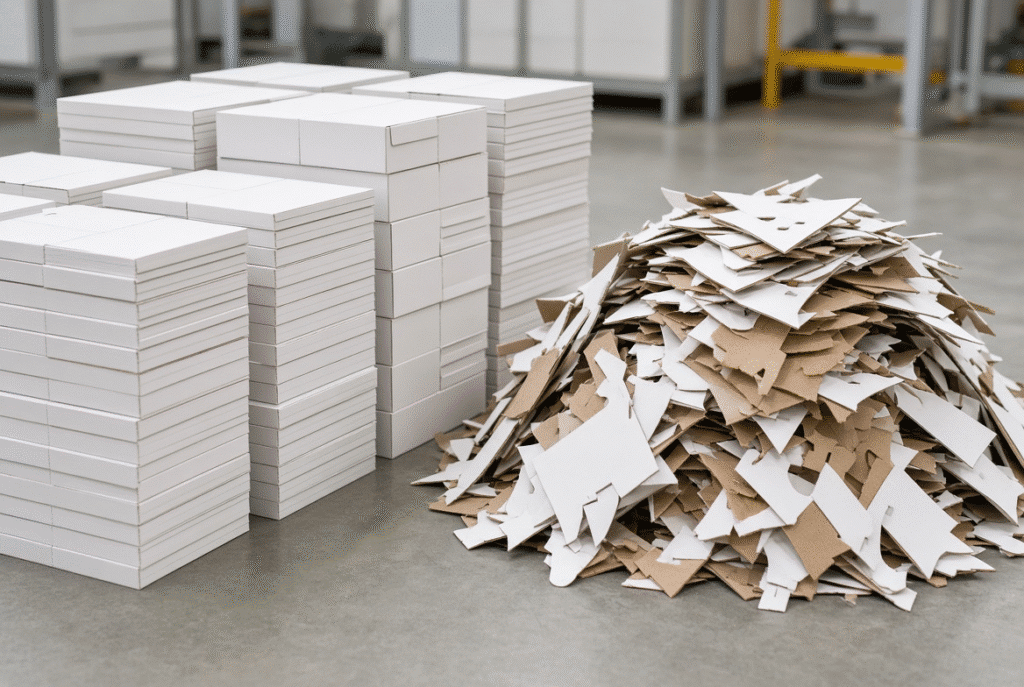
The liberated waste material is diverted away from the flow of the product and the finished blanks are sent to the delivery area. Blanks which have been separated without any waste attached can be stacked, counted, inspected, or transferred without much manual effort as compared to a blank still having attached waste.
Why Waste Stripping Matters in Packaging Production
When waste removal is entirely manual, it becomes a repetitive, variable and often rate limiting process. The more complex the product or it has internal openings, multi-up layouts and higher volume the greater the value of controlled stripping.
Preparing Finished Blanks for Folding and Gluing
Folding carton blanks should be delivered glued on the top of a folder so that there is no waste attached. Feeders may jam in window openings, lock tabs may cause feeders to jam or make complex folds that are not uniform, and complex outlines with small insets may also cause feeders to jam or cause glue flaps to interfere.
Reducing Repetitive Manual Breakout Work
Manual breakout involves operators having to push, shake or pick waste from all the sheets. This causes fatigue, difference between operators and slower line speed in the long runs. Automatic stripping does not eliminate the need for operators, it simply moves them to set-up, monitoring and quality checking.
Improving Stack Quality and Production Flow
Clearly defined blanks will create more countable and stable stacks. This makes the inspection, bunding and transfer to next operation easier. Equally, the whole machine path from feed to delivery should necessarily work together – even if the stripping or sheet damage occurs before the machine is finished.
Which Packaging Products Typically Need Waste Stripping?
It depends upon the amount of felt that is not removed by die cutting and is difficult to pull up by hand.
Folding Cartons with Windows and Internal Openings
Cosmetic, pharmaceutical, food and specialty retail cartons that have windows, handle holes or ventilation holes create internal waste that is tedious to manually remove at large scale.
Products with Complex Outlines and Narrow Waste Areas
Narrow bridges, small tabs, layouts that nest tightly and irregular shapes make it more likely for residual attachment and more time-consuming to manually sort. Product category alone should not be used as the basis to determine whether actual product drawings and samples should be used.
Multi-Up Sheets and Repetitive Production Jobs
If there are a lot of the same blanks on one sheet, each manual breakout doubles the handling. If the preparation of the tools takes longer than the breakout itself, simple one-up jobs, prototypes and short runs can benefit from the manual method of removal.
Selected Corrugated Board Applications
Selected corrugated board can be processed with some flatbed machines, depending on thickness, stiffness, flatness, flute structure, die layout and the type of strips used. Samples should be tested to ensure material limits are confirmed.
Manual Waste Removal vs Automatic Waste Stripping
Both are not necessarily the best. The correct option is the one that corresponds to the production profile.
When Manual Waste Removal May Be Suitable
Manual breakout is typically used for prototypes, samples, short runs, simple shapes, low-volume orders or when the work is very variable. Low tooling cost and quick changeovers. In longer runs, the trade-offs are: higher labour dependence, operator variation, and slower separation.
When Automatic Waste Stripping Becomes More Valuable
With complex internal waste, repeated orders, high sheet volumes, tight delivery schedules or less manpower, the value of automatic stripping is meaningful. Determine actual manual hours, rework and downstream waiting time before making decision.
The Main Decision Factors
- The geometry of products and internal openings.
- Size of the outer wastes and the design of waste-bridge.
- Thickness of substrate and type of substrate
- How many products will be in each sheet?
- The average duration of each run and average number of jobs per run.
- Manual labor availability
- Required output consistency
- Downstream process requirements
- Available setup time
Choose the machine based on the jobs, not just a stripping machine.
Types of Waste Stripping Systems
The type of system will be determined by the product, waste arrangement, substrate, volume and preference of the setup. There is no one-size-fits-all solution.
Plate Waste Stripping
A shaped plate imparts force to specific areas of waste. It can be used for layouts that can be repeated and for some internal-waste patterns where the plate is designed and positioned for the die.
Needle-Type Waste Stripping
Selected waste pieces are pushed free with the position of the needles. Adjustable or replaceable needle arrangements can be changed to fit different waste locations, but if the needles are positioned correctly, supported properly and not allowed to come in contact with finished blanks.
Three-Frame and Specialized Stripping Arrangements
In some systems, upper, middle and lower frames are connected to provide support for the sheet and removal of the waste. Frames can be designed to be easily pulled out to allow for the installation or replacement of needles/ plates. Depending on the machine type and configuration, the exact numbers of frames and their arrangement may differ.
Common Waste Stripping Problems and Their Causes
Most of the problems can be traced back to die condition, tool alignment, registration, pressure or material.
Waste Does Not Separate Completely
It might be due to incomplete die cutting, wrong waste bridge, misalignment of tooling, pressure, worn parts, or the substrate may be too soft or too stiff. Before just trying to increase force, check the die, stripping tool, sheet position and material.
Finished Blanks Are Damaged During Stripping
Crushing of the edges or marking of surfaces can occur due to excess force, needles or plates on product areas, poor support and/or misregistration. Ensure that force is applied to only waste zones.
Internal Waste Remains in Windows or Openings
For small or narrow openings, the tool layout may need to be adjusted, or partial clearing may be needed. Test the hardest openings but do not depend on outer waste as an indicator of success.
Sheets Jam or Stack Unevenly
Jams and oddly stacked sheets can be caused by feeding instability, skew, damage to the sheets, incomplete waste removal, or a buildup of waste in the delivery path. Inspect entire route from feeder to stripping to delivery.
How to Choose a Die-Cutting Machine with Waste Stripping
Use the process knowledge to develop practical purchase criteria.
Confirm Sheet Size, Die Size, and Material Range
Check maximum and minimum size sheets, maximum die-cut, substrate types, thickness, gripper margin and any corrugated board limitations. These limits are the actual run range that the machine can perform.
Ask Which Stripping Configuration Is Included
Check if the quotation contains needle stripping, plate stripping, or both, or does not include stripping unit. Verify the quantity of frames, tooling accessories, replacement items and setup equipment provided. Product images do not specify the configuration delivered.
Request Sample Testing with Real Products
Provide real paperboard or corrugated paper samples, die sketches, product dimensions, target volume and the most challenging waste areas. Request the supplier to show separation on those openings that are critical. Headline speed and pressure is not as reliable as sample testing.
Review Installation, Training, and Spare-Parts Support
Verify the arrangements for installation, operator training, adjustment instructions, maintenance procedures, availability of replacement needles or plates, lead times for spares and parts, warranty terms and any other costs involved with overseas service engineers.
Practical Setup and Quality Checks for Waste Stripping
Good stripping is not guaranteed by proper selection of equipment. Disciplined setup and monitoring is crucial for consistent results.
Before Starting a New Job
Verify correct die and matching stripping tool. Inspect sheet size, thickness, flatness and surface condition. Set the stripping frame in place correctly. Check plates, needles, supports and fasteners. Front and Side Registration. Check pressure and machine settings. Take a short trial and check both outside and inside trash prior to sending out the entire batch.
During Production
Look out for incomplete waste removal, edge damage, internal pockets, skewed sheets, irregular waste stacks, noise or vibration, dust or waste build-up and material changes. Prevent defects from cascading through a big run by stopping and fixing the root cause.
After a Changeover
New die set-ups typically involve variations in tool position, pressure and support. Keep notes of successful parameters and common issues to be able to make future changes quickly and predictably.
Summary Guidance – Understanding Waste Stripping Before Choosing Equipment
Waste stripping is the process of removing unwanted material around and within finished packaging blanks after the die-cutting process. It can be particularly beneficial if manual breakout causes downstream delays, inconsistent breakout, rework, or work bottlenecks. It is crucial to consider product geometry, substrate, die layout, production volume, waste pattern, stripping method, and support that the supplier can offer.
When considering a machine that cuts waste with die cutting, decide the size of the sheet, substrate thickness, product drawing, die layout, the quantity of products, and the most challenging areas of waste prior to talking to DAIS about a recommendation.