

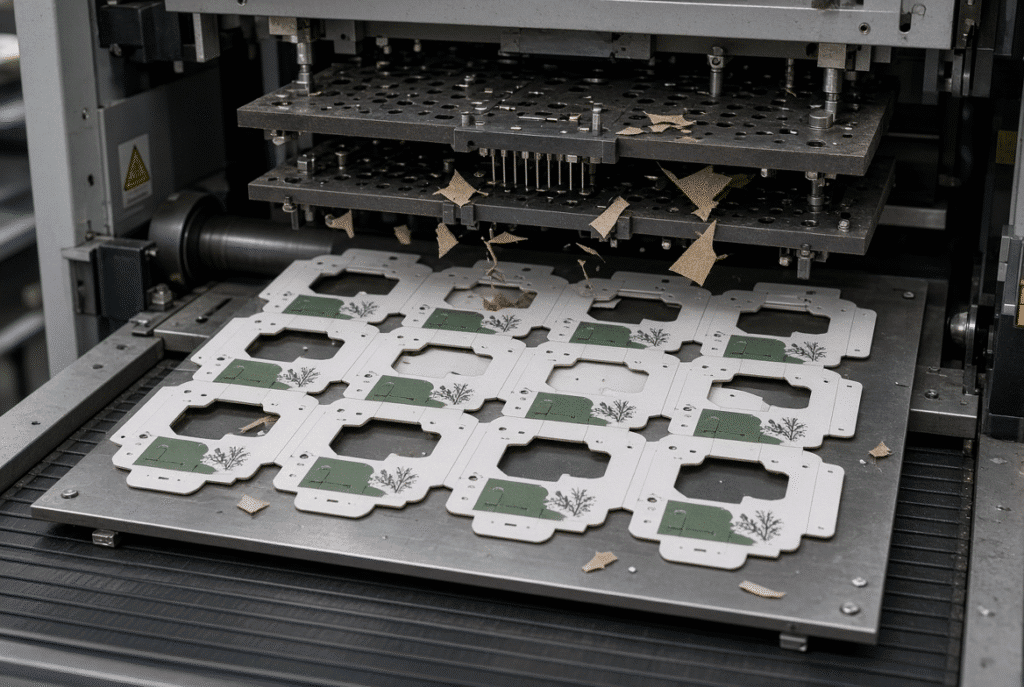
Only complex folding cartons can be stripped automatically where all waste pieces are programmed to follow a predetermined route through the stripping station. The machine force is not enough for complex folding cartons waste stripping. Including windows, hanging holes, narrow slots, decorative apertures and irregular cut-outs waste valuable material which may lead to marking or deforming the finished blank if it is not held, contacted and released and then cleared. The proper order is: carton layout, material, die-cut quality, bridge design, access to stripping tool, alignment of upper and lower tools, trial sheets and continuous production inspections.
Many people believe that if the flatbed die cutter is equipped with a stripping unit it can be used to strip all complicated cartons. In practice, some designs require full stripping, semi stripping, special tooling, slight layout changes, slower speeds or even controlled removal in the off line mode. The machine is part of a bigger engineering chain, and the geometry and behaviour of the carton determine whether or not that chain is successful.
What Makes a Folding Carton Difficult to Strip Automatically?
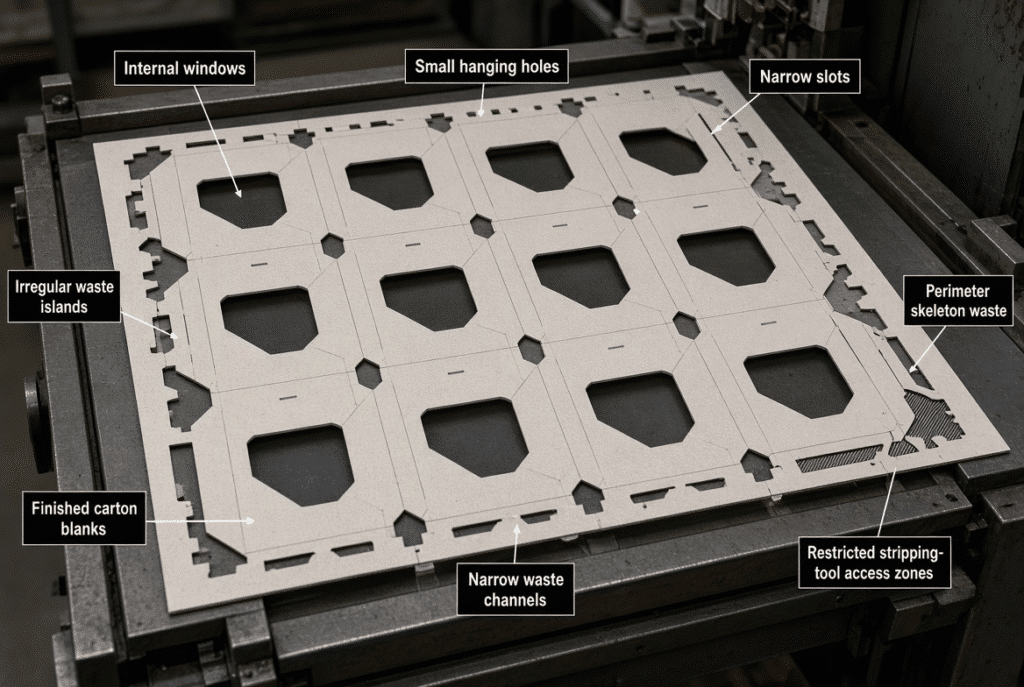
A carton becomes difficult to strip when waste areas are small, irregular, weakly supported, close to finished edges, hard for tools to reach, or unable to leave the stripping station in a controlled path. The number of holes does not define complexity; the physical behaviour of each waste piece does. Production teams must look at the whole imposed sheet, not a single blank in isolation. A carton that looks manageable on its own can become unstable once multiple blanks sit close together with narrow waste channels and limited tool clearance.
Windows, Holes, Slots, and Decorative Cut-Outs
Small, oddly shaped, poorly supported, adjacent to completed surfaces, inaccessible to tools or incapable of moving from the stripper in a controlled path make a carton difficult to strip. It’s not the number of holes that determines the complexity, it’s the physics of each waste piece. Production teams should consider the entirety of the imposed sheet and not just an empty space. While a single carton may appear easy to handle, it becomes difficult once it is packed with other blanks nearby with tight waste channels and little tool clearance.
Irregular Waste Shapes and Weak Waste Structures
Cosmetic cartons (display window), retail packs (hanging holes), pharmaceutical cartons (narrow locking holes), and gift packaging (decorative holes) all have limited contact area, limited clearance and result in internal waste. These pieces are near finished edges or crease lines and must be stripped, but not enough to mar the surface of the carton. Insufficient pin contact or clearance from the lower tool usually results in small pieces of waste being left on the pin or in the lower tool and/or flexing of the blank at release.
Multiple-Up Layouts Create Additional Access and Stability Problems
Placing multiple cartons on top of each other minimizes space for perimeter waste, bridges, stripping pins and clearance openings. If the waste channels are too narrow or the carton features are too close together, stripping may become less stable when there is a layout that maximizes board yield. The trade offs between material utilisation and setup time, stripping reliability, running speed, labour and scrap risk must be considered. Having the maximum amount of cartons per sheet isn’t necessarily the most productive option.
Carton Layout Planning for Windows and Internal Holes
The layout of carton determines if internal waste can be accessed and removed properly in a clean manner. Everything from hole shape to location with respect to edges and creases, to the placement of the bridge and the position of other blanks, has a bearing on the design of the stripping tool. A packaging designer is not required to remove windows or decorative elements, but should be aware of how those elements will be produced and removed once the design is in the final stages of tooling.
Give Small Waste Areas Enough Tooling Access
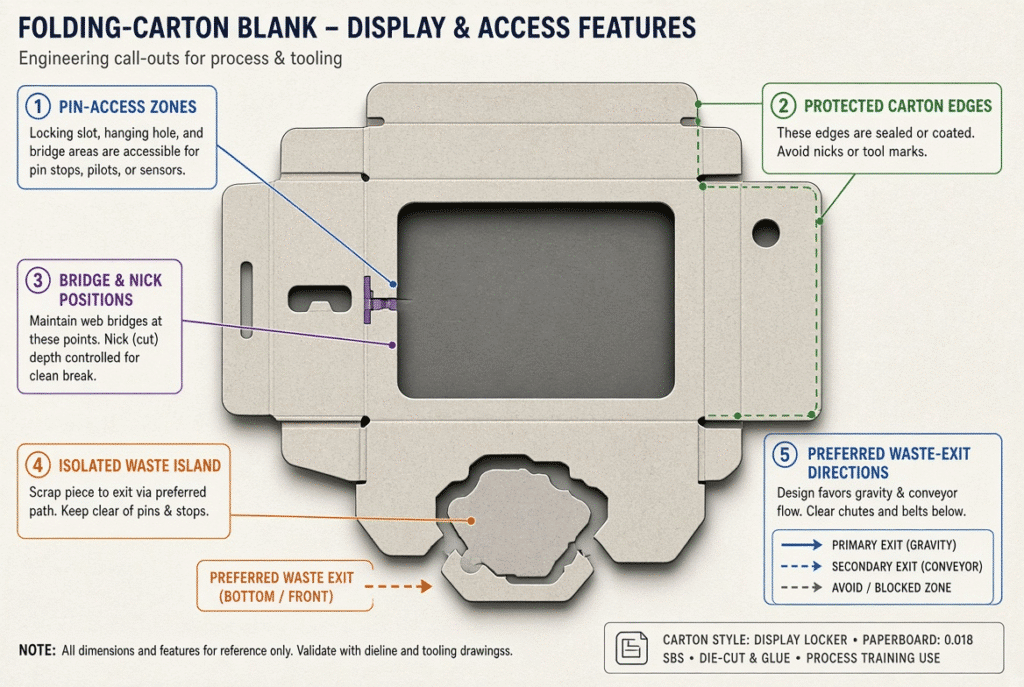
Room for stripping-pin contact, lower-tool clearance and carton support, all of which are required for small holes and narrow slots. If the waste area is too near to a crease, finished edge, print sensitive area or other internal cut-out, the tool may not have a safe access. There is no universal minimum, but feasible dimensions will depend on board thickness, material strength, layout of cutting-dies, stripping-tool system and machine configuration.
Plan Hole Position Around Creases and Finished Carton Edges
Holes near creases or carton edges are more susceptible to damage when stripping. If support is not provided, adjacent boards may flex, crack, mark or deform due to the removal of the waste. A window next to a fold line can appear correct on the dieline but may need careful tooling and support to not be distorted. Physical sample review is more accurate than digital geometry alone.
Avoid Uncontrolled Waste Islands
Early detaching of isolated waste islands, trapping in the sheet or requiring very special tooling to keep them from detaching, increase setup time and running stability problems. If the design forms such islands, the plant can shift the location of the bridges, modify the shape of them, change the imposition, use semi-striping or select other forms of removal. The goal is to retain the use and aesthetic purpose of the carton, and develop a feasible waste stream.
Tooling for Complex Waste Areas
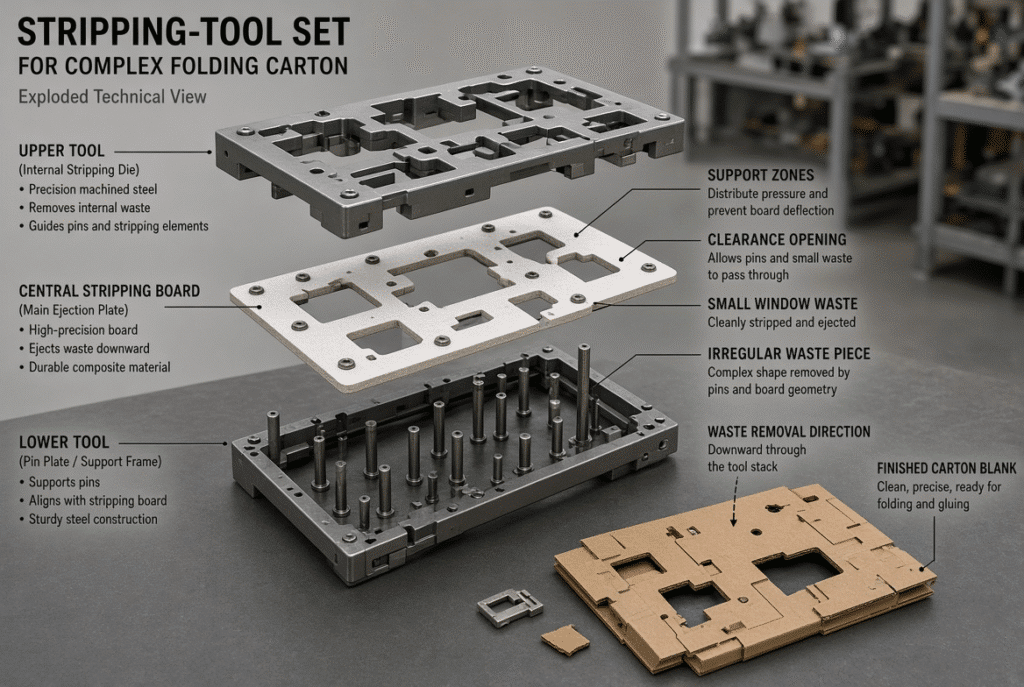
The vast majority of carton waste is complex waste and requires job specific stripping tooling. The central stripping board, upper tools and lower tools, pins, rules, claws and support must be designed on the actual carton and the imposed sheet.Central stripping board, upper tools, lower tools, pins, rules, claws and support must be designed around the actual carton and the full imposed sheet. A stripping tool is not just a set of pins, it’s a system that touches waste, holds the completed blank, provides clearance, and directs removed material out of the sheet flow. The method is different for each machine, depending on the material and carton size and shape.
Central Stripping Board and Waste-Exit Openings
Selected waste pieces pass through the openings in the central stripping board. When the carton will be used for a complex carton, the openings must not only be similar to the windows, holes, slots and irregular shapes, they must also leave support around the finished carton. Insufficient opening design can result in jamming, flexing carton panels, small components remaining attached to the bottom of the opening, or contacting the wrong area of the opening.
Upper and Lower Tool Coordination for Irregular Waste
The stripping tools, upper and lower, need to co-work around irregular geometry. The top tool will contact a selected waste area, and the bottom will provide support and a good outlet. If you want to control the waste in a long, narrow area, you may have to use more than one section, or a different solution than a window. Pin count, size and setting are dependent on the job rather than by rules.
Pin Position, Support Zones, and Clearance Around Finished Cartons
Finished edges, crease lines, embossed features, foil areas and print-sensitive areas must be avoided for pins and support features. The force is directed only towards the waste, and at the same time, the rest of the carton is supported to avoid marking, tearing and deformation. The geometry of the tools must be examined in relation to the actual imposed layout and material sample; geometry only on a digital basis does not clearly show the behavior of coated, laminated or flexible board when subjected to stripping force.
Material and Die-Cut Quality Challenges
The stripping-tool layout can vary depending on each of the following: board grade, thickness, coating, print finish, moisture, static level and/or die-cut quality. If a successful batch of a substrate is not guaranteed to work with another batch of the same substrate or printed surface.
Board Thickness, Stiffness, Coating, and Surface Sensitivity
Each of the products (stiff board, lightweight board, coated folding boxboard, laminated paperboard and metallic finishes) has a unique reaction. Some things bend easily but can’t let waste go and others let the waste out easily, but get scuffed or cracked at the edges. Typical issues include scuffing of the print, marking from coatings, cracking, tearing of fibre, deformation of the carton and release of waste.
Die-Cut Quality, Rule Condition, and Make-Ready
You can’t get the job done if the cuts aren’t done properly. Lack of sharpness in rules can cause fibres to connect to the waste or make-ready, which can result in inconsistent tearing. Check die-cut sheets first. If waste is not separated at the cutting stage, the underlying problem will not be addressed by repeatedly pin adjusting.
Static, Dust, and Lightweight Waste Behavior
Static, dust, coating friction, board moisture and machine airflow have an effect on small and irregular waste. Lightweight parts can stick to sheets, drop randomly or pile up in the stripper area. Look for shifts in the problem with different batches of material, humidity, print finishes, speed and cleaning parameters and don’t jump to conclusions.
Choosing Full Stripping, Semi-Stripping, or Another Process Route
A not all complex cartons need to be stripped along the same path. Full stripping suits are used for stable wastes where tooling can remove the internal and outer waste cleanly. If there are some connections or outer material that should not be removed, to maintain the stability of the sheet or to facilitate subsequent processing, it is often more convenient to do semi stripping. The right one is determined by the layout, the material, the feasibility of the tools, the output condition, the run length, the labour and the downstream process.
When Full Stripping May Be Suitable
Repeat jobs where time is critical and holes and slots are required where the plant would like a cleaner product and less manual waste removal may be considered for full stripping. The task should be able to provide adequate tool access and consistent waste shapes to achieve consistent results. Even though the features are small, delicate, irregular or on high value board or print surfaces, technical evaluation and confirmation needs to be conducted using actual material and trial conditions.
When Semi-Stripping May Protect Sheet Stability
Semi-stripping is selected in cases where all the waste areas cannot be readily removed at the same time, as this could cause the sheet to become unstable, or cause problems with the tools or increase the risk of carton damage. Carrier sections or connections, and some outer waste, can remain for later blanking or manual handling, or separation. It’s a deliberate workflow decision, not a workflow which is not complete, and must be evaluated based on the downstream handling and labour plan.
When Manual or Offline Waste Removal May Still Be Needed
Some more complicated items are more adequately suited to a controlled manual removal (off-line stripping unit or other downstream process). This is typically the case when a hole is very difficult, it has a short life, the design or carton is very variable and the surface protection is greater than the minimum required for maximum automation. It is not the objective to push all jobs into one mode; it is the objective to achieve stable finished cartons and acceptable over-all cost.
Common Production Problems with Complex Carton Waste Stripping
Complex-carton stripping defects must be diagnosed using a systematic approach to review layout, waste geometry, quality of die-cutting, material, alignment of tooling, clearance, waste path and delivery condition. Below is a table correlating common symptoms with where they may occur. It is a start but no replacement of machine-specific technical support.
Troubleshooting Table: Complex Waste Symptoms and Review Points
| Production Symptom | Possible Tooling or Layout Factor | Other Areas to Review |
| Internal window waste remains attached | Limited pin access, restricted lower clearance, unsuitable bridge strategy | Die-cut quality, board stiffness, static, material variation |
| Irregular waste twists or breaks | Waste shape lacks controlled contact or exit path | Tool alignment, waste bridges, die-cut condition |
| Carton edge is marked near a window | Tool contact or support too close to finished carton area | Board coating, print finish, upper/lower alignment |
| Loose waste enters delivery | Waste exit path uncontrolled | Lower tooling, delivery settings, static, machine cleanliness |
| Stripping performance drops at speed | Tooling cannot control complex waste consistently | Sheet transport, material variation, die-cut quality, machine condition |
| Excess manual cleanup remains necessary | Carton layout or stripping strategy does not match job difficulty | Full vs semi-stripping choice, offline process, labour plan |
Any recurring problems should be considered together by the carton designer, die maker, stripping-tool supplier, machine manufacturer and production staff with experience.
When to Revise Carton Design or Imposition
Sometimes, adjusting the machine and tools is not the optimal solution. When one or more of the above conditions apply or the waste islands are unsupported, the channels are extremely narrow, there is not enough pin access, or the perimeter waste or holes are unstable and near sensitive features, that layout may be more responsive to a layout revision. Small modification of hole shape, bridge position, carton spacing, feed direction and imposed layout can be used to maintain the package design, and ensure the reliability of waste removal.
How to Prepare a Complex-Carton Stripping Evaluation
Before buying machinery and/or making an automatic waste stripping route commitment, packaging plants should request an application-specific evaluation for a challenging carton. No generic machine specification can substitute for engineering in the application.
Information to Send for Technical Review
- Complete imposed sheet layout and carton dieline.
- Complete identification of all windows, holes, slots, irregular cut out and challenging waste areas.
- The type of material, board grade, thickness, coating, print finish and sensitivity of the surface.
- The maximum and minimum size of the sheet.
- The directional feeding and requirement of the grippers’ edge.
- Waste bridges, nicks, retained connections and required output condition
- The information on cutting-die and stripping tool where available are current.
- Samples of materials, acceptable versus unacceptable print samples and photos.
- If available, video of current problems of stripping.
- The quantity of jobs, the frequency of repeat jobs, target output and downstream workflow
- Requirements for blanking, folding-gluing, inspection, packing or manual separation.
These details can help to decide whether the carton can be fully stripped, semi stripped, processed using special tooling, offline or improved with a layout change.
Questions to Ask a Machine or Tooling Supplier
- What are the most challenging windows, holes and irregular waste spaces on our layout?
- Is there adequate upper/lower stripping tools?
- How to plan waste bridges/retention areas for this material?
- Will the proposed stripping configuration reduce print sensitive carton areas?
- What are the advantages of full stripping, semi-stripping or an offline process?
- Before finalizing the configuration, can the supplier test our carton and material in actual?
- Which of the following would be the output condition after the process of stripping?
- What additional installation, tooling, commissioning, training, spare parts and technical support is available?
- A supplier should examine the actual carton use and not just the simple question, “Can this machine strip complex cartons?”
To support the cleanup of complex waste, summarizing guidance is provided that explains the need to plan a path to manage the cleanup, rather than relying on force.
Summary Guidance – Complex Waste Requires a Designed Path, Not More Force
The rippling of complex folding cartons are reliable when the waste must be kept under control, machined using a tooling system, easily removed from the carton without harming it, and can be guided out of the stripping station. Consider the carton layout, inner details, bridges, paper, quality of die-cut, upper and lower stripping tools, waste path, carton delivery condition and downstream workflow when selecting the stripping method.
Submit your complicated carton dieline, material sample and waste collection request for a technical stripping assessment. If your packaging plant is considering die cutting and waste stripping, take a closer look at the D1060SQ Automatic Flatbed Die Cutting Machine with Stripping and discuss your complicated carton design with the DAIS technical team.