

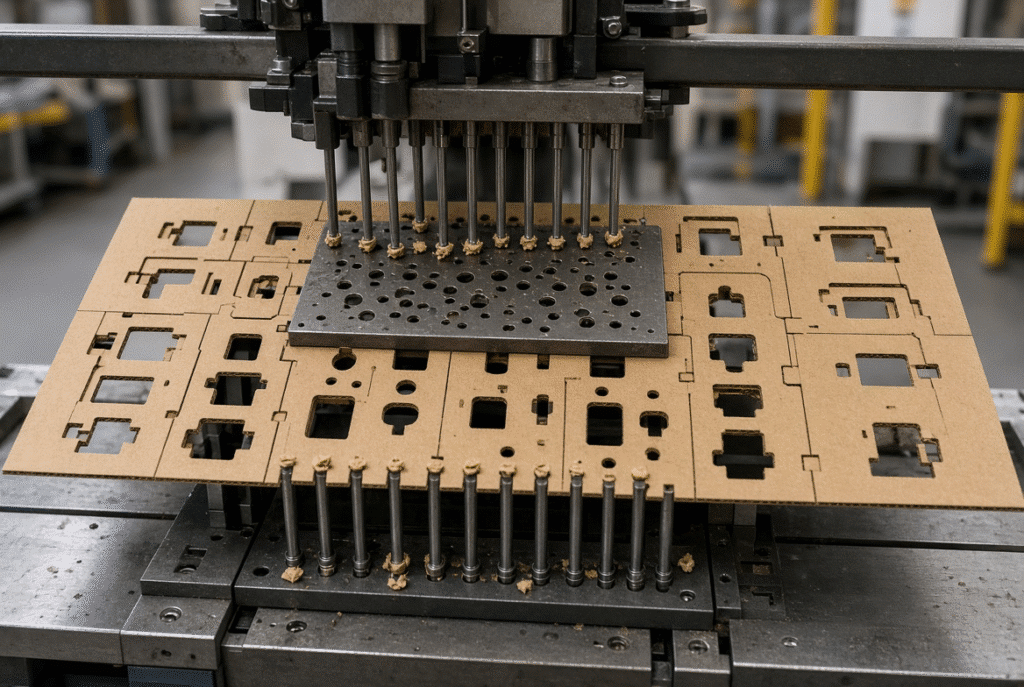
One of the more difficult applications in automatic flatbed die cutting is the small hole waste stripping of folding cartons. Whereas large perimeter waste pieces provide a good contact surface for stripping tools, small internal waste pieces provide less contact surface for stripping tools, are located near finished carton edges, and may still be attached by fibers or bridges. They can twist, become broken, miss the hole entirely or not come out smoothly.
Smaller pins or more force will not result in stable results. The small hole stripping process is sensitive to the decisions that are made in the carton layout, waste geometry, die-cut quality, material behavior, placement of the pins, alignment of the upper and lower tools, and the trajectory of the waste after it comes out of the sheet. Depending on the layout and production requirements, some holes may require modification in tools, bridges, stripping, layout change, or manual adjustments.
What Makes Small-Hole Waste Different from Perimeter Waste
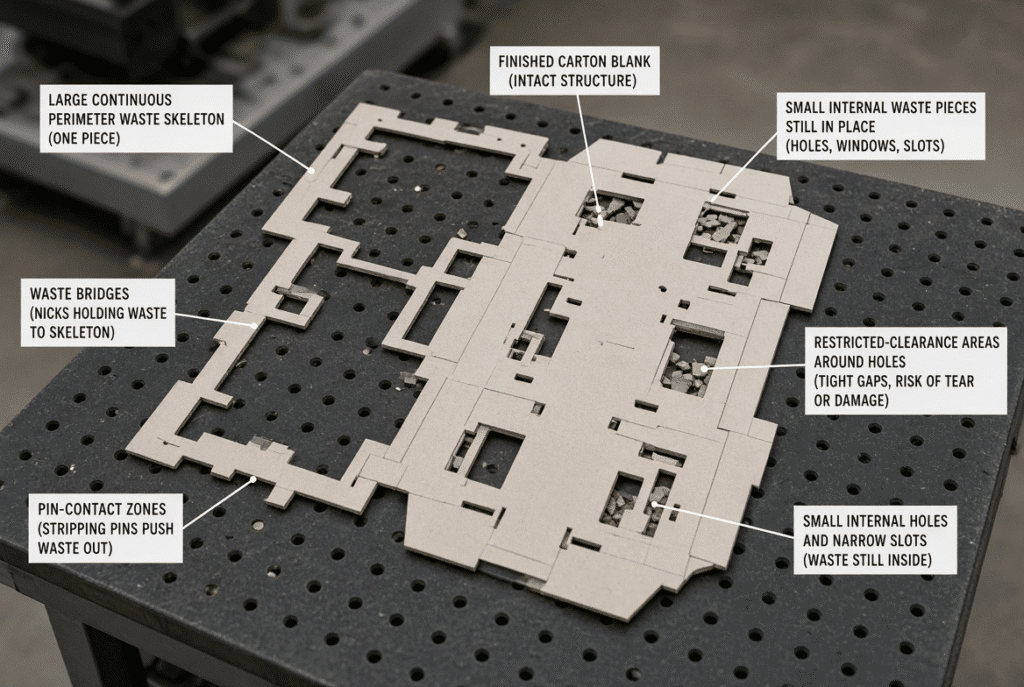
Perimeter waste generally is a larger, continuous skeleton. After making the outer cut, the waste may have a more direct path out from the sheet, and a greater surface area to grip by the stripping tools. The small internal waste is not. Each piece is completely surrounded with finished carton material and isolated and lightweight. Not only is there less surface area with which the tool can contact the waste, but there is also much less structural support within the piece itself and a very short path for the tool to clean up the waste without touching the surrounding blank.
Therefore it’s more difficult to strip cleanly from a carton with multiple small windows, hanging holes or narrow locking slots than it is from a carton where all the waste is the outer carton. The small pieces need to be controlled from the time of the cutting rule until the waste is removed from the stripping station. If the fiber is mis-aligned, or there are any residual connections, or there is any limited exit path, this waste will quickly become visible in the hole as waste, on the blank as fibres and on the finished carton as marks.
Limited Contact Area and Restricted Tool Clearance
If a stripper pin or tool is small, it has only a small area to work with. The tool must also provide a sufficiently controlled force to break the waste free, but it must not damage nearby finished edges, crease lines, printed surfaces or coatings. The gap between the waste and the finished panel is sometimes just a few millimetres, on a cosmetic carton with a small hanging hole or a narrow decorative window. This restricted area requires the tooling team to inspect contact areas and clearances before the process starts to run at production speed.
The pin may strike the carton edge or bend a crease if it is placed even slightly outside of the waste area. Waste may stick on the surface if it is not dropped heavy enough or at the right time. The more close to structural features or high value print areas the hole is located the more critical the early clearance review is.
Small Waste Pieces Can Twist, Tear, or Remain in the Hole
A variety of failure modes are seen over and over in the plant. The waste can be retained by means of residual fibres or nicks, it may twist round instead of moving forward through the desired gap, it may be broken up into fragments, it can adhere to a coated surface or it can be carried further down the delivery path. The shape of the waste, the position of any bridges, the stiffness of the board, the static charge, surface coating, quality of die cut and the alignment of upper and lower stripping tools all have an impact on these behaviors.
The first response of operators who see waste still in the hole is to change the pin. In reality, the apparent symptom does not necessarily indicate that the pin is incorrect. You should review the whole stripping path from the waste cutting stage to the exit of the sheet and determine which part of the path to adjust.
Carton Layout Decisions That Influence Small-Hole Stripping
The performance of the small hole stripping starts well before the first sheet is drawn into the machine. The packaging designer, die maker and tooling team are all involved in determining if the internal waste will be held, contacted, released, and cleared without any damage to the carton. Attractive layout on screen can cause problems in production if the waste geometry, the location or relative position of the holes leave no contact zone, or exit path, for the stripping tool.
When the dieline is open, look at challenging areas of waste before going to the end of the day to review. As the cutting die and stripping tools are cut, each change comes at a higher cost and more disruption.
Hole Shape, Size, and Position Relative to Carton Features
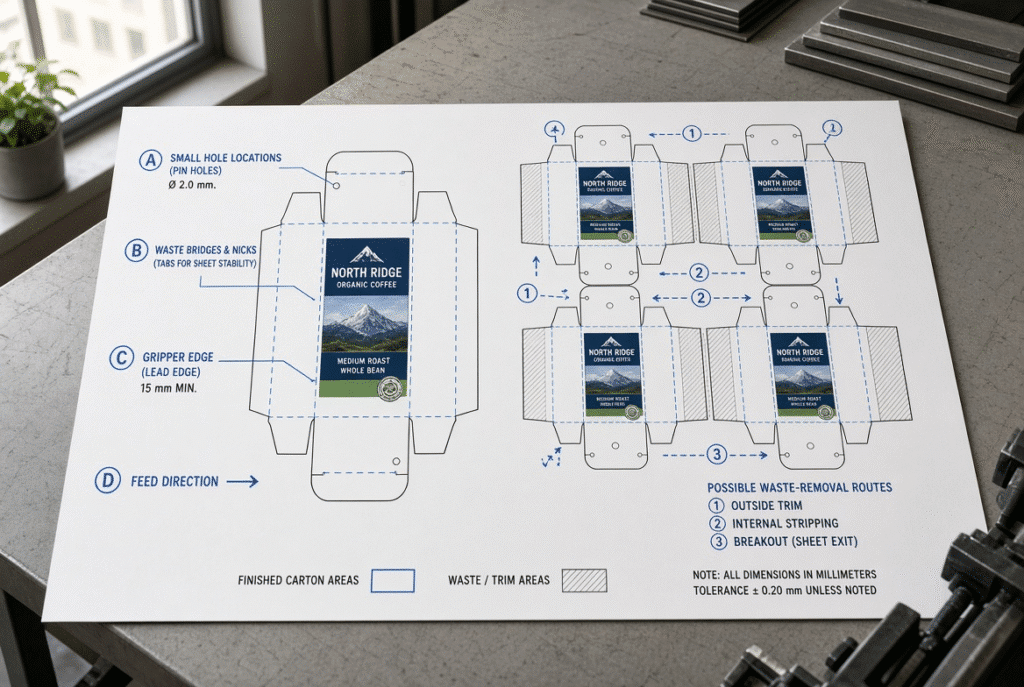
The geometry of the holes affects the behavior of the waste. The narrow slot, sharp corners of windows, small circles, elongated openings, and setbacks with apertures closer together are each a challenge. The long narrow slot may twist more easily, while a round hanging hole may be relatively stable when the bridges are released. In addition, the location of creases, carton edges, embossing, areas of foil and locking mechanisms places further limitations on where a pin can safely touch the waste.
There is no single minimum hole size for all boards/machines. The real issue is if there is sufficient controlled contact area and clearance for the tools that will be used, given the combination of shape, size, location and surrounding features.
Waste Bridges, Nicks, and Fiber Connections
The job of bridges and nicks is two-fold. They have to maintain stability of waste during cutting and transport but release in a predictable way when the stripping tool is engaged. If the connections are too strong, the small waste piece will remain attached and may tear the pin off. If they are not strong enough, the waste can break free prematurely resulting in issues in the transfer or delivery area.
The locations of the bridges are sometimes selected for a small window so that the piece stays under control until the upper tool(s) touch on to the bridge and then let it go in the desired direction. Numbers to specify a bridge width are not meaningful without the knowledge of the board grade, cut quality and tool geometry – the right combination is found by trial with the actual material.
Gripper Edge, Sheet Direction, and Waste-Removal Path
The gripper edge is not regular trash. It is used in an automatic Flatbed die cutter and should not be parted until the sheet has been completely cut. The direction of feed and the location of small holes with respect to the edge of the gripper and the feeding direction, determines the support of the sheet as well as the flow of the waste after release. The position of each small hole on multiple-up layouts may create practical egress for the waste or block it.
The greater the separation between the path the waste will follow and the area where the waste is removed, the less likely it is that pieces released into the system will bounce back into the blank or into the delivery area.
Tooling for Small-Hole Waste Stripping
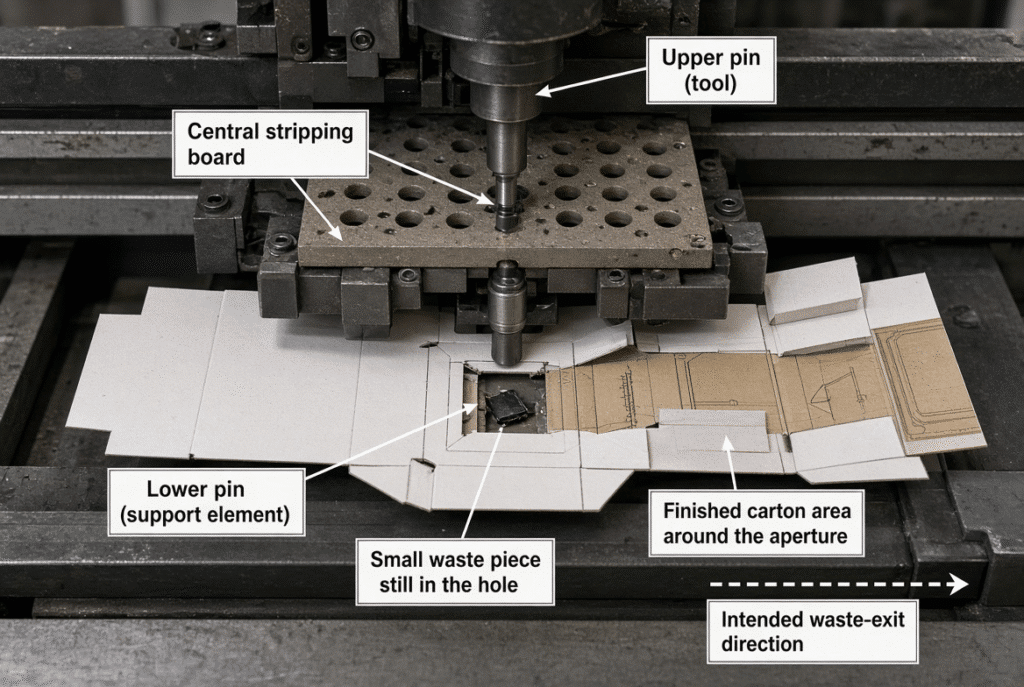
In almost all cases, small hole stripping requires custom tooling for the job. It consists of a central stripping board with the clearance openings perched in just the right spot, coupled with upper pins or tools, lower pins or support elements, pin holders and sometimes foam or sponge material to control the blank. The exact mixture is dependent on machine platform, tool manufacturer, carton layout and material. Many jobs require standard pin components, while others may require specialised or dynamic solutions.
Central Stripping Board and Clearance Openings
The small pieces of waste are permitted to go through the tooling system, as indicated by the central stripping board. The openings should be very precise, with the finished carton blank still supported at each opening by the board. When the clearance opening is too small, waste material can jam or stick. Removal of support in wrong locations may cause carton flex, tear or lose register during stripping.
Thus there are two requirements to board design: there must be an adequate amount of space for the waste to escape from the board, and adequate surrounding support to keep the blank from being damaged.
Upper and Lower Stripping Tools for Small Waste Areas
There is a synergy between upper and lower tools. The upper part of the tool comes in contact with the selected waste zones; the lower part is the opposing support, clearance or receiving path which allows the trash to move out of the sheet. The upper pin or tool will touch a specific area of the waste for a small internal window and the lower setup will provide a controlled exit point for that piece. The completed carton around the window should remain protected, supported and not be marked during the action.
It is very important that the top and bottom components line up. Any offset, no matter how small, will cause the waste to move sideways or allow the finished edge to be touched by the tool.
Pin Diameter, Height, and Position as a Coordinated Decision
The height and position of pins are selected in conjunction with the diameter of the pin. The available clearance and the contact area that can be used depends on the diameter. The timing and depth of engagement varies according to height. Position is where the force will be applied, and the direction the waste will tend to flow upon release.
It will vary according to the size and shape of the waste, thickness and stiffness of the board, surface coating, die-cut quality, design of the bridge and the machine and tooling set up. Standard pin dimensions and fixed height values are not accurate indicators and need to be checked by the production material.
Pin Setup Principles for Reliable Small-Hole Waste Removal
Pin set up is not a matter of pushing or pulling, it is a matter of movement in a controlled manner. The tool should be in contact with the part of the waste that is firmly bound, clear from finished carton surfaces and guide the freed piece through an open clearance path. These are the concepts that will be followed when reviewing, but they do not set any set machine settings.
Contact the Waste, Not the Finished Carton
Each pin contact must fall within an area of unwanted material which will allow the stripping action. Marks and deformations may result from the impact on the edge, crease, printed panel or narrow structural element of a carton. If, for instance, the panel is locked along a narrow locking slot, an incorrect pin position will indicate the panel next to the slot or affect the crease line and a reviewed layout will keep the panel completely in the waste and leave the finished blank untouched.
Support the Carton Around the Hole
For a small hole, the material around it may require deliberate support not to flex, tear, or be marked during the removal of waste. Upper and lower tools, board support and clearance openings should coordinate with each other, with the intent being to direct the force into waste removal instead of into the carton itself. Often thin, soft, highly coated or laminated boards can be easily impacted by local pressure and must be examined carefully before use.
Create a Clear Waste Exit Route
Removing the waste from the hole is only half the task. There should also be a stripping station that the piece passes through. If there is no way to get the waste out of the way, it may fold back, twist, get trapped in the sheet or move into the delivery area. All of the above factors must be taken into account simultaneously. Waste does not just go away, it needs to be directed.
Material and Die-Cut Quality Factors That Affect Small-Hole Stripping
The same tooling can have varied performance when the board changes. The thickness, stiffness, coating, moisture content, print finish and the warp will all affect the release of waste and skin response around the hole. One successful trial does not necessarily equal all trials.
Board Thickness, Stiffness, Coating, and Surface Finish
A stiff board can be resistant to being bent but still need to be released in a controlled fashion. The softer or thinner board can bend over the hole and let the waste lean. Coated or laminated surfaces may alter surface friction, static characteristics and potential for surface markings. Each of the following grades of boxboard, coated carton board, laminated paperboard and some grades of corrugated has a unique combination of these effects. One grade may require a different tooling set-up than another.
Die-Cut Quality, Rule Condition, and Make-Ready
Stripping pins cannot compensate for a poor cut. If the cutting rule is dull, pressure is uneven, or make-ready is incomplete, residual fibers will keep the small waste attached even when the stripping tool is correctly designed. The practical first check is to examine the die-cut sheet before it reaches the stripping station. If the waste is not consistently severed and held as intended, the upstream cutting issue should be corrected before further changes are made to the stripping tools.
Static, Dust, and Material Variation During Production
Lightweight wastes are susceptible to static, paper dust, coating behaviour, moisture changes and board-to-board variations. Issues that are found just on some batches, under specific humidity conditions or at higher speeds are more likely to stem from these factors than from a permanent tooling issue. The observation of the defect at the time of occurrence assists the team in deciding whether the cause is related to the material handling, the environment or the tooling itself.
Common Production Problems in Small-Hole Waste Stripping
A systematic approach to carton layout, die-cut quality, bridges, material, tool alignment, pin contact and clearance and waste exit path is more effective than repeated trial and error changes to the single pin, when small hole stripping problems occur. Some of the common symptoms are given in the table below with the area that is typically examined. It is not a replacement for instructions for the individual machine but a place to start talking with the die maker, stripping tool supplier and process workers.
Troubleshooting Table: Small-Hole Waste Symptoms and Possible Causes
| Production Symptom | Possible Tooling or Pin Factor | Other Areas to Review |
| Small waste remains in the hole | Pin contact, clearance opening or upper/lower alignment may be unsuitable | Die-cut quality, bridges, board stiffness, static |
| Waste breaks into fragments | Contact may land on a weak area or the waste path may be restricted | Waste geometry, material brittleness, cutting quality |
| Finished carton is marked near the hole | Pin location, support or clearance may be too close to finished area | Board coating, tool alignment, pressure sequence |
| Waste twists or rebounds | Pin position may not control removal direction | Lower clearance, waste exit path, sheet transport |
| Results worsen at higher speed | Tooling may not control the small waste consistently | Material variation, machine timing, die-cut quality, static |
| Operators repeatedly clear holes by hand | Pin layout or stripping method may not match job geometry | Carton design, bridges, board selection, upstream cutting |
Any repeated defects should be looked at and discussed rather than be thought of as an individual machine adjustment.
When a Carton Layout May Need to Change
Not all stripping problems need to be resolved on the machine. In some instances the most stable solution is to redesign the packaging structure, modify hole shape or position, reposition a bridge, increase local clearance, modify the imposed layout or implement a different stripping strategy. It is not an intention to state that the first design is incorrect, but rather an acknowledgment that decisions taken early in the design process can minimize risk of waste removal and enhance production stability later in the production process.
How to Evaluate Small-Hole Stripping Before Buying or Running a Machine
An application-specific review is recommended for packaging plants that frequently use cartons featuring small windows, hanging holes or cut-outs inside the carton. The right information prepared in advance enables the tooling or machine supplier to provide an accurate evaluation of the work that can be done automatically and that will require special measures.
Information to Prepare for a Technical Review
- Dieline and impose a carton sheet.
- Evident identification of all small holes, slots, windows and waste areas within the interior of the building
- Printing surface sensitivity, printing surface, coating, board grade, material type, thickness
- Samples of the material were taken and finished production samples were used if available.
- The direction of feed and the need for a gripper-edge are determined.
- A cutting die tool and stripper that are currently in use.
- Photographs or film of poor waste collection
- The output condition that has to be achieved after stripping
- Volume, frequency and planned production speed of jobs
- Blanking/folding-gluing/Inspection/packing (downstream)
This package is used to help identify if the job can be stripped using standard pins, if special tooling is required, if it could benefit from a semi-strip approach, if the layout needs to be modified or if it should be processed through another waste removal process.
Questions to Ask a Tooling or Machine Supplier
- Would the proposed stripping configuration be able to strip the specific small holes from our carton layout?
- What small waste areas are likely to be the most difficult and why?
- What will hold the carton up around each hole in the upper and lower stripping tools?
- What tests are to be run on the real board and print finish?
- Will the full stripping or a semi stripping or an alternative (wok) be needed for this job?
- What is the plan for maintenance and documentation of the stripping-tool system for repeat jobs?
- What training, commissioning and technical support is provided?
A technically responsible supplier will take a look at the actual sample, rather than just say the machine can strip “small holes.”
Summary Guidance – Small-Hole Stripping Needs a Complete Process Review
The small-hole waste stripping in folding cartons is not just about the size of the pin or the stripping force. The reliable results are achieved by the comprehensive design of the carton layout, waste bridges, die cutting quality, board characteristics, stripping board, upper board and lower board, pin installation, clearance and waste exit path, which is verified by the test inspection with production material.
Tackle every challenging small hole project as an application engineering problem. When a waste piece simply will not come off, perhaps it’s time to consider tooling, material, die cutting, layout design or the production route, rather than just more intense stripping.
Submit carton dieline, material sample and small hole waste-stripping spec to have it technically evaluated. If your packaging plant is considering integrated die cutting and waste stripping, please consult the DAIS technical team about your small-hole carton layout and discuss the D1060SQ Automatic Flatbed Die Cutting Machine and waste stripping with them.