

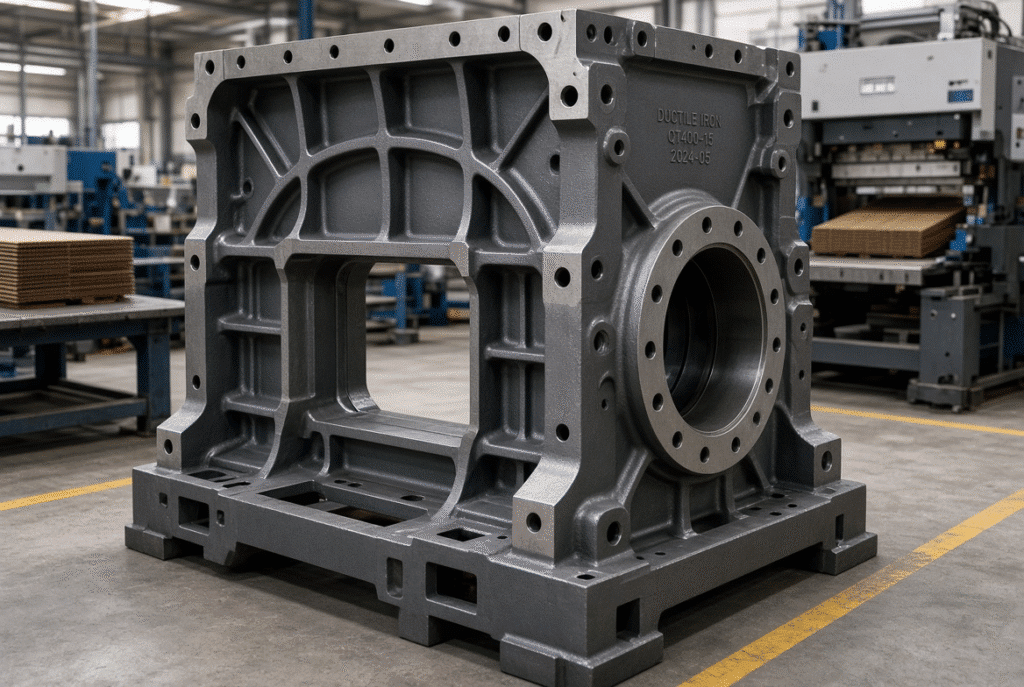
Pressure-bearing structure requires high pressure, and it is necessary for it to maintain its alignment, stiffness, and uniform force distribution. Therefore, the selection of materials is important in the die-cutting machine. The reason why QT600-3 ductile iron is widely used for some pressure-bearing parts is that the other production processes can be controlled with its mechanical properties. A stiff frame or wallboard that is not a large format frame can cause unequal pressure on the die, resulting in wrong cuts in some areas, over compression in other areas, inaccurate creasing or loss of registration over a long run.
The only input to QT600-3 is itself. Whether or not the material provides the stability that is promised to the buyer depends upon casting quality, heat treatment, machining accuracy, assembly, pressure distribution, and maintenance.
What Is QT600-3 Ductile Iron?
QT600-3 is a type of ductile iron (also called nodular iron or spheroidal graphite cast iron) according to Chinese national standard GB/T 1348. The designation refers to minimum tensile strength of 600 MPa, and minimum elongation of 3 percent on standard single-cast test bars, while the hardness is in the range of 190 to 270 HBW. Actual values will vary dependent upon section thickness, cooling rate, heat treatment and foundry practice – with thicker sections often producing lower strength and elongation. The name of the grade should therefore be regarded as a starting point and the buyer should ask for the certificate and test conditions for the casting in question, but not take it for granted that every casting will perform on a similar level.
How Ductile Iron Differs from Conventional Cast Iron
In conventional gray cast iron the graphite is present in flakes. Those flakes become stress raisers and toughness will be lowered. In ductile iron, the graphite is in the form of individual nodules. The nodular shape is more effective in interrupting crack paths thus increasing the tensile strength, elongation and resistance to crack initiation under cyclic loading. For pressure-bearing wallboards and frames this is a practical difference: the structure can resist repeated die-cutting forces without significant progressive cracking occurring, as would be the case in a casted equivalent made of gray iron of similar section.
What the QT600-3 Designation Tells Buyers
The label for grades is a statement of minimum mechanical objectives that are consistent with a defined standard. Does not ensure the targets will be automatically achieved in the resulting machine geometry. The final microstructure and properties will be affected by the section thickness, gating design, inoculation practice, and subsequent heat treatment. The grade name is not enough information; it is better to be backed up by a certificate of conformity, chemical analysis (if applicable) and mechanical test results from the same heat/lot.
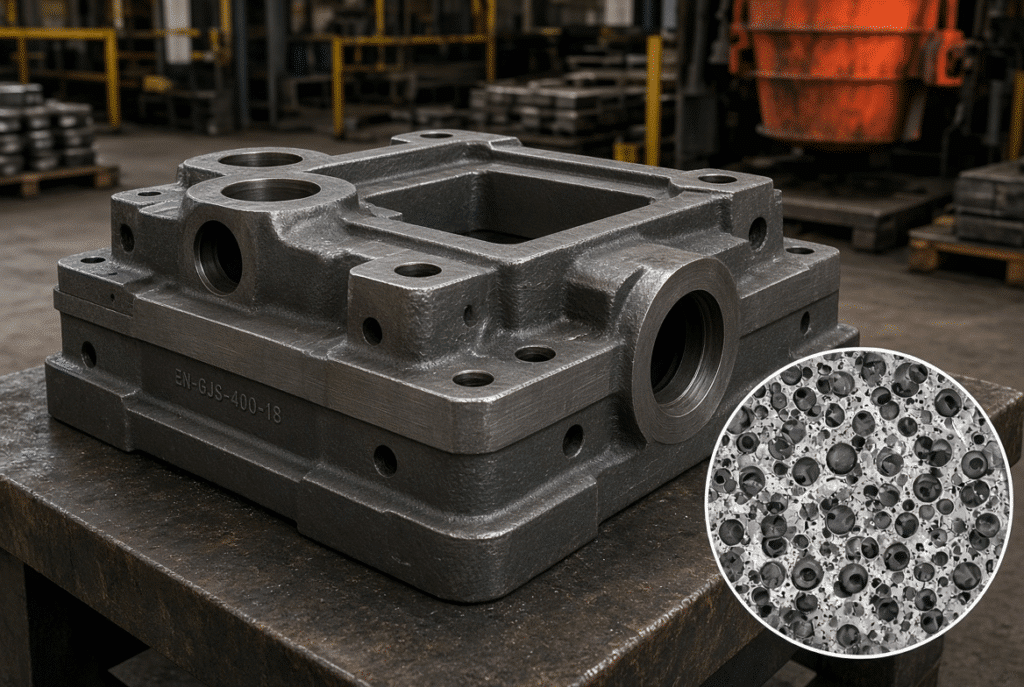
Material Grade Is Only One Part of Structural Performance
These factors all interact with the base material and affect the wall thickness, rib layout, load-path geometry, connection points, residual-stress state and machining accuracy. If not cast or machined to an acceptable geometric design, a QT600 casting will not provide the stiffness and alignment necessary to ensure the consistent pressure of the die. A well-executed, low-grade casting, on the other hand, can outperform a poorly executed high-grade casting. Therefore the selection of material should be considered along with the entire design and manufacturing process of the component.
Why Material Selection Matters in Die-Cutting Machines
The flatbed die cutting machines are machines which imparts high cyclic pressure through the die board and keeps the sheet registered and in time. The pressure-bearing structure is the base to hold the force path stable. Symptoms include uneven cuts, variable crease depth, increased noise, accelerated tooling wear and reduced repeatability in long-run cutting.
Repeated Mechanical Loading During Production
The wallboards and die platform and frame are loaded in each press cycle. The structure is subjected to cyclic stress over thousands of cycles, rather than just one static stress. Material and geometry, therefore, need to be capable of withstanding progressive deformation and fatigue. The grade is not the only factor for fatigue; section design and surface finish after machining and controlling residual stresses are also significant.
Pressure Distribution Across Large Die Areas
The force is applied by the drive and toggle/eccentric system to the machine structure to the die board and substrate. The path is long and the area of contact is great on large or multi-up dies. High and low pressure areas can occur in the same impression as a result of any local flexibility, any residual stresses, or any geometric error. The outcome is a panel with a pleasing cut and another with an imperfect cut or crush, even if make-ready looks right.
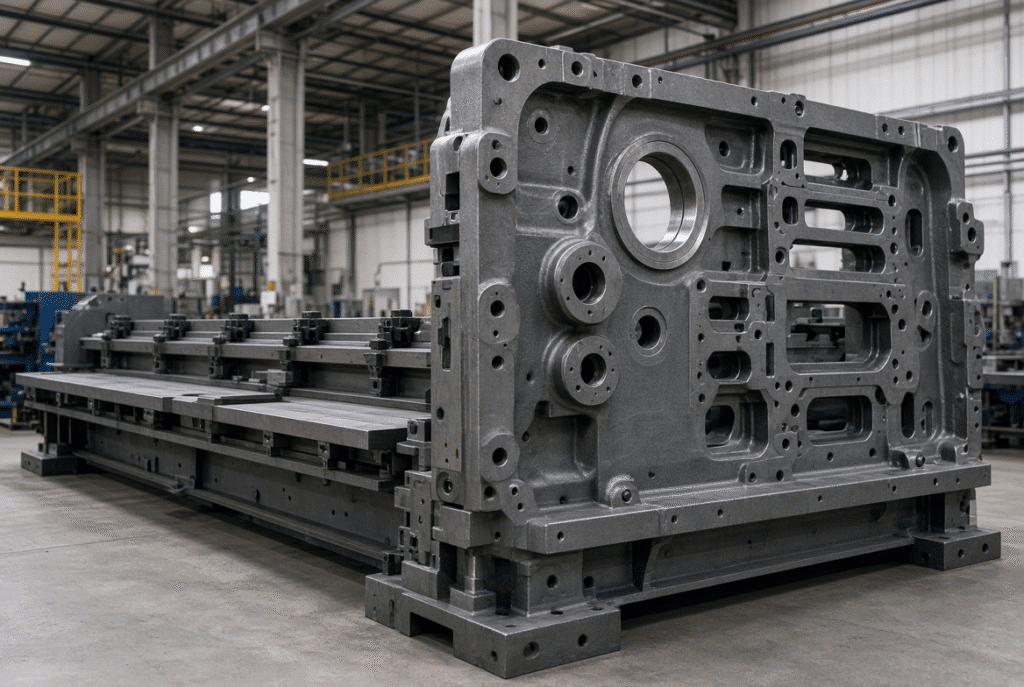
Vibration, Noise, and Machine Stability
Vibration amplitude and noise are affected by the structural stiffness, mass distribution, joint design, drive balance and foundation conditions. Ductile-iron castings can provide valuable damping properties when contrasted with some fabricated parts, but the overall vibration characteristics are a system attribute. The type of material is not a cure-all for vibration from unbalanced rotating parts, worn bearings or an uneven foundation.
Long-Term Alignment and Maintenance
Stable geometry ensures the same registration and cutting performance over time. Even if the main castings are in place, shifting of alignment can occur due to wear in moving components, loosening of fasteners, residual-stress relaxation, or settlement of the foundation. Therefore, it is necessary to inspect and maintain it regularly and correctly, and its material grade cannot replace the inspection and maintenance.
Potential Advantages of QT600-3 in Pressure-Bearing Components
With proper casting, heat treatment and machining, QT600-3 can provide a good combination of strength, stiffness and toughness for pressure bearing parts. The benefits are subject to limitations and can only be confirmed on the individual part.
Strength for Heavy Repeated Loads
The minimum tensile and yield strengths associated with the grade safety guard the frames and wallboards against die-cutting frame cyclic compressive and bending loads. The margin is only really defined when casting is free from critical defects and section design ensures that peak stresses are kept low.
Stiffness and Dimensional Stability
It is found that the higher the modulus, the better to reduce elastic deflection under the press force, and the appropriate section thickness also plays a role in it. Residual-stress relief during the machining also influences the dimensional stability, as well as the precision of the machining reference surfaces. The manufacturing sequence is not always guaranteed by QT600-3, dimensional stability is.
Resistance to Crack Initiation and Load Concentration
The stress-concentration effect of flake graphite is reduced by nodular graphite. This can enhance resistance to crack initiation at fillets, mounting holes and other geometric transitions. Even with the above, it is still important that the casting process and the design are well controlled because there is a possibility of the presence of crack starting points due to casting defect, sharp internal corner or improper machining.
Potential Vibration-Damping Contribution
The damping properties of cast-iron structures can sometimes be desirable compared to some welded-steel structures of similar mass. The practical benefit only occurs when geometry, joint stiffness, drive balance and foundation conditions are also controlled. Zero vibration are just not achievable for an industrial press.
Material Alone Does Not Determine Machine Performance
After introducing casting quality, heat treatment, machining, assembly as well as installation, the identical nominal grade can have different results.
Casting Quality and Internal Defects
Any sand casting has the built-in risks of porosity, shrinkage cavities, inclusions and segregation. These defects need to be managed in pressure bearing components by the process design, feeding and non-destructive inspection. Sound QT600-3 casting is acceptable; defective casting, even with a higher grade stamp is not.
Heat Treatment and Stress Relief
Normalizing or stress-relief cycles can help to refine the matrix, reduce residual stresses and enhance dimensional stability in further machining. The exact cycle depends on the process. The purchaser should inquire of the treatment applied and records of inspections available for the parts involved.
Machining Accuracy After Casting
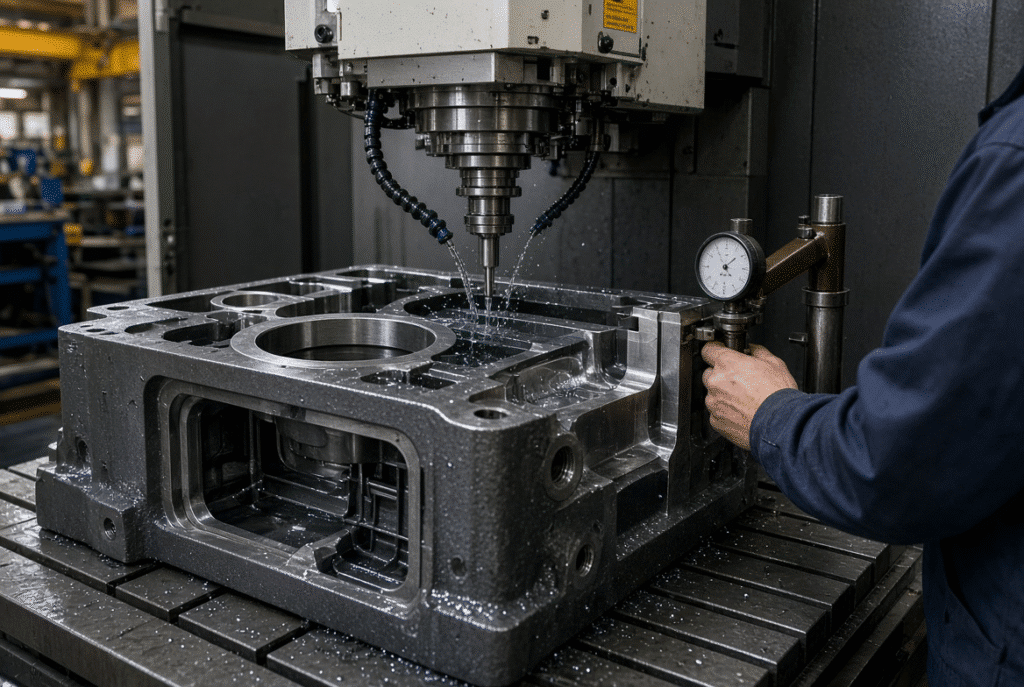
Accurate mounting faces, bore locations and reference planes need to be produced via CNC machining to create castings. A strong cast is not worth the money if the cast surfaces are not flat and/or the critical dimensions are out of tolerance. The precision of the machine directly influences the die positioning, bearing seats and the pressure distribution over the long term.
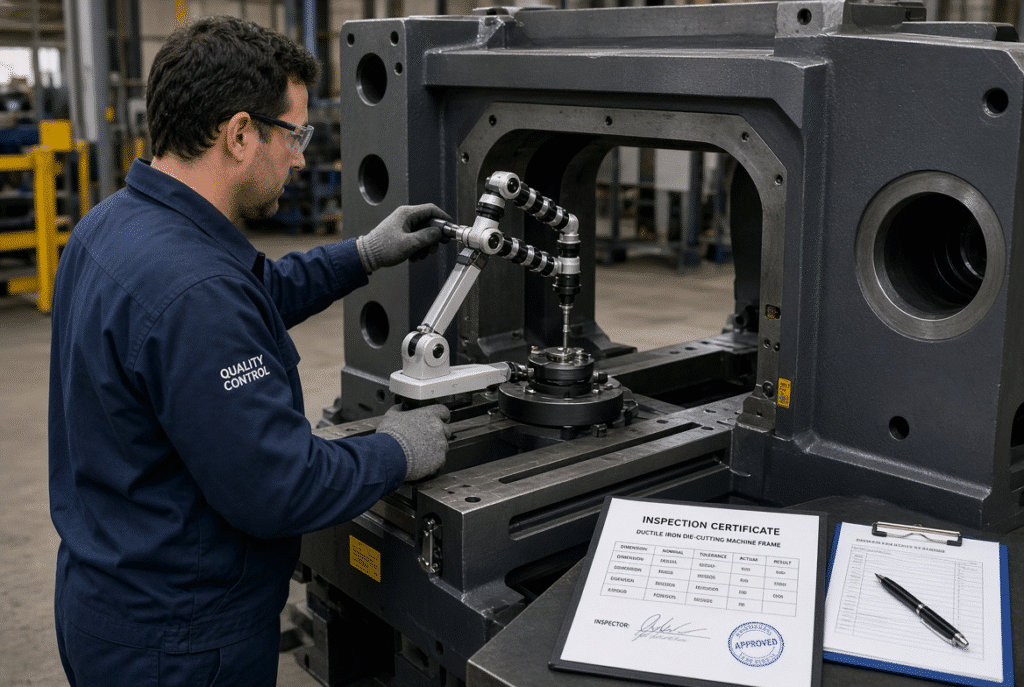
Assembly, Fastening, and Foundation Conditions
The performance of the castings depends on the quality of the contact surface, leveling and foundation support, as well as the bolt torque as a whole. Even if a frame has been cut to specification it may still be uneven if it is installed on an uneven floor or assembled out of alignment. Installation and foundation checks are therefore included within structural performance.
QT600-3 Compared with Other Machine-Structure Approaches
None of the materials is consistently better. The design, manufacturing route and operating conditions should be taken into account in the comparison.
Ductile-Iron Cast Structures
Ductile iron is appealing for use in large pressure-bearing frames and wallboards, due to its integrated geometry, high mass and good compressive strength. Conventional drawbacks are the requirement for good foundry work, pattern tooling expense, and a detailed examination of the soundness of the inside of the casting.
Gray Cast Iron
Flake graphite reduces the tensile strength and toughness of gray iron, however it provides good damping and is low cost. It can be suitable for lightly loaded or primarily compressive applications; for high cyclic tensile or bending loads the nodular structure of ductile iron is generally preferred.
Welded Steel Structures
Welded fabrications offer flexibility of design, and ease of repair or modification. Care must be taken in controlling weld residual stresses, weld distortions and post-weld machining. The design and utilization of joints and stress relief practice become critical. Therefore, it is not a question of one material being better than the other, but one of the ability to make a better choice of material for the intended use.
How Buyers Should Compare the Actual Machine
Review the full structural design, manufacturing documentation, inspection records, sample cut results and service history. Material grade is just one data point, among many.
How QT600-3 Can Affect Cutting Performance in Practice
Pressure distribution is affected by structural stability, which impacts cutting completeness, consistent crease, waste stripping and repeatability for long runs. The connection is remote and dependent upon a system.
Cutting Completeness Across the Die
A stiff pressure bearing structure helps to ensure uniform contact pressure. Despite a good set of rules, the possibility of incomplete cuts still exists due to make-ready problems, board thickness variation and pressure setting. Rarely, frame material is the sole cause.
Creasing and Folding Quality
Consistent crease depth and position with stable pressure and accurate die alignment. In addition to the selection of the rules, moisture content of the boards and setup technique play an important role in the final folding performance.
Waste Stripping and Finished-Blank Separation
Bigger, unbroken cuts are easier to strip. Waste may be left behind by incomplete or uneven cutting. The configuration of stripping units and die design is still the most important variables, and the material of the frame only affects them according to its cutting consistency.
Long-Run Repeatability
Repeatable results are achieved with controlled geometry and disciplined maintenance for extended production. It should be accepted that actual performance must be determined by sample testing and production references, not by grade of material.
What Buyers Should Ask About QT600-3 Machine Components
The usefulness of material claims lies in specificity, documentation and associating them with load bearing parts.
Which Components Use QT600-3?
Check to see if the grade is for a wallboard, pressure frames, bases, die platforms, or other specific components. Too general – machine body material – load path matters.
What Standard and Test Records Apply?
Ask for material standard, foundry certificate or mill certificate, mechanical test results, hardness data and inspection records, as applicable. It is better to have reasonable evidence of conformity than promotional statements.
How Are Castings Machined and Inspected?
Ask about the capability for CNC machining, the means they use to check dimensions, tolerances for flatness and bores, the process of stress-relief, and points of quality control. Performance may be more affected by the manufacturing process than the grade name.
How Does the Supplier Validate Long-Term Performance?
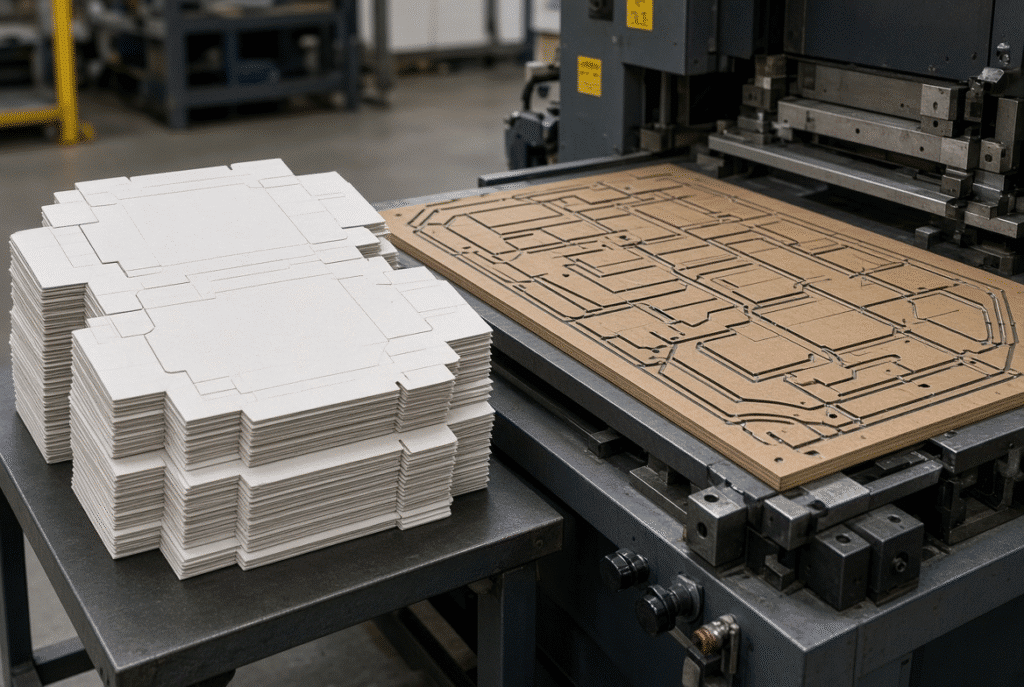
Request production references, cutting sample results, recommended inspection periods and details of any potential structural or alignment problems. Pay attention to evidence and process control – not guarantees.
Maintenance Practices That Protect Structural Performance
Even a well-made ductile-iron structure requires correct installation and ongoing care.
Leveling, Foundation, and Installation Checks
No matter how well a ductile-iron structure is fabricated, it needs to be properly installed and maintained.
Ensuring the leveling, foundation, and installation checks are completed.Completing leveling, foundation and installation checks.
Lubrication and Moving-Component Inspection
The pressure timing, noise and vibration in bearings, intermittent mechanisms, or drive components can vary even when the main castings are sound. Follow the manufacturer’s lubrication schedule and check moving parts frequently.
Monitoring Changes in Noise, Vibration, and Cutting Quality
Capture changes in machine noise, vibration, machine registration, cutting completeness, crease quality, and stripping performance. Recognizing change early means intervening in advance of any impact on production quality or safety.
Summary Guidance – Evaluate the Material and the Manufacturing Process
The strength and stiffness properties of QT600-3 ductile iron make it an acceptable material for selected pressure-bearing parts in flatbed die-cutting machines, provided proper design, production and machining are employed. The material selection is an important part, but there are many more parts to the chain, such as casting quality, stress relief, machining accuracy, assembly, pressure distribution, installation, and maintenance.
Don’t judge an equipment by just its name. Ask for written proof of the specific components using QT600-3, standards and records of tests, the route of machining and inspection, and production references in similar conditions.
For your own production, discuss structural design and material selection with DAIS, including providing substrate format, substrate range, die layout, pressure requirements, anticipated volume and any questions regarding pressure bearing components or service support. That information enables a practical and application-specific assessment instead of a generic and material claim.