

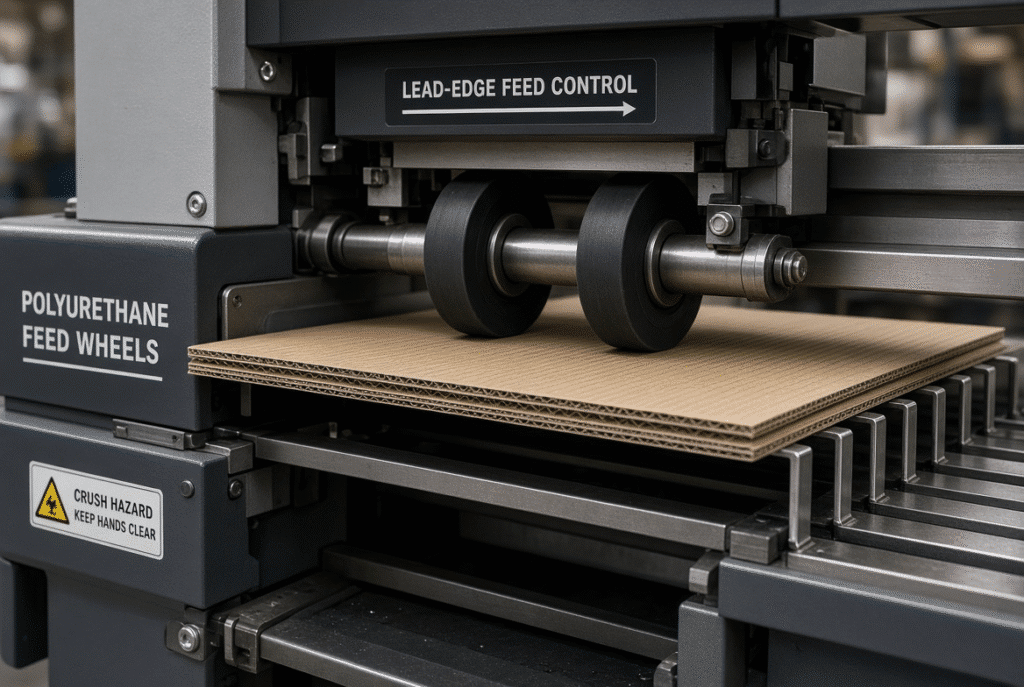
Polyurethane feed wheels for corrugated board provide controlled contact and traction which is necessary to separate and move sheets through a flatbed die-cutting machine or feeder. They grip the board without too much force, allowing the control of the lead edge and position of the sheet to be maintained.
The name of the material does not define the performance. Feeding stability is affected by wheel compound, hardness, diameter, surface condition, contact pressure, alignment, board thickness, flute structure, surface finish, warp and machine speed. Plants typically experience one or more of the following problems when any of these factors drift: slipping, double feeding, skew, missed feeds, paper jams, surface marks, or registration variation.
Why Polyurethane Is Used for Corrugated Board Feed Wheels
When contact pressure, alignment and the condition of the boards are proper, a polyurethane surface can produce enough friction to move the sheet without slipping. The weight of the sheet, board stiffness, surface finish, dust, coating residue, moisture, and the force actually exerted by the wheel are all factors that affect traction. A wheel’s adhesion to the rim will be inadequate even in the face of a properly compounded wheel, if the pressure is not great enough, the surface is contaminated, the support is uneven, or the board is warped.
Grip and Traction
Polyurethane resilience slightly conforms to irregularity of the boards and maintains contact. However, if the compression is too great: marked printed surfaces, bent flutes or squashed edge of the board. Thin E-flute stock is particularly sensitive and heavier C-flute or double wall board can handle more pressure; however, if the pressure is beyond the machine’s recommended limits, local damage may occur.
Controlled Compression
Resilient polyurethane can conform slightly to minor board variation and keep contact. Excessive compression, however, marks printed surfaces, deforms flutes, or crushes the board edge. Thin E-flute stock is especially sensitive; heavier C-flute or double-wall board can tolerate more contact force but still risks local damage if pressure exceeds the machine’s approved range.
Wear and Resilience
During the manufacturing, feed wheels slowly transform into other shapes and surface conditions. The flat spots, loss of diameter or glazing of the surface cause uneven pressure on the sheet, change the feed pitch and decrease the grip. The service life will depend on compound, load, speed and contamination. It is the operator’s responsibility to check wheels at regular intervals – not just on a set schedule.
Polyurethane Does Not Guarantee Mark-Free Feeding
Even with the wheels cleaned, board printed or laminated might bear the traces of a polyurethane wheel that is dirty, damaged, too hard, misaligned, or biased. Surface protection is not just the protection of the wheel material, it is a system result.
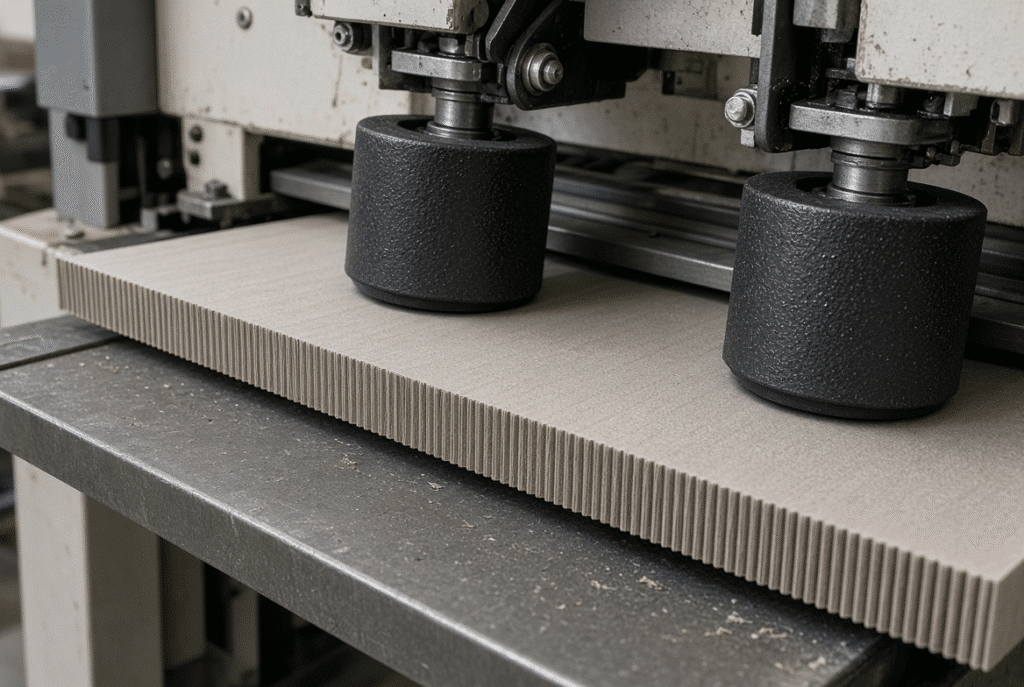
How Feed Wheels Control Corrugated Sheets
Feed wheels are an integral component of the feeding sequence, which include sheet separation, engagement of the lead edge, transport, positioning and timing to the next station. They don’t just exist in isolation as a spare part but are directly connected to the behaviour that governs the control of the sheet.
Feed-Wheel Contact with the Lead Edge
The wheels should roll on the top edge of the sheet without blocking or getting caught in it, and should pull the sheet into the transport path. Contact area, wheel position to edge, sheet support and the condition of the front edge all are important. A curled, crushed or damaged lead edge will result in inconsistent engagement even if the wheels are in good condition.
Maintaining Feed Pitch
Feed pitch is space and time between next successive sheets into next stage. A change in pitch is caused by slipping, small wheel diameter, uneven contact, or a timings drift. The inconsistent pitch results in empty cycles, overlap of sheets, variation in registration and downstream jamming.
Controlling Skew
If there is differential pressure, height, wear or alignment from one side to the other across the width of the sheet, the sheet will rotate, with the side under less pressure or height moving faster. Compare the wheel contact and movement between operator-side and drive-side before making any adjustments to side gauges or die position.
Interaction with Sheet Support
A wheel will not act as a control when a sheet is being pulled up and away from the support or when a sheet is moving from one surface to another. The board should maintain good contact with the wheels with the help of support tables, belts, transition points, board warp and sheet thickness.
Setting Feed-Wheel Pressure for Different Corrugated Boards
The minimum controlled force that moves the sheet reliably without any unnecessary compression or marking is the correct pressure. Always use manufacturer recommended settings and adjust only one variable factor at a time.
Too Little Pressure
Insufficient contact produces slipping, missed feeds, delayed sheet arrival, uneven feed pitch, skew, and inconsistent registration. Low pressure is rarely the only cause; also check worn wheels, contamination, poor support, board warp, and alignment.
Too Much Pressure
Too much force causes surface marks, compression, crushed flutes, edge damage, and, in certain separation situations, double feeding. Don’t always use pressure for the first remedy when there is a feeding problem.
Pressure for Thin E-Flute Board
Thinner board will be more sensitive for compression, surface marking and deformation. It is the combination of controlled contact, good separation and good support that is more important than any one pressure value.
Pressure for B-Flute, C-Flute and Double-Wall Board
A thicker or heavier stock could require other wheel height, support and guide clearance. Thickness alone does not equal too much pressure.
One-Variable Adjustment Method
Start with known settings. Vary one variable, repeat the test sheet, and analyze the stability of the feed, surface quality, registration, and edge condition. Take note of successful settings by board grade and job for future reference.
Inspecting Polyurethane Feed-Wheel Wear
Wear is usually noticed initially as periodic feeding difficulties, not as sudden failure.
Flat Spots and Uneven Diameter
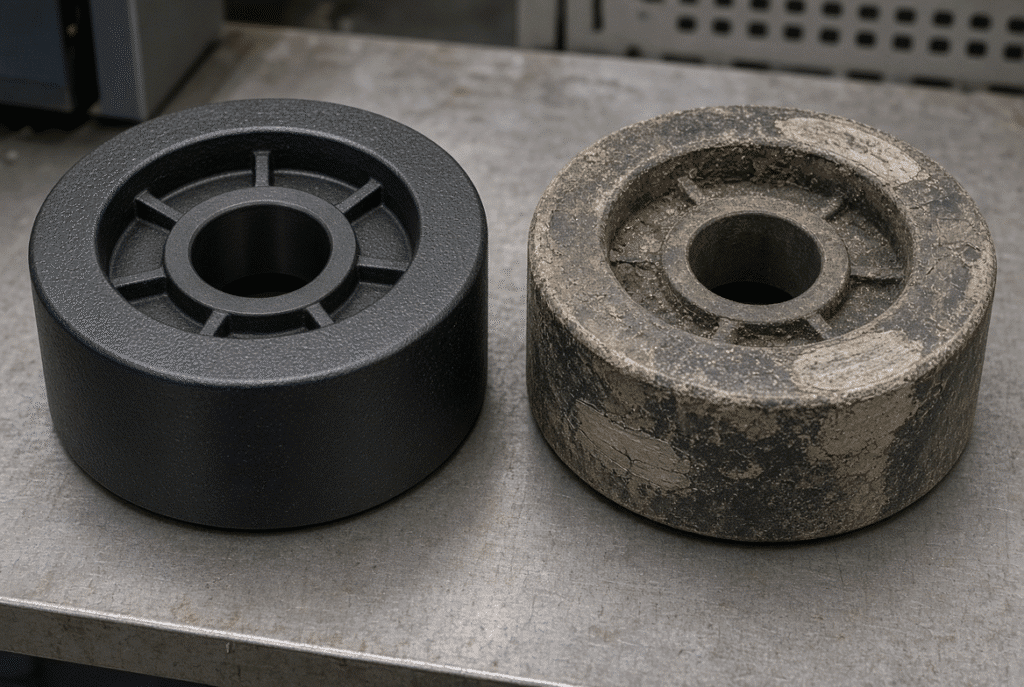
Cyclic feed changes, vibration, inconsistent contact, or shifting pitch are caused by flat spots or diameter variation. They appear as sheet spacing irregularity, registration drift and sometimes as machine noise.
Cracks, Hardening and Surface Deterioration
Rough patches, peeling, swelling, glazing, or hardening can leave the board with a loss of grip and may be imprinted by the cracks. If a new reference wheel is available, the surface condition should be compared to that.
Uneven Wear Across the Wheel Set
If the wheels are worn up unevenly, or in an operator/drive side fashion, then skew and uneven sheet movement occurs. Evaluate condition and contact throughout the entire width of the working machine.
Contamination and Embedded Debris
Paper dust, ink, coating particles, adhesive, film fragments, oil or grease decreases traction, make repeated marks and alter effective diameter. Cleaning can be used to restore performance, replacement is necessary if the surface is damaged.
When to Clean, Adjust or Replace
Identify removable contamination from alignment/pressure problems and from wearing out and the need to replace. Use the machine manual and component manufacturer’s instructions – not every installation has the same replacement schedule.
Polyurethane Feed Wheels and Printed Surface Protection
Polyurethane can impart controlled traction, but the protection of the surface is dependent on the kind and degree of the compound, its hardness, cleanliness, pressure, alignment, contact location and board finish.
Printed Corrugated Board
Transfer of ink, scuffing, pressure marks, surface changes in gloss and visible wheel impressions are still possible. Do a brief trial and check the contact area and see if there is a fixed mark, random mark, or a specific wheel mark.
Coated, Varnished and Film-Laminated Board
Coatings and films are not equal in their response to friction, pressure and contamination. Do NOT assume that all surface finishes are compatible with polyurethane; check the production board for actual measurements.
Contact Location and Job Layout
If machine design permits, if marks are visible, the position of wheel contact away from critical graphics can help to minimize those marks if sheet control is stable.
Surface Protection Beyond the Feed Wheel
Other actions such as guides, belts and support surfaces, die handover, waste removal and delivery stacking can also be a mark. A clean wheel will not correct faults produced at any other portion of the track.
Feed-Wheel Alignment and Sheet Control
The absolute performance of the wheel cannot make up for misalignment. Correct alignment will spread out the contact and minimize skew.
Wheel Height and Parallelism
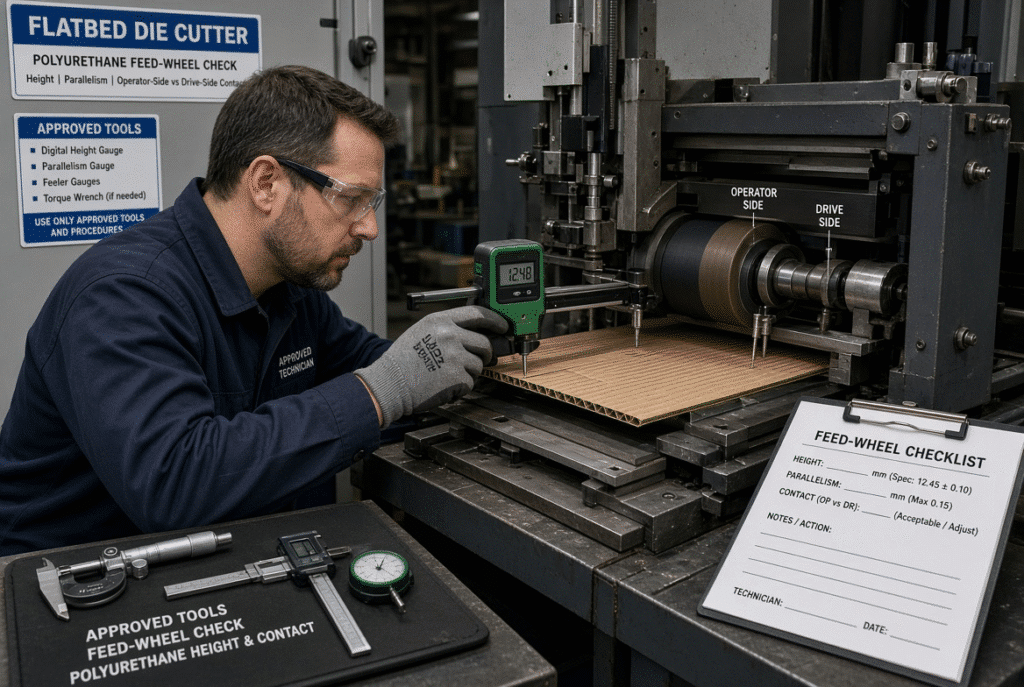
When the wheels are installed at different heights or not parallel, they cause unequal pressure and movement of the sheets. Follow machine approved alignment procedures and tools.
Operator-Side and Drive-Side Balance
Compare the contact, wear, movement and feed results of both sides of the machine. The causes of imbalance include skew, edge rubbing, and registration variations.
Alignment with Guides and Gauges
Feed wheels, guides, front gauges and side gauges are interconnected. If the sheet is freed up to move correctly, a wheel may be used for this purpose, whereas a misaligned guide or gauge changes the movement direction of the sheet. Inspect entire sheet path before adjusting pressure.
Sheet Support and Warp
When the board is warped, it can rise off of one or more wheels, causing alignment issues. Contact is affected by support gaps, transition points, board flatness, edge curl and flute direction.
Troubleshooting Symptoms Related to Feed Wheels
This symptom can come from the board, the sensors, the guides, the timing or the support system. Refer to the following table as a preliminary guide to issues related to a wheel.
| Symptom | Possible Wheel-Related Causes | First Checks |
| Sheets slip | Worn/contaminated wheels, low contact, uneven height | Wheel condition, pressure, support, board dust |
| Sheets skew | Unequal pressure/wear, misalignment | Operator vs drive side, height, parallelism |
| Double feeding | Excessive pressure, separation issues | Separation settings, wheel pressure, pile condition |
| Missed feeds | Slipping, hardened surface, damaged lead edge | Grip, surface condition, lead-edge quality |
| Paper jams | Curled edges, height error, double feed | First contact point, guide clearance, timing |
| Surface marks | Contamination, excess pressure, rough surface | Cleanliness, pressure, contact location |
| Registration variation | Changing pitch, uneven contact, wear, skew | Feed pitch consistency, wheel set condition |
Sheets Slip
Prior to just applying pressure, inspect for wear, contamination, inadequate contact, uneven height, board dust, inadequate support, and warp.
Sheets Skew
Inspect for unequal pressure, unequal wear, misalignment, resistance in the guides, and board warp from side to side.
Double Feeding
All of these factors affect each other when setting a separation. Replacement of wheels is usually not enough to cure the problem.
Missed Feeds
This can be caused by slippage, hardened surfaces, broken or damaged lead edges, gaps in the supports, sensors, timing, and high speeds.
Paper Jams
Choose the initial point of contact. Some common causes are curled edges, incorrect wheel height, guide clearance, uneven support, and double feeding.
Surface Marks
Marks can be caused by contamination, pressure (if too high), wheel condition, rough support surfaces, or leaks in the lubricant.
Registration Variation
Even if the die is properly mounted, it can be difficult to register due to the following:
Cleaning and Replacing Polyurethane Feed Wheels
Clean and replace the machine and component according to machine and component manufacturer’s instructions.
Approved Cleaning Methods
Only use approved tools and cleaning products. Effectively remove dust, ink, coating particles, adhesive, and oil, without harming the polyurethane surface. Avoid unconfirmed solvents.
Removing and Installing Replacement Wheels
Verify diameter, width, bore, compound, hardness, orientation and machine compatibility. Test alignment and pressure following installation. Even with a new wheel, if it is not mounted properly, it can still be poor.
Break-In and Verification After Replacement
Conduct a test to compare the new method with the old one. Check stability, pitch, skew, surface, registration and wheel contact of feed. Don’t expect the fresh wheel to be able to go as fast as the old wheel.
Original and Equivalent Components
Equivalent parts shall comply with the performance requirements and material compatibility of the machine that have been accepted. Select once finalized according to DAIS or original equipment documentations.
Polyurethane Feed Wheels by Corrugated Board Type
E-Flute and Thin Board
Pressure sensitivity, double feeding risk, surface marking, flexing and support gaps. Contact control is important with printed graphics.
B-Flute and Medium-Thickness Board
Average firmness and heaviness. As the sheet size grows, alignment, guide clearance and registration becomes more important.
C-Flute and Thicker Board
More thickness and weight requires good support, proper wheel level, adequate guide clearance and good lead edge engagement.
Double-Wall Board
Weight and thickness of the cut add to feeder capacity, support, clearance and separation requirements. Machine suitability can only be confirmed with the actual board and approved configuration of the customer.
Maintenance and Purchase Questions for Machine Suppliers
Questions About Wheel Specifications
Discuss materials used, sizes and hardness of approved parts, board grades and surface types that have been tried, parts that are considered wear parts, the inspection process of the wheels, the symptoms for wheel replacement, and whether parts can be matched.
Questions About Adjustment and Alignment
Explain the effect of operators on wheel height, pressure, spacing, parallelism, and contact position and what needs to be done by service personnel.
Questions About Printed and Laminated Board
Ask for data about surfaces that have been tested for printability, coating and lamination; ask about surface quality testing. Increase the use of real production materials for sample testing.
Questions About Training and Spare Parts
Verify operator training, maintenance documentation, spare parts availability, response to service calls, installation assistance and technical help resources.
D1060Y and Polyurethane Feed-Wheel Applications
The D1060Y flatbed lead edge sheet-fed die-cutting machine is made to suit sheet-fed paperboard/corrugated-board applications. For those who are evaluating feed-wheel performance on this platform, they should verify that the feed-wheel is actually part of the final platform and should request approved and documented specifications for replacement feed wheels. Give board Type, thickness, flute, surface finish and Production requirements to enable DAIS to conduct a proper technical evaluation.
Frequently Asked Questions About Polyurethane Feed Wheels
Why are polyurethane feed wheels used for corrugated board?
Polyurethane can offer controlled traction and resilience, but performance will vary depending on the machine configuration, pressure, board condition and type of compound and wheel.
Can polyurethane feed wheels mark printed corrugated board?
Yes. Dirty, worn, misaligned, too hard or too tight wheels can leave marks. Complete path on surface and real material testing are required for surface protection.
How much pressure should a polyurethane feed wheel use?
Pressure will vary depending on the type and thickness of the board, the finish of the surface, the weight of the sheet, and the machine documentation. Employ the minimum possible contact force required to ensure stable feeding.
When should polyurethane feed wheels be replaced?
Change if flat spots, cracks, hardening, unequal wear, loss of grip, repeated slipping, surface marking or inconsistent feed pitch are observed. Time according to machine instructions.
Can worn feed wheels cause registration problems?
Yes. The uneven wear or slipping may alter the sheet pitch, induce skew and result in an uneven arrival at the positioning system. Review the full feed path prior to changing the die.
How should polyurethane feed wheels be cleaned?
Depending on wheel design and machine capacity, board thickness, support, pressure and surface condition they may be suitable. Test representative double wall board and validate approved components.
Are polyurethane feed wheels suitable for double-wall board?
This will rely on the design of the machine, wear pattern, wheel-set arrangement and manufacturer advice. If the other wheels are very worn, replacing just one will result in uneven contact.
Should I replace all feed wheels at once?
This will rely on the design of the machine, wear pattern, wheel-set arrangement and manufacturer advice. If the other wheels are very worn, replacing just one will result in uneven contact.
Summary Guidance – Use the Wheel as Part of a Complete Feeding System
Polyurethane feed wheels also impact the traction and sheet control, but correct pressure, alignment, support, board preparation, sensors, timing and maintenance are also necessary for reliable corrugated feeding.
Some of the key practices are as follows: Confirmation of the proper wheel specification, inspection of wear and contamination, careful pressure setting, checking the contact of the wheel with the operator side and drive side, protection of printed and laminated surfaces, recording job-specific pressure settings, replacement of worn wheels according to approved guidelines, testing after installation, and contacting the supplier if the wheel specification or alignment is not known.
Please see the D1060Y product information for detailed technical support of feed-wheel specifications and corrugated-board applications or contact DAIS directly for your board and production needs.