

Being a machinery professional who has worked more than twenty years in DAIS Printing Machinery (Guangdong) Co., Ltd. I personally witnessed the effect that the maintenance of blades could have on a production line, whether it was a success or a failure. In our Dongguan plant, where we are designing and producing the paper cutting machines, to die cutting machines, dull blades are a frequent cause of down time and wastage. The blades have to be sharp since this will decrease the cutting resistance, increase accuracy, and increase the life cycle of the machine-blade maintenance makes one of the greatest impacts on improving production efficiency.
The direct correlation between the sharpness of blades and manufacturing effectiveness is obvious: Sharp edges cut without any problems, requiring minimal forces, which reduces energy consumption and increases the speed. Knife grinding machine are designated machines which help in restoring this sharpness through the careful reworking of the edges of blades, which is suitable in maintaining consistency of performance in the industrial knife grinder practice. Blades that are dull on the other hand tear, vibrate more and have a high reject rate, which delays everything. In the printing, packaging and paper converting business, proper sharpening of blades can boost throughput by a quarter to a third of the cost, and reduce waste. In this guide, I will use real-life situations in the factory counseling that we have been doing to illustrate why sharpness is important and how the process of sharpening the blade using a knife grinding machine works.
What Is a Knife Grinding Machine?
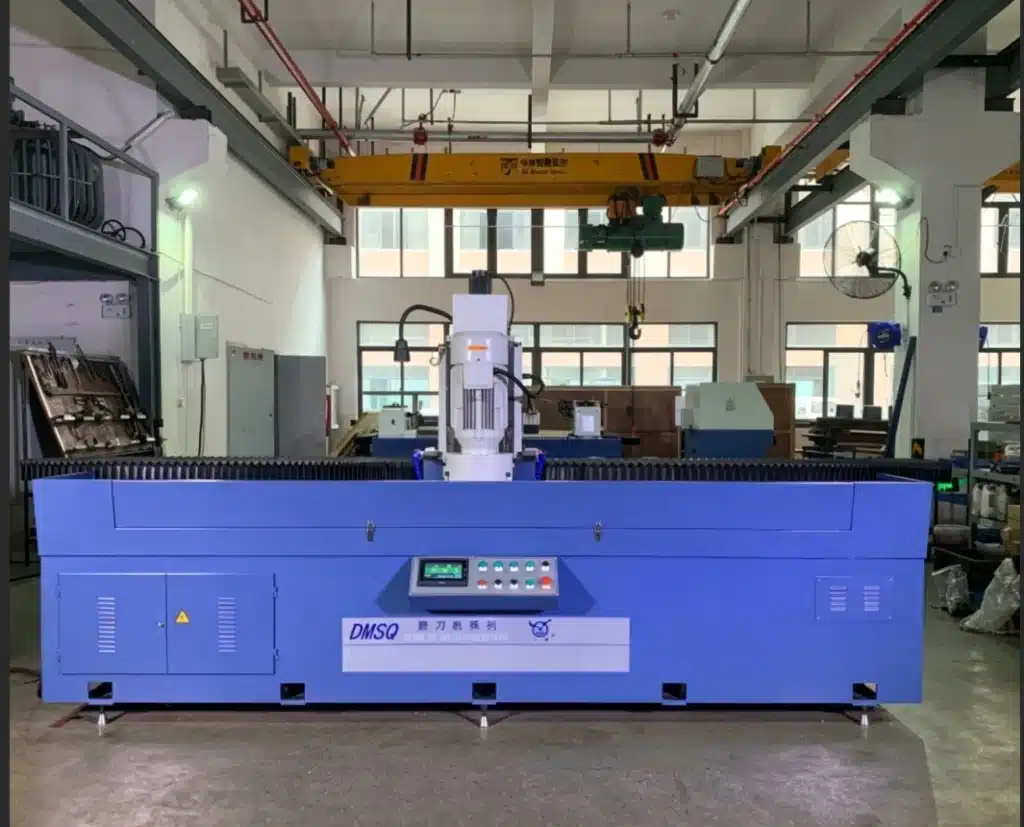
The machine is a fine tool used to sharpen, set the angle, and geometry of industrial blades by abrading away dull edges and re-forming them to factory specifications, using a knife grinding machine. It is applied to paper cutter, slitters, trimmers, guillotines, die-cutting machines, woodworking blades, plastic crushers and so on.
The role of blade geometry, bevel angle, and edge uniformity cannot be underestimated as the angle that is not aligned will result in an uneven cut whereas improper edge finish is going to result in a frayed material. These machines are used in our DAIS line in conjunction with our specialty industrial blade grinder to guarantee the blades of our models like the 1450 paper cutter are kept in their best state of operation. Even fine steel blunts even without regular grinding, and it affects the rest of the line.
How Knife Grinding Machines Work
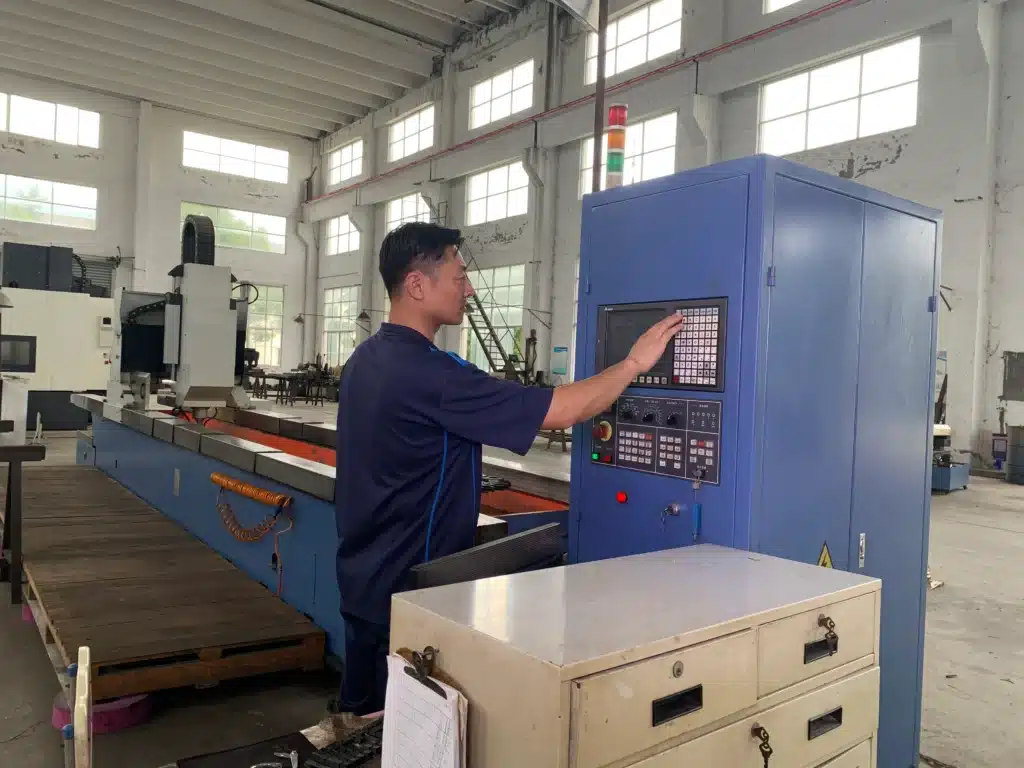
Knife grinding machines work under a sequence of controlled inputs in order to get precision.
Grinding wheel rotation: It is a high-speed abrasive wheel swirling in order to take out material on the blade edge. Blade adjustment: the blade is clamped on a magnetic table or holder to make it stable. Accurate bevel angle control: The mechanism enables describing the exact angles, commonly 18-25 degrees in the case of paper blades. Cooling and lubrication systems: Water or oil helps to avoid overheating of blades, maintains hardness of the blades. Micro-adjusted on the fly to maintain the same level of grinding: Servo-controlled heads allow a perfect, down to 0.01mm, removal.
In the engineering aspects, it ensures that the blades are straight and that edges are uniform, which is important in high-speed operations. In our knife sharpening machine models, variable wheel speeds are used in order to process the different steels without burning.
Components of a Knife Grinding Machine
Good machines are based on sound components.
Grinding wheel: This is a disc of abrasive usually diamond or CBN. Blade holder / magnetic table: This holds blades to a length of 3200mm. Servo-operated grinding head: The purpose of this is accurate movement. Cooling pump system: It is used to circulate fluid and prevent thermal distortion. Angle adjustment system: Bezel adjusts. Precise settings control panel: Programmable grinds.
Such knife grider elements guarantee dependability- the linear guide rails of our 3200 model reduce vibration to provide high quality finishes.
Why Sharp Blades Improve Production Efficiency
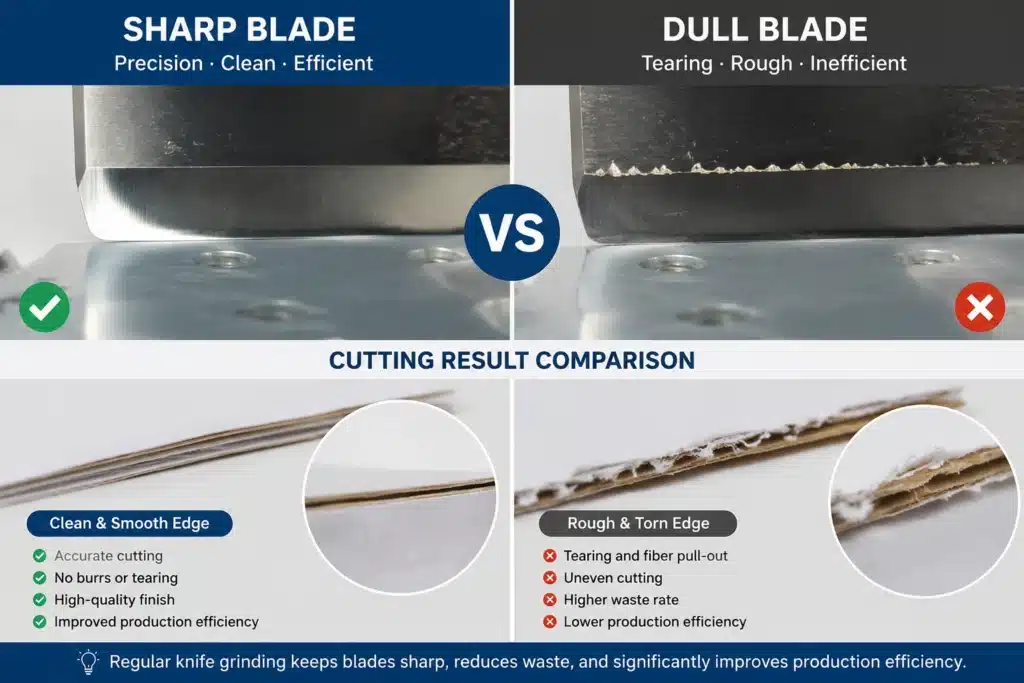
Sharp blades have several important advantages that compound the effectiveness.
The smoother cutting motion will result in less drag, which causes faster cycles. Less machine load reduces the load on motors and bearings. Cutting lines that are more accurate reduce offsets in die-cuts. Paperboard remains of good quality because of less material tearing or crushing. Reduce energy usage by as much as 15 percent. Increased speed of machines without compromising of quality-sharp edges can service up 8,000 sheets/hour without difficulty. Sharpening yields a longer blade life.
In the corrugated line of a DAIS client, the cutting efficiency had increased by 20 points (out of 100) when the regular grinding was used.
Problems Caused by Dull Blades
Shabby blades cause trickle-down problems.
Edges of cardboard are destroyed by tearing and fiber pull-outs. Uneven or rough cutting edges enhance rejects. Wear is increased by increased acceleration of the machine. Poor cuts increase the waste material. Cutting blades are warped by overheating. Mechanical wear reduces life due to machine overload. Reduced operator safety due to jam or kickbacks.
In a woodworking factory that was a partner to DAIS, dull chipper knives resulted in a 30 percent higher rate of down time until it was eliminated through grinding.
Blade Geometry & Sharpness Factors
The geometry of the blade is primordial.
Accuracy of the bevel angle should be the same as material–sharper with plastics. Hardness of blade steel (HRC) such as 58-62 does not dull. Edge micro-finish eliminates burrs. Grit on grinding wheels (course to remove and fine to polish). Cooling performance prevents the loss of temper. Tolerance of straightness of long blades less than 0.1mm/m.
These guarantee the precision of grinding- bad elements guarantee uneven cuts.
Types of Blades That Require Grinding
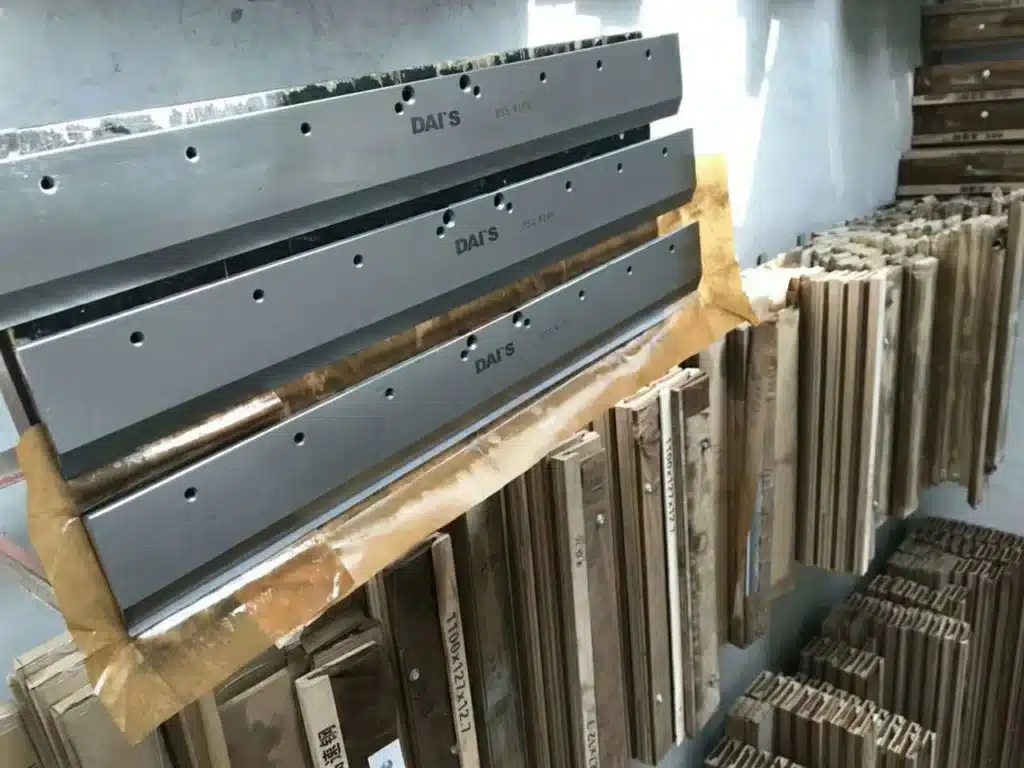
Various blades do so differently.
Guillotine blades: Server blades are sharp enough to avoid drag. Slitter blades: Keeps the rolls clean. Chipper knives: Minimizes the variation in the size of wood chips. Trimmer knives: Guarantees straight edges. Crusher blades: Enhances shredding of plastic. Rotary cutter blades: Increases accuracy of labels.
Both find the advantage of sharp blades such as less force-guillotine blades in our cutter of 1950 take twice as long to grind.
How Often Should Blades Be Sharpened?
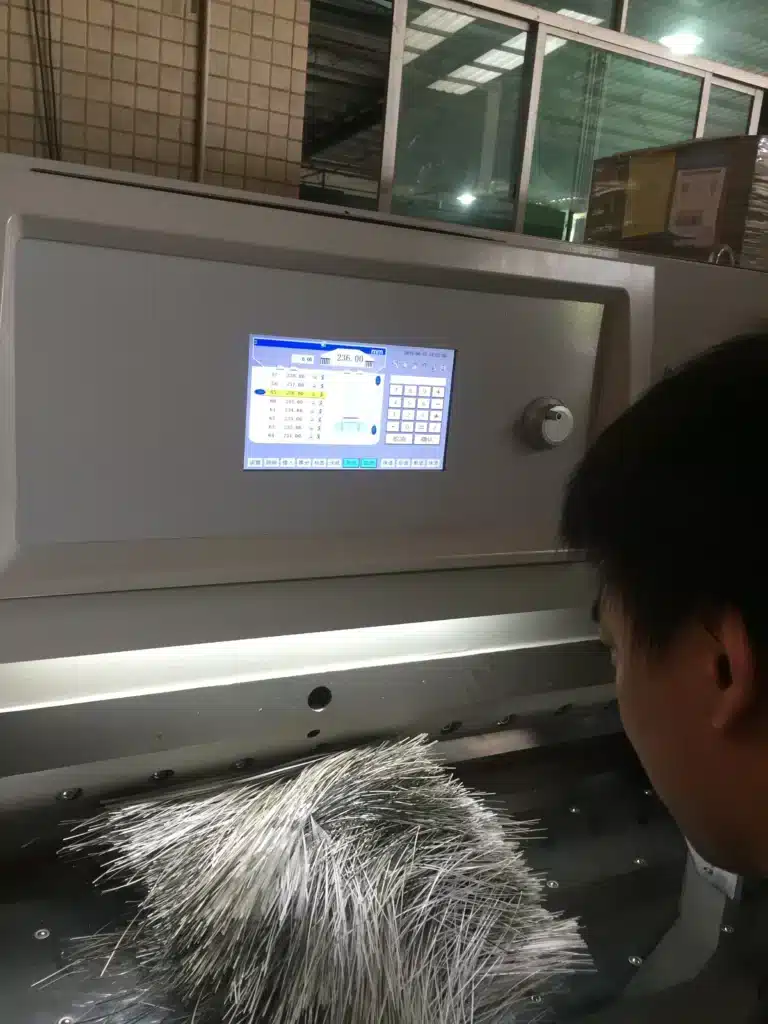
The frequency of sharpening is dependent on usage.
Hardness of material: Abrasive stocks wear out quicker. Reduction in frequency: High-volume should be checked once a week. Machine speed: The faster the machine, the faster the wear. Blade steel: finer alloys have a longer duration.
High volume paper cutting blades are normally sharpened after every 1-2 weeks with regard to load. Track through cut quality frays time.
Knife Grinding Machine Features That Improve Sharpness
Progressive capabilities are taken to the next level.
Automatic feeding system: Long blades are safely handled. Digital angle control: Repeatability is ensured. Grinding head, which is servo-controlled: Gives micro adjustments. Linear guide rails of high precision: Reduces deviation. Three cooling techniques to avoid burning: Cools edge. Adjustable grinding wheel speed: Equivalent to materials.
These are present in our automatic knife grinding machine.
Benefits of Investing in a High-Quality Knife Grinding Machine
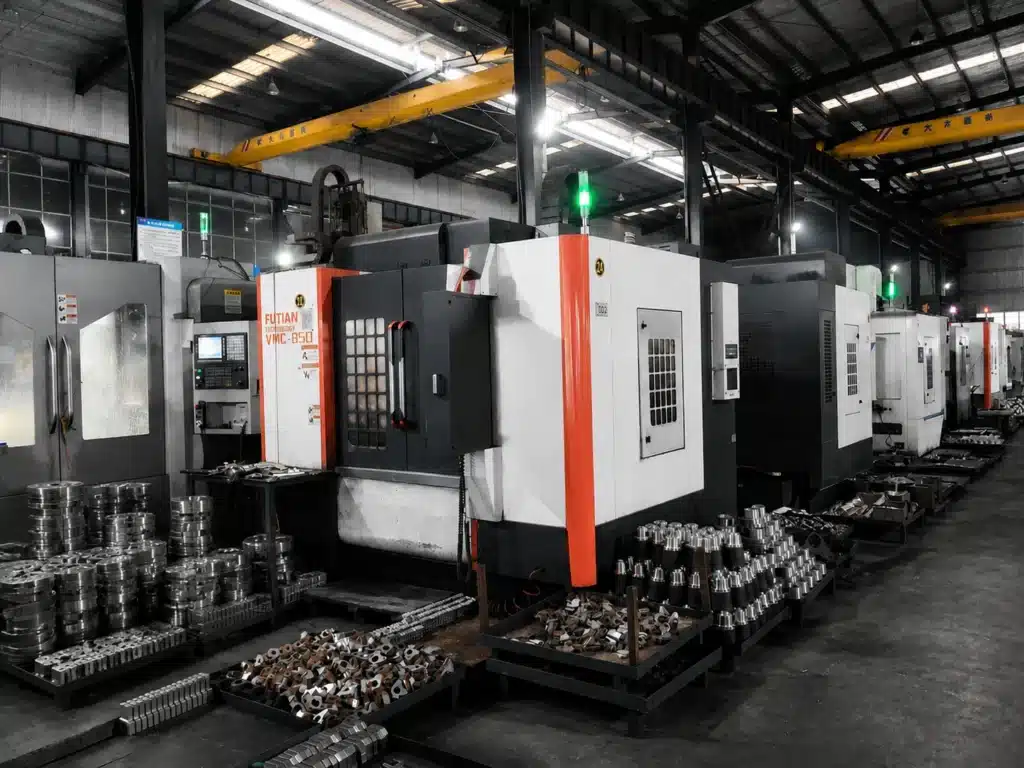
Reduction in long-term cost of blade replacement by reducing life cycle. Fewer variations in quality of products with clean cuts. Less downtime due to fast sharpening. Greater safety of operators through automated handling. Increased performance of cutting machines between lines.
ROI of knife grinder frequently breaks even in 6-12 months through the waste savings- a plastic manufacturing client of DAIS recovered in 8 months.
Applications Across Industries
The process of sharpening affects various spheres.
Printing & packaging: Guarantees accurate die-cuts. Paper converting: Slitter is held constant. Corrugated production: Aids in the prevention of board crushing. Plastic production: Enhances the efficacy of the crushers. Woodworking industry: Decreases chip variation. Textile processing: Maintains accuracy of trimmers.
In food industry employees such as meat separation, sharp blades reduce wastage.
Expert Checklist + Recommendation
This is the checklist to use when purchasing:
- Min. range of blade size needed: 3200mm and up?
- Precision tolerance of grinding: Less than 0.05mm?
- Efficiency of cooling system: Full flood or mist?
- Grinding wheel type: Diamond of hard steels.
- Level of automation Manual or servo?
- Hardness and blade materials: HRC compatibility.
- The maintenance needs: Convenient wheel change.
- Skill level of the operator: Easy controls.
- Budget & long-term ROI: Factor savings.
One of the simplest but most efficient methods of enhancing production efficiency is the use of sharp blades and a good knife grinding machine is required to ensure the consistency of cutting performance in all the industrial uses. Our models are fully integrated at DAIS- contact us during custom solutions.