

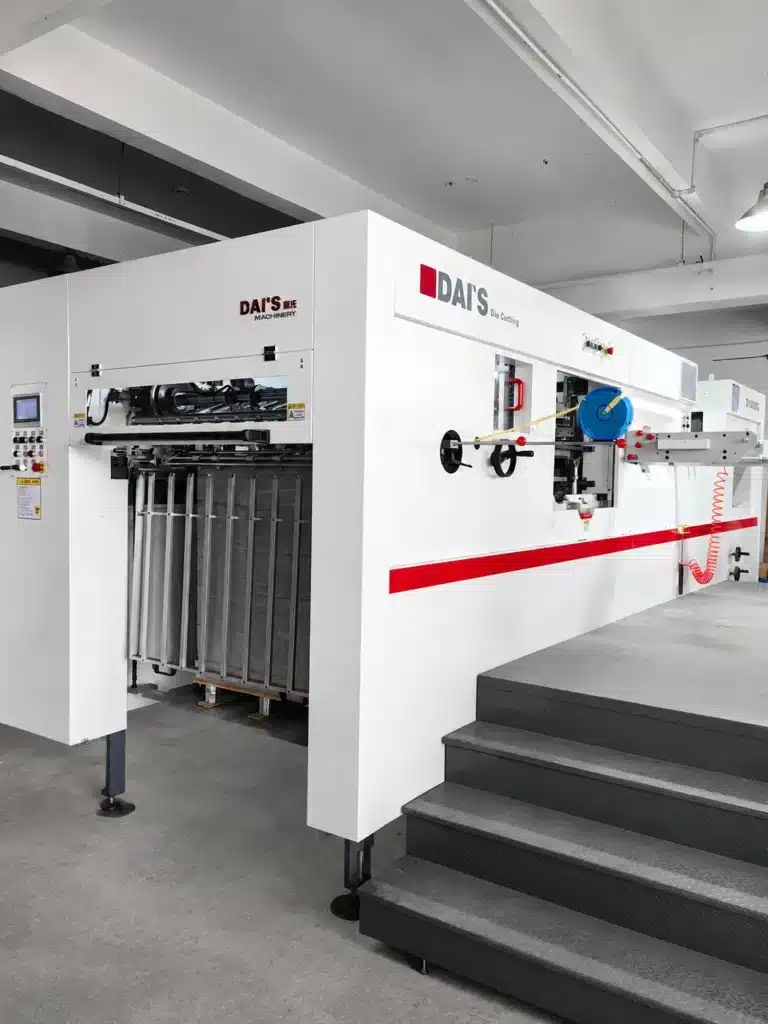
With high pile feeding and non-stop delivery, there are fewer interruptions to the sheet path of an automatic platen die-cutting machine. High pile feeding allows the operator to fill a high pile before the feeder requires attention. When the machine is set up and running for non-stop delivery, finished sheets can be controlled without interrupting the primary cutting operation. The outcome is reduced number of material-handling stops and optimum use of the equipment — provided feeder stability, sheet condition and downstream capacity are kept in check. The features do not automatically provide an increase in maximum speed or higher saleable output.
Often the production manager will only consider the maximum sheets per hour of machines, not the time lost due to the need to replace the pile, handle deliveries, inspect, collect waste and short stops. Knowledge of the nature of the interruption and the ability of high pile feeding and continuous delivery to meet the interruption, brings a clearer understanding of real productivity.
What Is High-Pile Feeding?
High-pile feeding refers to a feeder system that has a relatively high stack of sheets that can be fed before the machine needs to be refilled. The real-life situation is to keep the pile-loading cycle longer, and to minimize the need for manual interruption during an uninterrupted run.
Actual usable height will vary with the size, thickness, weight, stiffness, pile stability, machine set-up and safe handling practices of the sheets. More productive sheets are not necessarily a result of a taller pile when sheets are unstable or the feeder is not properly engineered to accomplish a clean separation.
How a High Feed Pile Supports Longer Runs
The higher the feed stack, the more sheets will be available in the beginning of a task. In a long run on folding carton, this could cause the next replenishment to be further away into the shift. The operators are then able to spend less time preparing or loading the next stack and more time on monitoring registration, crease quality, and waste removal. The advantage is more evident in continuous production where short stops would be required frequently when the pile is depleted.
Feed-Pile Height and Sheet Separation
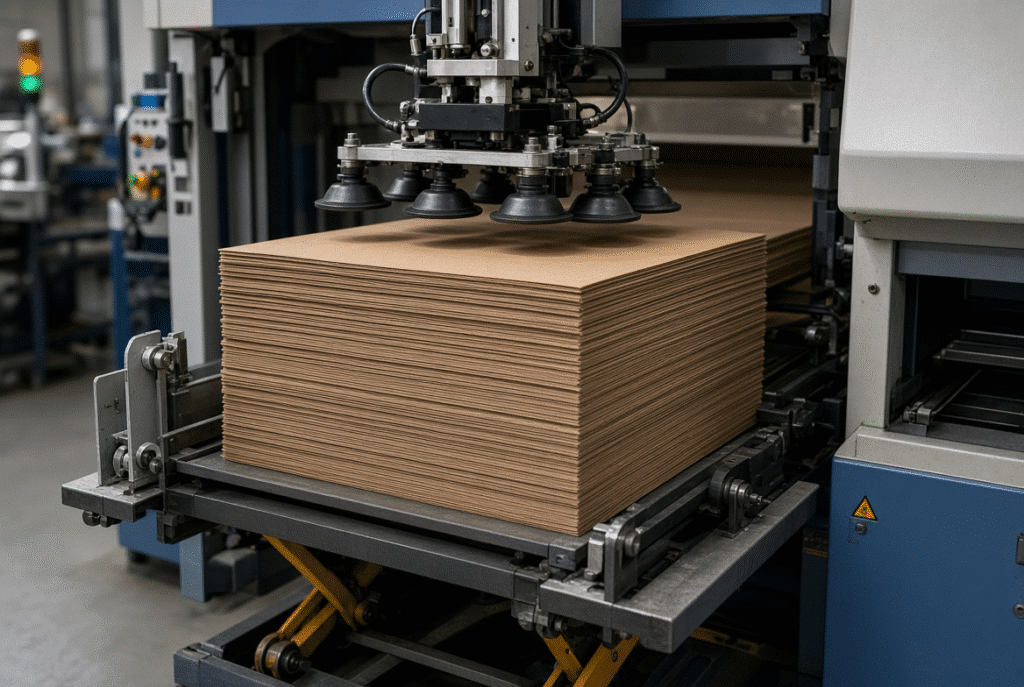
A high stack should be level and stable to allow the feeder head to consistently lift and separate sheets. Separation issues are not solved simply by height. For material in use, the suction, air assistant and feeder-head adjustment setting are still required to be correct. All feed rates for all pile heights are impacted by static, sheet curl, surface coating and board stiffness. Inaccurate preparation of the top of a tall pile can lead to a feeder beginning a double-sheet cycle or a miss-feed cycle that will negate any time savings expected.
High-Pile Feeding Is Not the Same as Automatic Material Supply
High pile feeding expands the capacity of the feed table/pile system. Paperboard or corrugated are still prepared, transported and loaded by the operator. System automatically loading material from pallets, conveyors or storage equipment is only possible when added handling equipment is installed and integrated in the system. While considering high-pile feeding to be a fully automated feeding supply solution can generate false hope for labour savings.
What Is Non-Stop Delivery?
Non-stop delivery is a function that enables the delivery section to take care of or modify the completed pile during the die-cutting cycle if the machine is set-up and run for that sequence. The exact mechanisms are different, depending on the manufacturer: some auxiliary supports are used, or controlled pile-change arrangements are followed, or specific handling procedures are used. It is never to be interpreted to mean the same operation on all machines.
Managing Finished Sheets Without a Main-Cycle Stop
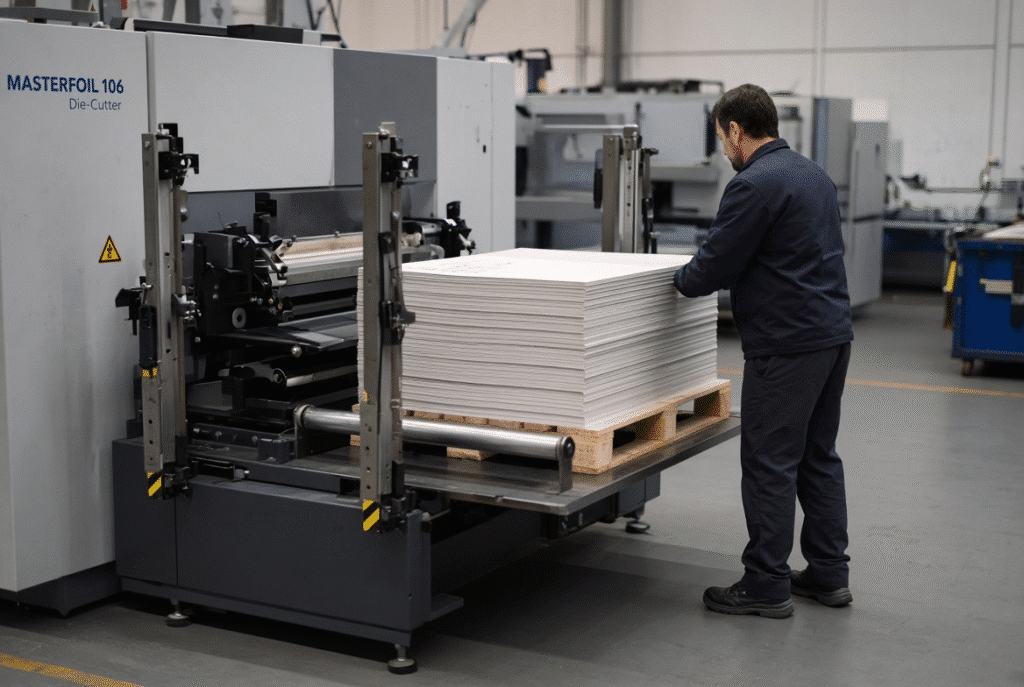
Once the pile is full of workable sheets, non-stop delivery can continue while the operator collects, secures or moves the collected sheets. The system delivering the sheets is required to keep them aligned throughout the sequence. There is still a brief period to be interrupted by an intentional operator action in some systems, but the function does not eliminate all human interruptions, it shortens the time.
Why Delivery Control Affects Product Quality
With non-stop operation, there are only benefits when finished sheets are aligned, flat, and undamaged. Herding piles results in skewed piles, curling piles, picking up edges or lack of uniformity in pile counts. These issues flow downstream to inspection, bundling, folding, gluing and volume preparation for shipment, and can cause more stoppages than the original interruption of shipment.
Non-Stop Delivery Does Not Mean No Operator Involvement
Operators continue to set up the receiving area, observe pile height, check alignment, control safety clearances and ensure that the changeover procedure is executed properly. The function enables continuity without generating production that is not attended.
Where Productivity Gains Come From
Staples of high pile feeding and non-stop delivery include the reduction of non-cutting time and repetitive handling, which help to increase productivity. They do not accelerate the cycle rate of the platen. Useful analysis includes machine running time, set up and change over time, material handling time, inspection time, short stops, delivery/pile change time, and downstream capacity.
Fewer Feed-Pile Replenishment Interruptions
The larger the feed pile, the fewer times the machine has to wait for the next pile. Minutes saved will vary based on sheet thickness, pile height, running speed and the speed at which the next pile is staged. The actual rates of replenishment and duration for existing jobs will be a realistic baseline if they are recorded.
Fewer Delivery-Pile Interruptions
When the finished pile is approaching its handling limit, the non-stop delivery helps to reduce or eliminate the need to stop. The cumulative effect really becomes evident on the long runs when the delivery would otherwise break production several times an hour. The advantage is less on very short jobs, since they have high makeready and die-change percentages.
Better Operator Utilization
This allows operators to shift their attention to monitoring the feed, registering parts, checking die-cutting quality, quality of the creases and perforations, removing waste, and carrying out preventative checks. The role of trained operators is still vital, and the changes are not about the elimination of skilled labor, but about how they are needed.
Improved Machine Utilization
It is important to use a careful method to measure utilisation. But more time on the machine does not necessarily mean more product produced if defects are occurring or the machine is waiting for the downstream processes. Stable production time should be considered in conjunction with acceptable sheets, stoppages, and total shift output.
How High-Pile Feeding Affects Different Materials
With the substrate, the pile capacity and feeding behavior will change. When using high pile performance, this needs to be considered with the actual material range that the plant will be operating.
Light Paperboard and Coated Sheets
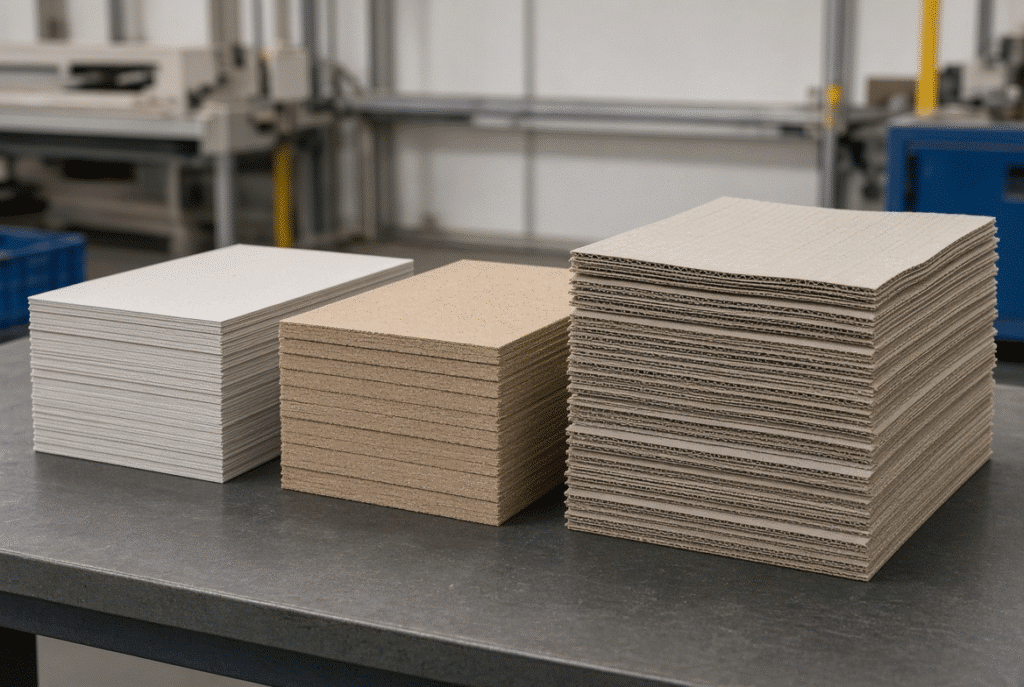
Light or smooth sheets are more susceptible to static and double feeding and changes in surface friction. A high stack will apply more pressure to the contact between the sheets and may be more sensitive to separation. Tight adjustment of suction, air assistance and separation settings are typically required when using lighter board.
Heavy Paperboard
Heavier board decreases the number of sheets in a pile given a specific height and increases the capacity of the feeder-head and support required for lifting the pile. The maximum height of the pile in millimeters is not necessarily equal to the same production for each grade of board.
Corrugated Board
Compatible corrugated sheets are thicker, stiffer or more likely to warp. High pile feeding needs to maintain regular separation of sheets, no excessive compaction or irregular sheet pickup. The condition of the material and the angle of the flute still play an important role.
Mixed or Variable Material Batches
Feeding instability and false assumptions about high pile performance result from mixing different sheet types, thicknesses or conditions together in one pile. Piles should be uniform and consistent; changes in materials should be noted and processed prior to loading the machine.
How Non-Stop Delivery Affects Finished-Sheet Handling
Conditions, speed and downstream handling are related to delivery-pile management. If the final stack doesn’t work, there’s no benefit to continuity.
Maintaining Pile Alignment
The pile is kept stable by side alignment, sheet-leveling mechanisms, air assistance, delivery speed and pile-lifting control as the operator controls the pile. When the non-stop sequence is running correctly, but the sheets are curved, skewed or damaged, the pile quality is diminished.
Protecting Finished Die-Cut Sheets
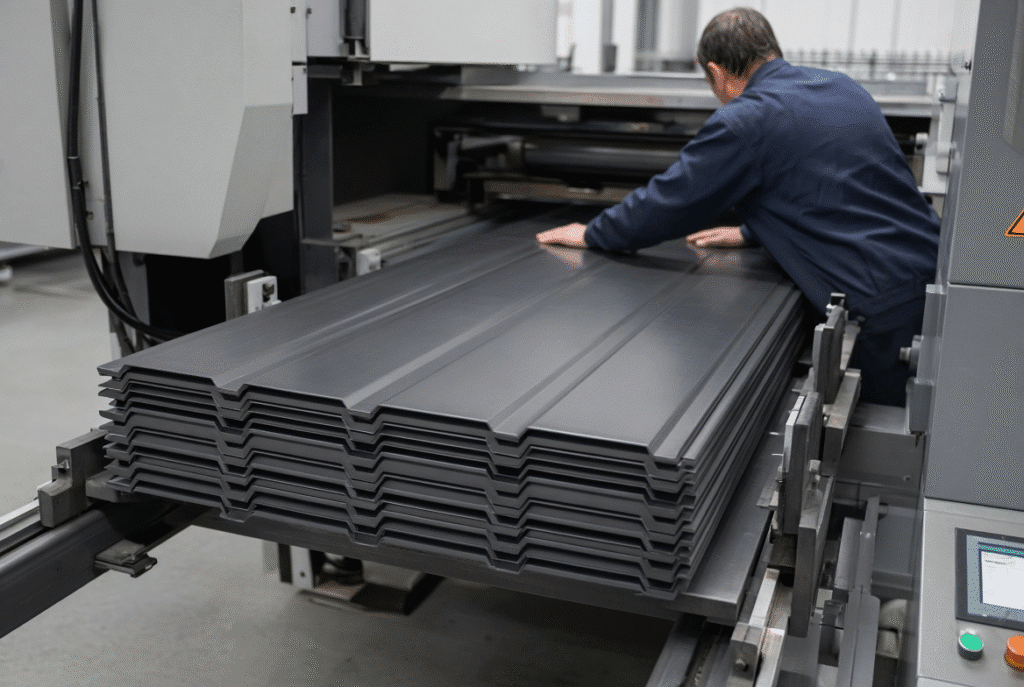
Cut edges, creases, printed surfaces, and blank geometry are all affected by the delivery settings. Thick sheets or rigid sheets may require a different approach to handling when compared to thin coated board. After completion, piles should be inspected for edge damage, marks on surface, curl and orientation of the pile prior to transfer.
Pile Change and Material Transfer
Operators must have a secure, logical way to secure, remove or move the entire pile. The non-stop function really can save time because of the layout of the floor, the use of pallets, carts, and lifting equipment, and downstream processes. If there is insufficient space and/or procedure, the feature is fairly insignificant, otherwise it can be very beneficial.
Counting, Bundling and Inspection
Consistency of delivery pile impacts on counting accuracy, sampling, bundling and transferring to gluing or folding/packing. The fewer times an employee has to stop, the more productive they can be, but if the pile is unstable, it can cause a loss of productivity. Clear checks should be established on finished piles and transfer steps should be used on plants.
Calculating the Real Productivity Impact
A practical evaluation is based on variables that can be measured in the plants instead of using percentages.
Track Feed-Pile Interruption Time
Document feed pile replenishments per shift, time to replenish the feed pile, number of operators in the feed pile, delays for material staging, short stops from pile alignment or feeder recovery. The advantage of high-pile feeding will rely on the frequency of the feeding events and the duration of each event.
Track Delivery-Pile Interruption Time
Document changes in the number of deliveries, time taken for each change, time to transfer materials, operator involvement, delay due to unstable piles, and damage to the product during the delivery process. This information is used to determine if there is an actual “bottleneck” with non-stop delivery.
Compare Saleable Output, Not Only Machine Runtime
Productivity is defined as acceptable finished sheets completed or completed jobs. All waste, quality rejects, set-up and inspection, downstream waiting, and customer requirements are factors in the calculation. If a machine is operating around the clock with registration or cutting mistakes it is not providing any value added productivity.
Consider Run Length and Job Mix
Typically, high pile feeding and non-stop delivery will provide greater value on long, repeat runs rather than short runs with frequent die changes. In short-run situations, the makeready often outweighs the schedule. Consider the specific workload, don’t take it for granted that all plants get the same benefit.
Limitations and Risks to Consider
Pile Height Does Not Remove Feeder Setup Requirements
Even with high pile feeding, one must still make sure the pile is level, sheets are separated, and there are no voids, as well as adjust the feeder-head to ensure the proper suction and inspect the material. The height of the pile may provide for more capacity, but can also make alignment and separation more critical when the preparation is not good.
Non-Stop Delivery Does Not Eliminate Quality Checks
During production, operators should maintain an eye on registration, cutting, creasing, perforation, delivery alignment and any damage to the material. The function does not provide for unattended operation; it supports continuity.
Floor Space and Material Flow
The practical result is impacted by access around the feeder and delivery areas, pallet or cart positioning, operator clearance, maintenance space, and safe transfer routes. The benefits that can be derived from a machine will not be realised if the layout of the factory is not conducive to the movement of piles.
Configuration and Optional Functions
There are differences between high-pile and non-stop types, depending on the manufacturer and model. Buyers need to confirm their standard configuration and what needs an option or separate system. Feature names have no meaning that implies that the same operation will be performed on all machines.
How to Prepare the Plant for High-Pile and Non-Stop Operation
Plan Feed and Delivery Access
Design the path for raw sheets, pallets, completed piles, carts, lifting equipment and movement of operators. Make sure machines have access, there is floor clearance, and maintenance room space before installing. Flow of materials that works on paper may not work when the machine is in use.

Standardize Pile Preparation
Set up a sheet alignment, pile height, material identification, static control, sheet inspection and pallet / cart preparation procedure. Good preparation of piles results in a high-pile feeding system that is more reliable.
Train Operators on Continuous Handling
In addition to training on feeder preparation, operators should be trained in pile monitoring, the non-stop delivery sequence, safe pile transfer, quality checks for continuous runs, and the response to alarms. Instead of the operator being in charge of the process, automation modifies the role of the operator and does not eliminate responsibility.
Define Quality Checks During Long Runs
Record inspection plan for registration, cutting, creasing, perforation, sheet flatness, delivery-pile alignment, material damage, and waste removal. The plan should be in line with the quality guidelines set by the plant and the risk level of the jobs which are to be executed.
Using the D800S as a Productivity Example
The D800S automatic platen die-cutting machine is available and has a paper-collecting ability of 1,500 mm and a feed-pile ability of 1,600 mm. These figures represent the envelope for which the pile-handling is rated and should be checked against the final machine configuration to be approved. They are not in themselves evidence of any time saving or evidence of the ability to deliver non-stop.
How to Interpret the D800S Feed-Pile Height
The number of sheets that can practically be placed in a 1,600 mm pile will vary depending on the thickness of the sheets, the weight of the sheets, the compression of the pile, the flatness of the sheets and the operator’s preparation. If pile height is not converted to a universal sheet count with verified material data, this will create false expectations.
How to Confirm D800S Delivery Functions
The buyer is advised to ensure that the delivery is by non-stop delivery, pile change, automatic pile lifting and other types of handling services are part of the chosen configuration. There are separate points to consider for maximum delivery-pile height and true non-stop delivery capacity – both will need to be checked in writing.
How to Evaluate Productivity on Actual Jobs
A realistic trial involves measuring real sheet size, paperboard or corrugated material, die layout, production speed, feed-pile preparation, delivery-pile handling, registration and quality results, operator workflow and saleable output. Peak running speed is not the only factor for interruptions and acceptable sheets.

Questions to Ask the Machine Supplier
Questions About High-Pile Feeding
What is the tallest possible height of the feed-pile? How thick and how heavy is it? What is used to control the height of the pile? What do you do with sheets that have a small curve or bend in them? Which feeder/suction adjustments can you make? What mechanisms does the system have for the prevention of double sheets? What is needed to replenish piles? What is the ordinary and what is the optional function?
Questions About Non-Stop Delivery
Is the machine capable of delivering true non-stop? What will happen if the delivery pile is full? Included is an auxiliary pile support system? How is the finished pile moved by the operator? Is it possible for the machine to keep the pile lined up throughout the sequence? Which materials/which speeds were tried?
Questions About Productivity Results
What is the buyer’s product yield? How many times were piles interrupted during the test? What were the number of operator actions needed? What was the set-up and inspection time? What was the amount of waste generated? Can the supplier offer references of the same plants?
Final Checklist for Evaluating High-Pile and Non-Stop Functions
- Record interruptions in the feed-pile on existing projects
- Record interruptions in the delivery piles on existing projects
- Verify the thickness and condition of material.
- Verify max feed pile height for materials to be fed.
- Check maximum delivery-pile height
- Ensure that the configuration includes non-stop delivery.
- Plan the layout of space and movement of piles.
- Provide training to train operators on continuous handling sequences.
- Have a consistent method for preparing piles
- Identify quality controls in long runs
- Test real materials and tools.
- Report on the saleable output of the process – not the amount of time spent running the process!
- Track work and idle time
- Verify the end configuration in writing
Final Guidance: Productivity Comes from Fewer Interruptions
High pile feeding and non-stop delivery can enhance the productivity of automatic die-cutting by minimizing interruptions and repetitive material handling operations. They are valued based on stable feeding, orderly delivery, appropriate preparation of the materials, trained operators, safe floor layout and adequate run length. Actual interruption time, saleable output and job mix plants are more useful for making purchasing and process decisions than headline speed plants.
If the production manager is looking at these functions on an automatic platen die-cutting machine, the best next step is to compare the appropriate pile-handling and pile delivery setup to actual job data. Speak with DAIS about feed-pile height, delivery arrangements and production needs for materials and run lengths.