

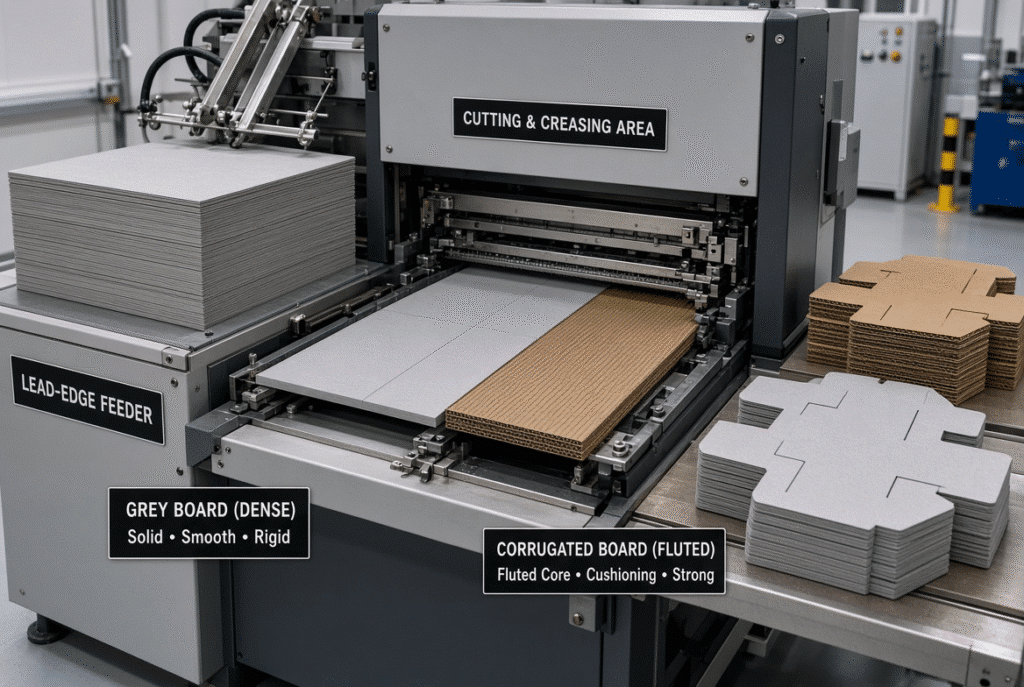
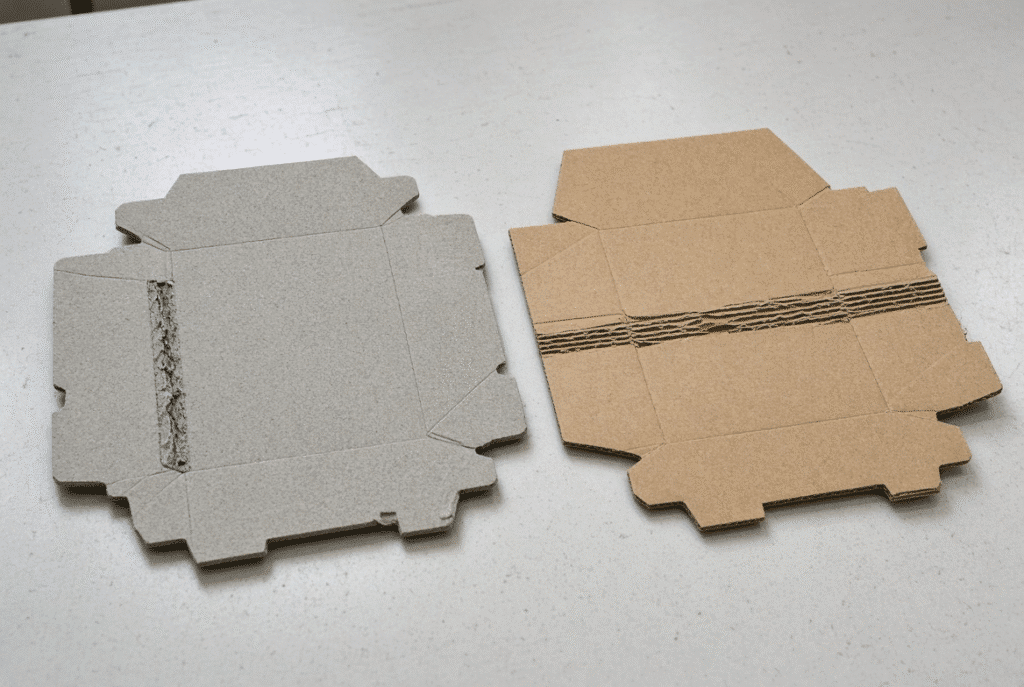
Since grey board and corrugated board are structurally different, the machines setup for grey board is different from corrugated board. Grey board is a thick, fairly uniform paperboard. Corrugated board is a composite material made by stacking one or more layers of fluted material on top of liners. These variations alter the weight, thickness, stiffness, compressibility, surface condition and warpage of the paper, necessitating retesting of feeding, guide clearance, pressure, die design, creasing, removing waste, and finished product checks.
If a machine is used to process one material successfully, it doesn’t necessarily process the other material successfully by simply changing the pressure or the die board. First set up change determined by material structure. Operators who neglect to consider the differences between the boards are exposed to an opportunity for compressed edges on grey board, crushed flutes on corrugated, registration drift, incomplete cuts, or failure to fold and assemble blanks downstream.
Grey Board and Corrugated Board Are Different Materials
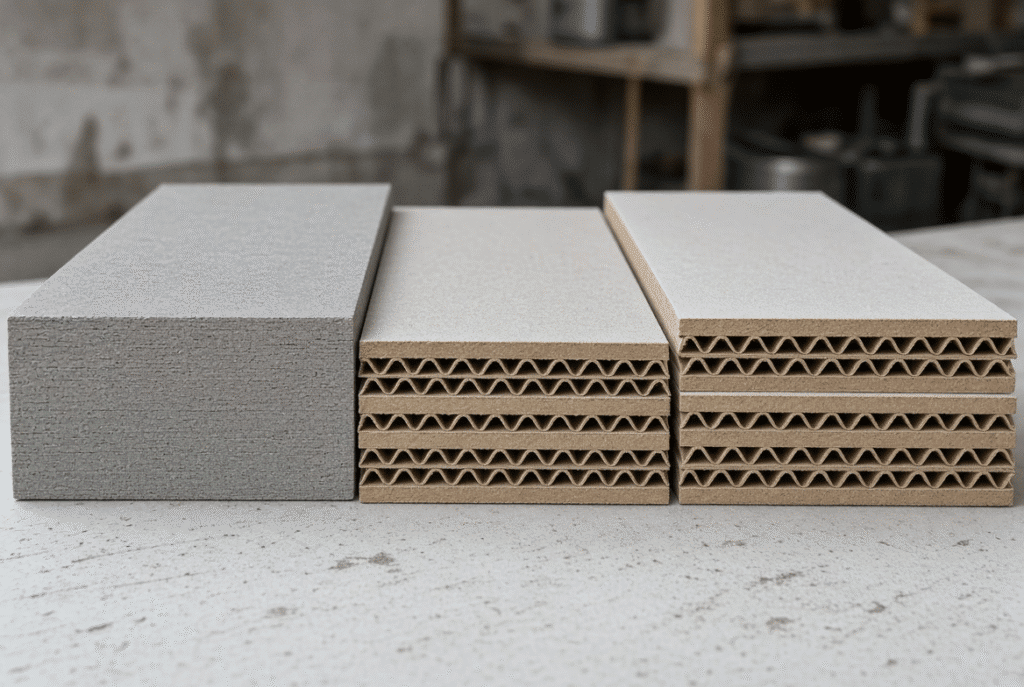
The boards should be understood before the feeder and/or pressure adjustment. The properties of density, caliper, stiffness, compressibility, surface finish and edge condition are not interchangable.
Grey Board Structure and Common Applications
Grey board, or also referred to as greyboard or chipboard, is a dense paperboard that is produced using recycled or mixed fibres that are pressed into a relatively uniform sheet. It is widely used in rigid-box panels, book covers, file covers, backing boards, puzzles, point-of-sale displays and structural inserts. Once the proper pressure and rule condition is achieved, cutting resistance is relatively uniform throughout the structure since it is homogeneous. If the die and make-ready are set properly, edges remain clean; too much pressure will cause the edge to become compressed and less stiff. If cuts are not made completely and bridges are too wide, waste pieces can be stiff and be difficult to separate.
Corrugated Board Structure and Common Applications
Corrugated board is the product of two or more liners bonded together with one or more mediums in between that have been corrugated. In packaging plant, the most common constructions are single-walls and double-walls. The applications include shipping cases, retail ready packaging, displays and protection inserts. Flute structure provides high stiffness-to-weight ratio, cushioning and makes sheet compressible in local pressure. Caliber, compression strength and sheet flexibility in the feeder and under the die are determined by flute height, liner grade and number of walls. Surface liners can be printed or coated, and it is important that the pressure and die clearance be such as to not mark the surface.
Why Grammage Alone Is Not Enough
The mass per unit area is expressed as grammage (g/m²). Caliper measures thickness. Density is a relationship between mass and volume. The orientation of fibers, flutes, water content, and treatment of the fibers influences structural stiffness and compressibility. Two boards of the same weight per square inch can need entirely different feeder clearances, supports and pressures, due to the difference in thickness and structure between the two. Never assume a single grammage figure but always note the actual thickness, fluted (if fluted) and the surface condition and observed warps.
Material Properties That Change Machine Setup
Each physical difference corresponds to one machine setting.
Density and Cutting Resistance
A relatively uniform resistance to the cutting rule is achieved by dense grey board. When using the rule on corrugated board, it has to pass through both the liners and the fluting without breaking through. The pressure should be sufficient for a good cut but not too great to reduce flutes height. Even more important than the board itself, the result will be affected by the condition of the board, the rule geometry, the make-ready packing, and the parallelism of the machine. Reusing a set pressure from the previous job is not usually a good idea.
Thickness and Guide Clearance
Grey-board caliper is typically moderate and regular. Available corrugated flute heights include thin E-flute to B- or C-flute and double-wall construction. Guide rails, support plates and transfer points need to be spaced to prevent the thicker board from floating or skewing the thinner board. If the corrugated can is not provided with enough clearance, the front edge will get crushed; if the corrugated can is given too much clearance, there will be movement laterally and loss of registration.
Stiffness, Flexibility and Compression
Grey board tends to be brittle during feed-wheel contact & die pressure. Corrugated board may bend or squash at flutes or in local areas. This impacts the separation of sheets, the pressure on feed-wheel, the pressure on guide, the contact of die and crease shape. Grey board can easily be crushed in corrugated flutes or slip and skew in a feed that holds the grey board firmly; a gentle corrugated feed may retain corrugated flutes.
Warp and Moisture Response
Warp is a possible characteristic of both materials, but the patterns are different. Edge curl or cupping of grey board can be caused by uncontrolled moisture or storage. Often, corrugated board is prone to flute-direction warp or twist due to the tension, printing, coating and stacking of the liner. The shape must be considered in the preparation of the pile, feeder timing, and support for the sheets.
Feeding Grey Board Versus Corrugated Board
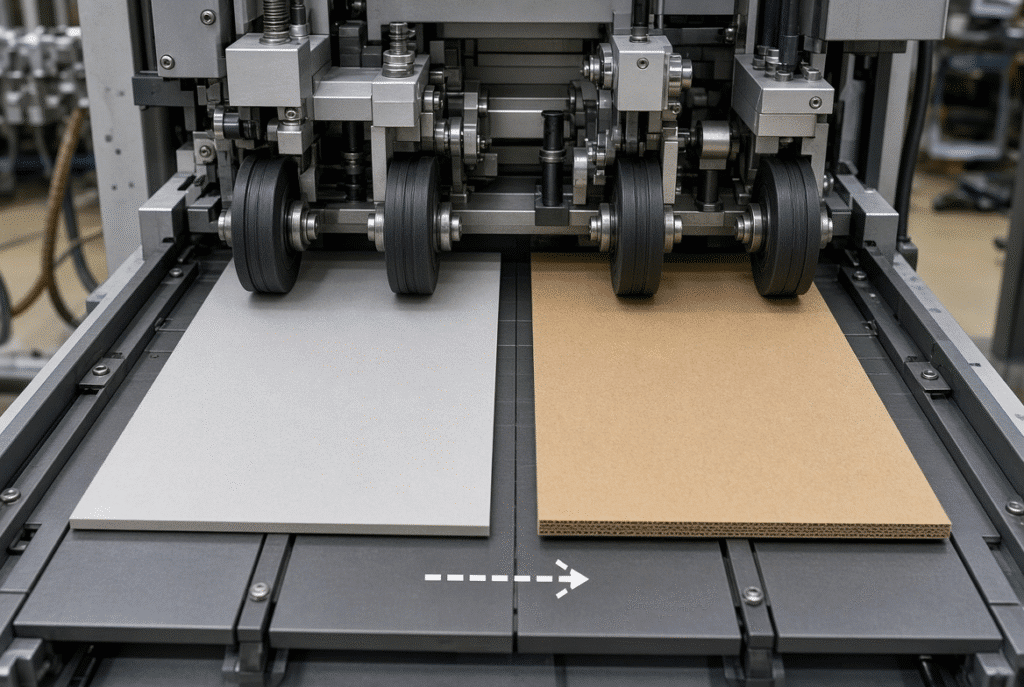
The thickness range, support surfaces, pressure adjustment and the sheet path of the same feeder must be appropriate for the job in hand.
Stack Preparation and Sheet Weight
Heavy pile height and lifting force, and heavy weight of dense grey board. Corrugated board is lighter than thickness but more likely to warp and edge crush in the stack. Align sheets accurately, cut off any bad edges, and prevent dust affecting the sensors and wheels.
Feed-Wheel Pressure and Contact
The pressure of the feed wheels should be equal to the thickness, surface, stiffness, and weight of the sheet. On grey board, the objective is to maintain a stable contact with no edge compression. The challenge for corrugated board is to achieve positive drive without flattening flutes or printing on board liners. Worn wheels and surface texture are important, as grey board wheels can slip on smoother corrugated liners.
Sheet Support and Guide Clearance
Grey board can sag or “catch” at the edges in unsupported spans and corrugated board can flex and lift in the same spans. Guide height and side pressure should be adjusted to the specific caliper to be used. The transition area between the feeder, front gauge and die has to be continually supported in proportion to the thickness or flexibility of the board.
Sheet Separation
Surface adhesion and/or static are the most common causes of double feeding grey board, or the mechanical separating force is too low compared to board weight. Corrugated board has a higher incidence of double-feeding due to warp, residual flute spring or lack of consistent pile pressure. The separation method and timing is not assumed to be universal, but must be verified for each material.
Registration and Sheet Positioning
The sheet squareness, flatness of the boards, front-gauge contact, side-gauge timing and support under the sheet all affect on registration. Printed grey board and printed corrugated board both require the checks of surface references and die features. A material that has been set one way will typically require retiming when used with the other material.
How Pressure Settings Change Between Materials
Pressure is adjusted based on the board, the die, the make-ready and the need for the finished product. It is never photocopied, but is always retold from the content of the previous year’s material.
Die-Cutting Pressure for Grey Board
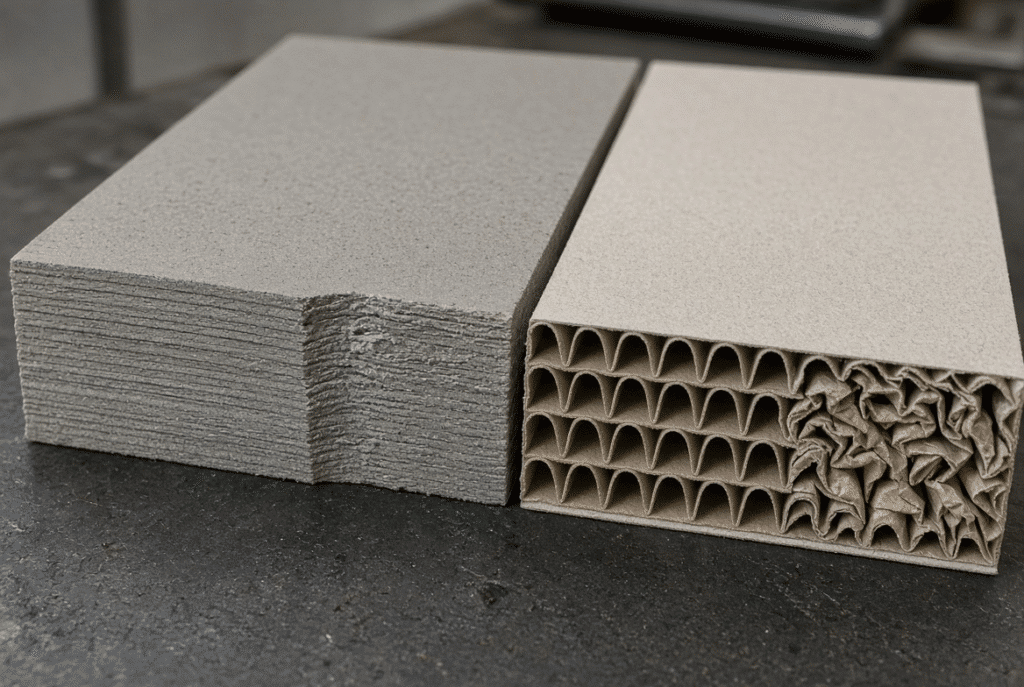
Dense grey board requires a high enough blow for complete rule penetration and clean edges. Incomplete cuts allow fibers to remain which don’t get taken out. The edge is compressed by excess pressure, which decreases the stiffness in the area and can leave a mark on the surface. Do not simply increase the pressure without checking rule height, make-ready and thickness variation of the board and machine parallelism.
Die-Cutting Pressure for Corrugated Board
The rule should cut the liner and the flute, but not compromise the height and cushioning of the structure. Excessive pressure will cause flutes to be flattened, damage printed surfaces, and reduce the blank’s strength. It is sometimes necessary to use different pressure and make-ready methods on the same machine for single wall and double wall boards.
Signs of Underpressure
Typical problems include incomplete cuts, uncut corners, partial windows, inconsistent results across the sheet and poor waste removal. These symptoms can also result from worn rules, make-ready variations, board caliper variations and loss of machine parallelism. Always inspect the cause before increasing the pressure.
Signs of Overpressure
On grey board: compressed edges, surface dents, crushing of fibers, decrease in edge stiffness. On corrugated board: crushed flutes, crease areas flattened, surface markings, loss of cushioning, permanent board deformation. Both materials indicate the problem most clearly at the finished product stage and not just on the machine bed.
Pressure Distribution Across the Working Area
Check both materials for center, edge, corner and complex die areas. This variation may be due to machine parallelism, die condition, packing locally, support height, or thickness difference in boards. It’s more important that the pressure is even all over the sheet than that one pressure has a high value.
Die and Creasing Setup Differences
Often material changeover involves changing cutting rules, creasing rules, counterplates, make ready, die layout and waste design.
Die Design for Grey Board
Close board prefers clean, sharp edges and the accurate little details. Waste bridges should be sufficiently strong to support the sheet but not so wide that they will not strip easily. Rule height and bevel need to match the actual caliper and the desired edge quality for rigid-box / cover.
Die Design for Corrugated Board
The die must be able to produce liners and fluting and maintain board height. The open structure needs to be incorporated into the geometry and waste retention. The direction of the flute often affects the way the sheet will react to the rule and waste will be retained.
Creasing and Folding Requirements
Scoring is typically required on grey board, and requires careful scoring to ensure a clean, sharp fold without cracking the board surface or compromising the strength of the panel. The geometry of a crease must allow the corrugated board to be folded without crushing the flutes or cracking the outer liner.
Make-Ready and Counterplate
Every time the board changes, make-ready packing will almost always require adjustment. Whatever the problem is, local packing is not a method to conceal serious die wear, rule height error or machine parallelism. The condition and material of the board to be cut should match the condition and material of the counterplate.
Waste Layout and Stripping
Waste may be dense grey-board that is stiff and may require more force to be stripped or nicks to be more aggressive. Corrugated waste can remain connected due to incomplete liner cuts, flute bridges or residual connections. The layout, nick pattern and stripping method should be confirmed for each material to ensure edge quality and high throughput.
Finished-Product Quality Differences
The correct setup is not simply the one that produces a clean sheet exiting the die, but rather is the one that produces the finished blank and in turn, performs well downstream.
Grey Board Finished Products
There are rigid-box panels, book covers, displays and inserts that require dimensional accuracy, clean edges, uniformity of stiffness and flatness. If the edges are compressed or the creases are not strong, these will appear as assembly gaps, no fit or visible damage to the surface.
Corrugated Board Finished Products
These are the requirements for shipping cases, retail packaging, and displays: print registration, reliable folding, intact flute structure, and panel alignment and stackability. Crushed flutes or flattened creases will decrease stacking strength and cause gluing or folding difficulties.
Folding, Gluing and Assembly Checks
Fold and assemble representative samples from both materials. Check panel alignment, seam closure, glue contact area, box squareness, flap movement, surface appearance, and finished dimensions. Problems that look minor on the flat blank often become critical after folding.
Stackability and Downstream Handling
Grey board blanks are dense, stable and mark if edges are compressed. Corrugated blanks are lighter in weight and more resilient, but will show loss of height if flutes are crushed. They both need to be reliable and able to be fed into the folder-gluers/packing line without jamming or distortion.
Common Changeover Problems Between Grey Board and Corrugated Board
The table below can provide a summary of common problems and initial troubleshooting steps.
| Symptom | Typical Grey-Board Cause | Typical Corrugated Cause | First Check |
| Feeder slipping or missed feeds | Insufficient wheel pressure, high sheet weight, surface finish | Warp, flute crush under wheels, low friction | Wheel pressure, wheel condition, pile prep |
| Skew / registration variation | Guide clearance, edge compression, support gap | Flex between flutes, uneven contact, warp | Guide height, support plates, gauge timing |
| Incomplete cuts | Density resistance, rule wear, make-ready | Liner + flute penetration, rule height | Rule condition, pressure distribution, caliper |
| Crushed edges or flutes | Excess pressure, hard contact | Excess pressure, wrong support | Pressure, make-ready, support clearance |
| Poor waste removal | Stiff dense waste, wide bridges | Incomplete liner cuts, flute bridges | Die layout, nick pattern, stripping force |
| Assembly failure | Compressed edges, weak creases | Crushed flutes, flattened scores | Fold test, crease geometry, edge quality |
Feeder Slipping or Missed Feeds
Adjust feed-wheel pressure and condition first, then confirm pile preparation and sheet support. Do not assume the previous material’s setting is still valid.
Skew and Registration Variation
Re-check guide clearance, front- and side-gauge contact, sheet flatness, and support under the sheet. Timing that worked for one caliper often needs re-adjustment for the other.
Incomplete Cuts
Inspect rule condition, make-ready, and actual board thickness before raising pressure. Both dense grey board and multi-layer corrugated can produce incomplete cuts for different structural reasons.
Crushed Edges or Flutes
Reduce pressure, improve support, and verify make-ready. Grey-board edge compression and corrugated flute crushing look different but often share the same root cause: excess force or poor support.
Poor Waste Removal
Review die layout, nick size, and stripping method. Dense waste and layered waste require different approaches.
Finished Product Does Not Assemble Correctly
Return to crease position, blank geometry, and pressure distribution. Fold and glue sample blanks before releasing the job for production.
Practical Material Changeover Procedure
Treat every switch between grey board and corrugated board as a controlled process.
Record the New Material Profile
Note material type, measured thickness, grammage, density if available, flute structure (for corrugated), surface finish, sheet size, observed warp, die-cutting and creasing requirements, and finished-product application.
Prepare the Feeder and Sheet Path
Set pile height, separation method, feed-wheel pressure, guide clearance, sheet support, sensors, and front/side gauges. Do not copy the previous job’s numbers without verification against the new board.
Install and Check the Die
Confirm orientation, cutting and creasing rules, counterplate, make-ready, waste layout, and a conservative starting pressure.
Run a Controlled Trial
Run several sheets at reduced speed. Inspect feeding stability, registration, cut quality, crease quality, edge condition, waste removal, surface marks, and delivery stack.
Verify the Finished Product
Fold, glue, stack, or assemble representative samples. Record any defects and the final settings before approving full production.
How to Select a Die Cutter for Both Materials
A plant that regularly processes both grey board and corrugated board should evaluate feeder range, sheet support, pressure capability, die flexibility, changeover time, and technical support.
Define the Material Range
Document grey-board thickness range, corrugated flute types and wall constructions, sheet sizes, surface treatments, typical warp, sheet weights, die-cutting sizes, creasing needs, production volume, and target speeds.
Ask About Changeover Requirements
Clarify which settings must change between materials, how feed wheels and guides are adjusted, how different thicknesses are supported, how pressure is controlled, whether different die and make-ready systems can be used, typical changeover time, and what operator training is provided.
Request Separate Material Tests
A successful grey-board trial does not prove corrugated performance, and vice versa. Run separate tests with representative sheets, production dies, surface finishes, target speeds, and finished-product criteria for each material group.
Reference the DAIS D1060Y Naturally
The DAIS D1060Y lead edge feeding flatbed die cutting machine is designed for grey board from 250 g/m² and corrugated board up to 9 mm thick, with lead-edge feeding suited to thicker or more rigid sheets and a maximum working pressure of 300 tons. Final suitability for any specific grey-board and corrugated range must still be confirmed by testing the actual materials, dies, and finished-product requirements on the configured machine.
Frequently Asked Questions About Grey Board and Corrugated Board Setup
Can the same flatbed die cutter process grey board and corrugated board?
Some machines can process both, provided the thickness range, feeder capacity, sheet support, pressure range, and die system cover the actual materials. Suitability is confirmed only by testing representative sheets and finished-product criteria for each board type.
Does grey board require more pressure than corrugated board?
Pressure depends on density, thickness, die condition, rule geometry, make-ready, machine parallelism, and board structure. Dense grey board and multi-layer corrugated board can each require higher or lower force depending on the specific combination; no universal ranking applies.
What changes when switching from grey board to corrugated board?
Feeder settings, guide clearance, sheet support, separation method, pressure, die and creasing components, waste layout, running speed, and finished-product inspection all typically need revalidation.
Why does corrugated board require different pressure control?
The cutting rule must penetrate both liners and the fluting while the open structure retains its height and cushioning. Excess pressure collapses flutes, marks surfaces, and weakens the blank.
Why is grey board waste difficult to remove?
Dense, stiff waste pieces, incomplete cuts, and overly wide bridges increase stripping force. Die layout and nick design must be matched to the material’s resistance.
Can a die suitable for grey board also cut corrugated board?
Die suitability depends on board structure, thickness, rule geometry, creasing requirements, layout, and final application. A separate die or adjusted configuration is often required.
Which material is easier to feed?
Feeding difficulty depends on sheet weight, flatness, surface, thickness, warp, feeder design, support, and stack preparation. Neither material is universally easier.
What should I test when buying a machine for both materials?
Test feeding stability, registration, cutting and creasing quality, waste removal, surface condition, delivery stacking, changeover time, stable production speed, and finished-product assembly for both material groups under representative conditions.
Summary Guidance – Set Up by Material, Not by Habit
Grey board and corrugated board require different machine settings because they have different structures and production behaviors. Confirm material properties, measure actual thickness, prepare the correct stack, adjust feeder contact and support, set guide clearance, select appropriate die and creasing components, apply pressure gradually, check pressure distribution, evaluate waste removal, inspect finished products, and record material-specific settings. Test both materials separately before approving a machine purchase or releasing a production job.
When evaluating equipment for mixed grey-board and corrugated production, review the actual material range against the machine’s feeder, support, pressure, and die capabilities, and request separate sample trials. DAIS technical teams can support a two-material evaluation using representative boards and finished-product criteria.