

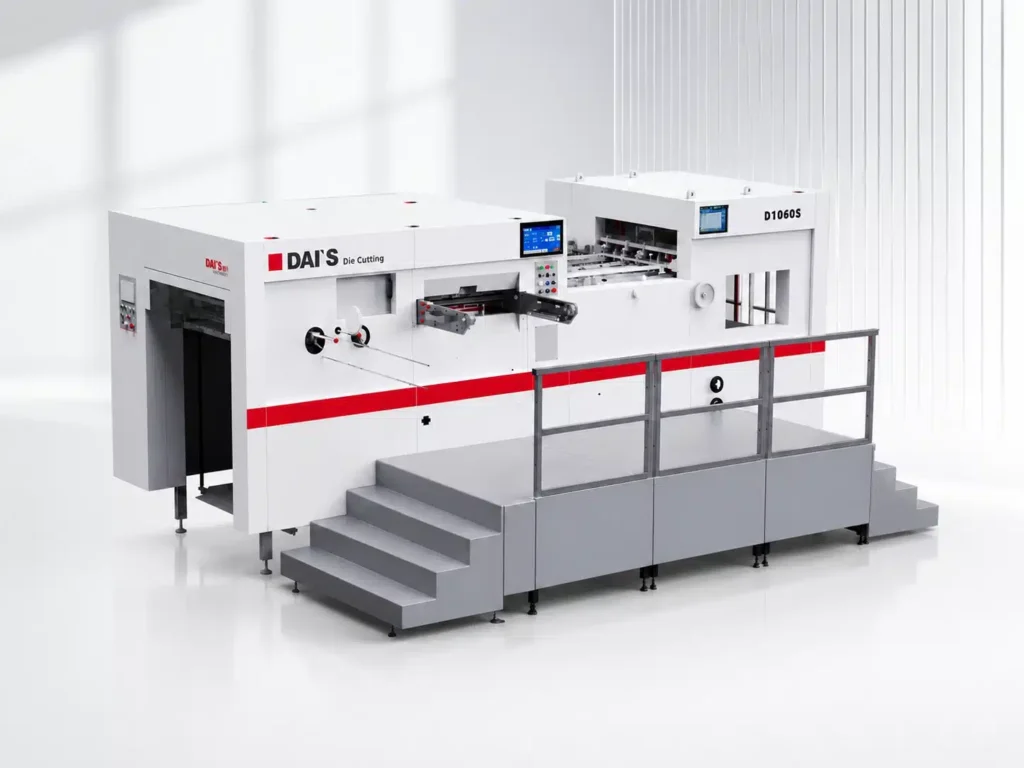
In certain applications, automatic flatbed die cutters can be used to cut corrugated board if the machine, feeder, tooling and pressure system are suitable for the thickness, flute of the board and the actual sheet condition. Fitting dimensions are not the only factor. The sheet must be fed, registered, cut, creased and stacked, without frequent jamming, crushing flutes or delivery problems. Compatibility is only verified by machine configuration and board specification and by some sample trials.
Package plants that take a yes/no approach to the question frequently end up finding out later that the board that fits the size chart doesn’t meet production requirements. This guide explains the practical tests that determine whether it is possible to obtain a stable, saleable output with an automatic flatbed or platen die cutting machine using corrugated material.
What Makes Corrugated Board Different from Paperboard?
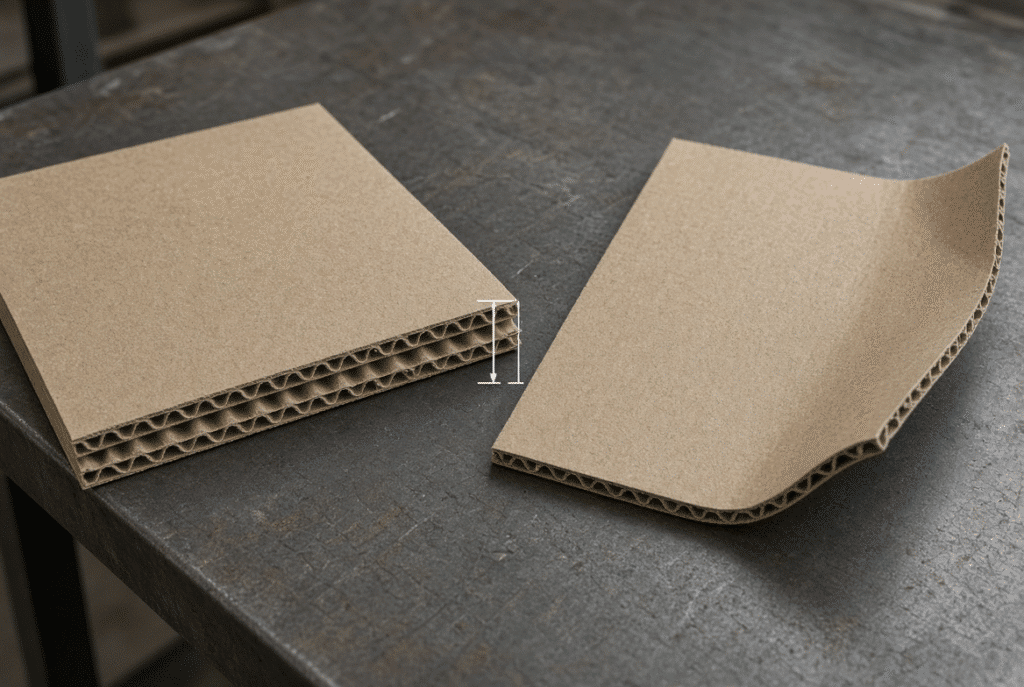
Corrugated Board is a multi-layered structure. The medium is two or more fluted layers of material between which the sheet is sandwiched, providing the sheet with thickness, stiffness and cushioning. That structure is very different to solid paperboard under the feeder, the gauges and the platen. The board is flexible, compresses or lifts differently than paperboard. There are other factors that influence the path of the sheet and the pressure’s effect on it as moisture, storage history and flute orientation vary.
Liners, Flutes and Board Thickness
Most of the tensile strength and print surface are located in the outer liners. The medium fluted between the layers forms the caliper and compression resistance of the board. There is only one thickness measurement, overall thickness. Two boards of the same caliper may vary widely in density, in weight of liner and in flut shape, and therefore feed and cut differently. If a plant questions if a machine can run a given thickness, the answer must always be the complete board construction and not just the caliper per se.
Flute Type and Direction
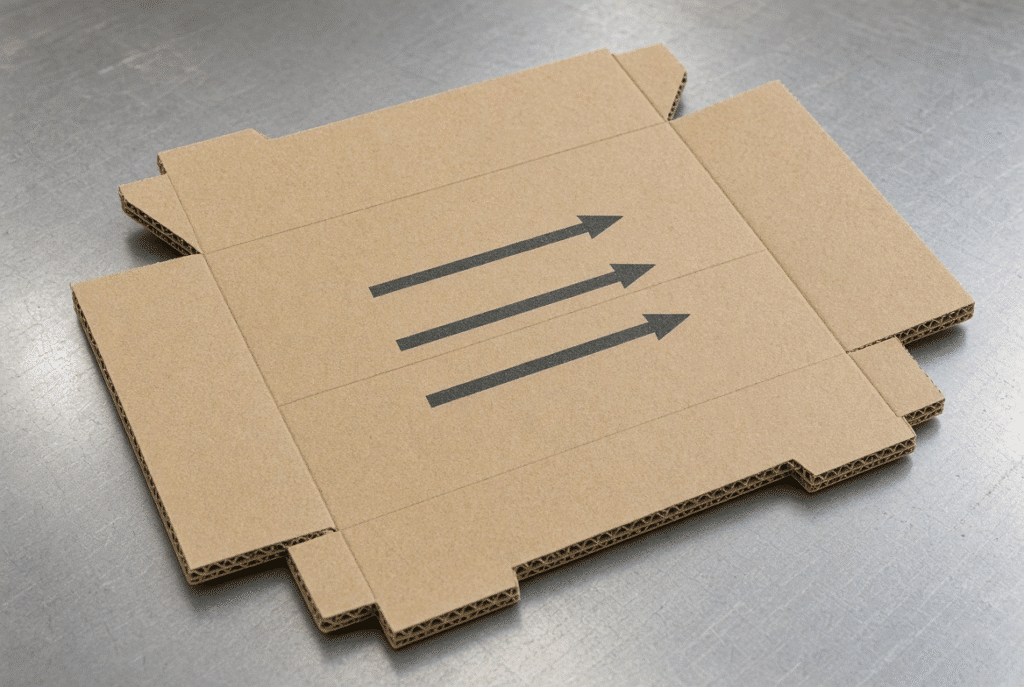
Flute type determines the thickness, bending strength and characteristics of the board. The direction of the flute in relation to the direction of feed and the die orientation affects resistance or yielding of the sheet during transport and pressuring. This blank may even run cleanly in one direction and creep or not be creased enough when it is run in another. Before the supplier can provide a reliable application answer, the flute design and the desired grain direction are required.
Warp, Curl and Moisture
Corrugated sheets are not as likely to maintain perfect flatness. Warm and cool air, adhesive moisture, stacking pressure and board age are all causes of warp or curl. A sheet that is lifting at the edges is no longer in a stable position in the feeder belts, the suction cups or side guides. Laboratory-flat samples can therefore be a false reassurance. The condition of the real plant floor should be considered.
When Can an Automatic Flatbed Die Cutter Process Corrugated Board?
There are four conditions that must be satisfied simultaneously for processing corrugated board with an automatic flatbed die cutter: the board must remain within the defined size and thickness specifications, the feeder must supply a single sheet at a time and not double feed, the platen must deliver clean cuts and usable creases without crushing the flutes and the delivery section must provide a consistent supply of blanks at the proper rate. Can process is repeatable saleable production, not a successful sheet.
Machine Size and Sheet Dimensions
The first filters are the max size of the sheet and the max size of the die-cutting area. All those must be within the blank, gripper margin, registration allowance and waste layout. Even if a sheet is dimensionally suitable, there may not be enough clearance for the die or the stiffness of the board may cause unstable movement through the feed chain.
Confirmed Material Thickness Range
Thickness published is a guide only. There are several factors that have an influence on real performance, such as the density of the board, the flute type, moisture content and local thickness variation. The technical data list, which is valid for the D800S automatic platen die-cutting machine, provides corrugated material up to 4 mm and a maximum size of 800 × 620 mm. These figures are engineering specific to each board grade and die design and do not necessarily include all flute structures or production speeds.
Feeder and Transport Capability
The thicker or stiffer the corrugated sheet, the more adequate suction, sheet support, separation and guide control are required. The feeder must lift one sheet at a time, keep it flat on the transport path and present it square to the front and side gauges. The only way to be sure of this ability is to test at the proposed production rate.
Pressure and Platen Structure
The platen should exert sufficient pressure for full cut-through and the right crease to be formed and should spread this pressure evenly so that no flutes are squashed. The make ready, die layout density and pressure have an impact on the result. In general, more tonnage is not necessarily the answer to all thick-board problems.
How Thickness Affects Corrugated Die Cutting
Thickness affects all phases of the process from feeding to delivery but it is not the sole concern. Rigidity, density and local differences are just as important.
Thin Corrugated Board
Thinner board can be easier to lift and move around, but may bend, double feed or mark the surface if the suction and separation setting is set too high. Even though light board is still a bit more sensitive to the air pressure, it requires careful feeder adjustment, not just increased air pressure.
Thick Corrugated Board
The thicker the board, the more support needed, the higher the cutting force, and the stiffer the delivery system must be and the higher the pile height. Typical dangers at the thickness extremes include incomplete cuts, crushed edges and unstable delivery piles.
Thickness Variation Across a Sheet or Batch
There is rarely a uniform flow of material into the system. A pressure that makes a good cut on one piece or one batch might not make a good cut on the next. Long runs are less likely to drift because of incoming inspection and/or sample testing.
Thickness Is Not a Standalone Compatibility Test
The listed thickness range is a minimum requirement but a badly warped board, too stiff for a feeder, and matching die/crease layout may also be considered unsuitable. Thickness should always be considered in conjunction with type of flute, moisture, sheet size and production speed.
How Flute Type and Direction Affect Machine Performance
The compression, bending and folding of the board is determined by its flute structure. The cutting and creasing process should not compromise the structural role the flute needs to perform.
Flute Structure and Board Stiffness
There are various flute profiles which provide varying thickness, compression response and bending stiffness combinations. When the die-cut is made, the flutes should not be cut off so that the package can still have good stacking strength and cushioning.
Flute Direction and Sheet Feeding
The direction of flute in relation to the direction of feed affects the resistance to or compliance of the sheet to suction and transport. You might be able to get a smooth orientation on one and then curl or skew on another. During a trial, material orientation as well as feeder behavior should be evaluated.
Flute Direction and Creasing or Folding
The relationship between crease lines to flute direction is crucial to crease quality and folding. Even a board that can be cut cleanly may not fold well or may crack when laid out in a crease due to the crease layout and the flute structure. Finished blanks must be tested for cut-through and they should also be tested for folding or assembly.
Feeding Corrugated Board Through an Automatic Flatbed Die Cutter
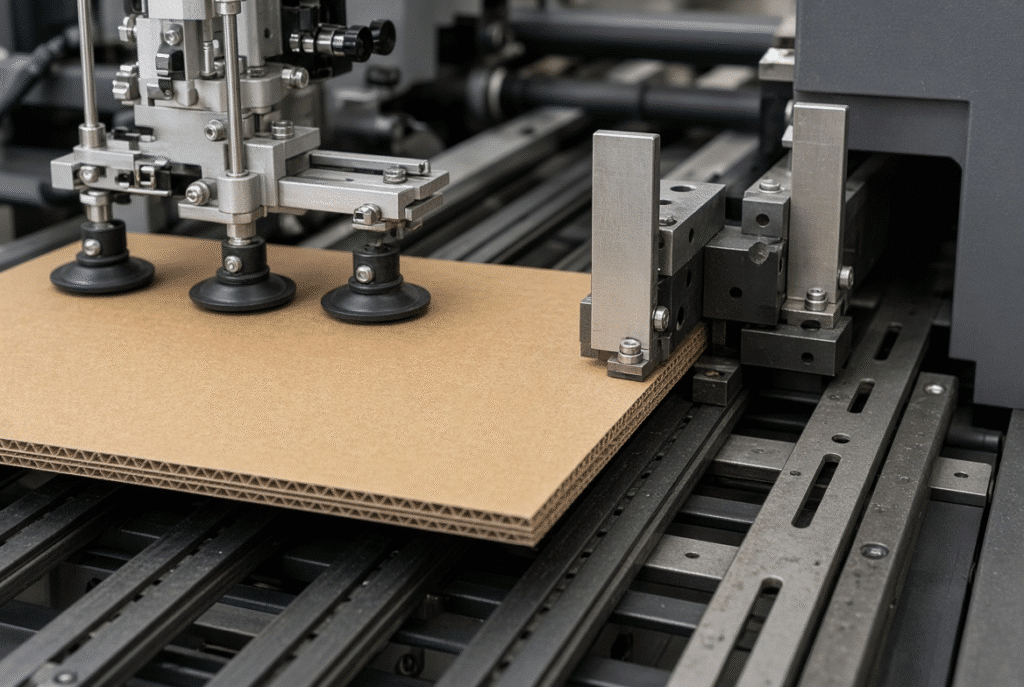
Often feeding makes the difference. Because of its thickness and stiffness, corrugated sheets are more likely to warp than regular paperboard and all components of the feeder (suction to registration) will need to be tested with the sheet itself.
Feeder Head and Suction Adjustment
For corrugated, the suction angle, nozzle location, air assistance, and feeder-head height often must be finely-tuned. If there is not enough suction, some sheets will not be sucked; if there is too much suction, the board will be distorted or doubles will be lifted up. Settings are specific to the content of the setting and should be determined in the trial and not from a generic chart.
Sheet Separation and Double-Sheet Detection
Stiffness, surface condition and residual static are quality characteristics that cause corrugated sheets to separate differently from smooth paperboard. Double sheet detection is a valuable safety net, but it can’t be a substitute for proper pile preparation and feeder adjustments.
Transport Belts, Support Tables and Guides
The board needs to be supported continuously in the feed section if it is thick and warped. Without adequate support, flex, skew or catching on guides allow the sheet to arrive at the gauges in an inconsistent manner. Any belts, feed wheels or table support should be checked whenever feeding becomes unstable.
Front and Side Registration for Corrugated Sheets
The front and side gauges should be consistently touched by corrugated sheets. Registration stability is lowered due to warp, damaged edges, flute direction and uneven trim. Registration of the trial can be more accurately done across the sheet than by a single edge reading.
Pressure, Cutting and Creasing Considerations
To achieve a clean cut through and functional crease, corrugated die cutting requires the right amount of strength, but too much can ruin the flute structure that provides the value to the board.
Cutting Through Liners and Fluted Medium
The cutting rules should cut through the liners and medium without compressing too much around the cut edge. The outcome depends on the rule condition, the die height, and the pressure distribution and local board variation. Cut edge and surrounding board should be checked for crushing or distortion by operators.
Preserving Flute Integrity
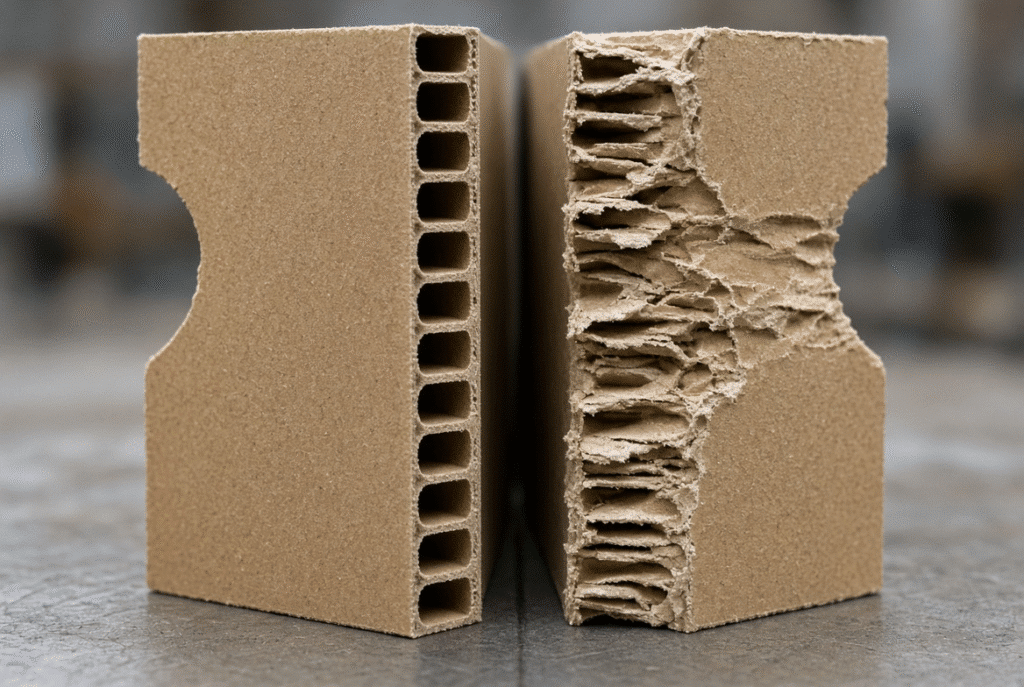
Too much platen pressure will flatten flutes, decrease board stiffness and weaken the package. The board may not be structurally sound and thus cannot be considered visually complete. There are some practical tests: flute profile, edge compression, folding behaviour and stacking strength.
Creasing Corrugated Board
The depth and width of the crease should be appropriate to the thickness of the board, the direction of fluting and the type of folding down stream. An under crease does not fold consistently and an over crease collapses the board. The blank should be tested for folding or assembly before it is approved for production.
Pressure and Die Layout
The pressure distribution is modified by large dies, dense cutting features, internal slots and multiple-up layouts. The maximum pressure of a machine does not provide a consistent result for all die arrangements. Raising tonnage is not effective everywhere: localized make ready can be more effective.
Common Problems When Flatbed Die Cutting Corrugated Board
The causes of most of the obvious defects are multiples. All factors of material condition, feeder settings, tooling, pressure and delivery interact with each other. Below is a list of the most common symptoms operators will observe, common cause clusters, and first checks that will solve most cases.
| Visible Symptom | Possible Cause Groups | First Inspection | Corrective Direction |
| Missed sheet | Suction, pile height, static, warp | Feeder head, air assist, board flatness | Adjust suction and separation |
| Double sheet | Separation, suction, static, thickness | Double-sheet detector, pile preparation | Reduce suction, improve separation |
| Sheet skew | Guides, belts, warp, flute direction | Transport path, gauge contact | Realign guides and support |
| Sheet jam | Edge damage, guides, stiffness, curl | Sheet condition, guide clearance | Check board edges and guide settings |
| Incomplete cut | Pressure, rule wear, thickness variation | Die condition, make-ready, board caliper | Localized make-ready or rule replacement |
| Crushed flute | Excess pressure, poor support, crease design | Platen pressure, die layout, board sample | Reduce pressure, check tooling |
| Cracked or weak crease | Crease depth, flute direction, moisture | Crease geometry, board condition | Adjust crease rule and test fold |
| Misregistration | Warp, gauges, timing, edge quality | Front/side gauges, sheet edges | Correct feeder timing and board condition |
| Uneven delivery pile | Curl, stiffness, air assist, skew | Delivery settings, sheet path | Trace path backward, adjust air |
| Waste-removal failure | Stripping design, board stiffness, pressure | Waste layout, stripping tools | Review die and stripping configuration |
Feeding and Sheet-Separation Problems
Typical sources are pile alignment, suction balance, residual static, curl and thickness variation. Operators are to check the material and the feeder prior to increasing the speed or pressure.
Incomplete Cuts
These are the leading contributors: Insufficient or uneven pressure, Worn rules, Die-board setup, Board thickness variation and local make-ready. Avoid applying pressure to the entire die as a high board pressure is indicative of a problem with the tooling or with consistency in the materials.
Crushed Flutes and Damaged Board
The flute structure is flattened due to the excessive pressure, the improper crease design, the lack of support or the wrong tooling. The quality of the cuts and performance of the finished box must be assessed.
Registration Errors
Registration is influenced by feeder timing, front and side gauges, sheet warp, and damaged edges and flute direction. It will save time if checking and reference edges of sheets before moving die or changing pressure.
Delivery and Stacking Problems
When boards are stiff, curled, subject to air assistance and/or have residual skew, it causes uneven piles or problems with handling. If the delivery pile is unstable, then the sheet path will be followed back from the delivery section.
How to Conduct a Corrugated Board Machine Trial
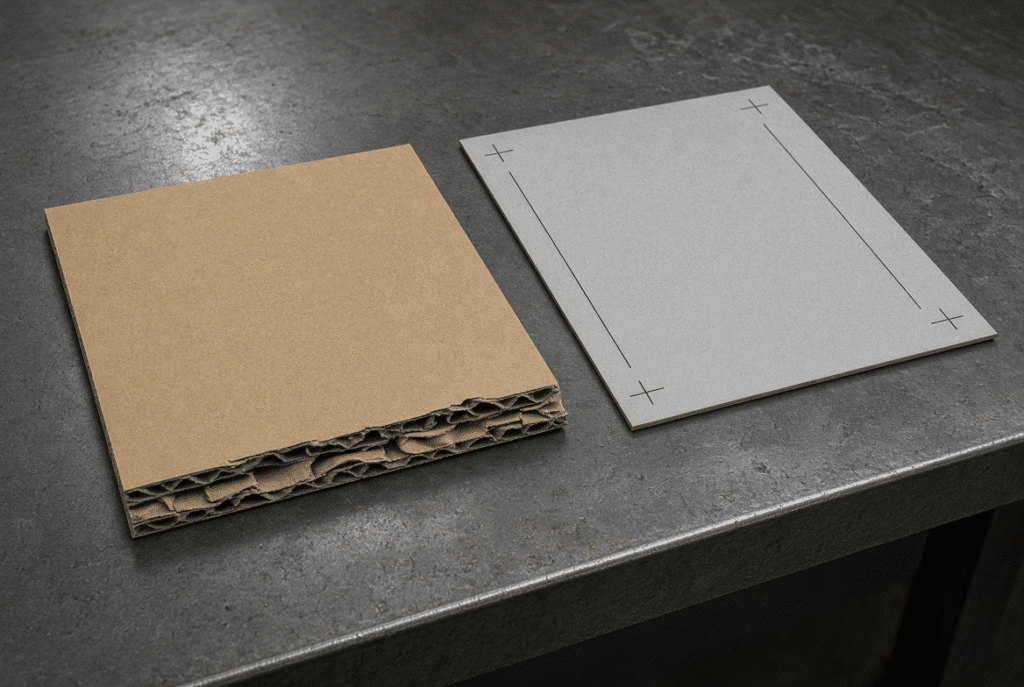
The only way to be certain of compatibility is to have a properly conducted trial. Whenever possible, the actual board, the size of the sheet and the die layout and target operating conditions should be used in the trial.
Provide Representative Board Samples
Ideal lab sheets are not indicative of plant-floor performance. Samples should reflect normal variation in thickness, flatness, moisture, flute structure and surface condition.
Test the Actual Die or Representative Tooling
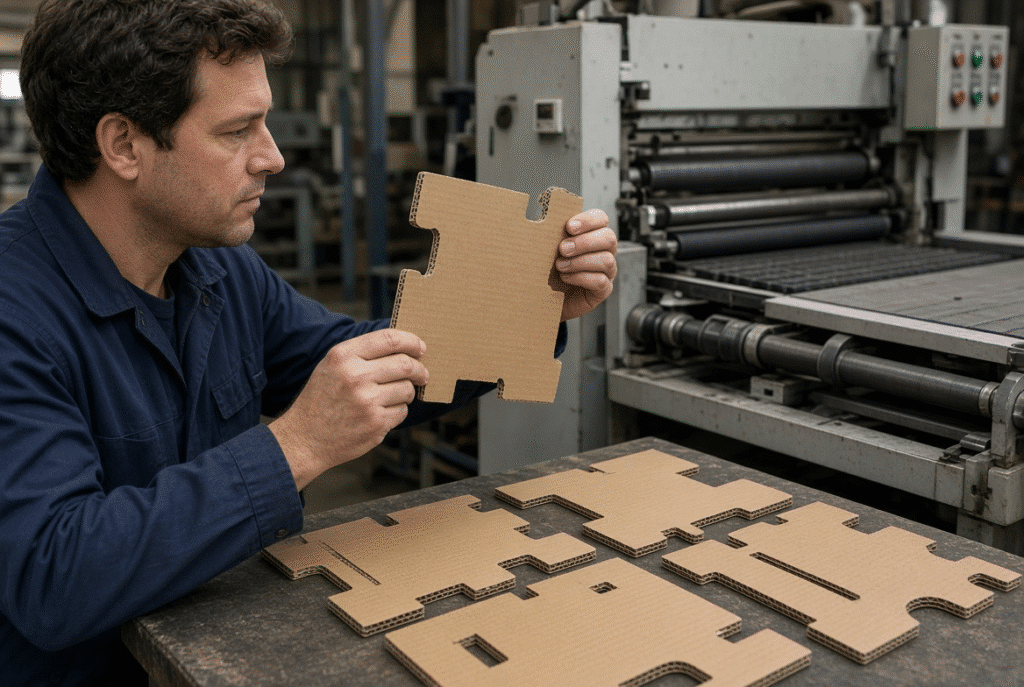
Testing of the product blank, cutting and creasing rules, perforations and internal slots and waste layout can be carried out. If the last die is not available, the supplier has to specify which parts are simulated and which are not verified.
Test Feeding Before Increasing Speed
No attempt should be made to increase output until stable sheet pickup, separation and registration have been achieved. First checks are made for missed sheets, doubles, skew, jams and registration consistency. The initial speed is never the maximum speed.
Inspect the Finished Product
A successful trial does not generate the one good specimen, it generates repeatable results. Inspection includes full cutting, crease quality, flute integrity, board flatness, print-to-die registration, waste removal, delivery-pile alignment, folding or assembly behavior and the desired production rate.
What Buyers Should Confirm with the Machine Supplier
A series of questions helps to avoid misconceptions from turning into production issues.
Questions About Material Compatibility
- What is the range of corrugated thickness that has been tested?
- What about the different flute structures that have been processed successfully?
- Which sheets can be used under production conditions?
- What is the machine’s control of the natural amounts of warp and curl?
- What were the moisture and flatness conditions of the board during testing?
- Does coating, laminating or liners have restrictions?
- What are the required functions and what are the optional ones?
Questions About Feeding and Registration
- What are the possible feeder-head and suction adjustments?
- How are double sheets detected?
- How are thick or warped sheets fed in the path?
- What can be done to make corrugated board fit in the front and side gauges?
- What results did they get from the real specimens?
- At what rate did they make those tests?
- What are the answers to questions of pressure and tooling?
Questions About Pressure and Tooling
- How much is the maximum pressure? and What is the Working pressure?
- What’s the pressure distribution over the die’s area?
- How big is the die board?
- Which are the rules for cutting and creasing corrugated?
- In practice how is flute crushing prevented?
- Are there any waste removal or stripping options?
Questions About Service and Installation
- What does it require in terms of installation and foundation?
- What kind of operator training is offered?
- Does customer have the option for trial support on their own board?
- What are spare parts and preventive-maintenance programs offered?
- What is the warranty given under the circumstances?
- Are overseas engineers available?
- What do you do about any recurrent pressure or feeding difficulties?
Using the D800S as a Corrugated Board Example
The D800S automatic platen die-cutting machine has a corrugated material range up to 4 mm, and a maximum cutting sheet size of 800 × 620 mm. These are model specific data points, not a guarantee for all board grades and production conditions. But still the flute’s structure, the stiffness of the board, the sheet’s warpage, the variation of the sheet thickness, the die layout, the feeder settings, the pressure distribution, the registration accuracy, the target speed, and the pressure delivery behavior are factors which have to be met.
What the D800S Technical Range Does Not Confirm
The listed thickness limit does not define all of the types of flutes and board thickness capable of running. It also does not imply stable feeding, cutting or delivery at maximum rated speed of machine. A full board set-up with the actual board and tooling will be required.
Information to Provide DAIS
Board grade, flute type, thickness, sheet size, product blank drawings, die layout, required cut and crease features, target speed, physical board samples and installation conditions are among the application data that are useful. This information enables DAIS to validate the final configuration and practical operating range.
Final Checklist for Evaluating Corrugated Board Compatibility
- Verify the thickness and density of the board.
- Determine flute direction and type.
- Inspect for liners, stiffness and surface condition.
- Check for warps, curls and moisture.
- Check sheet and die sizes.
- Check feeder and support design.
- Check double-sheet detection.
- Verify front & side registration.
- Assess pressure distribution and tooling.
- Check test cut quality and crease quality & flute integrity.
- Visit deliveries & waste collection.
- Test representative samples at desired speed.
- Look at the repeated output rather than a single sheet.
- Request supplier confirmation in writing of the operating range.
Final Guidance: Test the Board, Not Just the Specification
Only the combination of board, machine, feeder, tooling, pressure and registration and delivery system in an established application range will process corrugated board with automatic flatbed die cutters. The dimensional fit and a published thickness limit can only be a starting point and not a sign of stable production. The key is to have a correctly set-up machine trial with the actual material and the actual die layout. Plants following this sequence don’t have to discover the hard way that they can’t run that “should fit” board day in and day out at the expense of the company.