

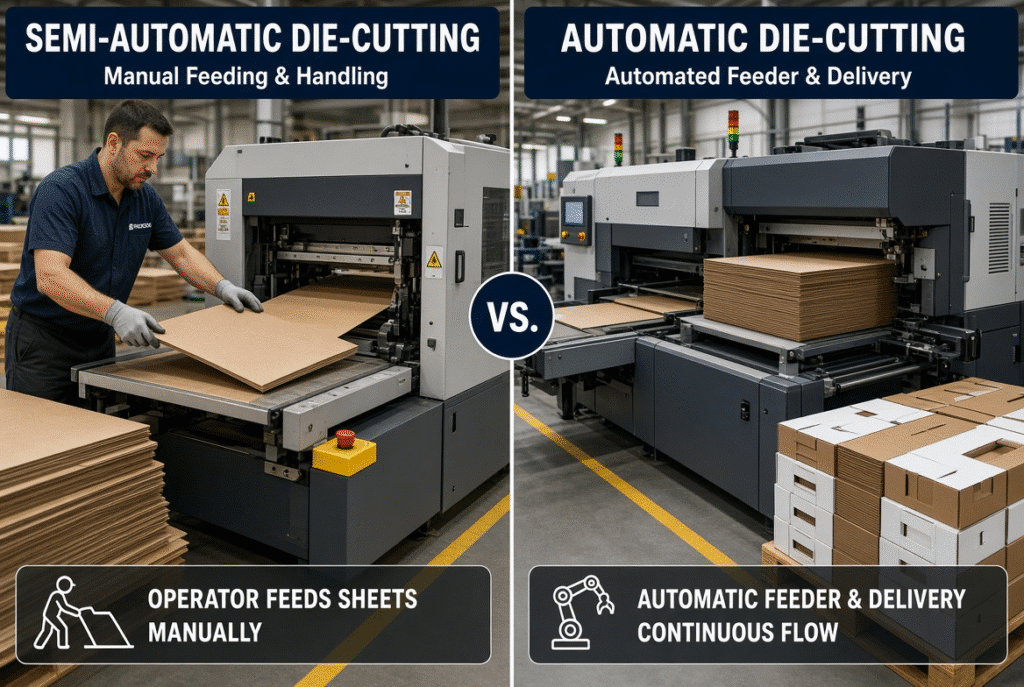
Lower volume plants, frequent short jobs, skilled labor and smaller capital budgets may make a semi-automatic die-cutting machine the practical choice. An automatic machine is better for standard production, where labor costs are higher, repeat orders, consistent sheet handling, and planned capacity increase. So, when it comes to automatic vs semi-automatic die-cut machines, it’s never the machine name on the label. It’s about the amount of sheet path that is actually automated, the number of operators needed to complete the job, the frequency of job changes at the plant and the number of saleable outputs that the floor can produce shift after shift.
When evaluating price or maximum sheets-per-hour, buyers are suiting up for the battle without knowing the full story. The actual costs of each completed blank are impacted by the number of labor hours, variation in setups, material handling, registration consistency, downtime and future growth. The correct machine is the one that matches the production model of the plant, not the one that sounds more advanced.
What Is the Difference Between Automatic and Semi-Automatic Die Cutting?
For packaging manufacturing the terms automatic and semi-automatic refer to varying degrees of operator engagement as the sheet is moved through the machine. Either feeding, transfer or delivery is left under manual/assisted control for a semi-automatic machine. An automatic machine brings in more of those stages making the machine’s mechanical and electronic components work together as a system. Definitions vary from manufacturer to manufacturer so the only good comparison is a list of functions performed by the machine without constant operator manipulation.
How a Semi-Automatic Die-Cutting Machine Operates
Operators set up and load or feed sheets, check registration and pressure and receive finished blanks at the output end of the machine. With appropriate staff and runs, good results can be obtained. Consistent human timing and attention are still needed throughout the job for the machine.
How an Automatic Die-Cutting Machine Operates
The automatic systems typically include combination of feeder (suction or air) with controlled transport, front and side gauges, die-cutting station and delivery. The sensors can be used for double sheets, pile height or sheet arrival. The operator is no longer a person who constantly handles the material, but one who sets up, monitors and checks for quality.
Why “Automatic” Must Be Defined by Function
An auto-operated supplier may only automatically operate the feeder and only then, the collection is manual. Another one can be used to automate both ends of the sheet path. Even with partial automation, there are still labor issues, interruption risks, and differences in consistency, impacting daily output. Ask for a written list of standard and optional functions, and see a complete production demonstration prior to making comparisons.
Feeding and Sheet Handling
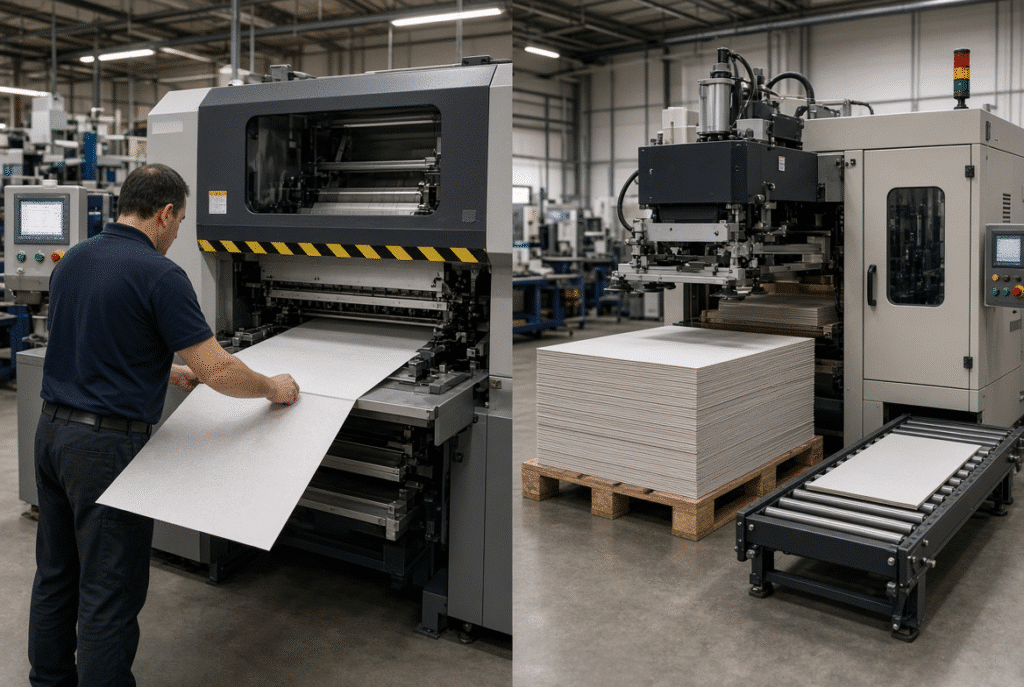
Typically the biggest operating mismatch between the two types of machines is feeding and delivery. Manual or assisted handling requires operator to be on the machine throughout the run. Automatic systems alleviate that repetitive burden, but still need to be adjusted to the material and properly prepared for the piles.
Manual Sheet Feeding and Delivery
Manual or low-tech devices are used to keep sheets aligned and fed at a controlled speed. This method is suitable for low throughput, short jobs or plants where labor is available. Fatigue, pile alignment drift, or operator exit station are all limitations. Usually, operation under steady-state conditions is less than the machine’s mechanical capacity.
Automatic Feeder and Delivery Systems
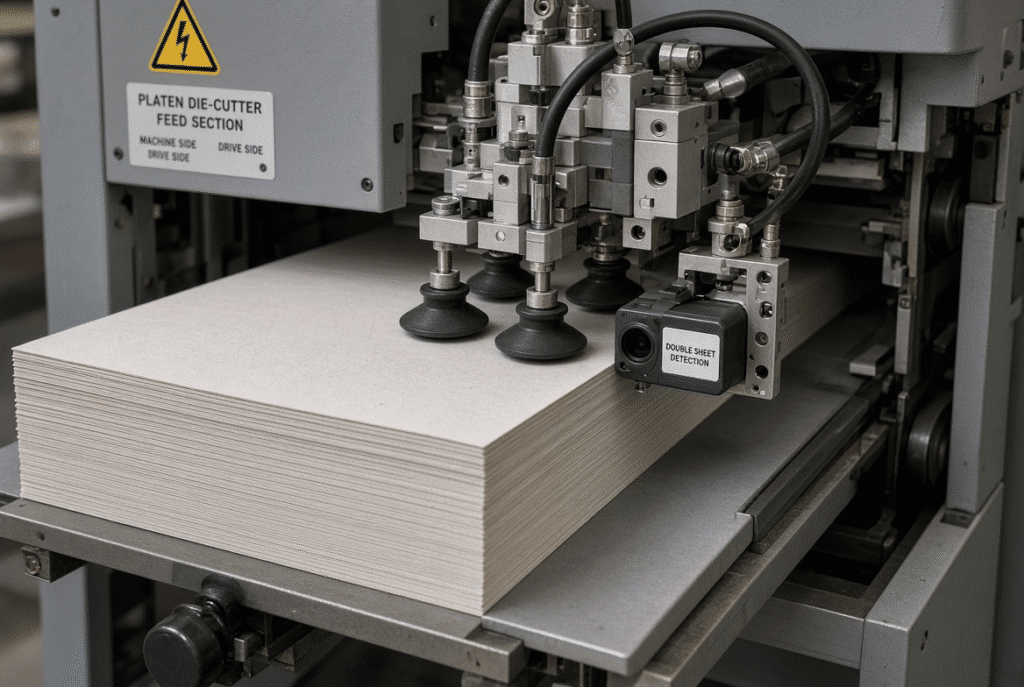
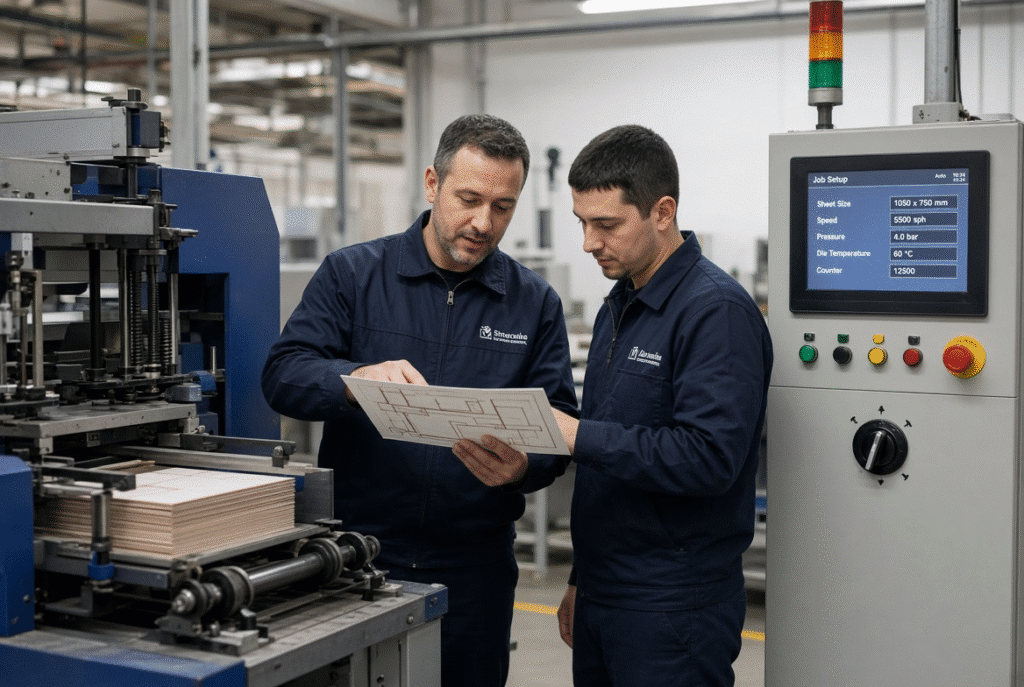
Automatic feeding generally works by controlled interval feeding of sheets by means of pile tables, feeder heads, suction or air separation, feed wheels, or sensors. Delivery systems coordinate and retrieve blanks without much human involvement. With material condition, setup and maintenance within the range of the machine’s design, consistency improves. But performance still requires the operator to be able to set up the pile and take action on alerts.
Double-Sheet Detection and Feeding Reliability
Double-sheet detection or other monitoring can prevent two sheets getting into the die area at the same time. This minimizes the generation of waste, tooling stresses and registration errors. Sensors are not substitutes for a careful preparation of the pile or the correct feeder settings to obtain a desired board grade. They only will catch problems that pass through the separation phase.
Productivity, Labor and Effective Output
The sheets per hour rating is just a starting figure. Effective production rate consists of set-up, change over, pile changes, sampling, waste, short stop and downstream capacity. A seemingly quick product can be slow to create when manual handling is the limiting factor.
How Manual Handling Limits Production
The production constraint is the operator when they are required to continuously feed, align or collect sheets. Even with a mechanical cycle time that is quite short, the pace is slowed by fatigue, breaks, and reassignment. A common scenario is a machine that is rated for high speed but that fails to produce the desired output level throughout an entire shift due to a feeder (or delivery end) that cannot match high speed for the entire duration of the shift.
How Automation Supports Production Continuity
Automatic feeding and delivery can help to keep the time of the sheets uniform over longer runs. The benefit is most evident on repeat jobs with constant material condition. Actual improvement will rely on the quality of the setups, the operator’s monitoring of the processes, and the ability of processes upstream and downstream of the die cutting process.
Rated Speed Versus Effective Production Rate
The rated speed indicates performance in specific conditions. Real output deducts makeready time, sampling, change of piles, waste removal, and quality rejects. The safest approach is to rely on real job figures or a production test with the plant’s own sheets and tooling conducted with a set amount of time allotted.
Labor Cost and Operator Allocation
Determine operator hours per completed unit instead of the number of people working on the machine. Include loading, feeding, delivery, inspection, setup and material handling. Automation can push operators to quality control and monitoring. It does not replace the need for trained personnel.
Registration Accuracy and Quality Consistency
When folding cartons, sheet positioning is a print-to-cut registration factor to consider when looking at narrow borders, windows and the accuracy of crease lines. Sometimes the manual variation can manifest itself as a wavy edge or a misalignment of the crease lines. First of all, automatic systems are only effective when material is stable, print registration is stable, die is stable and machine settings are stable.
Registration Challenges on Semi-Automatic Machines
Differences in the arrival of sheets through the manual placement process. The effect is more pronounced for the longer term and/or when operator boredom sets in. With good operators and close examination, acceptable results are likely to be maintained; however, consistency is more dependent on the skill of the operators.
Registration Control on Automatic Machines
Variation in the position of the sheet is minimized with automatic feeder timing, front and side gauges, and synchronized transport. This system still depends on the correct print registration, the correct dies and correct pressure settings. The mechanical aspect of the register is improved, but not the print or tooling.
Consistency Across Operators and Shifts
The standardisation of the repetitive part of the process is achieved by automatic sheet handling. Both machine types still require trained personnel to setup, inspect and troubleshoot the machine. If multiple operators perform the same job, documenting allowable job settings will help ensure the same results.
Changeover Time and Job Mix
Changeover is the installation of the die, feeder and gauge adjustment, pressure settings, sampling and quality approval. This plant’s ratio of short jobs to long repeat runs plays an important part in the cost of that time.
When Semi-Automatic Equipment Can Suit Short Jobs
Semi-automatic machines are frequently used in small batches, frequent product changes, occasional die cutting, or plants which have limited capital and skilled manpower. The danger is that too many manual adjustments may reduce the predictability of the output unless the setup procedure is standardized.
How Automatic Equipment Supports Repeat Production
Automatic feeding, delivery and control systems can help to facilitate repeatable setups and sustained runs. When records of the job are available and the tools are standardized then it helps. The automatic machine does not necessarily provide automatic changeover or full job memory.
Calculate the Cost of Changeovers
Record changeovers, minutes to changeover, number of operators, and materials used to set up, and lost machine capacity per shift. The additional capital investment can only be considered to be justified if the effect on the recurring setup and handling losses is sufficient to cover the increase in capital cost. Avoid using general claims.
Material Range and Packaging Applications
Automation level is not the only criterion for material compatibility. Designing a feeder, pressure range, die area, supporting transport and delivery configuration are important. Paperboard and corrugated should be considered separately.
Paperboard and Folding Cartons
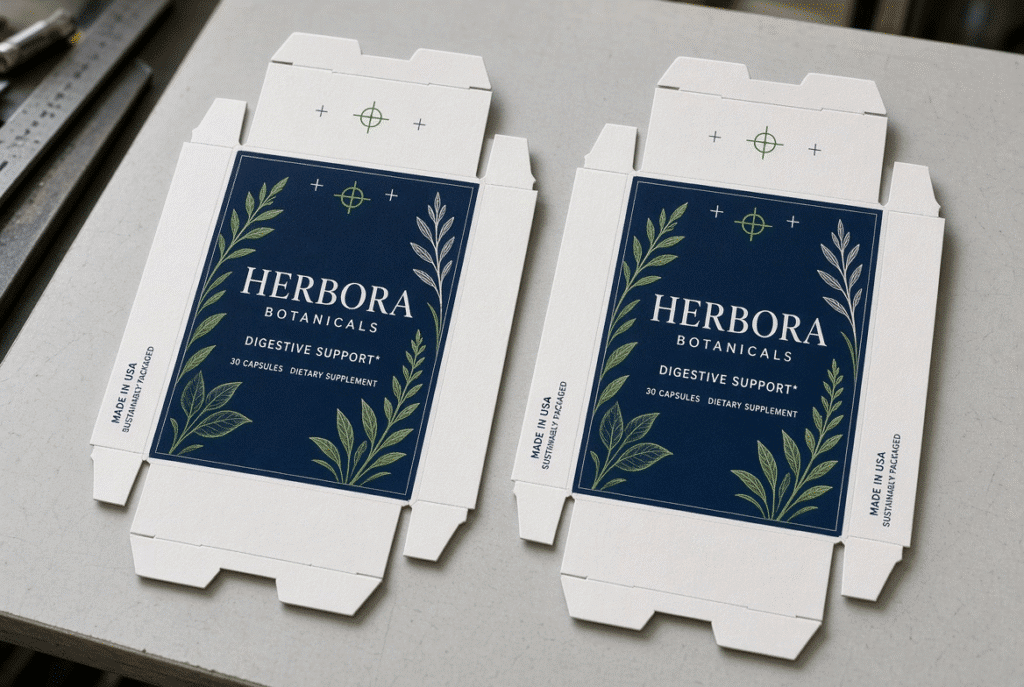
Typical requirements include clean cutting, controlled creasing and print-to-die registration. The value of automatic feeding depends upon the number of products per sheet, sheet size and job complexity. Often printed cartons, sleeves or inserts.
Corrugated Board Considerations
Corrugated board tends to be thicker, stiffer and/or warped than paperboard. Verify flute type, thickness, size of flutes, feeder capacity, pressure, registration and delivery performance. Not all paperboard grades will require an equally good machine.
Confirm Material Compatibility Through Trials
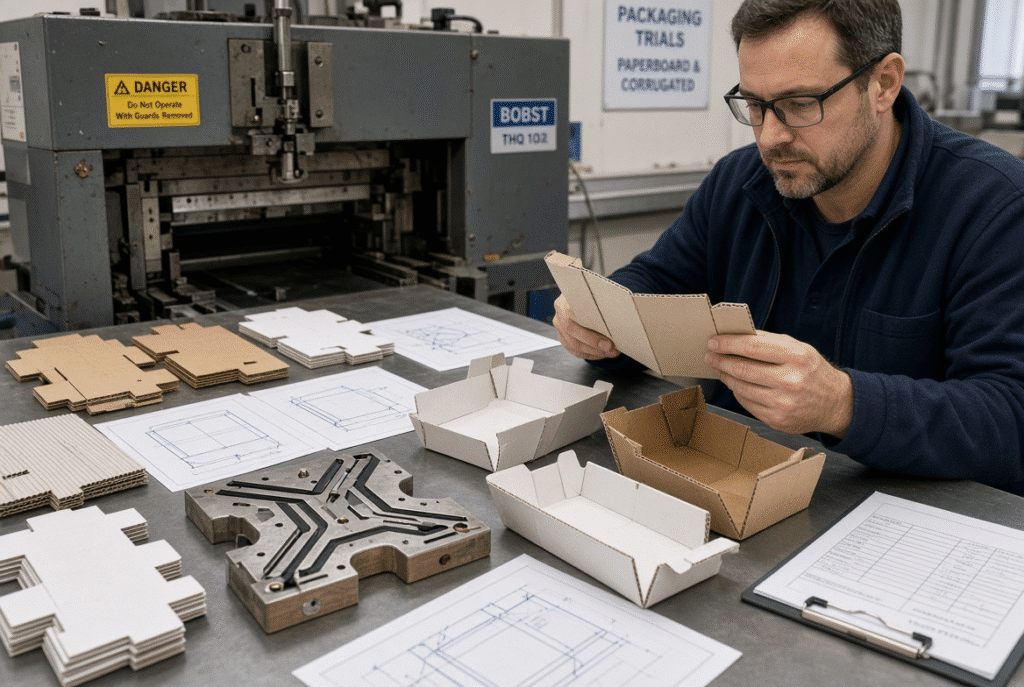
Supply samples of the board, material specifications, product drawings, and representative tooling. The trial should be used to evaluate realistic feeding, registration, cutting, creasing, damage to the board, delivery and achievable speed.
Investment Cost and Total Cost of Ownership
The cost sheet only has one line for purchase price. Each of these factors (labor, waste, downtime, maintenance, training, capacity) impact the cost per saleable sheet.
Why Semi-Automatic Machines May Have a Lower Entry Cost
Semi-automatic equipment tends to cost less up-front and may be a viable option for smaller quantities. The tradeoff does seem to be in higher continued labor hours, more reliance on the operator, and perhaps lower continued production. This is not an automatic cost savings done at the purchase level.
What Automatic Equipment Adds to the Investment
The capital cost is increased by feeder automation, sheet separation, sensors, controlled transport, automatic delivery, pile control and monitoring systems. Only when the plant takes advantage of the greater continuity and consistency these features provide do they add value to it.
Total Cost Factors
Machine price, installation, commissioning, operator labour, training, electricity, compressed air, tooling, spare parts, maintenance, setup waste, downtime, floor space, technical support, production capacity. Look at cost per saleable sheet or cost per finished job – not machine price.
Capacity and Future Growth
Automation is not about eliminating the need for skilled operators, it’s about decreasing repetitive manual work. The knowledge and skills needed to prepare material, set up the dies, register the material, apply pressure to the stock, inspect, clean, maintain, and operate the machine safely are required for both machine types.
Operator Skill, Training and Safety
Operators must have good manual feeding and delivery skills, timing, aligning, visual inspection, and response in case of any problems. Individual technique is more important to consistency.
Skills Required for Semi-Automatic Operation
Operators need good manual sheet handling, timing, alignment, visual inspection, and quick response to feeding or delivery issues. Consistency depends more on individual technique.
Skills Required for Automatic Operation
Operators must configure feeder settings, sensors, gauges, pressure, and delivery. They also need to respond correctly when the automation detects a problem. The role shifts from constant sheet handling to setup, monitoring, quality control, and troubleshooting.
Supplier Training and Support
Ask about installation, commissioning, operator training, manuals, spare parts, technical support, and response procedures. A machine’s value drops if the plant cannot operate it confidently after installation.
Automatic vs Semi-Automatic: Practical Comparison
| Aspect | Semi-Automatic | Automatic |
| Sheet feeding | Manual or assisted | Integrated feeder with suction/air assistance |
| Sheet delivery | Manual or assisted | Automatic collection and alignment |
| Operator involvement | Continuous handling throughout the run | Setup, monitoring, quality control |
| Sustained production | Limited by operator pace and fatigue | Better continuity on stable, longer runs |
| Registration consistency | More dependent on individual technique | Improved by gauges and synchronized transport |
| Changeover | Flexible for short jobs, less standardized | Supports more repeatable setup on repeat work |
| Labor requirement | Higher hours per finished sheet | Lower repetitive handling hours |
| Initial investment | Lower | Higher |
| Flexibility | Good for varied short jobs | Better for regular and higher-volume production |
| Material handling | Operator-dependent | Reduced repetitive handling when properly set |
| Best-fit plant | Lower volume, available labor, limited capital | Regular production, higher labor cost, growth plans |
| Growth potential | Limited by labor availability | Supports additional shifts and higher throughput |
| Training and maintenance | Focus on manual technique and basic upkeep | Focus on system settings, sensors, and diagnostics |
When a Semi-Automatic Machine May Be the Right Choice
Semi-automatic equipment works well for smaller production quantities, numerous short runs, existing skilled labor, limited initial investment, die cutting three or four times a year, or accessory or secondary die cutting, when the market needs to be tested in the early stages, or when the production volume is not high enough for automatic equipment. However, there is still a need to take into account the availability of labour and future growth.
When an Automatic Machine May Be the Right Choice
Usually automatic equipment is better suited for sheet-fed or heavy volume production, repeat requirements for packaging, manpower problems, expensive manpower, consistent sheet feeding and delivery, multiple shifts, planned growth of capacity and fewer repetitive operations. Final suitability through material and tool testing remains to be done.
Questions to Ask Before Purchasing
- What operations are truly automated and what operations still require human action?
- How many operators will be required during normal production?
- What materials and thicknesses have been tested using the machine?
- Will the machine provide any real benefit to the purchaser’s product?
- Do the feeder curls or irregular sheets?
- Which registration system comes standard?
- How long do you think the average time it takes to change over for the same type of work?
- So which functions do you have and which do you not?
- What type of installation and commissioning and training are involved?
- What are the appropriate spares to stock in the plant?
- What is the warranty and what after sales service are provided?
- Does the supplier provide a trial of the buyer’s sheets, die and product drawings?
- What will the workflow be when production is completed after installation?
Obtain a written technical configuration and actual trial results before making the final decision.
Using the D800S as an Automatic-Machine Example
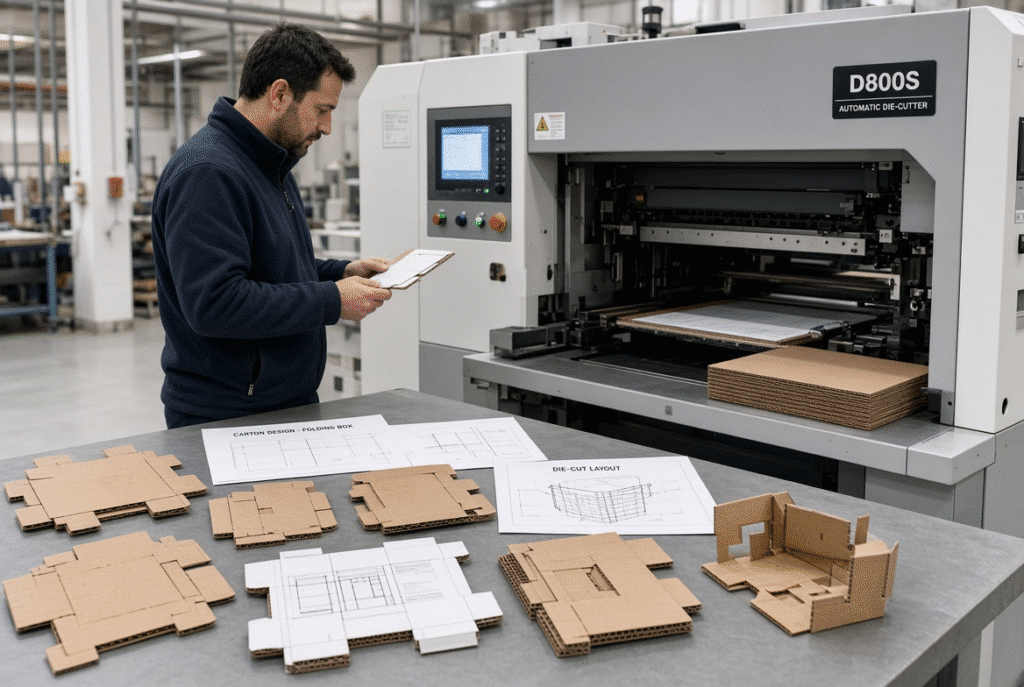
The D800S is an automatic platen die-cutting machine for compatible sheet-fed paperboard and corrugated. Automatic feeding, front gauge and side gauge, photoelectric detection and automatic delivery are functions that have been confirmed. Final configuration always shall be checked against the specific job requirements.
Where a Machine Like the D800S May Fit
Such a machine is applicable to plants requiring repeated task of sheet fed Die cutting, creasing or perforating with a lower man power in the feeding section and organized delivery. Not a one size fits all solution for all packaging plants. The suitability depends on the size of the sheet, material, volume and standards of quality.
What Semi-Automatic Buyers Should Compare
Consider not just the price of the two machine types, but actual operator hours, changeover time, saleable output, consistency of quality, material handling and future machine capacities. When there’s a limited amount of product, and workers are plentiful, a semi-automatic machine may be the superior option.
How DAIS Should Confirm Application Fit
Specify the sheet size, material and thickness, product drawings, die layout, number of products per sheet, production volume, SKU number, creasing and perforation requirements, target speed, quality requirements, and installation conditions. A machine trial and cost review should be done before any machine is purchased.
Final Checklist for Choosing Between Automatic and Semi-Automatic
- Make reasonable production and growth projections.
- Count number of jobs and SKU changes by shift or week.
- Determine operator hours for complete job cycle.
- Using existing technology measure set up and change over time.
- Measure effective saleable output, not rated speed.
- Verify the compatibility of materials with real samples.
- Assess requirements for registration and completed quality.
- Determine costs of tooling, down time, and waste.
- Discuss maintenance, training and technical support.
- Determine the space and function needed.
- Be aware of additions and changes and new product segments.
- Ask for a machine trial.
- Get final machine setup written down.
Final Guidance: Match Automation to the Plant’s Real Needs
Semi AUTOMATIC equipment is suitable for flexibility, reduced entry cost, limited labor availability, and limited production volume. Automatic equipment is more suitable when the need for continuity of production, less repetitive handling, consistent production, high efficiency of labor and future capacity are more important. The right option is the one that fits the actual job mix, labor model, quality requirement and growth strategy of the plant.
Look at the D800S automatic platen die-cutting machine or just get a consultation with DAIS about the material, volumes, job mix and growth requirements.