

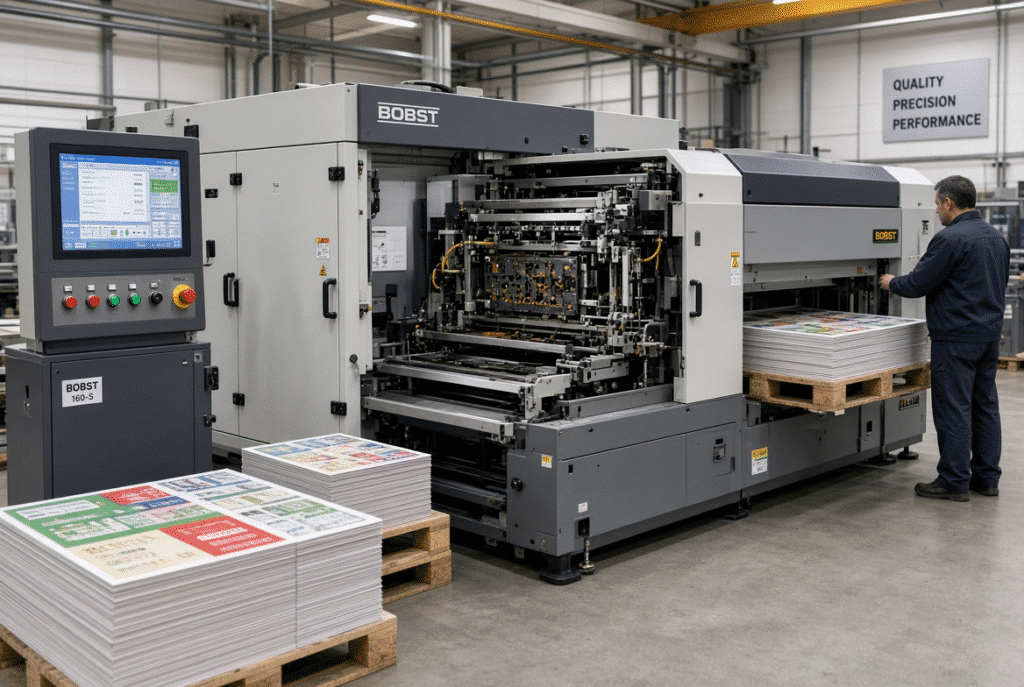
To compare an automatic die cutting machine with stripping unit to their actual production jobs, the complete configuration (sheet format, effective area, substrate range, pressure, actual production speed, registration, stripping setup, delivery, installation and service) shall be matched. On paper, a machine may appear to be perfect, with a suitable maximum sheet size, a daily board thickness that matches, a complicated die layout, and frequent changeovers and the downstream machine or process, but it may simply not be able to deal with the internal waste or the daily load of the board.
Many purchasing teams believe that when products are referred to as “automatic” or “with stripping unit,” it means a completely standardized package. In reality, all of the above functions, such as frames, plate or needle tooling, accessories, delivery, sample testing, installation, training, spare parts and after-sales should be confirmed in writing. Choosing the right machine begins with the job that the machine needs to be able to do, rather than the biggest number on a brochure.
Start with Your Production Requirements
Don’t start equipment selection with a catalogue model, rather the data of products and processes. Prior to considering any quotation, clarify what the machine is going to produce, day-by-day.
Product Types and Typical Applications
Identify the products you product: folding cartons, printed paperboard packaging, specialty cartons or selected corrugated applications. Record windows, handles, internal holes, locking mechanisms, glue flaps, complicated outlines, etc. and multi-up layouts. The geometry of products directly impacts on the layout, the way waste is removed, the design of the stripping tools and the finished quality. A well working machine might not cut internal windows or complex locking tabs.
Sheet Sizes, Product Sizes, and Run Lengths
Document the largest and smallest size sheets required, dimensions of finished products, the number of products per sheet, average product order size, jobs per shift, and job repeat frequency. Select the machine you use for your heaviest daily task—not necessarily the biggest sheet or the most convenient product. Any format that can be used on the largest sheet and requires the most material to generate the daily mix will cost more with time.
Substrates and Thickness Range
Record actual materials, grammage or thickness, stiffness, surface coating, moisture condition and any selected grade of corrugated. Avoid using a general term like “paperboard compatible.” But for materials to be suitable, they need to be confirmed by technical specifications and sample testing using the sheets that you use on a daily basis.
Current Production Bottlenecks
Determine the root cause of the current problem is in either feeding, die-cutting, manual waste removal, inspection, delivery, folding, gluing, labour availability or changeover time. A stripping unit cannot eliminate a downstream or section bottleneck. Make sure the actual constraint is not confused with the constraint that the new machine is supposed to solve.

Sheet Format and Die-Cutting Area
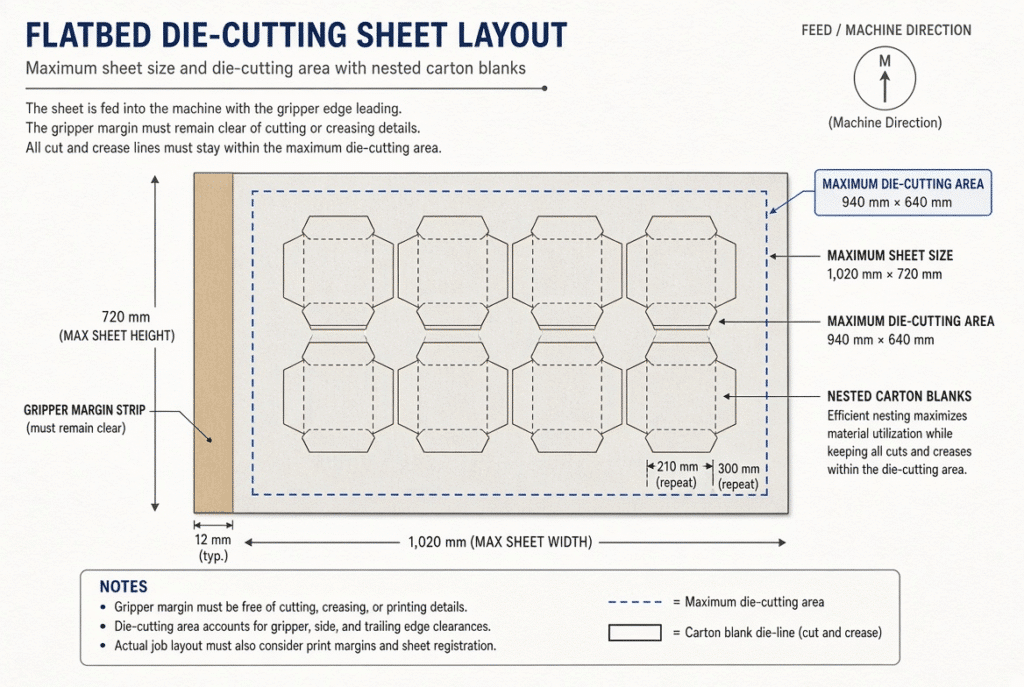
A common mis-specification error is assuming maximum size of the sheet to be the usable size for the sheet. The two figures are different and must be checked separately.
Maximum and Minimum Sheet Size
Verify input and output sizes of largest and smallest sheets in the feeder and compare to actual production sizes (grippers, sheet orientation, etc.). When it comes to the machines in the 1060 mm format class, like the DAIS D1060Q, published values may be as large as 1060 mm x 770 mm and as small as 400 mm x 260 mm; these should be checked against the final approved configuration before a purchase is made.
Maximum Die-Cutting Size
Because of elements such as gripper margins, feeding geometry, and machine structure, maximum die cutting size is virtually always smaller than the maximum sheet size. Purchasers should work out if the die configuration they require fits within the cutting area. A standard size for the same class is 1050 x 760 mm, but, once more, this is merely indicative and must be verified with the supplier’s final class specification sheets.
Gripper Margin and Sheet Orientation
The gripper margin is the area of sheet that is being held by the transport system. It decreases usable area, impacts product nesting, Print-to-Cut registration and die layout. In many specifications a minimum gripper value is specified, however, the buyer is responsible for making sure the supplier’s specification actually specifies this particular term and the method of measurement. The orientation of the sheet relative to the edge of the gripper also affects the nesting efficiency and the waste as well.
Format, Nesting, and Material Utilization
Try out your real product concept, in the usable area. The larger the sheet size the worse material use can be if the edge of the gripper, trim waste and product spacing is overlooked. Test out a couple of common multi up installations before taking any format claim.
Substrate Range and Material Compatibility
It can differ depending on paperboard with a surface coating, uncoated paperboard, thick stock and certain corrugated stocks. The compatibility of materials must be carefully considered.
Paperboard, Folding Carton Stock, and Coated Materials
Feeding, cutting, creasing and stripping of waste are affected by grammage, thickness, surface coating, stiffness, moisture, and fiber direction. Provide actual production materials for testing, don’t just take it on faith that it will accept paperboard.
Selected Corrugated Board Applications
Selected corrugated applications can be processed on some flatbed machines, but it depends on the thickness, flatness, flute structure, stiffness, product geometry and machine configuration. Always assume no compatibility with all corrugated grades. Make sure that any corrugated work is confirmed in writing with sample testing.
Material Condition and Storage
Feeding/registration, cutting and stripping issues can arise from warping, varying moisture levels, dust, torn edges and mixed batches. Know the difference between a machine limitation and a substrate-condition problem and don’t blame the machine.
Questions to Ask About Material Limits
- What is the smallest and largest thickness that it will handle?
- What are the grades of the boards that have been tested in production?
- Are coated and laminated sheets covered?
- What corrugated structures have been successfully run?
- Are there any precautions for warped or stiff sheets?
- Are there any limitations on holes inside or on the die?
Pressure, Cutting Performance, and Machine Structure
Pressure rating should be determined in conjunction with the die area, tooling, rigidity of the machine, material and cutting-rule requirements. It is an easy and costly error to make when selecting an object on the basis of the highest tonnage number.
Maximum Working Pressure
Verify if the quoted pressure is maximum working pressure, nominal pressure, or other manufacturer specific value. The pressure is often lower at normal operating pressure, and can vary based on the work to be performed. A maximum working pressure of 300 tons is often given for the D1060Q class: check exactly what is meant by maximum working pressure and what the conditions are for this maximum value.
Pressure Distribution and Structural Rigidity
Peak tonnage is not likely to be as significant as stable pressure distribution across the die area. Check pressure bearing parts, machine frame, die platform, make-ready and alignment. One of the many structural features, some machines employ pressure-bearing elements made of ductile-iron (e.g. QT600-3) but this does not guarantee accuracy or operation without permanent deformation.
Die-Cutting Accuracy and Actual Conditions
Discuss the definition, measurement and influence on accuracy of material, die quality, setup, speed and operating conditions. A typical statement is ±0.1 mm, which is a specification that can and should be confirmed and is dependent on the conditions for which the production is guaranteed.
Pressure and Waste Stripping
Use clean die cutting, for reliable waste stripping. Uncompleted cuts result in a loss of product; over cutting can cause the blanks and/or the stripping tools to be damaged. Try cutting and stripping at the same time in a sample trial to assess their relative effectiveness.
Rated Speed vs Actual Saleable Output
Words of speed should be used with caution. Don’t compare the machine’s stated speed, but compare the good finished blanks per hour and total time for the order.
What the Rated Speed Usually Describes
The rated speed is usually a maximum or reference speed under certain conditions. Not necessarily making output on complex dies, thick board, difficult waste patterns, frequent stops or challenging quality requirements. It is important to note that published figures for machines in this class may vary between ranges across the document; they may be considered in a “conditional” manner until verified under your own conditions.
Factors That Reduce Actual Output
Real output is reduced by the thickness and stiffness of the substrate, condition of the sheet, the complexity of the die, the number of products per sheet, internal waste, the stripping set-up, operator adjustment, inspection and sampling, delivery-stacks management, change-over time and unplanned stoppages. If the machine is slower, but is more consistent in its performance on the buyers products, it could actually provide more saleable output.
How to Measure Good Output
Record the number of good finished blanks per hour, rejected/reworked blanks, set-up time, changeover time, manual waste removal time, machine down time, downstream waiting time and total time to complete the order. In any supplier trial, compare the same substrate, die and product conditions.
Waste-Stripping Configuration and Tooling
The term ‘with stripping unit’ is not a complete specification. The stripping method, included frames, tooling, accessories and product suitability are all important considerations for the buyer.
Plate and Needle Waste Stripping
The process of stripping plates involves configuring contact surfaces; stripping using needles involves selecting pins/needles. The method used is dictated by product geometry, internal holes, waste pattern, substrate, run length, flexibility, and setup requirements. A mix of systems or a single system optimized for a specific waste area are useful for many complex (or complex) cartons.
Standard vs Optional Configuration
Ensure waste stripping is clearly included in the base rate or as an extra. Some models like the D1060Q are offered with the option of plate and needle waste stripping. This differentiation in the quotation and final contract must be evident.
Included Frames, Accessories, and Replacement Parts
inquire if the quotation covers stripping frames, plate tooling, needle tooling, upper, middle and lower frames, supports and fasteners, replacement needles, tool-storage accessories, setup equipment, manual waste-cleaning tools and recommended spare parts. Not all of the items can be found in all configurations as listed in a general parts catalogue.
Tool Changeover and Product Protection
Production efficiency is impacted by all installation, alignment, access and changeover time on tools. Ensure that the chosen stripping system will not come into contact with finished carton surfaces, glue flaps, windows, and/or printed surfaces during the stripping process to remove waste.
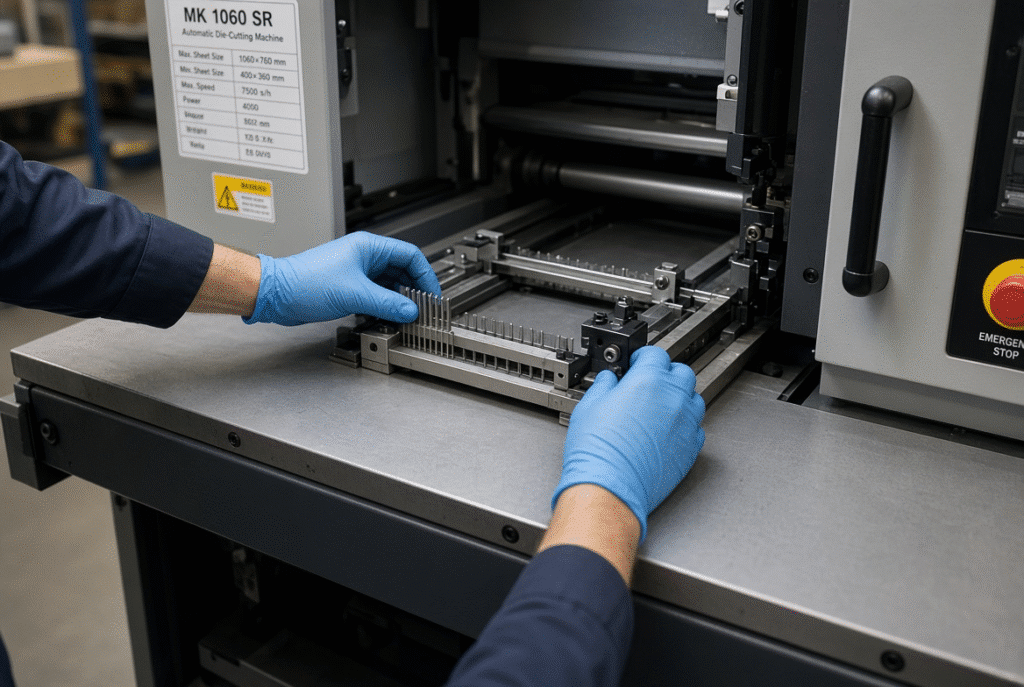
Feeding, Registration, and Delivery Specifications
A consistent stripping operation is not possible if the sheets do not arrive properly or finished blanks are not being picked up.
Feeder and Double-Sheet Detection
Discuss sheet separation control, photoelectric double sheet detection, transport belts or wheels, feeder adjustment and your actual sheet condition. Instability in feeding leads to further defects such as registration and stripping further down the line.
Front and Side Lay Registration
The position of the sheets and the accuracy of the print-to-die are specified by front and side lay systems. Avoid accepting a pre-made production tolerance without proof with your particular substrate and layout.
Delivery Pile and Stack Management
Ensure the height of the feed pile, delivery height, feed pile alignment, pile lifting, paper receiving control, and sampling functions are correct. 1060 mm class: typical values are a maximum feed-pile height of 1 600 mm and a maximum collecting height of 1 500 mm – check against the approved final configuration.
Non-Stop Sampling and Inspection
Depending on the configuration, operators may be able to view the production without interrupting the machine with sampling functions. Check if the function is standard or optional or whether it is part of the final quote.
Machine Footprint, Weight, Utilities, and Installation
If these requirements of floor space, access, power, foundation, ventilation, transport and service clearance have not been checked, a machine can be technically suitable but incapable of being installed efficiently.
Overall Dimensions and Service Clearance
Review the complete machine footprint, working space, tool change space, maintenance space, feeder and delivery extensions, and space for material movement. Some specifications include overall dimensions of around 4 626 × 4 350 × 2 325 mm – check if the published dimensions for this format include all sections of the machine and accessories.
Machine Weight and Foundation Requirements
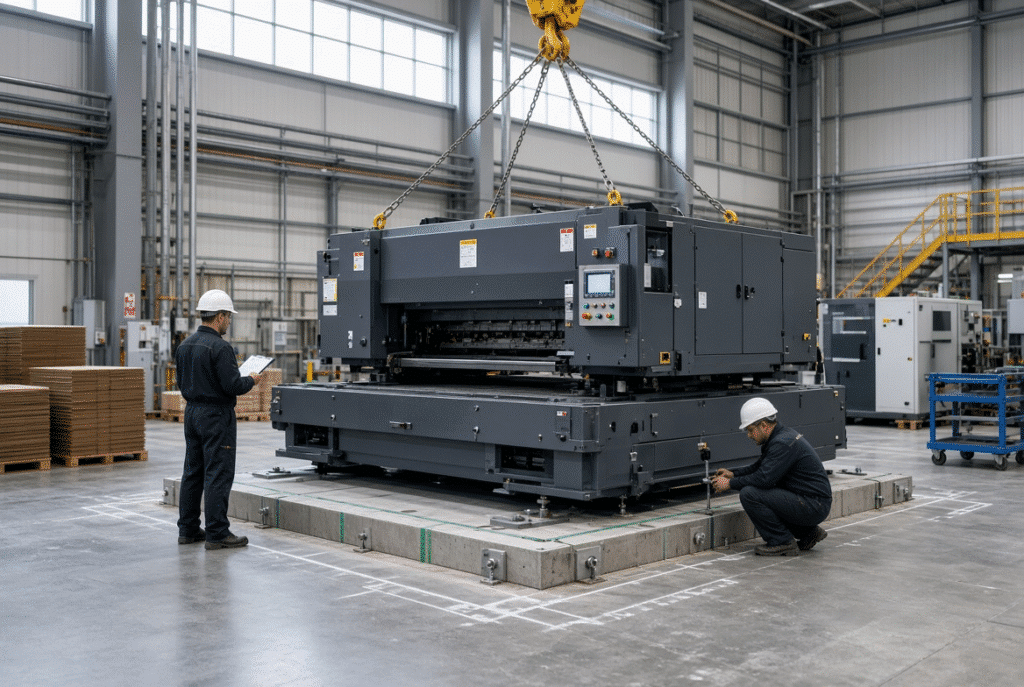
If the heavy machine is to be transported, foundation exam, floor-load verification, lifting equipment and anchoring and leveling procedures may be necessary, as well as foundation review. The shipping weights vary from 16 tons, which is an approximation, to a shipping and installation weight, which is to be determined with the supplier before moving.
Electrical, Pneumatic, and Environmental Requirements
Verify power supply, installed power, compressed air needs, ventilation, oil-air cooling, temperature, humidity, dust and local safety needs. Don’t accept catalogue estimates, ask for a final installation and utility document instead.
Installation and Commissioning
Commissioning usually involves leveling the machine, mechanical inspection, electrical connection, die setup and stripping-tool installation, test production, and training for the operators. Discuss what is covered and if it’s an out of country trip, if it’s covered for accommodation or engineer costs.
Service, Training, Warranty, and Spare Parts
The purchase specification includes after-sales support. To keep a stripping unit and high pressure die cutting system working properly, it must be correctly set up, maintained, troubleshooted and maintained with correct replacement parts.
Operator Training and Technical Documentation
Inquire about sheet feeding, registration, die setup, pressure adjustment, stripping-tool installation, quality checks, cleaning and safety practices during training. Ask for operating instructions, maintenance schedules, parts diagrams, electrical drawings and troubleshooting guides.
Warranty Scope and Exclusions
Check warranty terms, included parts, parts that are not covered, warranty misuse, installation requirements and warranty response. A typical reference is 12 months after installation and commissioning with proper maintenance and operation; final term depends on destination and configuration and is variable.
Spare Parts and Wear Components
Inquire for replacement needles, stripping parts, bearings, sensors, belts, electrical components, lubrication components and other areas of wear. Ask for a list of required spares and a realistic delivery lead time, don’t take it for granted.
Overseas Service and Engineer Costs
Further additional expenses may arise for overseas installation, commissioning, maintenance and travel of engineers, depending on the contract and the destination. Do not take it for granted that there is free service on-site all over the world; make these costs very clear in writing.
Sample Testing and Supplier Comparison
Use actual product and test conditions, not just catalogue specifications to compare machines.
What to Send for a Machine Trial
Create real-world substrate samples, thickness and material properties, sheet dimensions, product drawings, die layouts, number of products per sheet, internal openings, waste pattern, desired speed, quality specifications, and existing issues encountered in manufacturing. The trial should be more complex than just a simple sample – it should be the toughest regular product.
What to Measure During the Trial
Capture set up and change over time, feeding stability, registration, cut completeness, crease quality, waste removal completeness, product edge condition, delivery stack quality, good output, rework, machine adjustments, and operator requirements. Just one good sheet is not sufficient; check repeatability over a representative number of sheets.
How to Compare Supplier Quotations
Compare complete machine configuration, stripping equipment included, tooling and accessories included, technical specification, utility requirement, installation and commissioning, training, warranty, spare parts, service response, delivery terms, exclusions and additional costs. Using a side-by-side table makes it easier to see if quotations are really equivalent.
Buyer’s Final Specification Checklist
During negotiations with suppliers and review of contracts, refer to the following list.
Machine and Performance
- Type and Model of the machine.
- The maximum and minimum size for the sheets.
- Maximum die-cutting size
- Gripper margin
- The range of materials and thickness are limited.
- Maximum working pressure
- Die-cutting accuracy definition
- The rated speed and output as tested are shown.
- The height of the feed and delivery piles.
- The weight of the machine and its size are not given.
Stripping and Tooling
- Plate or needle stripping (or combination)
- The standard or optional option.
- Frames, plates, needles, supports
- Changeover method, accessories
- Replacement components
- Samples for buyer’s products test result
Installation and Ownership
- Electrical and pneumatic needs.
- Foundation/ floor load confirmation.
- Service clearance
- The installation and commissioning scope:
- Content and documentation for training.
- Warranty terms and exclusions
- Newspaper list and information about stock availability.List and availability for spare parts.
- Maintenance schedule
- Overseas engineer costs
- Final contract exclusions
Summary Guidance – Buy the Complete Configuration, Not a Headline Number
The automatic die cutting machine that matches the actual sheet sizes, materials, die layouts, production volume, waste pattern, quality requirements, installation conditions and services expectations of the buyer is the right automatic die cutting machine. Check all important details, confirm all standard and optional features in writing, validate actual materials, compare to output that is to be sold, and review ownership expenses before entering into a contract.
Submit your sheet size, substrate and thickness information, die layout, product samples, waste-removal needs, target output and installation location to receive a suitable configuration recommendation from DAIS. Clear production data means he ensures that production proposals are clearer on the machine, and that there are no surprises after installation.