

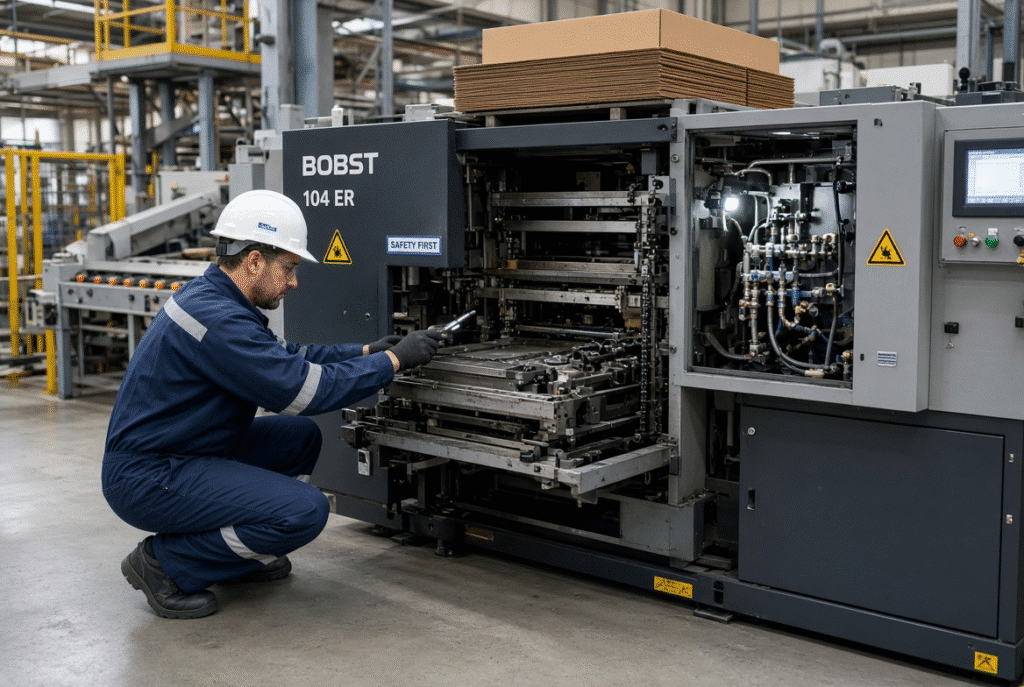
Minimizing downtime on the automatic die cutting machine is best accomplished by seeing small warning signs before they become feeder stops, scrap, damage to the tooling or unplanned repairs. The main points of an automatic diecutting machine maintenance checklist include routine cleaning and inspections, lubrication verification, maintenance of tools, sensor checks, safety tests, and thorough documentation. This makes it easier for packaging plants to move away from a “responding to failure” mindset to a “preventing failure” mindset.
Specific tasks and periods should be in accordance with the plant’s safety procedures and the machine manufacturer’s manual. This guide provides a workable procedure for organizing preventive work; it is not a substitute for model specific instructions, lockout/tagout requirements, or the experience and judgment of trained persons. All of the following are early signs to look for: operators, supervisors, quality staff, maintenance technicians. A reliable system ensures that the people who are checking, what is being checked, when it is checked, the people who are recording the findings, and when production has to stop for qualified recording.
Why Preventive Maintenance Matters in Packaging Die Cutting
An automatic die cutting machine integrates mechanical movement, exertion of pressure, sheet feeding, registration, tooling, electrical control, safety protection, and delivery process, etc. A quality drift is the initial sign of a problem in one of these areas, and can ultimately turn into a production stop. Maintenance performed as a repair operation is likely to be found once accepted output has dropped, scrap has increased or a job has been interrupted at the worst possible time.
It’s not just the machine that’s getting protected by maintenance. It does so by safeguarding accepted sheets, on-time delivery, labour efficiencies, tooling cost, folding-gluing performance and customer’s expectation of quality. The operator’s small and repeated adjustments to the setting, rising waste or small drifts occurring in the registration are production signals that need to be addressed before larger losses occur.
Maintenance Protects Accepted Output, Not Only the Machine
A machine may be operating and quality may have begun to suffer. The operators may see repeated feeder adjustments, more skew, incomplete cuts, fluctuations of the crease quality, poor waste release, unstable delivery stacks, or gradual print-to-die registration drift. These are not just a nuisance, they just mean fewer saleable sheets come off the press. Monitoring them early allows the plant to safeguard output before there is scrap, rework, late orders or customer claims.
Planned Maintenance Is Cheaper Than Emergency Repair
Production windows can be planned around a scheduled replacement or planned inspection. An emergency failure can disrupt a job at the worst possible moment, and will cause harm to tooling, material, machine parts or safety systems. Minor wear is minimised by cleaning, lubrication checks, wear inspections and spare part preparation. It’s not in abstract percentages, but in production hours that you lose, emergency freight for parts, overtime and risk of secondary damage.
Maintenance Supports Accuracy, Speed, and Safety Together
Various factors such as feeder condition, sensor cleanliness, bearing health, lubrication condition, die setup, condition of cutting-plates, integrity of fasteners affect registration, cutting, creasing, noise, vibration, and machine behavior. Maintenance of safe operation is also dependent on good guards, interlocks, emergency stops, photoelectric devices and trained manpower. The isolation procedure and local safety requirements for mechanical areas, electrical systems, press mechanisms and moving parts should be completed as per the manufacturer’s works. Safety devices are not checkpoints to be put in or taken out, they are an integral part of the reliability system that ensures the machine continues to produce accurate work.
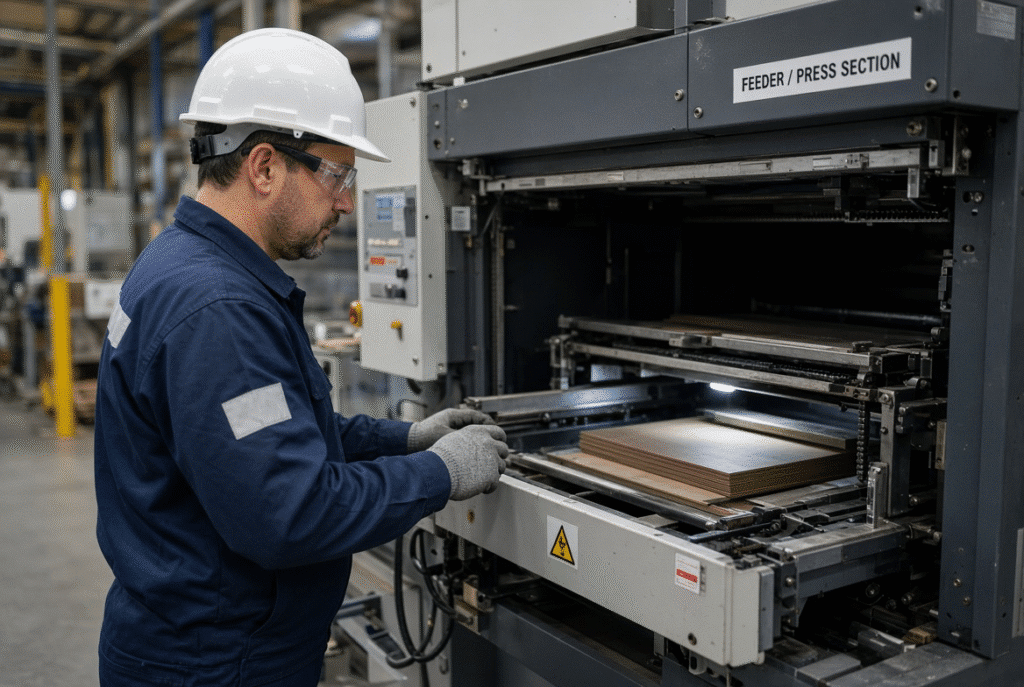
Build a Maintenance Program Around Daily, Weekly, Monthly, and Planned-Shutdown Tasks
Maintenance must be planned on the basis of the type of task, the number of operating hours, material conditions, and manufacturer’s recommendations. Some checks should be done prior to each change. Others need to be inspected once a week, reviewed once a month or for planned shutdown access. The frequencies listed here are not meant to replace the official manual and are offered as a practical guide. The processes and time spent on each task should be customized to the individual plant, the machines, the amount of dust produced, the speed of operation, the work crew, and the instructions given to them.
Daily and Shift-Start Tasks
More detailed feeder/transport inspection, belt/brush/chain/wheel cleaning and checking, inspection of chain tension/mechanical drive condition (if accessible), sensor function checking, pneumatic/vacuum component inspection (if applicable), review of chain tension/operation of lubrication system, and review of repeated fault records are all typical tasks performed weekly. Refer to manufacturer’s lubrication map and use approved lubricants. Don’t make up the amounts and/or frequencies of the oil changes.
Weekly Tasks
Monthly or planned shut down work enables the in-depth examination of bearings, transmission, press mechanism, die frame, cutting plate, electrical connections, guards, interlocks, lubrication distribution, vacuum or pneumatic systems and fasteners. Such checks should be done by competent staff in accordance with the approved safety procedure. A deep inspection can be scheduled to detect issues before they can occur during a peak production time, allowing the plant time to change out planned wear items before they fail.
Monthly and Planned-Shutdown Tasks
Monthly or planned-shutdown work allows deeper inspection of bearings, transmission components, press mechanism, die frame, cutting plate, electrical connections, guards, interlocks, lubrication distribution, vacuum or pneumatic systems, and fasteners. These checks must be performed by qualified personnel under the approved safety procedure. Scheduled deep inspection finds problems before peak production periods and gives the plant time to replace planned wear parts rather than waiting for failure.
Use the Manufacturer’s Manual as the Final Authority
Official maintenance periods, the type of oil and grease, type of filters, torque specifications, safety procedures, and methods of adjustment vary by machine. Have latest manual, electrical drawings, pneumatic diagrams, spare parts list and lubrication schedule close to the machine or in the plant maintenance system. If instructions are missing, confusing or contradictory to the behavior observed on the machine, contact the machine manufacturer. Don’t make up instructions to fill in.
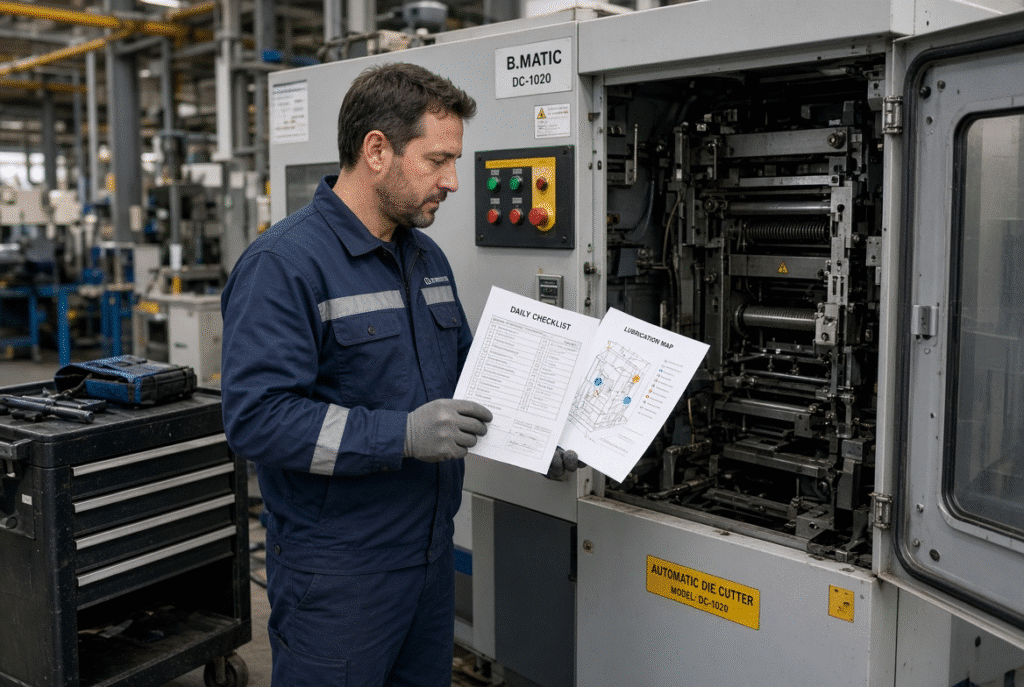
Daily Cleaning and Housekeeping Prevent Many Feeder and Delivery Stops
The following paper contaminants interfere with sheet feeding, sensors, suction, transport, registration, stripping and delivery: paper dust, loose fibers, coating residue, waste pieces, adhesive contamination, and packaging debris. Cleaning should be a process-control operation and NOT cosmetic housekeeping. Safe isolation of the area, as prescribed by the manufacturer’s procedure, must be followed before cleaning is allowed to be performed inside guarded areas or around moving parts.
Clean the Feeder and Sheet-Transport Path
Dust and loose paper fibres are gathered around suction points, transport belts, wheels, brush, sensors, side guides, support bars and sheet-pile surfaces in feeder areas. Poor feed consistency can be caused by contamination, which leads to missed feeds, double feeds, skew on the sheets, static issues or arrival at the front lay. Always clean as per the manufacturer’s instructions. Do not use compressed air in an uncontrolled manner around sensitive sensors and electrical equipment, and follow site procedures for dust removal and collection.
Remove Waste From the Die-Cutting and Stripping Areas
Leading to waste release, stripping, delivery or interference with sensors, moving mechanisms, waste pieces, loose fibers, damaged blanks or die-cut remnants. Sweep work area after each job and check for debris before next run. A misplaced piece of trash can cause future registration problems, jams, sheet damage, etc. It is important to recognize that if waste continues to build up it is not simply a cleaning issue; it is a tooling and/or stripping issue.
Maintain Delivery-Section Cleanliness and Stack Control
Delivery tables and piles, guides, photoelectric sensors, air-blowing equipment, anti-backflow equipment, stack-support areas should all be kept clean and unobstructed. The substandard delivery conditions lead to edge damage, unstable stack, false sensor signals, scuffing and handling delay in downstream. A clean and stable delivery area also enables operators to check samples and prevent finished printed packaging from getting damaged.
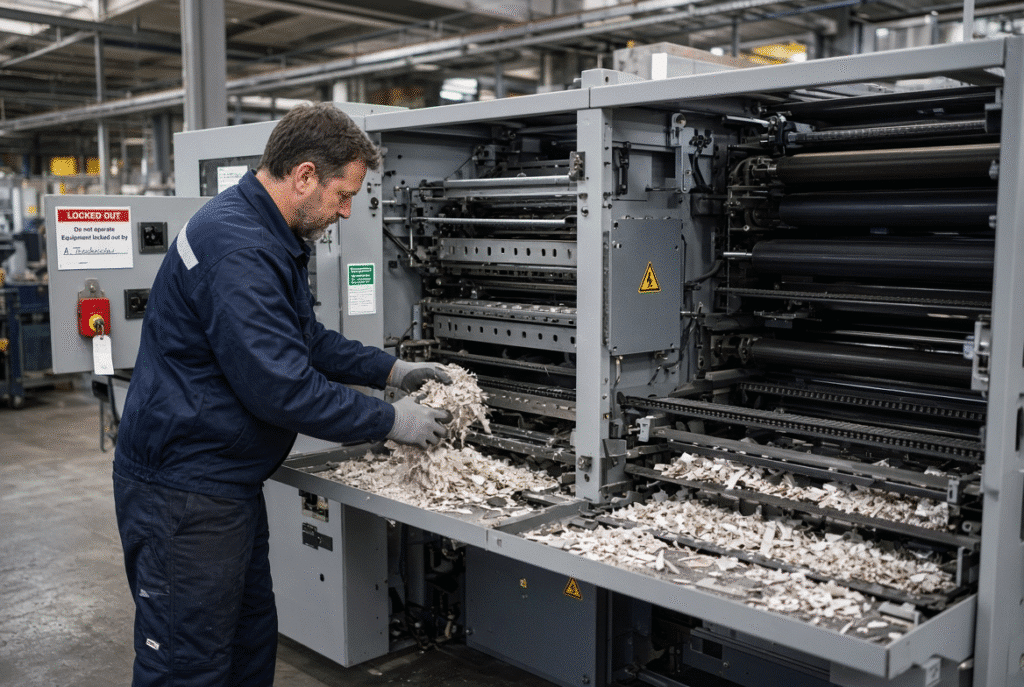
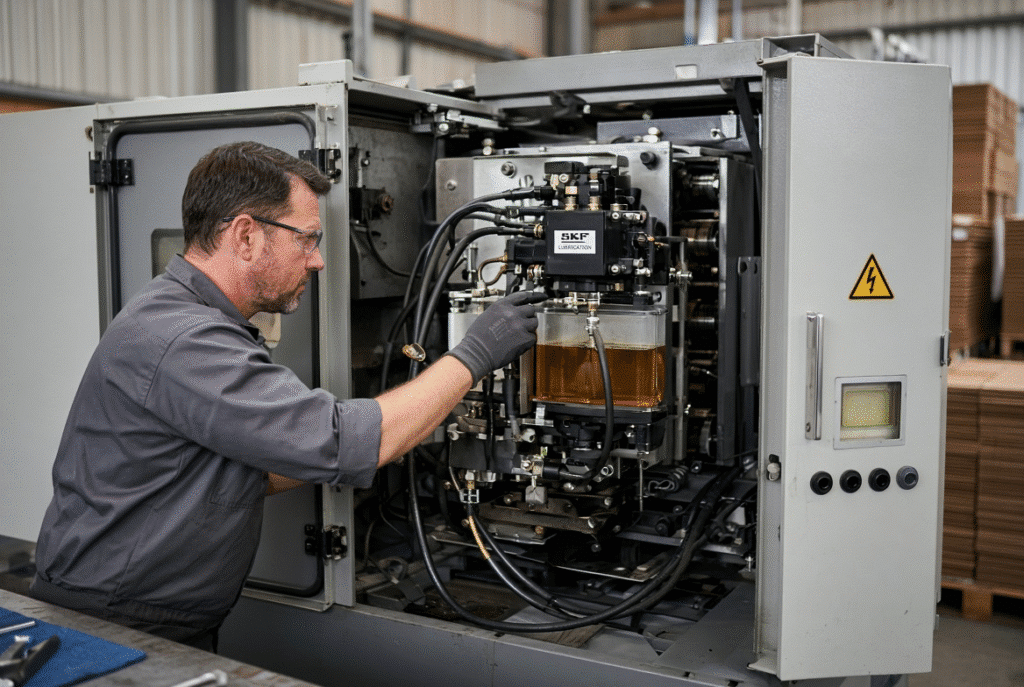
Lubrication and Mechanical Inspection Protect Long-Term Accuracy
It is important to lubricate because the automatic die cutting actions include repeated cutting, feeding, bearing, chain, gear and guide surface movement in the press, transmission and other mechanical interfaces. Insufficient lubrication or neglected leaks create additional friction, heat, wear, noise, vibration and quality variations. Lubricant, lubrication method, amount and frequency can only be supplied by the machine manufacturer. Do not mix products or change lubrication settings without appropriate technical advice.
Check the Lubrication System Before It Becomes a Failure Point
Only as per the machine’s approved inspection procedure, operators/technicians should inspect: Lubricant level; visible leaks; pump operation; line condition; alarm indication; and lubrication is not reaching intended locations. An automatic lubrication system is good for routine delivery, but not for removal of the need for verification. The official manual states that verification is required in machines with forced lubrication system and microcomputer electric lubrication pump like the D1060S. Never rely on oil type, pressure level or service interval without documentation.
Inspect Bearings, Chains, Gears, and Transmission Components
Mechanical wear can be determined by abnormal noise, heat, vibration or visible wear, contamination, incorrect chain tension, damaged gear teeth, or recurring timing problems. These conditions should be checked by maintenance personnel, following manufacturer’s recommendations, to replace worn parts before they become a production failure. More than just uptime, bearing and transmission issues impact motion repeatability, feeder timing, press behaviour, registration and cutting consistency.
Check Fasteners, Alignment, and Structural Condition
Fasteners, supports, mounts and mechanical alignments can be impacted by repeated operating loads. Loose fasteners or misaligned parts cause vibration, noise, uneven pressure, repeated adjustments and premature wear. Structural adjustments and alignment can only be carried out by professionally qualified technicians. Do not attempt to make unauthorized repairs to the press, frame, transmission or safety systems and report symptoms according to the escalation procedure.
Use Abnormal Noise and Vibration as Maintenance Data
Any change in sound, vibration, heat use, oil use, running action etc. should be noted along with job information, speed, material and machine condition. A trend is generally more beneficial than one observation. Compare the machine’s performance in similar repetitive jobs. The noise or vibration might only happen at specific speeds, materials, die layout, or certain points during the run; thus the maintenance team can investigate more efficiently.
Feeder, Registration, and Delivery Maintenance Protect Production Stability
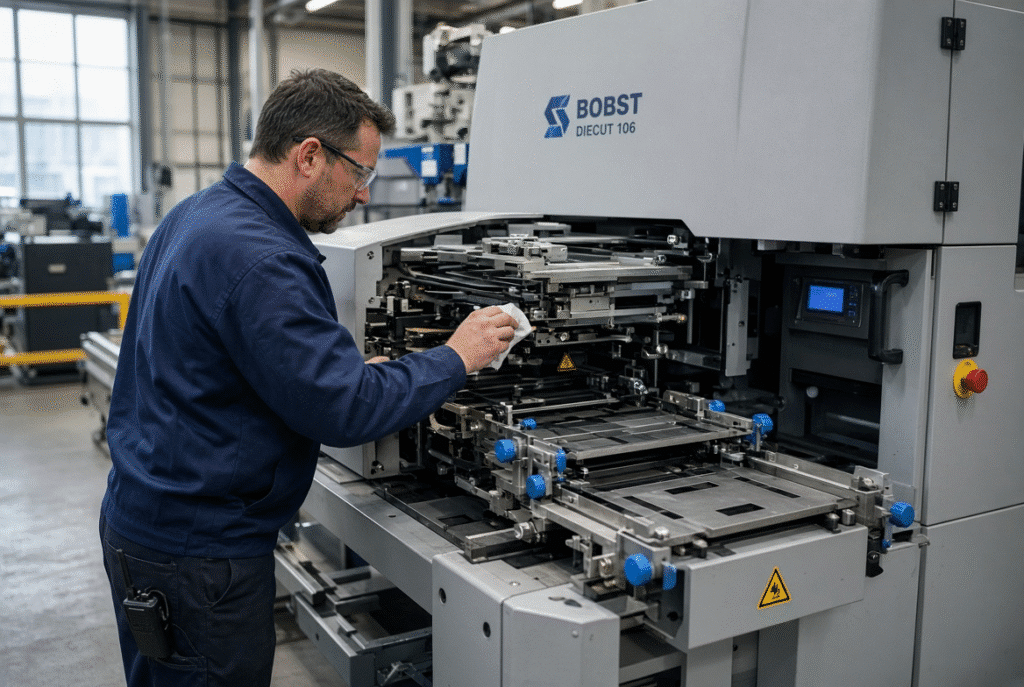
A surprising number of the seemingly “machine” problems start in the sheet-handling system. Regular inspection and cleaning of the suction of the feeders, air separation, transport belts, brushes, wheels, guides, sensors, front and side lays, gripper transfer and delivery control is required. These systems are essential to the maintenance of accepted output, print-to-die accuracy, feeder-stop reduction, and material protection.
Inspect Feeder Separation and Sheet-Transport Components
Dust, wear, contamination, deformation and correct adjustment of feeder suction parts, air-separation areas, belts, wheels, brushes, support bars, side guides and transport surfaces should be inspected based on the machine manual. Double feeds, missed feeds, skew, damaged edges or feeder stops are caused by worn or dirty components. When materials change, there is a need to review feeder settings. If the flat white board system is not working properly, the coated, laminated, curled or corrugated board may require adjustment.
Keep Sensors, Front Lays, and Side Lays Clean and Functional
Sheets are positioned and machines protected with photoelectric sensors, double-sheet detection, front lays, side lays, limit switches, position related components. When wiring, alignment, contact surfaces become worn, or dirt or paper dust gets in, false signals and inconsistent registration is created. When print-to-die alignment starts to wander, it could be the feeder condition, sheet edges, contamination of the sensor, front or side-lay set-up, gripper transfer, print variation or tooling; it’s not necessarily the press.
Maintain Delivery, Pile Lifting, and Sample-Checking Functions
All delivery mechanisms must be tested for smooth pile lifting, stable guides, sensor function, paper leveling, anti-backflow condition, and safe sample access. A delivery problem may result in stacking damage, scuffing on the sheets, missing quality issues, or forming a bottleneck in the downstream process. Regularly check completed stacks. Quality of delivery is a maintenance indicator as well as a final indicator of quality in the product.
Tooling, Cutting Plates, and Make-Ready Need Their Own Maintenance Routine
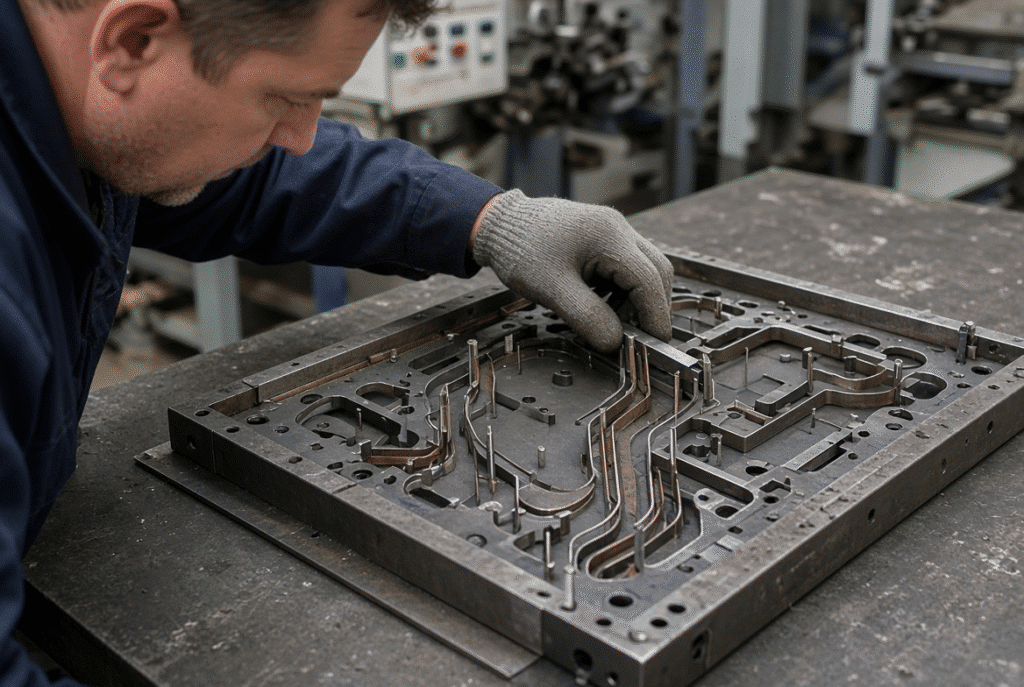
However, a machine can function mechanically well and still yield poor packaging if there is a lack of care for the die, a lack of cutting rules, lack of creasing rules, lack of ejection rubber, lack of cutting plate, lack of die frame, lack of matrix, or poor packing or make-ready. Poor tooling results in quality defects, press adjustments, waste-release and unplanned intervention, all of which are part of the downtime prevention process that includes tooling care. Plants need to differentiate between the problems caused by tools and machine capacity.
Inspect Dies Before and After Each Job
This should be inspected for dull or damaged cutting rules, broken or bent creasing rules, loose parts, damaged ejection rubber, contamination, corrosion and abnormal wear. Die storage should prevent moisture, impact, distortion and loss of identification of the dies. Sharpening or repair should only be done by qualified die makers. Die handling and inspection procedure of the plant are followed by operators.
Check Cutting Plate Condition and Packing Consistency
Damaged, worn and uneven cutting plates lead to imperfect cuts, uneven pressure, over packing, poor waste release and repeated setup time. Packing should be applied following approved make ready practice and be recorded for repeat jobs. If the hanging fibres occur in one area repeatedly, check the condition of the dies, cutting plate, packing, material variation and press set-up before adding more pressure across the board.
Protect Creasing Quality and Folding Performance
Whether cartons fold cleanly is influenced by crease rules, matrix systems, board condition, grain direction, pressure settings and make-ready. When carton is sent to folding-gluing, a crease problem is likely to occur. Flexed samples should be checked by maintenance/service and quality technicians along with flat blanks. Cracked creases, out-of-square panels, poor glue flaps and cartons that don’t square correctly generate downstream waste and customer complaints.
Keep Tooling and Job Records
For each job repeat, there should be a record of the die ID, material, condition of cutting-plate, make-ready notes, approved settings, common defects, inspection results and maintenance history. This enables operators and maintenance personnel to detect reoccurring issues rather than re-starting the diagnosis process.
Electrical, Pneumatic, Vacuum, and Safety-System Checks Must Be Planned
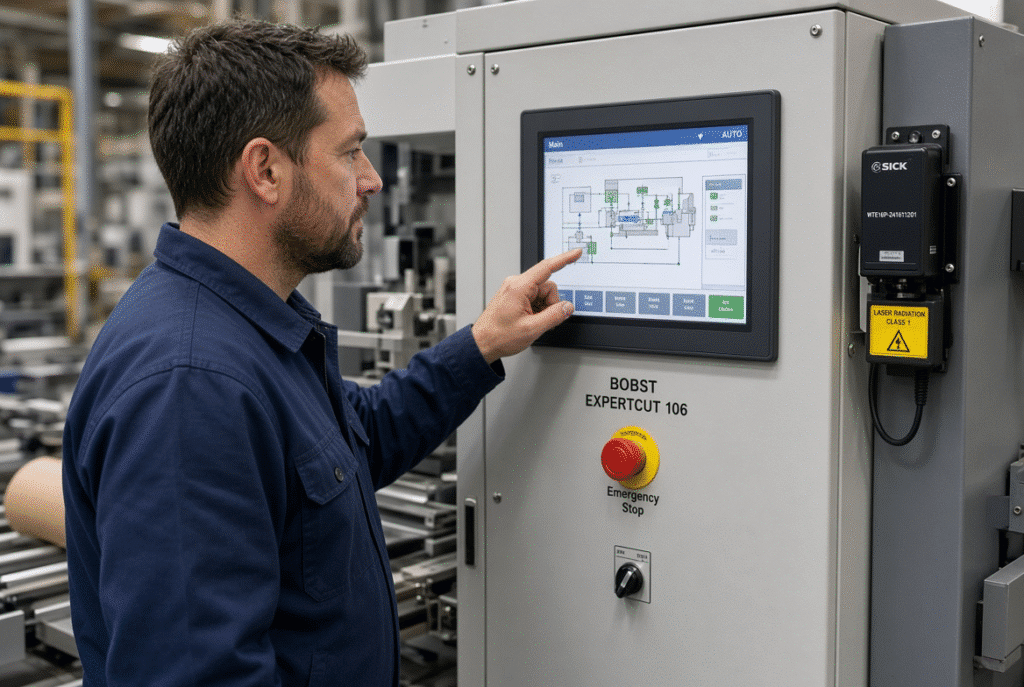
Automatic Die cutting Machines are made of a combination of mechanical and control systems. Inspect and maintain electrical panels, HMI and PLC controls, sensors, wiring, pneumatic components, vacuum systems, switches, emergency stops, guards, interlocks and photoelectric protection by qualified personnel. Operators shall not make changes or bypass electrical panels and safety circuits. After any fault in a protective system, the fault must be escalated and rectified per the manufacturer’s procedure prior to recommencing normal production.
Electrical Controls, Sensors, and HMI Alarms
Production teams are responsible for reporting repeated alarms, inconsistent sensor signals, damaged cables, odd HMI messages, heat/odors in electrical areas, loose cables, and intermittent control behavior. Technicians who are qualified evaluate electrical systems based on site safety requirements and manufacturer’s specification. Lens cleaning and electrical diagnosis and parameter changes are only to be performed by authorized personnel, while lens cleaning and checking accessible connections can be part of approved sensor operator tasks.
Pneumatic and Vacuum Components
Depending on the machine configuration, pneumatic and vacuum systems can be used to support clutching, feeder suction, air separation, sheet handling and more. Leaky air, moisture, contamination, pressure instability, leaky hoses and worn seals have an impact on machine performance. Examples of configuration have been documented for pneumatic components and vacuum pump on machines like the D1060S. Never either set or specify air pressure, pump service interval or replacement procedure without the official manual.
Guards, Emergency Stops, Interlocks, and Photoelectric Protection
Safety devices must be tested as recommended by the manufacturer and as required by the local regulations. Reducing operating risk is done with various types of guards, emergency stops, protective covers, limit switches and photoelectric devices that should not be bypassed for speed or convenience. If a safety device fails to perform its function, stop the machine and, before going back into production, follow the site’s escalation and repair procedure.
Create a Downtime-Reduction System, Not Just a Checklist
A checklist is only useful if the plant does all of the above: assigns responsibility, documents results, initiates corrective action, and investigates reoccurring issues. The maintenance must be built into the production scheduling process, tooling management, spare parts, operator training and quality data. The point is to have a useful reliability exercise and not a piece of printed information that is quickly forgotten.
Assign Clear Roles for Operators, Maintenance, and Supervisors
The operators are generally the best person to detect variations in sound, feed behavior, registration, delivery, waste, and product quality. Maintenance technicians perform authorized mechanical, electrical, pneumatic and safety maintenance. Supervisors are responsible for coordinating production planning, downtime windows, training and escalation. Each inspection point must have an owner, a time to inspect, a definition of an acceptable condition, a reporting method and an escalation path.
Maintain a Machine Log and Fault History
The maintenance record should contain the following information: Date, shift, machine number, job or material, the problem observed, the symptom, action taken, parts used, downtime time, technician, quality impact, follow up. Problems can then be analysed, not just dealt with as one-off occurrences. Coated sheet feeder stops repeatedly, for instance, can indicate a problem with the material preparation, worn suction elements, sensor fouling, or the wrong feeding method. Using logs, the team is able to see the pattern.
Plan Critical Spare Parts Before Failure
High-wear and high-risk parts should be determined by plants according to manufacturers’ recommendations, operating experience, lead time and the criticality of production. This can range from a variety of items such as feeder wear parts, sensors, belts, wheels, brushes, seals, filters, electrical relays, bearings, lubrication parts, pneumatic parts and tooling consumables, depending on the specific machine type. The final recommended package is provided by the machine manufacturer and represents the machine configuration and production environment of the buyer.
Review Downtime and Quality Trends Monthly
The following accepted output, unplanned downtime, feeder stops, scrap rate, maintenance work orders, recurring alarms, tool wear, spare part usage, registration defects, cutting defects and safety observations should be reviewed by management. The purpose is to find trends and to prioritize remedial activities. This review is to help you modify your training, maintenance planning, purchasing of spares, tooling methods and investment decisions on future machines.

Automatic Die Cutting Machine Maintenance Checklist
Important: Customize this checklist to meet the machine manufacturer’s manual, approved lubricants, site safety procedures, local regulations, production environment and requirements for qualified persons. Never work on electrical, safety system, press, transmission or guarded area work without appropriate authorization and isolation.
| Frequency | Area to Inspect | Typical Checks | Escalate When |
| Before each shift | General condition and safety | Check guards, emergency stops, visible leaks, abnormal debris, machine alarms, tooling installation, and obvious damage; follow approved start-up procedure | A guard, interlock, emergency stop, alarm, leak, tooling issue, or abnormal condition is found |
| Daily | Feeder and sheet path | Clean accessible dust and waste; inspect suction/air areas, belts, wheels, brushes, guides, sensors, pile condition, and sheet movement | Double feeds, missed feeds, skew, repeated feeder stops, damaged transport components, or false sensor signals occur |
| Daily | Die-cutting and delivery areas | Remove accessible waste; inspect die, cutting plate, delivery stack condition, paper damage, and sample quality | Incomplete cuts, cracked creases, poor waste release, pressure marks, edge damage, or unstable stacks appear |
| Daily | Lubrication observation | Check oil level, visible leaks, pump/alarm status, and approved lubrication-system indicators according to the manual | Low level, leak, alarm, abnormal noise, heat, or suspected lack of lubrication is observed |
| Weekly | Mechanical motion and transport | Inspect accessible belts, chains, wheels, brushes, guide surfaces, fasteners, and wear points according to approved procedures | Wear, looseness, contamination, abnormal tension, vibration, or repeated adjustment is found |
| Weekly | Registration and sensors | Clean approved sensor surfaces; inspect front/side-lay condition, photoelectric devices, detection functions, and recurring registration trends | Registration drift, false alarms, damaged wiring, dirty sensors, or repeated sheet-positioning issues occur |
| Weekly | Pneumatic/vacuum systems | Check accessible hoses, fittings, filters, drains, leaks, suction performance, and abnormal sound according to manual | Air/vacuum leak, pressure instability, moisture contamination, damaged hose, or weak feeding support is observed |
| Monthly / planned interval | Press, transmission, and bearings | Qualified technicians inspect drive components, bearings, chains, gears, intermittent mechanism, alignment, lubrication distribution, and wear | Abnormal noise, heat, vibration, wear, movement, oil contamination, or timing issues are found |
| Monthly / planned interval | Electrical and safety systems | Qualified personnel inspect electrical condition, HMI fault history, cables, relays, cabinet condition, guards, interlocks, E-stops, limit switches, and photoelectric protection | A safety device does not function correctly, recurring fault occurs, cable damage is found, or electrical abnormality is observed |
| Monthly / planned interval | Tooling and quality | Review die condition, cutting plate, packing, matrix, recurring defects, folded-carton performance, and job records | Tool damage, repeated quality defects, increasing setup time, or abnormal scrap trend is found |
| Planned shutdown | Full machine review | Perform model-specific deep inspection, cleaning, lubrication service, replacement of approved wear parts, safety review, documentation update, and operator feedback review | Any unresolved defect, overdue replacement, safety concern, or declining trend remains open |
| Long shutdown / storage | Preservation | Clean machine, protect tooling, follow approved corrosion/lubrication/storage procedures, and plan periodic checks | Rust, moisture, sticking components, degraded lubrication, or sensor/control issues are found before restart |
Turn this Checklist into a Plant owned routine, assign people, sign off, log defects, assign defect codes and ensure there are clear escalation rules. The checklist should be modified as per the material mix, factory working hours, repeat faults and manufacturer’s instructions.
Final Guidance: Reduce Downtime by Detecting Change Before Failure
Maintenance of automatic die cutting machine is not a production quality maintenance job. Inspection, cleaning, lubrication verification, feeder maintenance, use of tooling, ordered deliveries, machine and carton safety testing, spare parts planning and record keeping all support accepted output, carton quality, machine reliability, and operator safety.
Follow a methodical approach to the daily to planned shutdown maintenance routine, then develop it from fault history and official machine documentation. The aim isn’t to have a zero downtime environment, but to avoid unnecessary shutdowns and quickly address warning signals before they become issues.
Please refer to DAIS with the machine model, operating hours, material types, recurring feeder or quality issues, maintenance history, spare-parts requirements and destination country information on model-specific documentation, suggested service planning and available spare-parts support. The manufacturer’s current manual, which provides for automatic sheet feeding, a forced lubrication system, a microcomputer electric lubrication pump, photoelectric detection and a maximum working speed of up to 6,500 sheets per hour under suitable operating conditions, is the definitive guide for all service intervals and procedures for the models.