

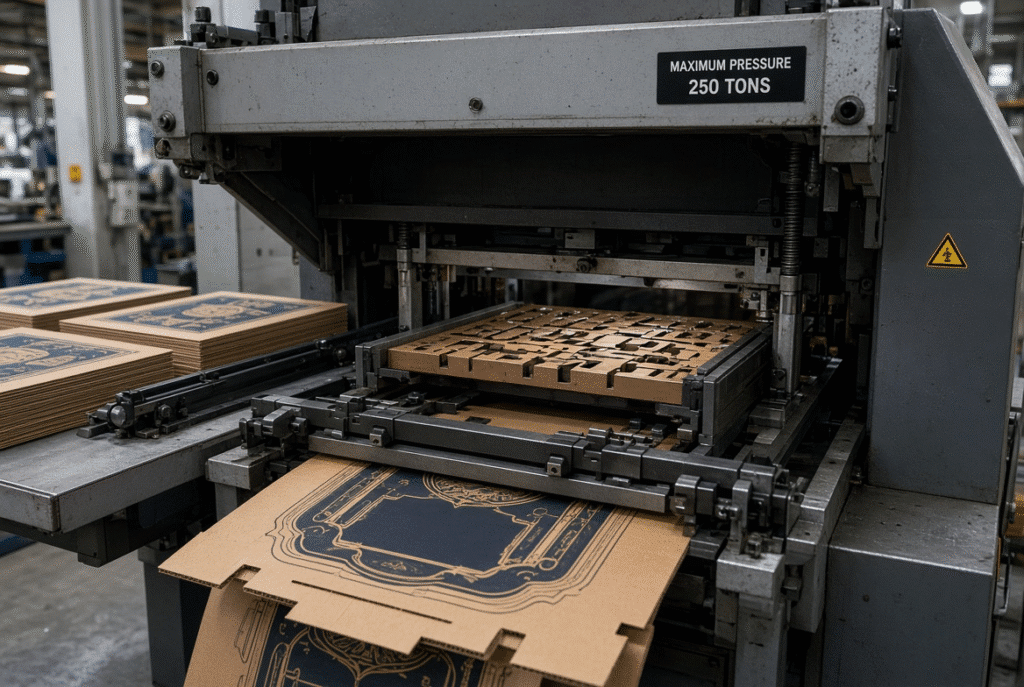
The 300 ton die cutting machine is designed to provide up to 300 ton of maximum working pressure for proper flatbed die-cutting applications. This rating alone does not ensure clean cuts or quality consistent carton. The actual performance will vary with the pressure applied across the die, the rigidity of the machine structure, the die height and condition, the thickness and flatness of the substrate, the accuracy of registration and the adjustments that the operator is making.
A lot of plants seem to think that more tonnage equals more better. The fact is that too much force could crack printed surfaces, lead to a shortened tool life, cause hidden defects that only show up when folding or gluing or cause damage to the board. Right pressure is the pressure that makes the cut and crease without excessive loading of the sheet or the press.
What Does “300 Tons” Mean in a Die-Cutting Machine?
The machine’s maximum working pressure under certain conditions is indicated as 300 tons. Every job should not use it’s weight and it should not be the pressure. The number indicates to a buyer the maximum pressure that the press can achieve. That limit is largely determined in conjunction with other factors such as effective die area, pressure bearing structure, material range and actual die tooling the plant will use.
Maximum Rated Pressure vs Normal Operating Pressure
In most production jobs, the rating is not set to its maximum. This is determined by the substrate, cutting and creasing rule length, die construction, product layout and area to be cut. The end result is controlled adjustment: enough pressure to cut and finish crease lines, no more. If all jobs are run at the ceiling, the rules will have a shorter lifespan, and the machine will be stressed and may damage the board.
How Pressure Is Distributed Across the Die Area
The total pressure is acting on the die board through the machine frame and die platform. If the distribution is uneven, in some areas of the sheet, the cut is clean and in other areas, it may be incomplete or over compressed. A typical case is that of a large multi-up layout where the outer blanks are released from the well, and the center or corner blanks contain waste or crushed edges. The real reason is not the overall tonnage, but how the force gets to all the active rules.
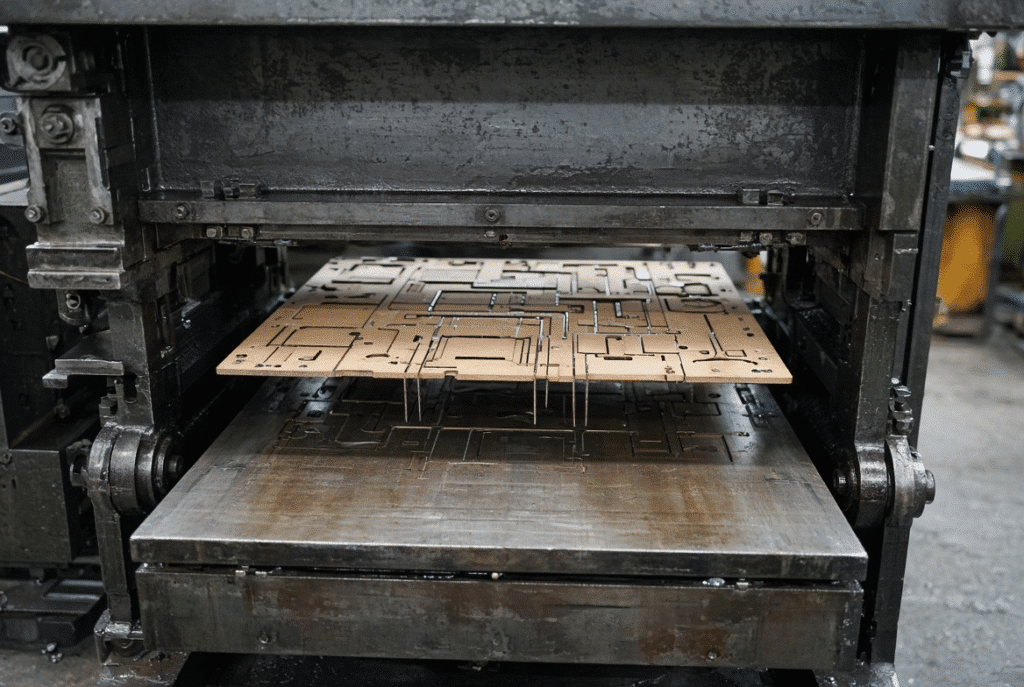
Why Pressure Rating Must Be Considered with Effective Die Size
The two machines may be able to handle 300 tons, but when the die area, frame stiffness, adjustment system and make-ready method are different, the two machines will act differently. It is important that this is a comparison of the maximum size that can be cut with the sample results and not just by the number of tonnes. The larger the active die area, the greater the force exerted over the length of the rules, making it important to maintain proper pressures for a larger area.
How Pressure Affects Cutting and Creasing Performance
There are two actions going on in the same stroke which are controlled by the pressure. Cutting rules should go to the desired depth in the substrate to be able to separate blanks nicely. The edges of the crease lines must be formed without breaking the board or the printed surface. This ratio of those two requirements affects carton quality.
Pressure and Cutting-Rule Penetration
Lack of pressure results in uncut fibers, waste attached, incomplete internal windows or blanks that don’t separate. The actual amount of force required depends on die height, the condition of the rules, board thickness and flatness of the die board. Everything else should be ruled out before increasing the pressure; first, check to see if the rules are sharp, if the die is seated properly, and that the substrate is in the recommended thickness range.
Pressure and Creasing Quality
There’s a different balance needed for creasing. Too little pressure causes the fold lines to be weak or inconsistent and eventually will crack or tear on the folder-gluer. Excess pressure will break the board, print the board or make over-creased lines which will make the board weaker. This is visible on glue flaps, panel folds and locking tabs which need to withstand repeated handling when folding carton.
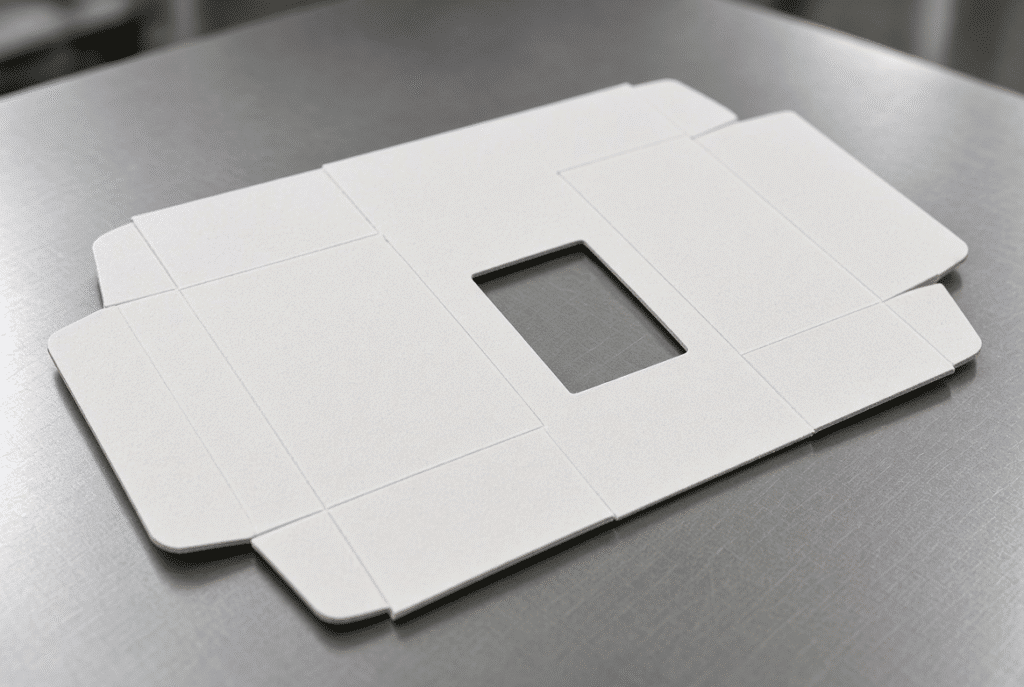
Pressure Effects on Waste Stripping
Clean die-cutting makes waste stripping easier. Incomplete cuts result in operators wasting additional time on manual breakout, as waste remains inside the cut. Too much pressure can cause product edges to be damaged or cause compressed zones which can snag the product in the stripping process. Even with pressure quality, the sheet must be properly aligned and tooling must be correct for the plate or needle stripping system to operate properly.
What Determines the Pressure a Job Actually Needs?
It is important to recognize that there is no single pressure setting that will be suitable for every material or die. There are multiple variables that determine the required force.
Substrate Type, Thickness, and Structure
There are different response of paperboard, coated board, thicker grey board, and selected corrugated grades. The thickness, stiffness, compressibility, surface coating, moisture content, and flute structure affect the penetration into and recovery from the stroke of the rules. Actual board sample testing is the only sure way to set pressure; tonnage tables are a starting point.
Die Area and Number of Products per Sheet
Pressure demand will vary depending on total cutting length, number of products in a multi-up layout and whether there are internal openings. The size of the sheet alone is not necessarily a determinant of the amount of force required, as the quality of the space and the amount of the rules is more important.
Cutting-Rule Height, Die Board, and Counter Material
How the machine pressure is translated into actual cutting and creasing results depends on the rule height, crease-rule configuration, die-condition, make-readys and counter plates. The entire tooling system should be considered in the pressure equation and not simply the press rating.
Sheet Flatness, Moisture, and Thickness Variation
Cutting differences occur locally due to warped sheets, moisture variation, etc. or to batches not being uniform in the material’s composition. Increasing the total pressure is unlikely to correct a material-uniformity problem, and can over-compress the areas that are cutting properly.
Too Little Pressure vs Too Much Pressure
A real-life example aids operators and process engineers in making rapid diagnoses when pressure-related problems occur.
| Condition | Typical Signs | First Checks Before Changing Pressure |
| Insufficient pressure | Incomplete through-cuts, waste still attached, internal openings not released, irregular cut depth, weak creases, more manual breakout, defects concentrated in certain sheet zones | Die height, rule condition, pressure distribution, registration, substrate thickness and flatness, make-ready |
| Excessive pressure | Crushed board, cracked printed surfaces, over-creased fold lines, damaged cutting rules or die board, marked product faces, higher stripping force, increased machine noise or vibration | Same checks plus confirm that make-ready is not already compensating for an uneven die |
Signs of Insufficient Pressure
There are not through-cuts, the waste is not removed, internal openings are not cut out, the depths are cut irregularly, the creases are not strong enough, more manual breakout, and defects are pooled in certain parts of the sheet.
Signs of Excessive Pressure
Crushed board, cracked print faces, fold lines too creased, stripping force higher than usual, machine noise and vibration, product faces marked, or cutting rules and die board is damaged
A Safe Adjustment Sequence
- Check the proper material and die for the task.
- Examine for sheet registration and flatness.
- Check the die board, cutting rules and crease rules.
- Check make ready and pressure distribution condition.
- Do small documented changes.
- Run test sheets (limited amount).
- Carefully inspect cuts, creases, waste removal and finished blanks.
- Write down the agreed setting for the next time.
Always observe the operating manual and safety precautions outlined in the machine manufacturer’s instructions.
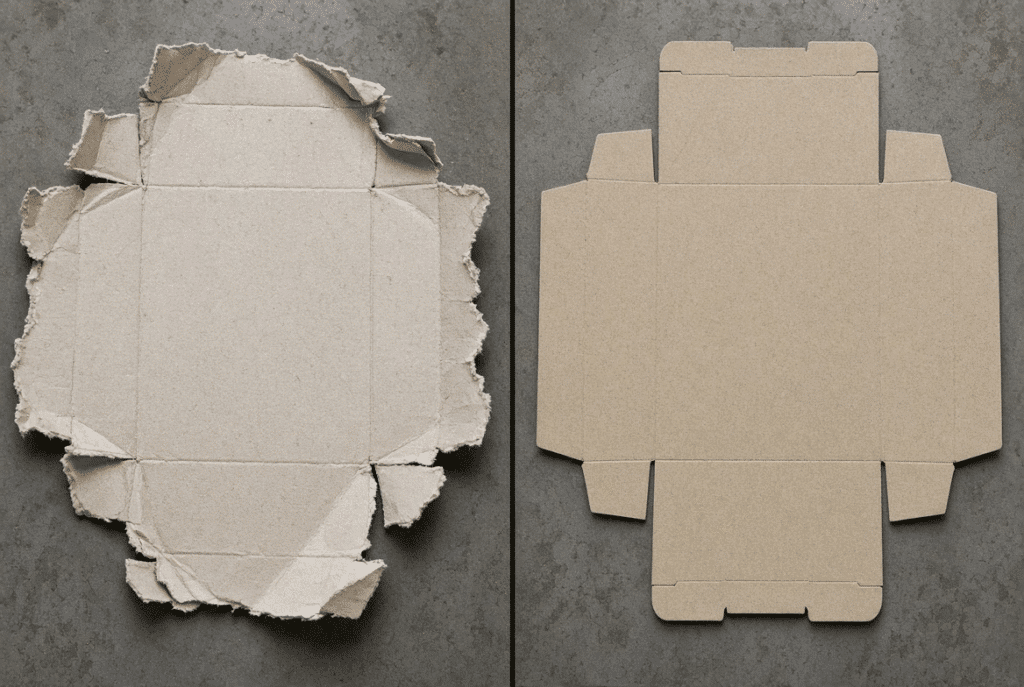
Machine Rigidity and Pressure Stability
Creating pressure is not the only part. The machine should stay aligned and apply the same amount of force to a thousand cycles.
Pressure-Bearing Components and Structural Stability
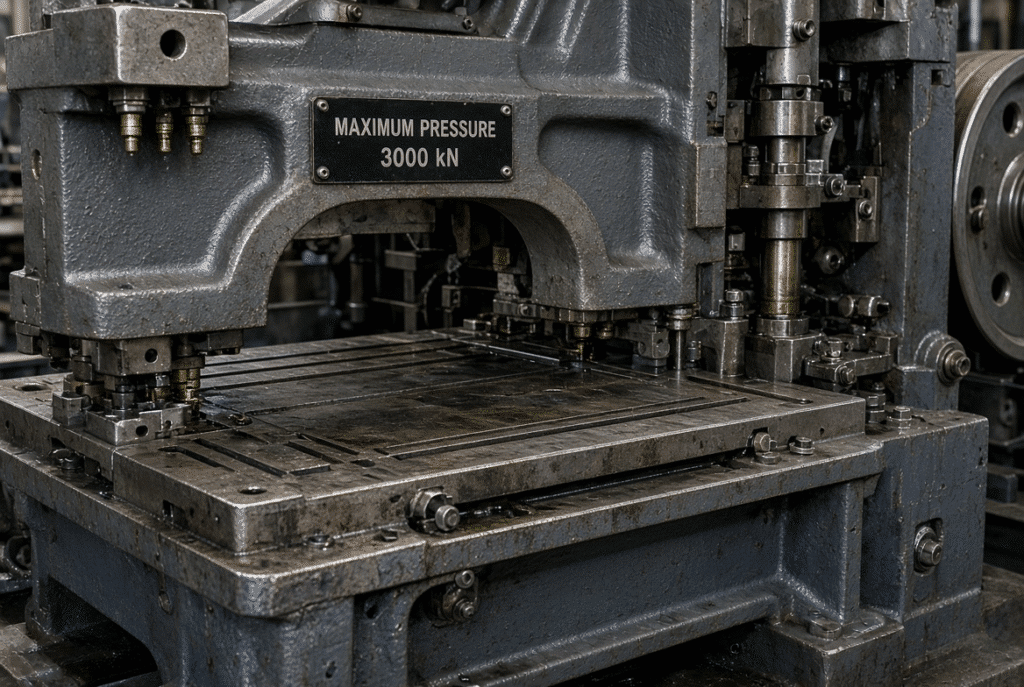
All frames, wallboards, die platforms, and drive components should be able to withstand deflection when loaded. In pressure-bearing parts of machines of the 300 ton class, high strength materials are usually used, including QT600-3 ductile iron. The material doesn’t make up for improper setup and maintenance.
Intermittent Motion and Pressure Consistency
Repeatability of positioning the sheet and the evenness of pressure applied are influenced by the die-cutting cycle, intermittent mechanism and drive timing. Consistent results from the first sheet to the last are provided by synchronized motion and stable pressure.
Lubrication, Wear, and Long-Term Performance
How 300-Ton Pressure Affects Different Packaging Applications
It is always dependent on the type of material used, the layout of the die and the machine configuration.
Folding Cartons and Printed Paperboard
Pressure should form clean edges, windows, locking tabs, glue flaps, and avoid damaging printed surfaces, with usable crease lines. For board grade and die design, 300 tons is a capacity, it is not a prescription.
Multi-Up Production and Complex Die Layouts
Every multi-up sheet must be equally pressed on the active area. Zones to be checked during trials: corner, center, internal-opening. Test out the most challenging layout instead of a one-up sample.
Selected Corrugated Board Applications
The pressure required depends on thickness, flute structure, stiffness and compression sensitivity. The force has to be adequate to cut through the die but not so great as to crush the flutes. Prove performance on actual board grade and product samples.
Waste Stripping and Finished-Blank Separation
The quality of the waste is dependent on the pressure quality in which it is separated after the cutting stroke. Compression that is not complete adds a lot to the manual work; over-compression may damage finished blanks or may hinder stripping tools. Even with the optional plate or needle stripping system, it is important to ensure the proper tooling and alignment.
How Buyers Should Evaluate a 300-Ton Die-Cutting Machine
Think of the pressure rating as a specification within a full production system.
Confirm the Actual Pressure Specification
Questions: Does 300 tons mean maximum working pressure, rated pressure or something specific by the manufacturer? Explain the functions of controlling, distributing, adjusting and monitoring pressure. The same amount of tonnage does not necessarily indicate the same performance from various suppliers.
Compare Effective Die-Cutting Size and Material Range
Verify maximum, die-cutting, minimum sheet size, gripper margin and practical material size range. Typically, machines in the DAIS 1060 series indicate a maximum sheet size of 1060 x 770 mm, a maximum die cutting size of 1050 x 760 mm, a minimum size of 400 x 260 mm, and a minimum gripper margin of 8 mm – always check the final configuration for the exact model being considered.
Ask About Pressure Distribution and Make-Ready
Ask questions about the machine’s ability to accommodate large dies, multi-up printing, die-board adjustment and pressure compensation. Always ask to see a demonstration or sample test, not just a figure from a catalogue.
Confirm Waste Stripping and Delivery Configurations
Find out if the waste is strippered by a plate or a needle; if optional or standard; and what frames, accessories, delivery functions and sampling features are provided. Have the final configuration on paper.
Review Maintenance, Training, and Service Support
Correct operation and maintenance is required for pressure stability. Inquire about: Installation, Operator Training, Lubrication Schedules, Spare Parts Availability, Troubleshooting Support, Any Engineer Overseas Costs, Warranty Coverage. In accordance with the written commercial terms.
How to Test Cutting Performance Before Purchase
Any pressure rating on paper is worthless compared to a representative sample test.
Prepare Representative Materials and Dies
Provide the real substrate, thickness, surface finish, real product drawing, the layout of the die, number of products per sheet, internal openings, and the desired production conditions. Make sure that you include the most challenging product, not just a simple one.
Inspect More Than Whether the Sheet Cuts Through
Check for cut completeness, crease quality, condition of product edges, damage to the print surface, registration, internal-opening quality, waste-stripping performance, product delivery organization and ease of setup and adjustment, repeatability across multiple sheets. If a clean cut does not yield a good folding or damaged print, it is not a successful production.
Record Pressure, Setup, and Quality Results
Record material, die, pressure setting, make-ready, setup time, speed, defects, corrections, acceptable result. Buyers can make objective comparisons of machines and operators have a reliable starting point for future production.
Summary Guidance – Match Pressure Capacity to the Complete Process
Pressure capacity of 300 ton is provided by a 300 ton die cutting machine, which is appropriate for the packaging application. Even distribution of pressure, tooling condition, material uniformity, registration accuracy, careful set-up, and structural stability are still important factors in cutting performance, along with controlled pressure. Choosing the machine on tonnage is not taking into account the factors that will give the finished product.
Check the effective die size, material range, waste stripping setup, pressure control method, sample results, maintenance, training and service support when assessing equipment. Submit your substrate, thickness, sheet size, die layout, samples of your product, internal-opening specifications and required cutting and stripping performance and DAIS can determine the suitability of the 300-ton flatbed die-cutting machine in a real production environment.