

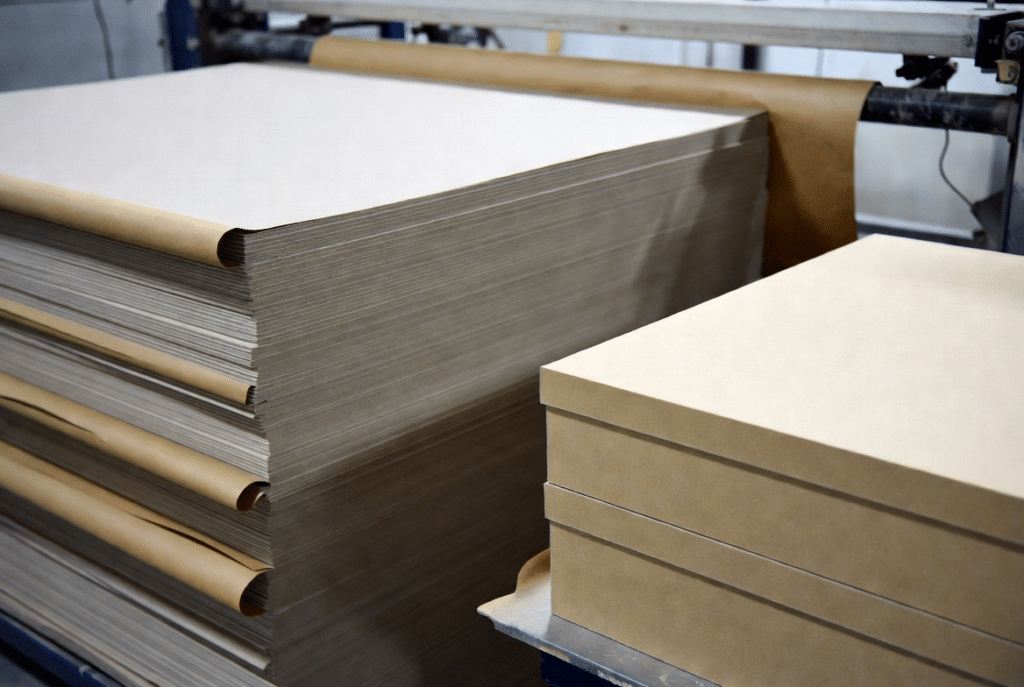
A laminating machine for rigid boxes must not only be the same size and speed as dense greyboard or chipboard, decorative wrap paper, edge coverage and forming steps to follow—it must also meet the requirements. Corrugated lines and rigid-box lines both secure paper-based materials, but address different issues. Corrugated equipment is designed as per flutes structure, large sheet handling and throughput. Rigid-box work is concerned with surface appearance, alignment of panels, glue uniformity, corner quality and compatibility with grooving, wrapping and pressing. The most frequent cause of the machine “marking”, “wrinkling” or “weak edges” when the greyboard and specialty papers go into the line is to treat the two as equal.
This article explores the differences in material, the definition of “lamination” in each process, what is and is not covered by the specifications, and a handy checklist to help buyers determine if an existing corrugated laminator can be adapted for the job or if a special configuration is needed.
Understanding the Structural Difference Between Corrugated and Rigid-Box Materials
It all begins with the board. In corrugated board, there is a fluted medium sandwiched between two liners. Rigid boxes are created using a thick dense flat structural board (usually greyboard or chipboard) that is wrapped in a thinner decorative overlay. The behavior of the two constructions is different when subjected to feed, pressure, glue and conversion downstream.
Corrugated Board: Flutes, Liners, Warp, and Compression
A corrugated sheet is a compressible sheet. Several factors influence the path that the sheet takes through a feeder and under pressure, such as flute direction, caliper variation, moisture and residual warps. Normally, good sheet support, reliable bottom feeding and pressure control, which ensure flute integrity, are offered by machines designed for this material. Even though the blank is slightly bowed during shipping, it needs to be flat and will not bow through the glue and press machine to be usable for die cutting and folding.
Greyboard and Chipboard for Rigid Boxes
Greyboard and chipboard are heavy and hard. They do not compress like flutes and don’t have the same surface absorption and edge behaviour as liner paper. There is no “standard” range of thicknesses, densities, flatness and moisture content that fits every rigid-box plant since these vary by supplier and box style. Before viewing any machine, the actual board grades, panel sizes and moisture condition that the buyer will be operating the machine on should be specified. This board is then later cut, grooved or assembled, so dimensional stability after lamination is as important as the bond that was created at that time.
Decorative Wrap Materials and Printed Surfaces
Art paper, coated stock, textured paper, foil-stamped paper, embossed paper or a variety of finishes can be used on the outer wrap. Friction, static behaviour and adhesive wetting change with ink coverage, with varnish, with soft-touch coating and surface texture change. A plain sheet of the same grammage fed and bonded differently than the final printed sheet that will be on the box. The most important thing is that trials should be conducted with the final decorative material, not an unfinished substitute.
Why Material Differences Change Machine Requirements
A machine that is chosen just because it’s called “paperboard lamination” is nearly always going to produce less than optimal results on either of the two applications. High volume and fluted safe pressure is required for corrugated work. The rigid-box work requires exact positioning, controlled glue film, surface protection and ease of handling of smaller/closer panels and/or delicate wraps without marking. The material combination and the finished product—not the generic process name—should drive the specification.
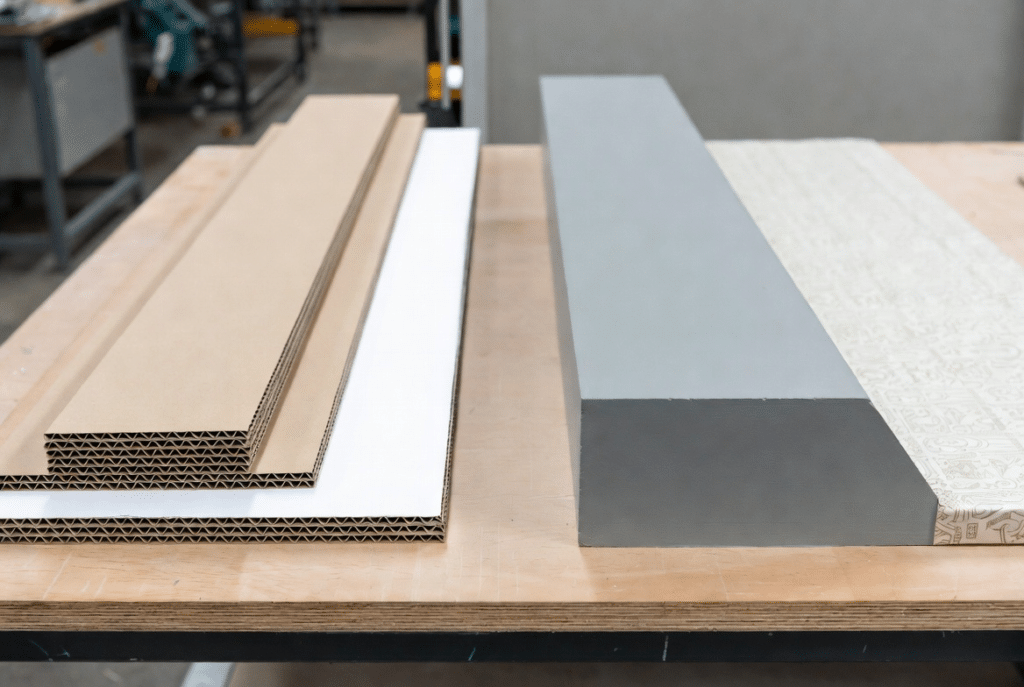
There are several different operations that are called “lamination”. Unless all laminating machines are doing the same work, there will be issues of quality and mismatching of equipment.
Sheet-to-Sheet Lamination for Corrugated Packaging
Typically, in corrugated production, a printed top sheet is laminated to a corrugated bottom sheet, adhesive is applied evenly and then the two sheets are pressed together and the resulting laminated blank is sent to a die-cutting, creasing or folding machine. The primary concerns are between artwork and board, protection of flute structure and high throughput. The laminated sheet needs to be dimensionally stable and have minimal warp to feed the next converting machines without causing jams.
Paper-to-Board Lamination for Rigid Boxes
Rigid-box lamination is usually used to attach a decorative wrap to dense board panels or to an existing construction. Some sequence it so that the paper is glued on top of the board, others sequence it so that the paper is glued underneath the board. In both cases, the paper must be correctly positioned in relation to the edges of the panel, grooves or wrap allowances and the bond should not be affected by subsequent corner forming and edge folding. The finished appearance of clean edges, no exposed board, continuous pattern is part of the quality standard.
Film Lamination Versus Structural Paper Lamination
Film lamination process is another process which is different in materials, adhesive and machine sections for gloss, matte, scuff or moisture resistance. In this article, the adhesive bonding of printed or decorative paper to rigid board or corrugated board, the structural step which forms the external surface of a gift or set-up box, is focused on.
Lamination as One Stage in the Rigid-Box Workflow
Lamination is only the first step in creating a rigid box, as it still requires board cutting, grooving, corner joining, wrap positioning, edge folding, pressing and final inspection. Even if the corners look fine when the sheet comes out of the laminator, they may not look that way when it arrives at the wrapping station.Corners may appear fine when the sheet is out of the laminator but not when it arrives at the wrapping station. Thus, when considering machine selection, it is not just the laminating unit itself that needs to be considered, but the entire sequence.
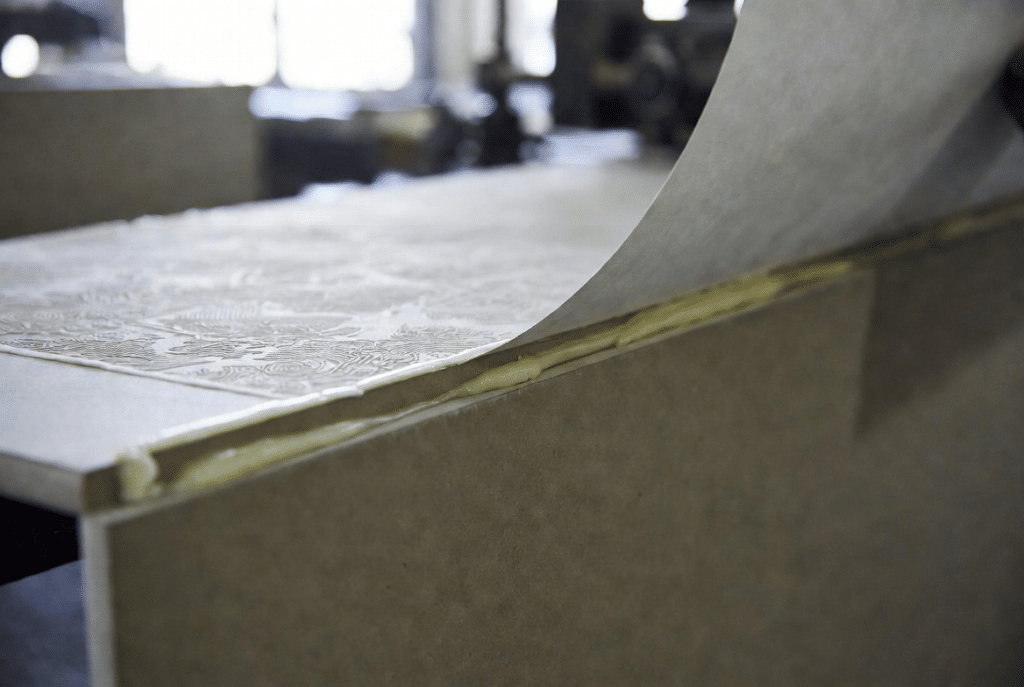
The differences in practice are reflected in the feeding, glue, pressure, registration and surface protection.
Feeding and Sheet-Handling Priorities
Corrugated feeders are suitable for processing relatively thick sheets with slightly lower warps and are suitable for continuous processing at high speed. Rigid-box work is generally performed with smaller panels, more closely spaced boards, usually a thin or fragile wrap paper. Suction pressure, separation, guide design and guide support tables should be verified with the material in question. Even with a reliable corrugated runner, a feeder can double-feed coated paper, or cause damage to the edges of stiff greyboard panels.
Glue Application and Adhesive Control
Hard surfaces, rigid boxes are evaluated at short distances. The glue streaks, squeeze-out or contamination that may be acceptable on a shipping carton are now evident flaws on a gift box. The adhesive film must be clean and even in the bonding area. The various qualities of board and coated decorative papers affect the characteristics of open time, viscosity and absorption in comparison to the porous corrugated liners. The machine and adhesive system need to be tested in combination with the materials to be used.
Pressure and Contact Requirements
Flutes on corrugated board may be crushed if too much pressure is applied, and weak bonds or air bubbles are left on rigid board if pressure is too light or uneven. If the press rollers or plates are set too aggressively, particularly if they are coated with soft-touch, foil or embossing, dense greyboard still marks will form. The quality of the bond is not just a function of the bond force, though it is certainly a factor; it is related to how well the adhesive is compatible with the material, how long the time is between putting the product together and applying the force, and the distribution of the force.
Registration and Visual Accuracy
The primary concern of corrugated registration is artwork to board and die-cut alignment. Rigid-box registration also must ensure that decorative paper stays in place in relation to the edges of the panels, hinges, lid-base connections and wrap turn-ins. The off-centre logo, irregular border or pattern that does not align across a corner will be obvious on a quality box.
Surface Protection and Cosmetic Quality
Premium rigid boxes are checked for scratches, pressure lines, glue marks, wrinkles, fibre lift and damage to the edges. These cosmetic requirements should be included in the machine acceptance test and not be an add-on after the production has begun.
Feeder and Positioning Requirements for Rigid-Box Materials
Handling Dense Greyboard and Chipboard Panels
Heavy panels must be supported, and accelerated, slowly and steadily. Damage to the edges, skew or stopping position inconsistencies will be evident later in the wrap and corners. When looking at the machine, buyers should ensure that it has minimum and maximum panel sizes and inquire how the guide and suction are set on a panel change.
Handling Thin, Coated, or Specialty Wrap Paper
Thin or smooth papers create static, and curl and friction issues. Coated surfaces, embossed or heavily printed surfaces mark more easily. Separation and transport conditions with the actual wrap paper to be used in production shall be shown by the supplier.
Positioning Paper Relative to Board Panels
Rigid-box positioning is seldom accomplished by aligning two large sheets in the middle of the box. Specific edges, grooves or wrap allowances frequently need to be referenced in the paper. Tolerances should be agreed upon before the trial to ensure that the parties understand what the term “accurate” means for the completed box.
Format Changeover for Multiple Box Styles
Rigid box plants perform short runs and high SKU variety plantations such as lid-base, book-style, drawer boxes and multi-panel constructions. The changeover time of guides, glue width, pressure and positioning recipes directly impacts productivity. Inquire about the way recipes are kept, and the time it takes to change size for a typical quantity of real materials.
Glue Application and Bonding for Gift Box Manufacturing
Uniform Glue Coverage on Dense Board and Wrap Paper
After wrapping, adhesive unevenness causes bubbles and/or surface defects (notices). Roller condition, metering accuracy and cleaning procedures are important. Full surface or controlled zone application may be required for some jobs while others are suitable for only a controlled zone to minimise squeeze-out at the edges.
Glue Absorption, Open Time, and Drying
The difference between dense greyboard and coated papers is that they absorb and release moisture differently than corrugated liners. A glue system that is good for one material can wet or dry the other material before the press. The bond strength should be tested following the actual open time and pressing cycle run on the production line.
Preventing Squeeze-Out, Staining, and Surface Damage
Adhesive marks and roller streaks are more noticeable on dark colours, soft-touch coatings and textured papers. These defects can be minimized by controlling the quantity of application, pressure, paper condition and the cleanliness of the rollers. Operators require a definite setting and not continual correction.
Adhesive Selection and Recyclability Considerations
The properties of the adhesive have an effect on both production performance and end-of-life behaviour. Some adhesives leave a residue, or are not easily separated, in paper recycling streams. It is important to consider all components—board, paper, adhesive, coatings, films and inks—as well as local mill processes and their suitability for recyclability. There is no single adhesive that is “recyclable” generally. Don’t believe claims just by reading the material labels: check with the adhesive manufacturer and accepted testing procedures.
Pressure, Pressing, and Surface Quality in Rigid-Box Lamination
Avoiding Excessive Compression on Rigid Board
Board can still be marked or defaced in dense board. Pressure tests over the entire thickness and paper surface range are more reliable than setting a machine scale. The intent is to make contact in such a way that there is no impression and no edge deformation, or a uniform contact.
Maintaining Flatness and Preventing Curl
Curl can be caused by adhesive moisture, paper tension, board moisture and asymmetric construction. The flat laminated panels are easier to be grooved, wrapped and stacked. Watch materials before and after lamination and note the settings for maintaining the flatness of the material combinations.
Floating or Adaptable Press Structures
Some machines incorporate floating or flexible press sections which are able to maintain contact despite material variations. Functional question is if the pressure is even throughout the working width if the board thickness or format changes. Inquire about the manner in which the operator adjusts the system and the limits of practice.
Cosmetic Inspection After Pressing
Check for smoothness, bubbles, alignment, edge coverage, glue marks, pressure lines and wrinkles after material is stabilised – not on exit from machine. These tests should be repeated after wrapping and final assembly.
Downstream Processes That Change the Machine Specification
Grooving, Scoring, and Panel Formation
Fold lines, hinges and corner geometry is defined by grooves and scores. These features and weak zones must not be affected by the laminated paper. Any machine should be evaluated by looking at panel drawings and groove layouts.
Corner Pasting and Box Assembly
The misaligned panels and missing bonds can be observed at the corners when the box is put together. Full process trials are more useful for complex constructions that have multiple pieces, inserts or hinged lids than flat-sheet trials.
Wrapping, Edge Folding, and Pressing
The wrap paper should be put in the correct position, have the correct glue condition and be flexible enough to turn the edges and tuck the corners. Even with the laminate will the paper look great on one sheet, but wrinkle, lift or crack during wrapping. Assess material in real-time, during the wrapping and pressing process in production.
Inspection and Premium-Finish Requirements
Box grades are given at arm’s length or less when finished. The acceptance standard includes colour consistency, pattern alignment, surface cleanliness, embossing and foil integrity and edge quality. They are not the only factors that ensure the saleability of a premium product.
Can a Corrugated Laminating Machine Be Used for Rigid Boxes?
A number of jobs can be done with an existing corrugated laminator for selected rigid board or paper-to-board applications. Maximum sheet size or overall “lamination” ability does not imply suitability for the job. It will be based on the Board thickness and density, the wrapping paper behaviour, the glue system, pressure range, registration accuracy, the feeder design, and the forming process downstream.
Situations Where Existing Equipment May Be Adaptable
If the rigid-board and wrap materials are within the proven range of the feeder, they will not be marked, double fed, or pressure will be controlled to ensure the finished boxes are to standard bond and cosmetic requirements, then adaptation may be possible. It can only be confirmed by a documented trial with real materials and any representative formats.
Warning Signs That the Machine Is Not Suitable
If you are finding yourself double-feeding, slipping the boards, wrinkling the paper, gluing, exposing the edges, making pressure marks, or constantly needing to manually intervene, you are likely facing a problem that is more than likely a fundamental mismatch.
Questions to Ask the Machinery Supplier
- What thickness and density was the machine able to successfully run?
- Will it work on paper with thin, coated, textured or embossed wrap papers?
- How to adjust and check pressure for rigid board?
- What types of glue can be used and what viscosity range?
- What is the relationship of paper to the edges and wrap allowances of the panel?
- Are samples available for the precise box design and embellishment?
- Did previous application tests get completed through wrapping and assembly?
- Are there installation, training and process support options available?
Ask for samples of similar rigid box work, not corrugated.
Common Mistakes When Selecting a Rigid-Box Laminating Solution
Assuming Maximum Sheet Size Equals Application Compatibility
A machine can take a large sheet size, but may not be able to handle a dense board, delicate paper, small panels or high-precision wrapping. All the above five factors should be assessed simultaneously.
Using Corrugated Glue and Pressure Settings Without New Trials
Excessive amounts of adhesive, surface marks or weak bond between the liner and the greyboard or the decorative paper are common settings problems that can result in corrugated products. Test quantity, viscosity, pressure, contact time, drying conditions of various materials in the order of controlled test.
Testing Only Flat Laminated Sheets
A flat sheet may pass inspection and fail when grooving, edge folding or corner forming. A minimum of one (or the most challenging corners, hinges or decorative features that require alignment) of the box styles should be done end-to-end.
Ignoring Specialty Paper and Surface Finishing
Friction, soft-touch coating, pressure tolerance and wetting of the adhesive are changed by foil, embossing, varnish and heavy ink coverage. Use end product samples in each trial.
Treating Sustainability as a Material Label
Paper-based or plastic-free does not necessarily mean that the package itself is recyclable in all markets. Along with local recycling guidance, adhesives, coatings, films and inks and specialty materials need to be evaluated. Just don’t take the word of any claims for granted, but validate them using well-known methodologies.
A Practical Specification Checklist for Rigid-Box Lamination
Material and Product Specifications
- Grade, thickness range and density and flatness of greyboard or chipboard
- Wrap paper type, grammage and surface finish (printed, coated, embossed, and foil)
- The dimensions of panels and sheet sizes.Panel and sheet sizes.
- Product Style, Construction, Edge-wrap and Corner requirement.
- The properties of the adhesive and the bond strength of the materials.
- Actual materials samples and product drawings.
Machine and Process Specifications
- Board and paper that is both dense and fragile.
- The accuracy of separating sheets, supporting and positioning, is ensured by the use of various mechanisms and devices.
- Apply glues with the proper width, even application and cleanability.
- Pressure range, adjustment method and surface protection
- Preparing recipes and switching them on the table.Recipe preparation and change over time.
- Delivering and stacking materials
Downstream and Quality Checks
- Set to work with the grooving, scoring, corner pasting and wrapping feature.
- Surface appearance, paper alignment, bond strength after forming and edge lifting after forming.
- Absence of wrinkles, bubbles, glue marks and pressure lines on the finished box
- Assessment parameters for cosmetic packaging for high quality products
The most important thing about the best machine is that it will make suitable finished boxes and not just pretty laminated sheets under real production conditions.
Final Recommendation for Gift Box and Rigid-Box Manufacturers
When choosing laminating machines for rigid boxes, never choose a specification by copying from a corrugated line. Start with the board, wrap, box making, surface finish, adhesive system, pressure behaviour and entire grooving, wrapping, assembly process. The machine that would be suitable for making gift-box and rigid-box production should provide clean and accurate material with good bonding, which can meet all the following production requirements without any cosmetic and structural defects.
Create real samples of greyboard and decorative paper, provide box drawings and establish bonding and cosmetic acceptance. Ask for a full process trial which includes wrapping and end assembly – then compare the results with any corrugated equipment that is currently in place. That documented trial is the most reliable grounds for the purchase decision.