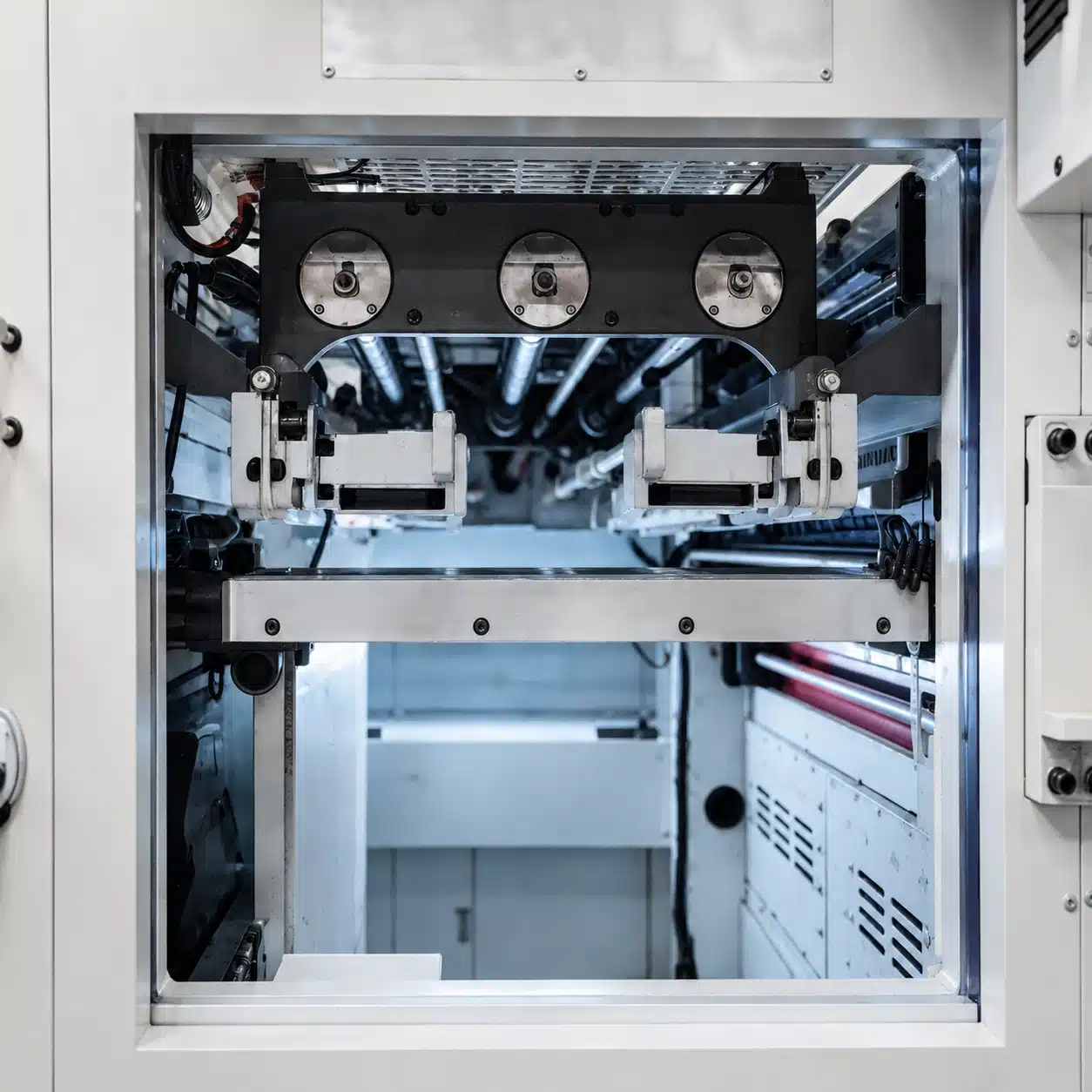
Large-Format Paperboard and Corrugated Converting
D1300 Semi-Automatic Flatbed Die Cutting Machine
The DAIS D1300 combines operator-controlled sheet feeding with precise registration, heavy-duty flatbed die cutting and organized sheet delivery. It is engineered for large paperboard, cardboard and corrugated sheets where production flexibility, dependable pressure and straightforward operation are essential.
- 1300 × 950 mm
- Maximum Sheet Size
- 350 Tons
- Maximum Die-Cutting Pressure
- 4200 Sheets/Hour
- Maximum Mechanical Speed
Product Positioning and Ideal Users
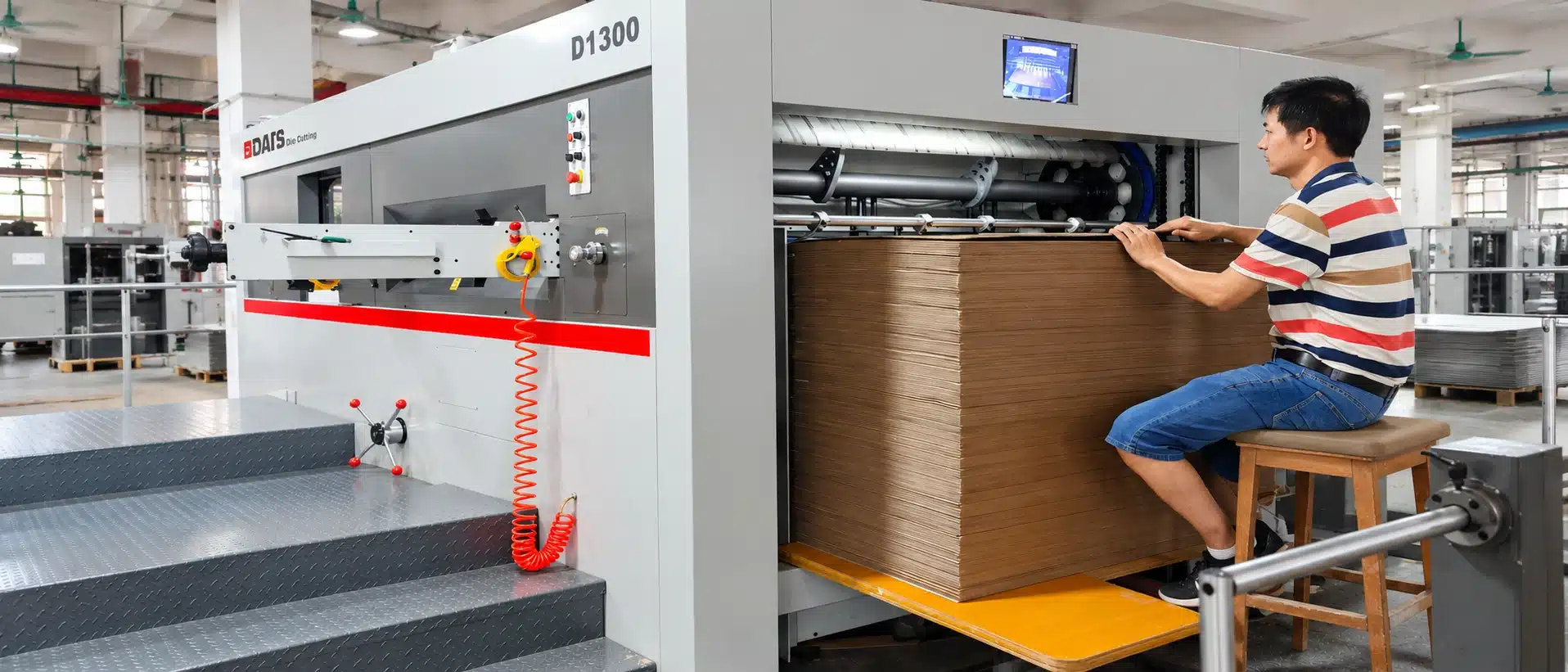
The D1300 is designed for packaging converters that need a large-format die-cutting platform without the investment and production complexity of a fully automatic feeding system. The operator introduces and positions each sheet at the feeding station, while the machine provides controlled registration, gripper transfer, flatbed die cutting and organized delivery.
Its semi-automatic operating concept is especially practical for short and medium production runs, frequent job changes, mixed sheet sizes and materials that require closer operator control during feeding.
Ideal for
-
01
Folding Carton Manufacturers
Factories processing large or heavy paperboard sheets for cartons, sleeves and packaging components.
-
02
Corrugated Packaging Converters
Plants working with corrugated sheets up to 8 mm thick for cartons, inserts and protective packaging.
-
03
Flexible Packaging Production
Manufacturers handling varied orders, changing formats and applications that do not require continuous automatic feeding.
-
04
Production Upgrades
Companies moving from manual platen cutting toward more controlled registration, higher pressure and organized sheet delivery.
Applications and Compatible Materials
The D1300 is developed for large-format paperboard and corrugated converting. Its usable range covers packaging work that requires cutting, creasing or a combination of both processes, subject to the selected die and material condition.
-
01
Folding Cartons
Die cutting and creasing for large paperboard cartons used in food, cosmetics, pharmaceuticals and consumer products.
-
02
Corrugated Packaging
Processing corrugated sheets for shipping cartons, protective packaging and structural inserts.
-
03
Retail and Display Packaging
Large-format display cartons, promotional structures and point-of-sale packaging.
-
04
Industrial and Shipping Packaging
Heavy-duty board components, dividers and transport packaging for industrial products.
Material Range
≥250 g/m²
Paperboard
≤8 mm
Corrugated board
Actual material suitability depends on sheet flatness, flute profile, surface condition, die layout and feeding condition. Sample testing is recommended for materials or applications outside normal production experience.
D1300 Technical Specifications
The following values describe the standard D1300 machine. Final technical specifications and supply scope should be confirmed in the technical agreement and sales contract.
| Parameter | D1300 Specification |
|---|---|
| Die-Cutting Type | Flatbed die cutting |
| Maximum Sheet Size | 1300 × 950 mm |
| Minimum Sheet Size | 550 × 480 mm |
| Maximum Die-Cutting Size | 1290 × 920 mm |
| Minimum Gripper Margin | 8 mm |
| Maximum Die-Cutting Pressure | 350 tons |
| Paperboard | ≥250 g/m² |
| Corrugated Board | ≤8 mm |
| Parameter | D1300 Specification |
|---|---|
| Die-Cutting Accuracy | ±0.25 mm |
| Maximum Mechanical Speed | 4200 sheets/hour |
| Maximum Feeding Pile Height | 1550 mm |
| Maximum Delivery Pile Height | 1250 mm |
| Main Motor Power | 15 kW |
| Total Installed Power | 18.5 kW |
| Approximate Machine Weight | 15 t |
| Overall Dimensions (L × W × H) | 5846 × 4245 × 2332 mm |
Maximum mechanical speed is not a guaranteed production output. Actual operating speed depends on material type, sheet size, board condition, die layout, feeding stability, operator setup and required product quality.
Discuss Your Requirements
Semi-Automatic Feeding and Precision Registration
The D1300 uses operator-controlled sheet feeding to provide direct control over large, heavy or varied materials. Each sheet is introduced at the feeding station and aligned against the registration system before being transferred into the die-cutting unit.
-
01
Operator-Controlled Sheet Feeding
The operator can observe the condition and position of every sheet before it enters the machine. This is practical for corrugated board, heavy paperboard, mixed formats and production with frequent job changes.
-
02
Front and Side Registration
Front and side positioning references help the operator establish a stable sheet position before gripper transfer, supporting consistent cutting and creasing registration.
-
03
Stable Gripper Transfer
After registration, the gripper bar carries the sheet through the die-cutting process in a controlled movement, reducing unnecessary sheet movement between registration and cutting.
-
04
Flexible Job Handling
The semi-automatic feeding concept allows production teams to handle different sheet sizes and board conditions without the complexity of a fully automatic feeder.
Heavy-Duty Die-Cutting and Drive System
The die-cutting section is designed to combine structural rigidity, controlled pressure and stable transmission for large-format paperboard and corrugated production.
-
01
High-Rigidity Platen Structure
Key cast structural components use QT600-3 ductile iron to support rigidity and long-term stability under repeated die-cutting loads.
-
02
Up to 350 Tons of Pressure
The flatbed die-cutting unit provides a maximum pressure of 350 tons for cutting and creasing large paperboard and corrugated sheets within the specified material range.
-
03
Crankshaft and Worm-Gear Drive
The crankshaft and worm-gear transmission arrangement transfers power through the die-cutting cycle and supports controlled platen movement.
-
04
Intermittent Transmission
The intermittent transmission coordinates gripper-bar indexing with the die-cutting cycle for stable sheet movement through the machine.
-
05
Pneumatic Chase Locking and Fine Adjustment
Pneumatic locking helps secure the die-cutting chase during operation, while the fine-adjustment system supports accurate production setup.
-
06
Forced Lubrication
The forced lubrication system supplies oil to critical transmission positions, supporting stable operation and routine mechanical protection.
Electrical Control and Operator Safety
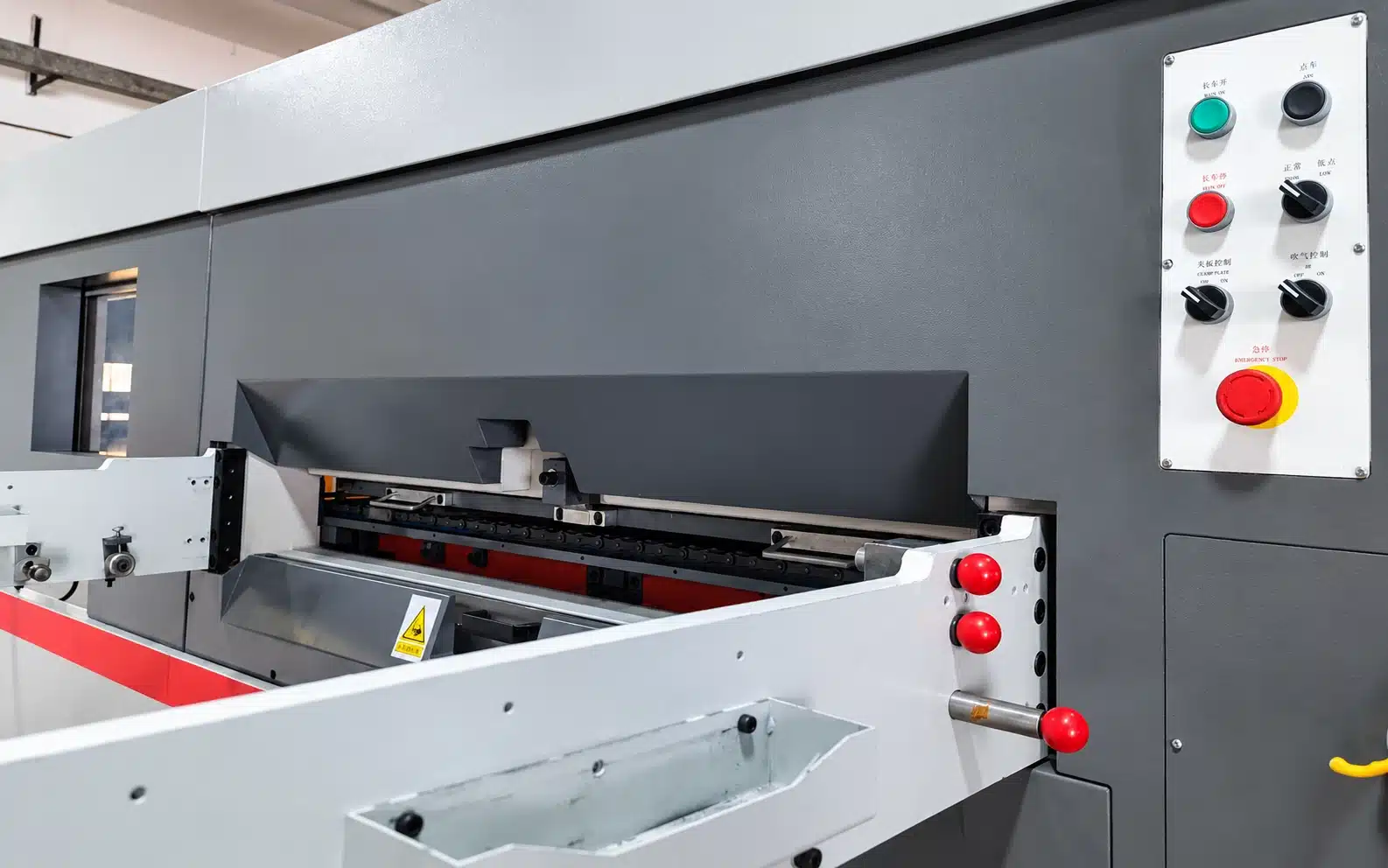
The D1300 centralizes machine settings, operating status and system monitoring to support straightforward operation and faster fault checking.
-
01
PLC Control
The PLC coordinates the main machine functions and operating sequence through a centralized control system.
-
02
15-Inch Human-Machine Interface
The 15-inch interface provides access to operating settings, machine status and diagnostic information in one location.
-
03
Operating Monitoring
Sensors and limit switches monitor key operating positions and help confirm that machine movements occur in the required sequence.
-
04
Electrical and Mechanical Protection
Circuit protection and torque-limiting safeguards help protect the machine when abnormal resistance or operating conditions occur.
-
05
Operator Safety Devices
Safety guards, interlocks and emergency-stop controls are integrated around critical operating areas. Operators must follow the supplied operating and safety instructions at all times.
Electrical component brands and detailed configuration are subject to the final technical agreement and sales contract.
Organized Sheet Delivery
After die cutting, the delivery section helps collect and organize sheets for inspection, removal and transfer to the next production stage.
-
01
Sheet Leveling
The delivery mechanism helps guide finished sheets into a more consistent stacking position.
-
02
Two-Way Air Assistance
Air assistance supports sheet separation and placement during delivery, particularly when working with larger sheets.
-
03
Photoelectric Detection
Photoelectric monitoring helps detect delivery conditions and coordinate the related delivery movements.
-
04
Automatic Pile Lifting
The delivery platform adjusts with the accumulating sheet pile to support continuous collection within the specified delivery height.
-
05
Anti-Return Mechanism
The anti-return arrangement helps limit backward sheet movement during the delivery process.
-
06
Non-Stop Sampling
The sampling arrangement allows operators to remove inspection samples during production without unnecessarily disturbing the complete delivery pile.
Standard Configuration and Included Accessories
The following list provides a practical reference for the main systems and standard supply associated with the D1300. Final component specifications, quantities and brands must be confirmed in the signed technical agreement.
Reference Machine Configuration
- Heavy-duty flatbed die-cutting unit
- Intermittent gripper transfer system
- Pneumatic die-cutting chase locking
- Die-cutting pressure fine-adjustment system
- Forced lubrication system
- PLC control with 15-inch human-machine interface
- Operating detection, circuit protection, torque limiting and safety devices
- Sheet delivery and stacking system
Standard Supply
- One complete D1300 machine
- One cutting steel plate installed in the machine
- Two die-cutting chases or frames, with one installed and one packed
- One gripper bar
- Ten spare gripper teeth
- One manual waste-cleaning unit
- One toolbox with standard supplied tools
The final standard supply, spare parts, component brands and optional equipment are determined by the confirmed machine configuration and sales contract.
For production that requires continuous automatic feeding, ask DAIS about the D1300S Automatic Die Cutting Machine.
Installation Footprint and Site Planning
The D1300 has overall machine dimensions of 5846 × 4245 × 2332 mm and an approximate machine weight of 15 t. These figures describe the machine itself and do not represent the complete operating area required around it.
Before shipment, the installation area should be planned for machine access, feeding and delivery operation, electrical-cabinet access, routine maintenance, material movement and safe operator clearance.
Site Planning Checklist
-
01
Confirm a level foundation with sufficient load capacity for the machine and operating conditions.
-
02
Reserve suitable clearance around the feeding, die-cutting, delivery and electrical areas.
-
03
Confirm the lifting route, workshop entrance and unloading plan before the machine arrives.
-
04
Prepare the electrical supply according to the final electrical specification and local requirements.
-
05
Plan safe movement routes for raw sheets, finished piles, operators and material-handling equipment.
-
06
Review the final installation drawing supplied with the confirmed order before foundation or utility work begins.
Manufacturing and Quality Control
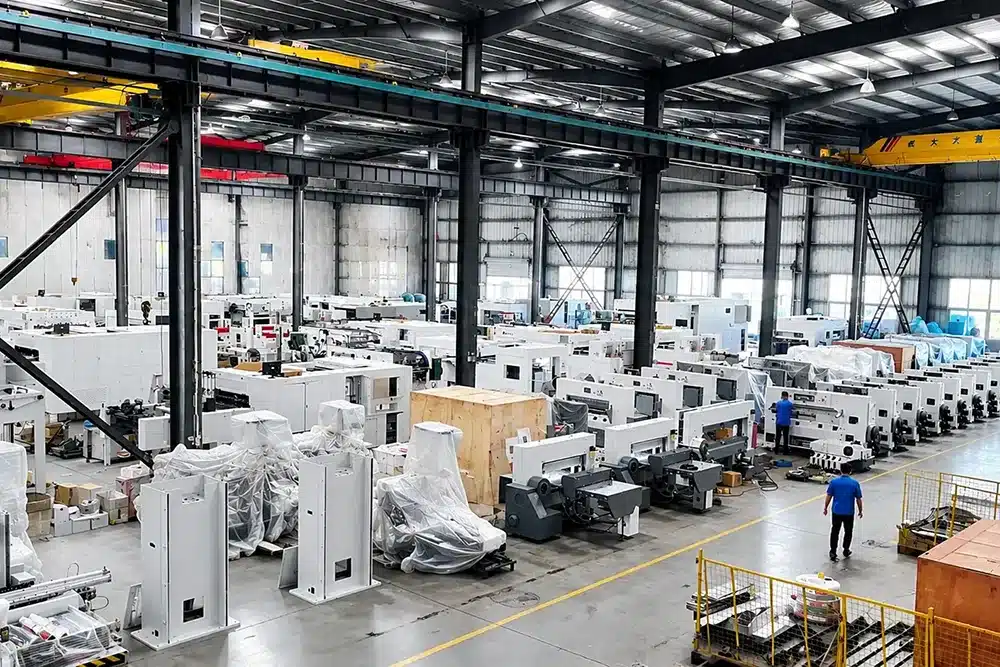
DAIS has manufactured post-press converting equipment since 1993. Its production base covers approximately 50,000 square meters and operates more than 100 CNC machining units. DAIS equipment has been supplied to customers in more than 50 countries.
Manufacturing control covers key-part machining, component inspection, machine assembly, alignment, test running and final inspection before packing. The objective is to verify mechanical movement, operating functions and the confirmed machine configuration before dispatch.
-
01
Precision Machining
Key mechanical components are processed and checked according to the applicable production requirements.
-
02
Controlled Assembly
The machine is assembled and aligned by production technicians according to the model configuration.
-
03
Test Running
Main movements, control functions, safety devices and operating sequences are checked before release.
-
04
Pre-Shipment Inspection
The machine configuration and supplied accessories are reviewed against the confirmed order before packing.
Worldwide Shipping
Large-format die-cutting equipment requires model-specific protection, fixing and loading. DAIS plans the packing and container-loading arrangement according to the final machine configuration, destination and agreed shipping conditions.
Before dispatch, major components are protected for transportation, accessories are inventoried, packages are marked and the machine is secured for loading. Shipping documents and handover information are prepared according to the confirmed order.
-
01
Export-Suitable Protection
Machine surfaces, electrical areas and separately packed components are protected according to the agreed shipping method.
-
02
Secure Loading
The machine and packed components are positioned and fixed to reduce movement during transportation.
-
03
Packing Documentation
Packing lists and package identification help the customer check the delivered machine and accessories.
-
04
Destination Coordination
Shipment planning is coordinated according to the destination, delivery terms and confirmed logistics arrangement.
The exact packing method, container arrangement and shipping scope depend on the final machine configuration and sales contract.
Installation and After-Sales Support
DAIS provides technical support for installation preparation, commissioning, operator training and troubleshooting. The exact service scope is confirmed according to the machine configuration, destination and sales contract.
-
01
Pre-Installation Guidance
Site, electrical, lifting and access requirements can be reviewed before the machine arrives.
-
02
Installation and Commissioning Guidance
Remote technical guidance is available to support installation checks, commissioning preparation and initial operation.
-
03
Operator and Maintenance Training
Training can cover machine operation, production setup, routine inspection, lubrication, safety and basic troubleshooting.
-
04
Troubleshooting and Spare-Parts Support
Technical communication and spare-parts coordination are available for confirmed machine and service requirements.
Overseas Onsite Service
Where overseas onsite service is required, the service content, schedule, visa arrangements, travel, accommodation and related charges must be agreed in the contract before dispatch.
Warranty
The standard warranty period is 12 months from commissioning, subject to the terms, exclusions and responsibilities defined in the sales contract.
Product Information
Frequently Asked Questions
Clear technical information for planning, material evaluation, installation and production setup.
What materials can the D1300 process?
The standard material range includes paperboard of at least 250 g/m² and corrugated board up to 8 mm thick. Actual suitability depends on sheet flatness, flute profile, surface condition, die layout and feeding condition. Sample testing is recommended when material behavior is uncertain.
Is the D1300 a fully automatic die-cutting machine?
No. The D1300 is a semi-automatic flatbed die-cutting machine. An operator introduces and positions each sheet at the feeding station, after which the gripper system transfers the registered sheet through die cutting and delivery.
What are the maximum sheet and die-cutting sizes?
The maximum sheet size is 1300 × 950 mm, and the maximum die-cutting size is 1290 × 920 mm. The minimum sheet size is 550 × 480 mm.
What pressure and die-cutting accuracy does the D1300 provide?
The maximum die-cutting pressure is 350 tons, and the specified die-cutting accuracy is ±0.25 mm. Actual results depend on correct machine setup, die condition, material stability and operating practice.
What is the production speed of the D1300?
The maximum mechanical speed is 4200 sheets/hour. Actual production output depends on substrate, sheet size, board condition, die layout, feeding stability, operator setup and the required quality level.
Is the D1300 suitable for frequent job changes?
Yes. Its operator-controlled feeding concept is suitable for short and medium runs, changing sheet formats and jobs that require closer control of individual sheets. Changeover time still depends on the die, material and production setup.
What site and electrical information is needed before installation?
The machine measures approximately 5846 × 4245 × 2332 mm and weighs approximately 15 t. The main motor is 15 kW, and total installed power is 18.5 kW. The final installation drawing, electrical specification, foundation requirements and operating clearances must be confirmed before site preparation.
What installation and after-sales support is available?
DAIS can provide pre-installation guidance, remote commissioning support, operator training, troubleshooting and spare-parts coordination. Overseas onsite service can be arranged when required, with the scope and related costs confirmed in the sales contract. The standard warranty is 12 months from commissioning, subject to the contract.
Start Your Project
Discuss Your D1300 Application
Tell us about your material, sheet size, packaging application and production target. Our team will review the information and help define an appropriate D1300 configuration for your project.
Please Include
- Material type and thickness
- Maximum and minimum sheet sizes
- Finished product or packaging application
- Cutting, creasing or embossing requirements
- Expected production output
- Factory power supply
- Destination country and port
Machine configuration, pricing, delivery time, shipping scope and service arrangements are confirmed according to the final technical agreement and sales contract.