

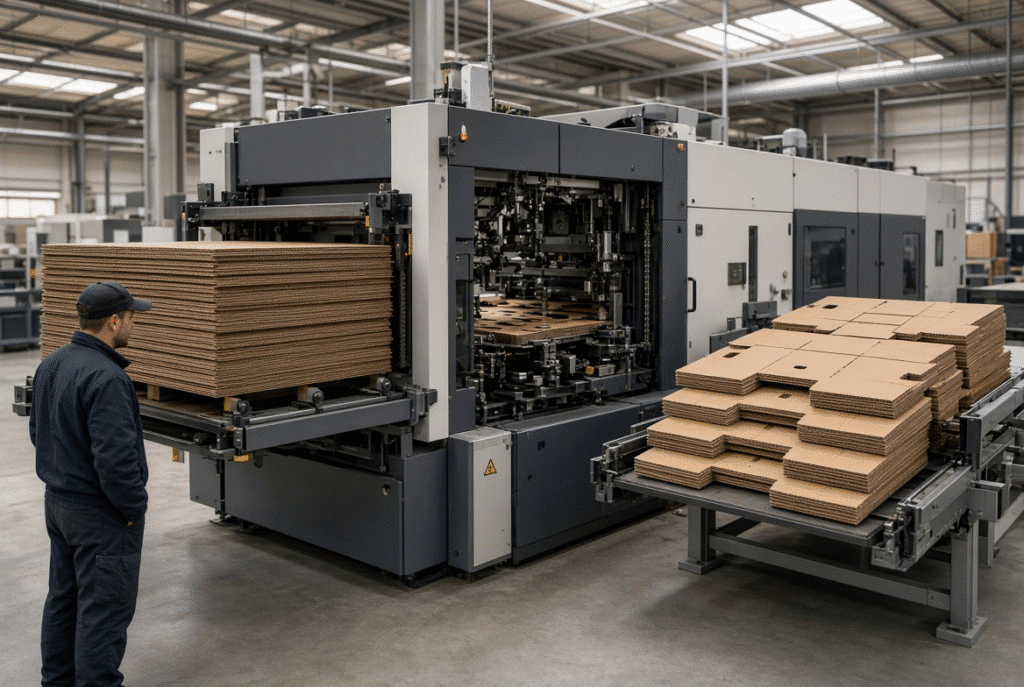
This is because an automatic die cutting machine for corrugated packaging should be chosen based on real behavior of the board and not just in terms of sheet size or rated pressure. Compared with flat paperboard, corrugated board is thicker, more compressible and much more susceptible to warping, thickness variation and flute damage. When switching to a different stock, a good press may feed into some trouble such as misfeeding, crushing flutes, weak creases or stacks that shift.
The real question is NOT “Can this machine cut corrugated?” Whether the feeder, pressure system, tooling and delivery can handle your actual sheets without compromising the structure of the board or slowing the line. The answer depends on thickness range, flute construction, sheet condition and job layout.
Understand Corrugated Board Before Choosing a Die Cutting Machine
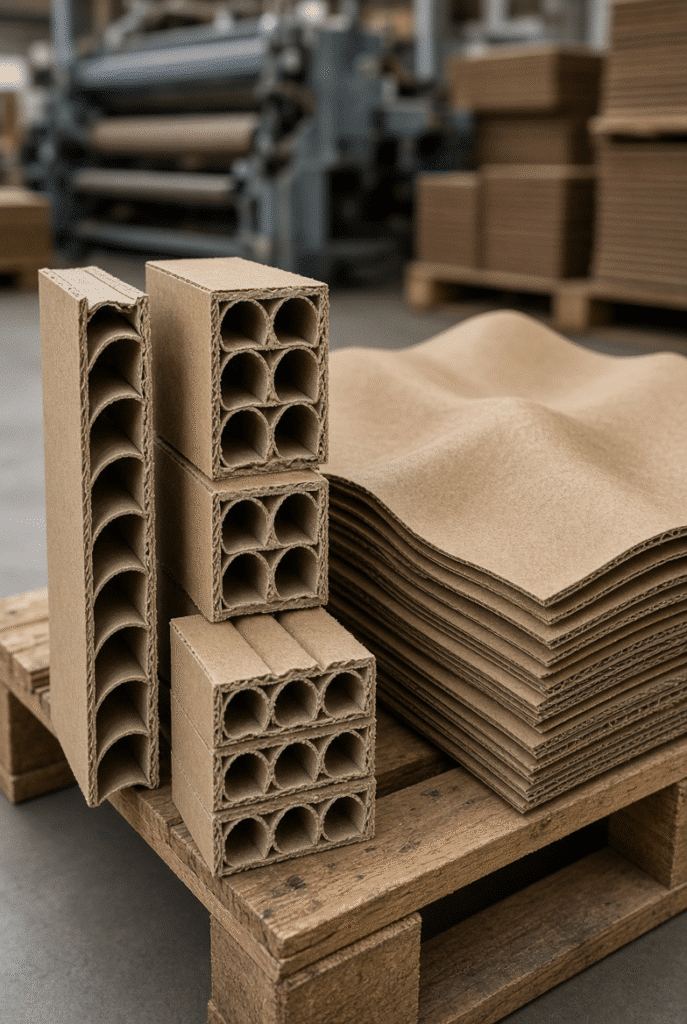
Corrugated board is composed of linerboards which are bonded to one or more fluted board mediums. That structure also imparts stiffness and cushion to a sheet, but it also makes it more pressure, moisture, and handling sensitive than solid cartonboard. The material difference is the basis for each decision – feeder type, pressure setting, crease design, waste removal – that follows.
Flute Profile, Board Construction, and Thickness
Flute profile and board construction control for total thickness, compressibility, print surface, and resistance throughout the cutting and creasing process. Single-wall and double wall boards and various combinations of flutes pass through the feeder and are applied differently. The buyer is responsible for providing the correct board type, construction of flutes, thickness range, liner type and specification, and sample sheets — not just generic flute charts. The supplier should have the actual substrate and not a description from a catalog.
Warp, Moisture, and Thickness Variation
Typical moisture imbalance, storage, liner behavior, and pallet handling issues cause corrugated sheets to bow, twist, or cup. The thickness may vary from stack to stack as well. A pallet may appear OK on top, but may begin to warp or change in caliper deeper within the pallet. These conditions are aspects of the separation of sheets, positioning on the front and sides, cutting pressure, crease quality and stacking for delivery. Evaluate an entire batch rather than one flat sample.
Printed Liner, Lamination, and Surface Quality
A lot of corrugated packaging jobs employ printed liners, laminated top sheets or coated faces. Friction, static, curl and pressure sensitivity are altered on these surfaces. When the cut is clean, scuffing and pressure marks may still occur. Production trials must be run with the printed, laminated, coated and stored product, and not with raw board.
Match Machine Format and Material Range to the Corrugated Job
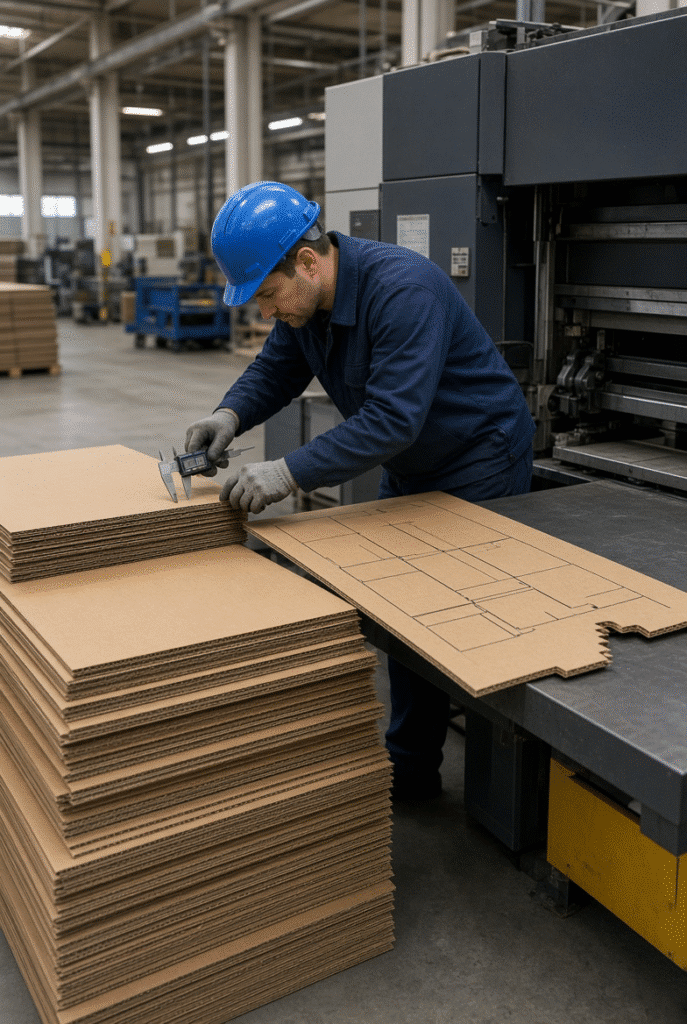
Use the production sheets, not the size of the finished box. The machine needs to accommodate the largest, smallest and most common sheets as well as retaining the necessary die-cutting space for the complete layout, gripper margin, waste bridges, and handling requirements.
Maximum Sheet Size vs Maximum Die-Cutting Area
The maximum sheet size is the size that the feeder will accept. The usable cutting area is called maximum die cutting area. The difference is significant where corrugated work is involved as large blanks may have to have edge clearance and additional support. For the DAIS D1060S, for instance, the maximum sheet size is 1060 x 770 mm and the maximum size of die-cutting is 1050 x 760 mm. These are merely the numbers of physical entries, and do not ensure process suitability. Please send confirmation of real sheet and die layout.
Thickness Capability Must Be Confirmed, Not Assumed
One of the most important selection criteria is the thickness of the board, but it is not thickness per se, that determines suitability. Flute construction, stiffness, warps, moisture, die layout and sheet size effects performance. According to the D1060S specification, appropriate corrugated paper thickness is up to 4mm. This is not to say that every 4 mm sheet or packaging layout will perform the best. Complete job conditions should be confirmed with the supplier.
When a Larger Corrugated-Specific Machine Is More Appropriate
When the work is recurring and involves larger format or corrugated, or thicker or double wall board, heavy warp, large display packaging, high volume blanks or feeder requirements that surpass a standard paperboard machine, larger format or corrugated type equipment becomes applicable. The design of the feeder, the support for sheets, pressure system, stripping system and the execution of the delivery are yet to be confirmed to the application.
Feeding Design Is Often the Deciding Factor for Corrugated Sheets
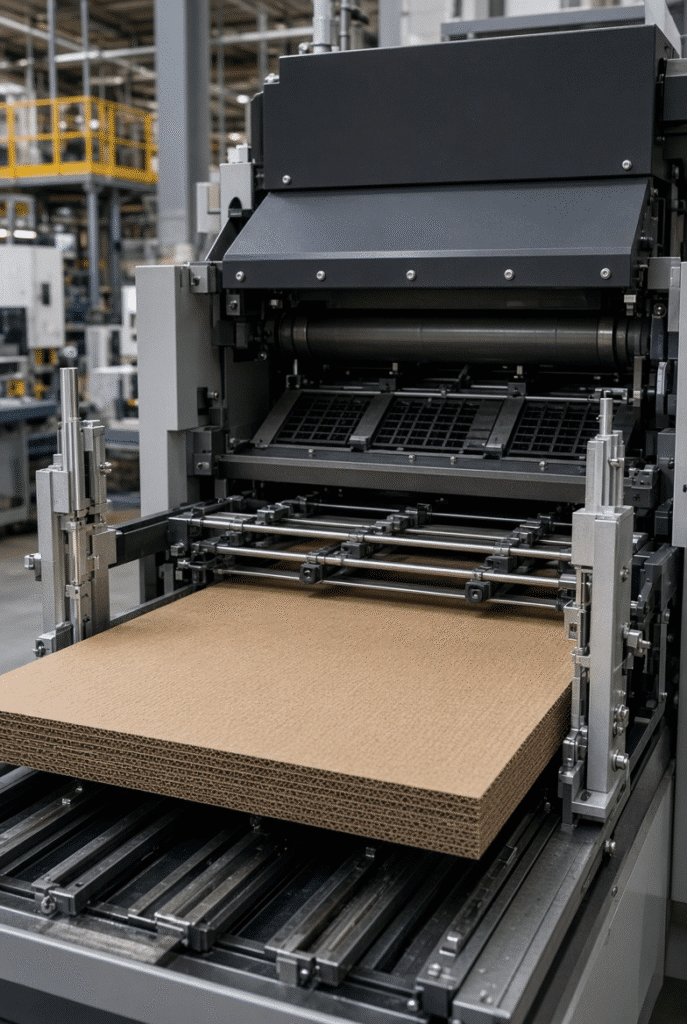
Paperboard is often thinner, lighter, flatter and more uniform than corrugated sheets. The speed of usable feed, accuracy of registration, and percentage of waste, are therefore determined more often by stable feeding than by the press section itself.
Top-Suction, Lead-Edge, and Vacuum-Assisted Feeding Concepts
Feeder designs vary. For some paperboard and lighter corrugated sheets, a top-suction or feeder-head system can be suitable. Larger, heavier and warped sheets may require lead-edge or vacuum-assisted configurations, depending on the machine’s support and transport system. There is no one right or wrong design. Choose the feeder to fit the sheet, thickness, warp, stiffness, and surface and the desired speed of the feeder. Ask to have a demo of representative material.
Sheet Support, Separation, and Warp Management
Support bars, suction, separation, transport belts, vacuum zones, side guides and anti-double-feed systems are all important. Extra support may be required for corrugated sheets to avoid the risks of sagging, skew, collision or double feeds. If the sheet is slightly curved, it can be fed at low speeds without any trouble, but may be unstable at higher speeds. The feeding stability should be tested over the operating range of the trials and not just a brief slow demonstration.
Front and Side Registration for Corrugated Packaging
Printed corrugated, retail ready trays, and display work all need to be positioned correctly to the cut and crease lines. The influences of registration performance include sheet squareness, feeder stability, edge quality, warp, gripper handling and operator adjustment. An accuracy statement on a datasheet, by itself, is not a substitute for application testing.
Set Die-Cutting Pressure to Cut Cleanly Without Crushing Flutes
For corrugated die cutting, the pressure must be sufficient to cut through the liner and medium without being so high as to crush flutes, weaken the board, damage the printed surfaces or produce poor creases. Quality does not necessarily increase with tonnage rating. The even pressure distribution, make-ready and material condition is required.
How Board Thickness and Die Layout Affect Pressure Demand
The more complex the internal cut-outs, perforations, and heavy creasing the more it will demand of the press section, in addition to having to process thicker board and longer cutting-rule lengths. Submit the die layout, approximate length of the cutting rule (if available), board specification and sample material for technical review. Pressure requirements must be determined based on the specific tooling and substrate and not a generic formula.
Signs of Too Little or Too Much Pressure
Low pressure indicates either incomplete cuts, hanging fibers, uncut corners, waste that does not release or inconsistent perforation. Pressure problems are manifested in crushed flutes, flattened score areas, damage to liners, pressure marks, delamination or loss of strength of finished box. Increasing pressure will often hide a dull rule or poor make-ready, but can also result in new quality issues.
Creasing and Scoring Must Protect Folding Performance
For corrugated packaging, the score lines must be able to fold without cracking the liner or crushing the flute structure. The final fold depends on a number of factors such as score depth, choice of rules, matrix design, flute direction, board thickness, and pressure setting. If the score line is damaged by a cutting display carton, it may end up with a bad score line that could lead to a failure to fold. Look for fold behaviour and completed geometry and not the die-cut sheet.
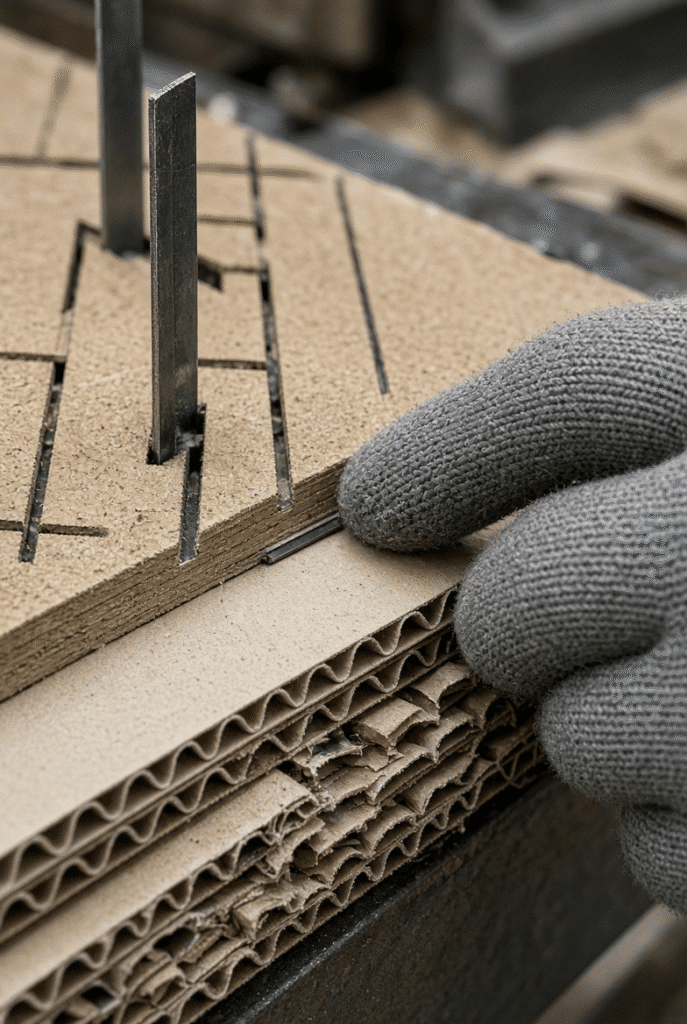
Consider Stripping, Waste Removal, and Finished-Sheet Delivery
Large waste segments, blank internal cut-outs, hand holes, display windows and blank complicated geometry are common in corrugated packaging. Handling waste on high volume display work can be a significant labour and throughput limitation.
Corrugated Jobs That May Need Stripping
When jobs are repeated, have numerous internal holes, windows, display requirements, complex cut-outs or large waste areas, it is highly beneficial to strip the job. If the labor cost and output requirements are not too high, manual or semi-manual removal may be suitable for simple box blanks or for lower volume jobs.
Manual Waste Removal and Operator Ergonomics
Large corrugated sheets are harder to work with. With manual waste removal, there are ergonomic, safety and productivity issues. Test time per sheet, operator count, quality of waste removal, risk of repeated motion, and impact on downstream packing/folding. This is data that will give a better foundation to choose from than just including stripping on a quotation.
Delivery, Stack Quality, and Downstream Handling
The delivery of finished sheets and blanks must have no damage on the edges, compression of board, mixed orientation or unstable stacking. Board weight, thickness, pile height and blank geometry should be supported in the delivery section. In trials, test the alignment of the stack, edge quality, board flatness, protection of printed surface, and the ability to move blanks to folding, gluing, or packing.
Select Speed Based on Stable Output, Not Maximum Sheets Per Hour
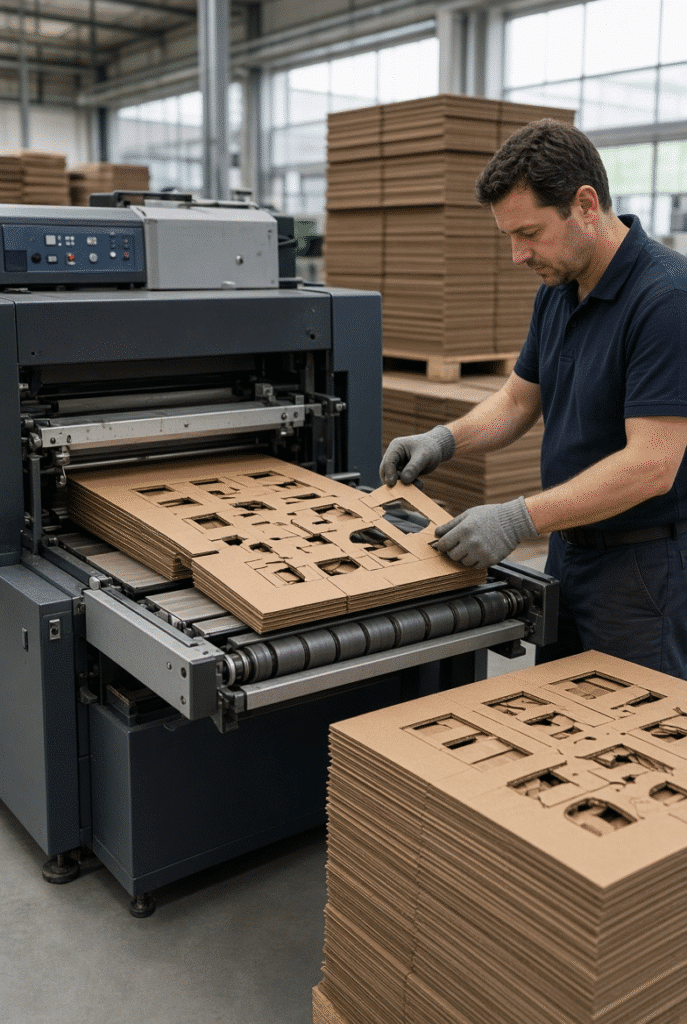
The speed of corrugated production is to be judged on accepted sheets, not on the maximum speed the machine is rated at. Real output is limited by board variation, feeder stability, die complexity, stripping, delivery stacking, and quality inspection. For some jobs, it is better to be able to run at a lower, steady speed and get good use from the packaging and minimize the amount of scrap and stoppages than attempt to achieve a high nameplate and end up with lots of scraps and stoppages.
Why Corrugated Sheets Often Require Lower Stable Speeds
Thick, heavy, warped or irregular sheets require more controlled feeding, registration and handling at delivery. The inclusion of complex display packaging with cut-outs and lots of waste makes it even slower as waste release and inspection needs to be paid attention. Actual output must be verified on representative job layout and material.
Measure Accepted Output, Waste, and Feeder Stops
Monitor accepted sheet count per hour, waste rate, double feeds, missed feeds, skew events, pressure adjustments, stripping interruptions, stack quality and operator interventions. These are the signs that it is indeed stable or not. Gather data on trials and early production runs, and then it can be beneficial for scheduling, training, maintenance, and future investment decisions.
Avoid Oversizing for Speed Alone
Simply larger or faster machines aren’t necessarily more productive for corrugated. Oversized equipment may lead to higher capital cost, floor space requirements, material handling complexity, tooling cost, energy consumption and set-up burden. Matching the machine to the recurring job mix with the objective of achieving the most important sheets to run at a usable rate while maintaining some level of flexibility for future work.
How to Evaluate a Corrugated Die Cutting Machine Before Purchase
Selection shall be based on a technical review that is structured and, if practicable, based on a machine trial with representative board. The name of the model, a claim of size in a sheet or of pressure is not enough.
Prepare a Corrugated-Board Inquiry Package
Supply the following information:
- Is it wooden or plastic?What kind of board is it made of?
- Windscreen thickness range from nominal to measured.
- Single wall, double wall or other structure
- Surface conditions (liner grade or printed/laminated)
- Size of the sheet: Maximum, minimum and most common.
- The typical warp condition of boards, and their stiffness and their weight
- The die layout, cut-out pattern, crease lines, perforations and waste bridges are all the same for each test.All tests using the same “die layout”, cut-out pattern, crease lines, perforations and waste bridges.
- Sample packaging completed, display structure or box drawing
- The required output, shift pattern and frequency of orders.
- Requires stripping, blanking, manual waste removal or downstream folding/gluing to remove waste
- The layout of the site, utilities and material-handling equipment of the country to be visited
This package enables the supplier to assess format, feeder, pressure range, tooling, delivery and installation requirements with greater accuracy.
Run a Representative Material Trial
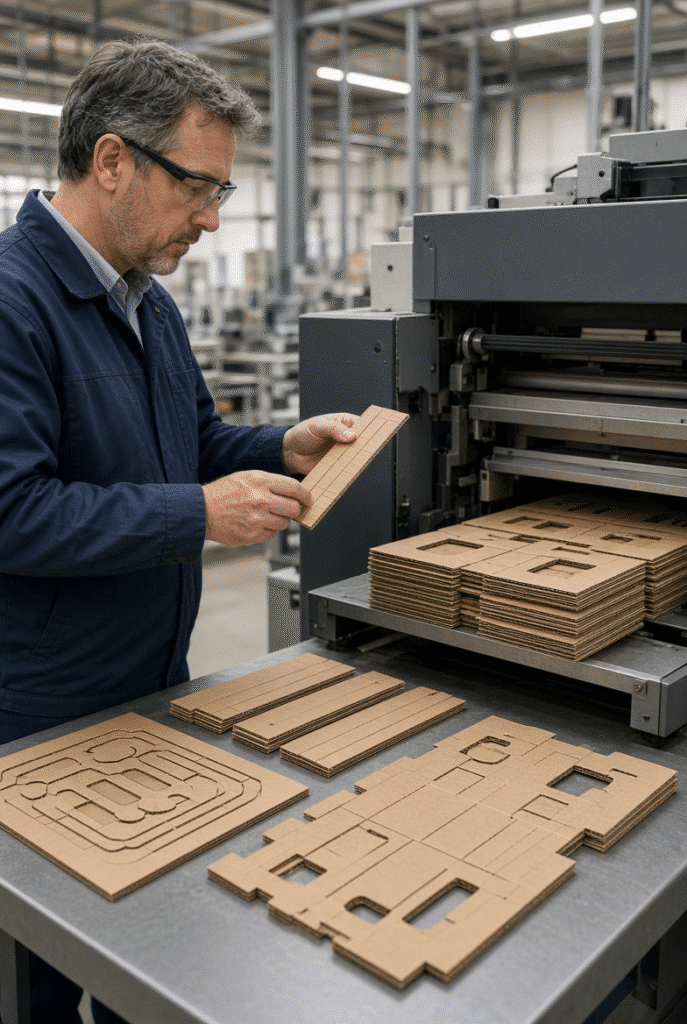
Apply real or representative corrugated board with realistic complexities of warp, thickness variation, printing condition and die-layout. Watching sheet feeding, registration, cutting quality, score performance, protection of flutes, waste release, behaviour of delivery stack, sustainable speed, finished-box folding. Record the following: batch of documents, measured thickness, layout of dies, machine configuration, machine settings, operating speed, defects, documents accepted, and sample quality. This record is more useful than a demonstration that lacks a qualification.
Review Installation, Service, and Spare-Parts Planning
Corrugated machines tend to require heavier sheets, larger machine footprints and special material-flow requirements. Ask for the installation drawings, clearance for services, loading instructions, power and air specifications, recommended spare parts, lubrication instructions, scope of operator training, terms of warranty and overseas engineer support. Continuous production also requires continuous maintenance, proper tooling and trained operators.
Corrugated Die Cutting Machine Selection Checklist
| Selection Area | What the Corrugated Plant Should Define | What the Supplier Should Confirm |
| Board construction | Flute type, single/double wall, liner structure, measured thickness range, moisture and warp condition | Suitable board range and relevant configuration limits |
| Sheet format | Largest, smallest, and most common sheets, including sheet weight and handling method | Maximum/minimum sheet size, usable die-cutting area, and feeder suitability |
| Thickness capability | Actual board thickness, variation across sheets, and required quality level | Confirmed thickness suitability for the specific board and job |
| Die layout | Cut-rule length, windows, hand holes, perforations, score lines, waste bridges, and blank geometry | Pressure, tooling, stripping, and layout compatibility recommendation |
| Feeding | Warp, curl, sheet support needs, pile quality, surface friction, and print/lamination condition | Feeder type, support system, separation method, and representative-material trial plan |
| Pressure and creasing | Required cut quality, flute protection, score/fold requirement, and box-strength concerns | Pressure-setting approach, crease-rule guidance, and process limitations |
| Waste removal | Internal waste, manual stripping time, operator count, and blank separation needs | Manual, stripping, or blanking configuration recommendation |
| Production output | Accepted sheets per shift, job frequency, changes, inspection needs, and staffing | Realistic stable-output discussion, not only maximum speed |
| Delivery and downstream flow | Stack quality, sheet weight, blank handling, folding/gluing, packing, and internal transport | Delivery configuration, pile handling, and workflow compatibility |
| Installation and support | Floor space, material flow, utilities, forklift access, maintenance, training, and spare parts | Installation drawing, utility checklist, documentation, service scope, and warranty terms |
A supplier who gets the same detailed inquiry package can make more precise technical suggestions and can enable the plant to evaluate proposals based on actual corrugated-production requirements, instead of speculating on the plant’s ability to handle cardboard.
Final Guidance: Choose the Machine Around the Board, Not Only the Box Design
To achieve success in corrugated die cutting, it’s important to know the thickness of the board, the flute configuration, warp, moisture content, sheet size, and the requirements for the packaging end product. The best machine is the one that is able to feed, register, cut, crease, strip as required and produce the plant’s regular corrugated production in controlled quality and stable output.
Assess the entire system: the board, feeder, pressure, tooling, creasing, waste removal, delivery, factory layout, maintenance and service support. Not just a maximum pressure or a maximum sheet-size statement, but a representative statement with a documented technical review, that validates the decision.
Please submit to DAIS your specification of corrugated board, type of flute, measured thickness, sheet size, warp, die layout, sample of finished box, output requirements, waste removal requirements, and destination country for a technical review of the configuration of the appropriate die cutting machine. Within the range of thickness that has been proven for D1060S, the suitability of this configuration can be used as a reference for larger, thicker or more demanding jobs – which can then be evaluated for appropriate larger format or corrugated specific configurations).