

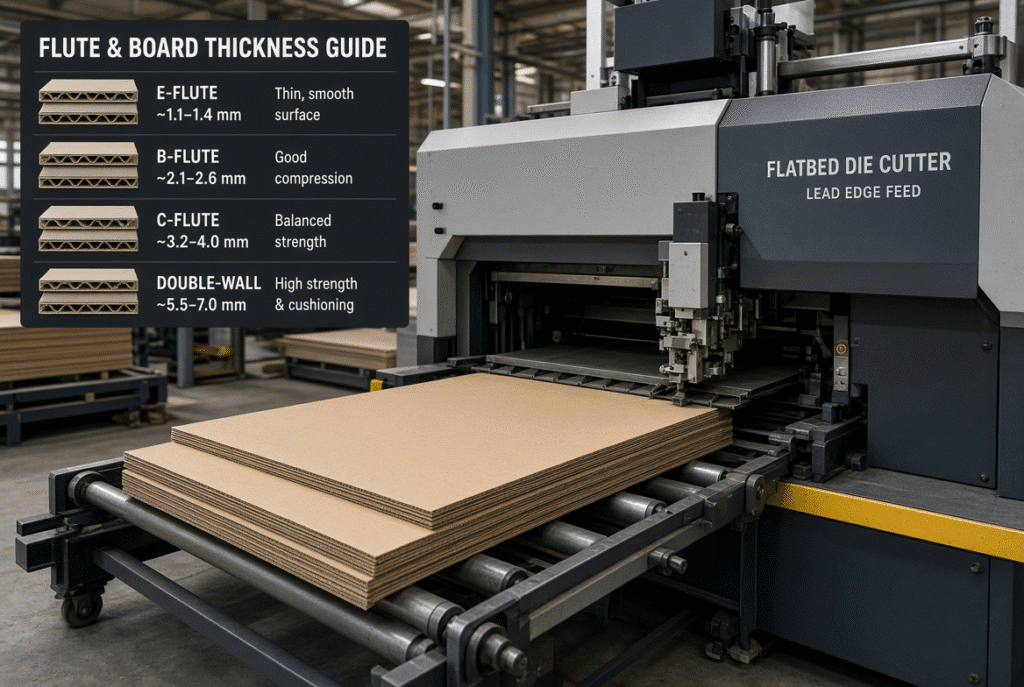
Lead edge feeding different corrugated flutes is acceptable as long as feed-wheel contact, separation, support, guides, position, and speed are appropriate to the actual board thickness, stiffness, weight and surface condition. There are different responses of E-flute, B-flute, C-flute and double-wall board to the same feeder settings.
A thinner board is likely to be more susceptible to pressure and double loading. Thicker or double wall board generally requires more support, more space and feeder capacity. A flute letter cannot be used to determine machine suitability.
What Corrugated Flute Type Means
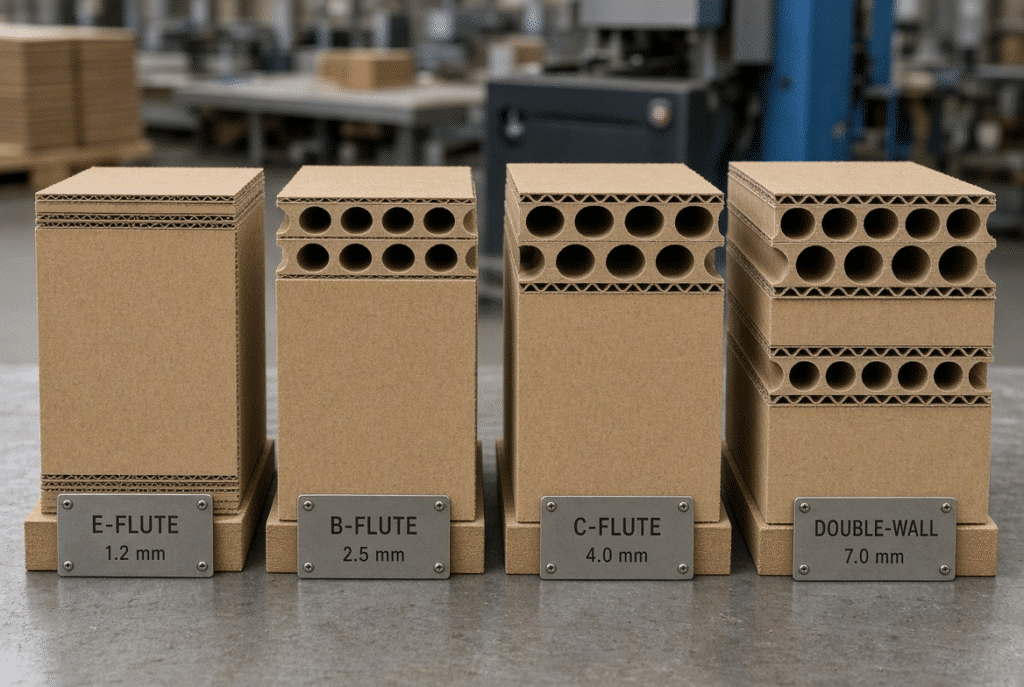
A flute is the corrugated board wave-shaped medium between the liners. The finished thickness and stiffness is affected by flute height, flute spacing, liner grades, adhesive strength, compression and manufacturing process. Flute grades, board quality, moisture, surface treatment, and single-wall or double-wall construction can all affect the way a flute sounds in the same category.
E-Flute Corrugated Board
E-flute is a relatively fine flute structure that is typically used for printed carton and retail packaging applications and jobs that require surface appearance and print quality. It may be more prone to double feeding, surface marks, lead edge deformation, excess feed pressure and lack of support.
B-Flute Corrugated Board
The most common variation is b-flute, which is thicker and is usually stiffer. It is common use when there is a need to package on a printable, strong, protective basis. This additional stability improves sheet manipulation over thinner board, but can generate feeding issues due to warping, damage to the edges, thickness variation, and improper guide/setting of the wheel.
C-Flute Corrugated Board
C-flute is a thicker structure design that is frequently chosen for cushioning and stacking properties. The thicker and stiffer sheets will influence sheet separation, guide clearance, sheet support, delivery timing, die-cutting pressure, creasing and delivery behavior.
Double-Wall Corrugated Board
Double wall board has a thickness with two fluted layers plus a middle liner, making it thicker and heavier. Some common combinations are available, but no matter what combination is used, it will operate based on what its thickness, weight and liner grades are. Double-wall board often needs extra feeder capacity, support, clearance, machine rigidity and die cutting ability.
How Flute Structure Affects Lead Edge Feeding
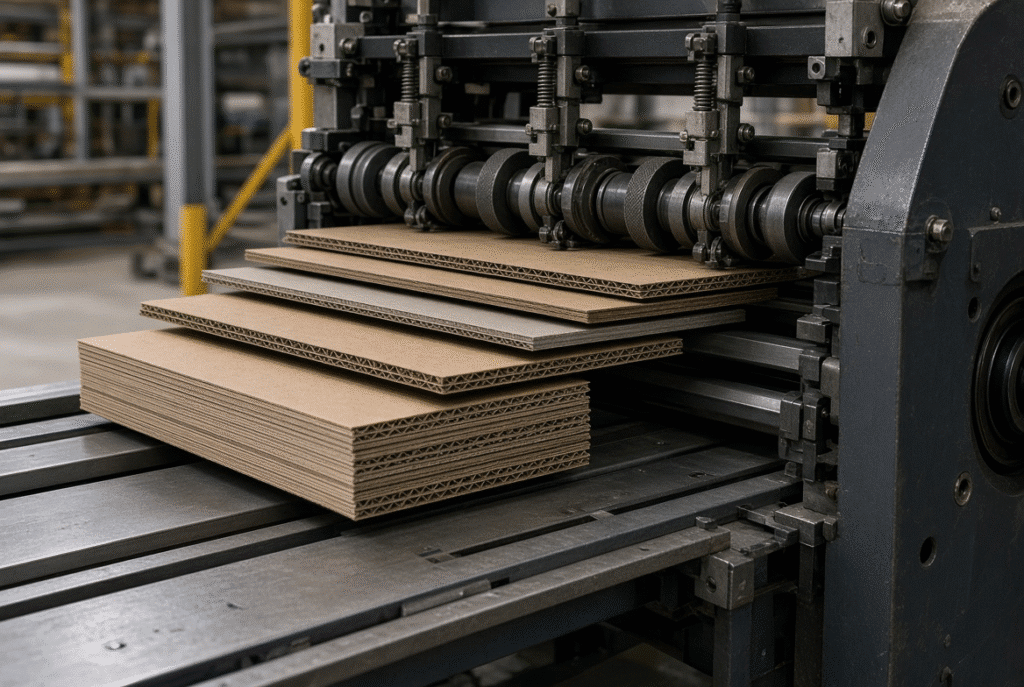
The fundamental feeding sequence remains the same: separation, engagement of the lead edge, transport, positioning and handover, but the response of the sheet may vary depending on the thickness, stiffness, weight and compressibility of the sheet.
Sheet Separation from the Pile
Thinner E-flute board will stick together due to static or surface friction, and can double-feed if pile pressure or separation is not managed properly. A heavier double-walled board requires either more powerful or more judicious pickup. Moisture, warp and surface condition also affect the cleanliness of the top sheet off the stack.
Lead-Edge Engagement
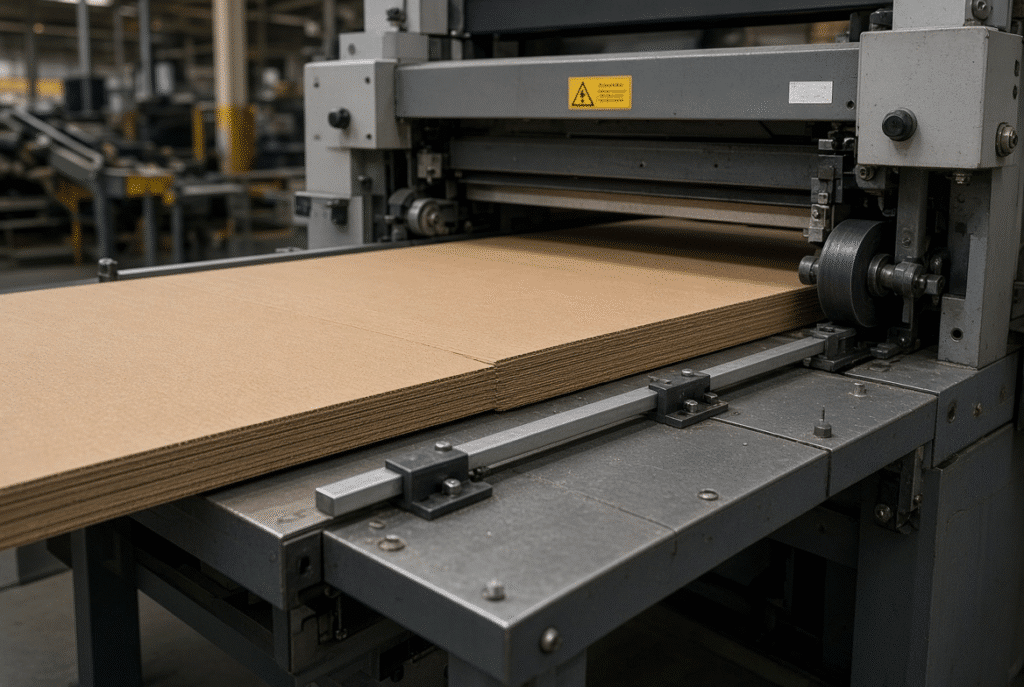
Lead edge should be held tightly, but not so tight as to slip or compress it or damage the edges. The sheet will move cleanly or be damaged by the deformation from wheel height, contact pressure, wheel material, quality of the lead edge, board thickness, etc.
Transport and Sheet Support
Thin board can bend or droop over gaps in the support path. Thick or double wall board requires more clearance and is to be continually supported at each transition. Bending, edge catching, missed feeds and skew are caused by lack of support.
Positioning and Machine-Cycle Handover
The front and side gauges, sheet timing and die-cutting handover shall be the same for each flute type. Higher or thicker board may require slower initial set up and careful timing checks to ensure stability in registration, at higher production speeds.
Feeding E-Flute Corrugated Board
Surface appearance, clean separation and controlled pressure are particularly critical issues for print packaging applications in which a thinner, finer structure is required by E-flute.
Common E-Flute Feeding Problems
Common problems are double feeding, flexing of sheets across gaps in support, deformation of the leading edge, marks on the surface of the sheets caused by feed wheels, uneven wheel contact, skew, non-uniform wheel separation, and sheets falling into unsupported zones. These issues are starkly evident in printed retail cartons and small format sheet when handling wrong pressure or handling incorrectly.
Feed-Wheel and Brush Settings
If too much pressure is put on the thin board it can either compress or mark. If the pressure is not adequate, slips or feeds are missed. Use manufacturer specified setting and print a few test sheets testing for feeding reliability and the printed surface area before locking the setting.
E-Flute Registration and Surface Protection
Ensure wheels are kept clean, contact is not in a critical printing area, guide clearance is correct, and there is continuous support. The pressure and speed are still job specific and will not be identical to each E-flute grade.
Feeding B-Flute Corrugated Board
B-flute is typically sandwiched between the fine and coarse structure, and this can be a good level of stiffness for many packaging applications. Even though the liner grades, thickness, warp, surface finish, and sheet size are still important, they are not as significant as they are when handled actually.
B-Flute Feeding Risks
The following defects are common on larger or printed sheets: Uneven feed-wheel contact, board warp, edge catching, side-gauge pressure, inconsistent spacing, and registration variation. It is a common mistake to consider B-flute a single specification.
Support and Guide Adjustment
Inspect support table condition, guide clearance, feed wheel alignment, side-gauge pressure and all transition points. Even if the feeder appears fine, a B-flute sheet with a curled edge can be caught near the positioning section.
Registration on Printed B-Flute Sheets
If the orifices are skewed or if the pitch of the feed is uneven, margins may be uneven or the creases may be misaligned. Instead of using a single sample, compare printed registration marks, edges of sheets and blank features that are complete on multiple sheets.
Feeding C-Flute Corrugated Board
The thickness and stiffness of C-flute have a positive impact on certain sheet handling properties, but increase the demands for separation, clearance, support and die set up.
C-Flute Feeding Risks
Common concerns include heavy pile pressure, lack of guide clearance, catching at the lead edge, sheet arrival delay, uneven support, higher die cutting and creasing requirements, and waste removal.
Feeder Capacity and Sheet Support
Ensure the feeder and guide opening, transport support and machine capacity is correctly matched with the actual board thickness and sheet weight. Describing a product as having a ‘C-flute capability’ is not sufficient.
C-Flute Die-Cutting and Creasing Considerations
It is impossible to correct a bad die or pressure with a stable feeder. Inspect for completeness of cuts, quality of crease, crushing of flutes, separation of wastes and finished blank flatness. Carry out a controlled sample test prior to production speed.
Feeding Double-Wall Corrugated Board
Double-wall board will also alter the mechanical requirements of the feeder and the die-cutting machine since it is generally thicker, heavier and structurally more complex than single-wall board.
Why Double-Wall Board Requires Additional Checks
The capacity of the feeders, sheet weight, guide clearance, support for the lead edge, machine rigidity, drive strength, die cutting pressure, creasing rules and delivery capacity should be checked. As the thickness of the boards rises, then small problems of clearances or supports are more serious.
Common Double-Wall Feeding Problems
Inadequate pile preparation, guide restriction, support or settings cause incomplete pickup, double feeding, lead-edge damage, jams at narrow transitions or delayed positioning, pressure marks, or unstable delivery stacks.
Testing Double-Wall Board Before Production
Verify actual board thickness, sheet weight, flute combination, sheet size, feeder capacity and die requirements. To test separation, registration, cutting, creasing, removal of waste, stacking in delivery, and level of operator intervention, a supplier test should be performed on sufficient sheets.
Flute Type, Feed-Wheel Pressure and Guide Clearance
Of course, the category of the flute is important, but thickness, sheet weight, surface treatment, warp, format, and the condition of the edges need to be taken into account in terms of actual machine settings.
Feed-Wheel Pressure
The purpose is to establish stable contact with no slipping or over-compression. Pressure marks are commonly found in thin board. If the weight of the board requires more firmness in contact, it should be kept within the maximum limits of the machine. Adjust one variable at a time and check a number of sheets following this change.
Guide Clearance
Too tight guides can damage or skew thick board. Loose guides have a tendency of leaving thicker or warped sheets uncontrolled. The clearance must be the same as the thickness of the board, quality of the edge, warp and direction of travel.
Sheet Support Across the Transport Path
E-flute can bend over an un-supported span. Double wall board might catch at a transition or need additional clearance. Examine the entire support chain between pile and die-cutting handover.
Machine Speed During Setup
There is no one universal speed for all types of flutes. The sheet format, construction of the board, warp, feeder design, die layout and quality requirements are factors that will influence a stable speed. Start at a steady rate and ramp up when the sheet path is steady.
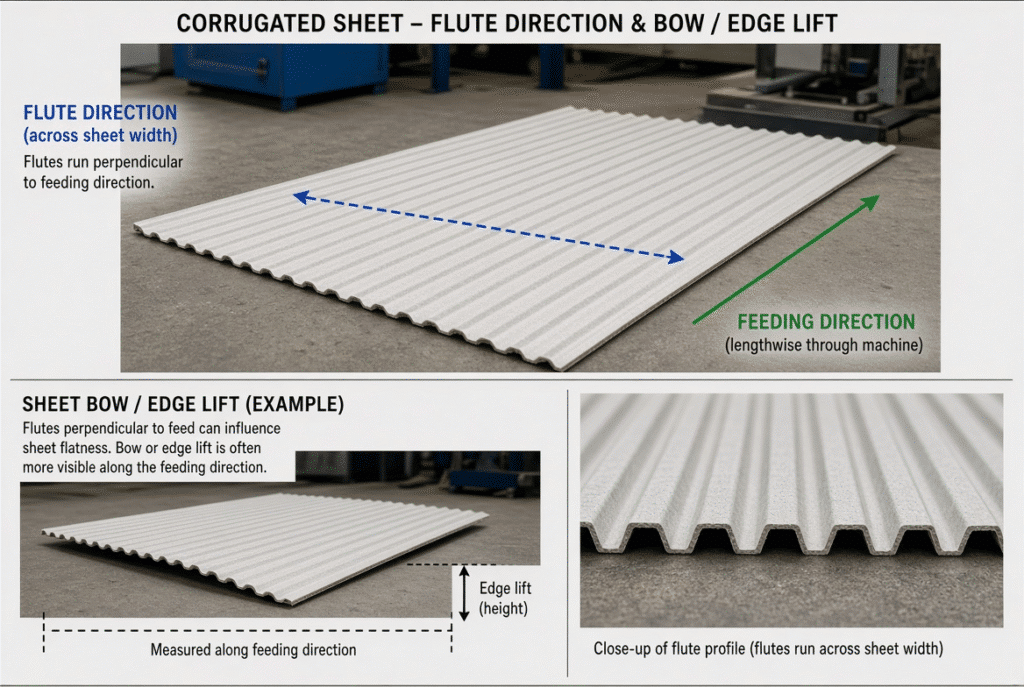
Flute Direction, Warp and Sheet Orientation
Flute direction changes bending stiffness and hence the response of the sheet to feeding and support.
Flute Direction and Bending Behavior
One direction of a sheet is typically more resistant and the other more compliant. Feeding orientation must be taken into account with the sheet size, direction of flutes, layout of support and die design. There is no right or wrong way of orienting the board or machine for this.
Warp Relative to the Feeding Direction
Bowing or twisting becomes more of an issue if the bowing or twisting occurs in conjunction with the direction of travel of the feeder. The possible outcomes are lifted edges, uneven wheel contact and front-gauge arrival that is not consistent.
Printed and Laminated Surface Considerations
Extra attention must be given to wheel contact, guide rubbing, contamination and registration when it comes to printed or laminated surfaces. Test representative surface finishes, not just based on flute type.
Troubleshooting Feeding Problems by Flute Type
| Symptom | Board types most often affected | First checks |
| Double feeding | Thin E-flute and light single-wall | Static, pile pressure, separation, brush settings, surface condition |
| Sheet flexing / sagging | Thin board, damaged fluting | Unsupported gaps, transport speed, table transitions |
| Edge catching | Thick C-flute, double-wall | Guide clearance, curled edges, support at transitions |
| Feed slipping | All flutes | Wheel condition, contamination, contact pressure, alignment |
| Registration variation | All flutes | Warp, feed consistency, side-gauge pressure, timing, thickness variation |
Double Feeding on Thin Board
Common causes are static, sticking sheets, excess pile pressure, separation problems, brush setting, and variations in surface. Thin board (e-flute) requires special handling when separating, as it may require pressure and only a small amount of it.
Sheet Flexing and Support Problems
Flexible board will sag or lift even if the settings of the feed wheels appear correct, due to unsupported gaps, high transport speed, thin board, damaged fluting and poor table transitions.
Edge Catching on Thick Board
Catching is caused by insufficient guide clearance, when the edges are curved, poor support, narrow transitions, and when the board is thick or double-walled. Inspect first contact point and verify the working range of the machine.
Feed Slipping Across Different Flutes
These include worn and contaminated wheels, lack of contact, uneven wheel pressure, surface finish and stiffness of the board. Check the condition and alignment of wheels before applying more pressure on the machine.
Registration Variation
All types of flutes are affected by the registration issues that apply to warping, uneven feed, side-gauge pressure, sheet thickness variation, and timing. Compare multiple sheets and distinguish between machine variation and material variation.
Practical Setup Procedure for Different Corrugated Flutes
Confirm the Board Specification
Record the type of flute, single-walled or double-walled, the actual thickness, the weight of the flute sheet, size of the flute sheet, surface treatment, warp, edge condition, and flute direction. The name of the flute is never enough.
Inspect the Material and Stack
Before loading, inspect flatness, edge damage, alignment of the pile, size of the sheets, contamination, moisture, storage conditions and damaged sheets.
Set Feeder and Support Components
Fine-tune feed-wheel pressure, wheel height, brushes, separation, guide clearance, surfaces, sensors and front and side positioning. Follow manufacturer suggested starting points and vary one variable at a time.
Run a Controlled Trial
Start at a slow pace and check sheet separation, movement of the lead-edge, skew, registration, surface marks, edge condition, cutting, creasing, waste removal and delivery stacking.
Record Job-Specific Settings
DOCUMENT SETTINGS – By flute type, thickness, format, surface and job. The record helps to reduce the changeover time and increase repeatability on future runs.
How to Select a Flatbed Die Cutter for Different Flutes
Machine selection should be based on the entire job profile and actual testing, not from a flute-letter listing in a brochure.
Information to Provide the Supplier
Provide specifications for E-, B-, C-, or other flute type, single or double wall construction, actual thickness of board, size of sheet, weight of sheet, printed or laminated surface, typical warp, flute direction, die-cutting size, target speed, registration requirement, and daily production volume.
Questions to Ask About Feeder Capability
Which types of flutes have been tested? What is the range of thicknesses that is supported? Is it possible to double wall board on the feeder? How is the feed wheels and guides adjusted? How is the warp dealt with? What help is provided at transition? What is the name of the parts that touch the printed surface? With similar board, what speed have they reached? What maintenance needs are there? Is there a possibility of testing samples?
Test the Actual Material
The flute list for a brochure does not constitute proof of performance. Test representative sheets and assess feeding, registration, surface condition, die cutting, creasing, waste removal, delivery, speed and the level of operator adjustment required.
D1060Y and Corrugated Flute Applications
DAIS D1060Y is flatbed style Lead Edge feeding die-cutting machine for die-cutting paperboard and corrugated-board sheets. Final suitability of E-, B-, C- or double-wall board has to be verified as to actual thickness, sheet format, flute construction, surface treatment, warping, die requirements, target speed and final machine configuration. It is important to never assume that a machine will handle all flute combinations, without testing.
Frequently Asked Questions About Corrugated Flute Feeding
Can one lead edge feeder handle E-, B-, and C-flute board?
It can accommodate various flute types if the machine is designed for the flute’s range and adjusted for every board. Normally pressure and separation, guides, support and speed will vary from grade to grade.
Is double-wall board suitable for lead edge feeding?
The suitability will be determined by the capacity of the feeder, clearance of the machine, its support, drive force, thickness of board, sheet format, and die-cutting needs. Test individual double wall samples, not a general claim.
Which flute type is easiest to feed?
The difficulty of feeding is influenced by the construction of the board, thickness, warp, size of the sheet, edge condition, surface treatment, and machine design. There is no easy-to-play flute type.
Does E-flute require lower feed-wheel pressure?
E-flute is generally more sensitive to pressure and surface marks, but the pressure required will vary depending on the machine, wheel material, board and production conditions. Start with the guidelines from the manufacturer and controlled trials.
Why does C-flute board jam in the feeder?
The typical causes are guide clearance, curled edges, insufficient support, separation problems, sheet weight, incorrect settings and machine suitability.
Does flute direction affect feeding?
The direction of the flute changes the stiffness and bending properties. It can be considered along with sheet size, warp, direction of feeding, support, printing and die design.
Can a flatbed die cutter process both single-wall and double-wall board?
Depending on structure, feeder capacity, pressure, clearance, die design and actual board thickness, some machines can. Check with supplier specifications and testing.
What should I provide for a flute-specific machine test?
Fill in the flute type, actual thickness, sheet size, sheet weight, surface finish, warp, die-cutting size, target speed, registration requirements and representative samples.
Summary Guidance – Match Lead Edge Feeding to the Actual Board
Flute type is just the beginning. Check actual thickness and construction, check board and stack, adjust pressure and guides carefully, provide sufficient support for sheets, take into account the direction of the flutes and warps, use separate settings for different grades of board, test heavy or double-walled board, try to use stable speed instead of maximum speed, record settings for particular jobs, check the suitability of the machine with actual samples.
For different flutes, supply the supplier with samples of the board, sheet thickness measurements, sheet formats and die specifications to get a realistic assessment of the feeding performance of the equipment.