

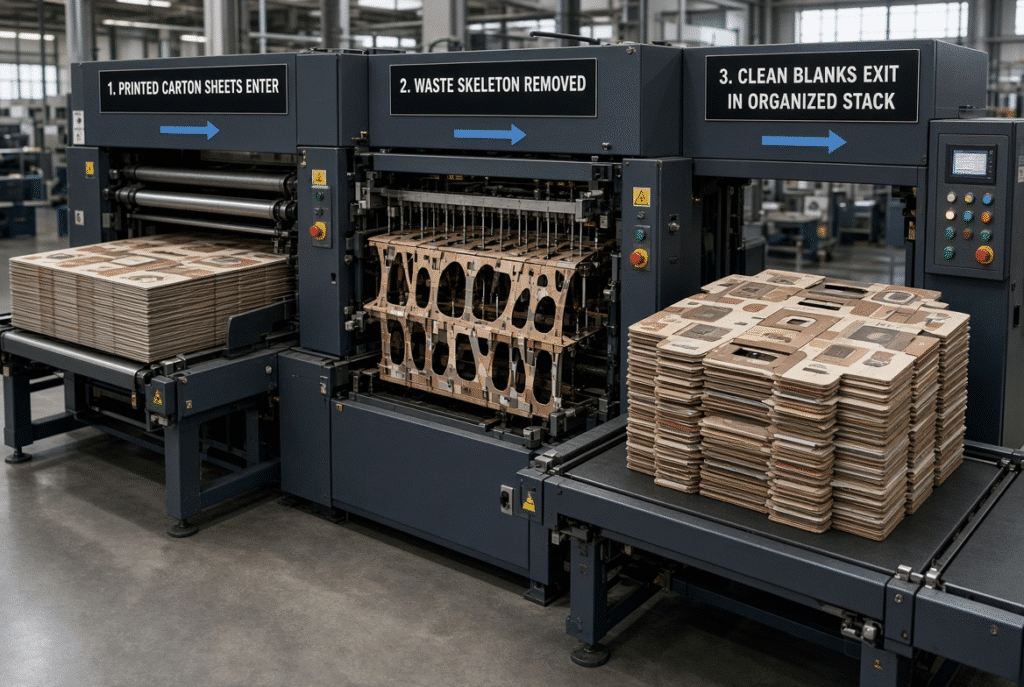
The effective waste stripping from the folding carton production line will reduce the repetitive breaking out of waste manually, the waste attached to the blanks will be reduced, blanks will be separated more uniformly to reduce the rework, and the material will flow more steadily during the folding, gluing, inspection and packing process. Although the speed of the die cutter is the same, the operators still need to break out window waste by hand, pull window outer skeleton, pull blanks and check window stacks. The actual limiting step in overall throughput is the post-press operation sometimes.
Not all jobs come with a benefit. The degree of improvement in practice will vary with product geometry, waste bridges, substrates, run length, die quality, stripping-tool setup and downstream capacity.
Why Folding Cartons Create Waste-Removal Challenges
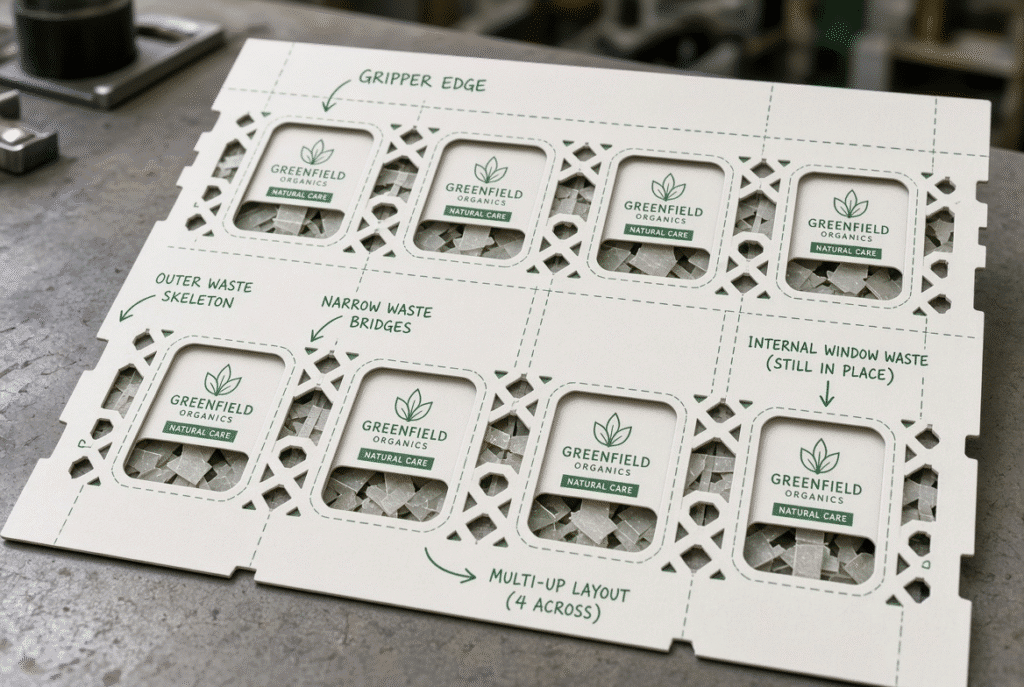
Typically, folding cartons don’t end just at the outer lines. Inside pieces and outside skeletons are left that can’t move on downstream with the blank when windows, locking tabs, handles, ventilation holes, decorative cutouts, glue flaps, or tight multi-up layouts are used. If not separated, failure will result in edge problems, inability to open, extra handling, and slower line speed.
Internal Windows, Holes, and Decorative Openings
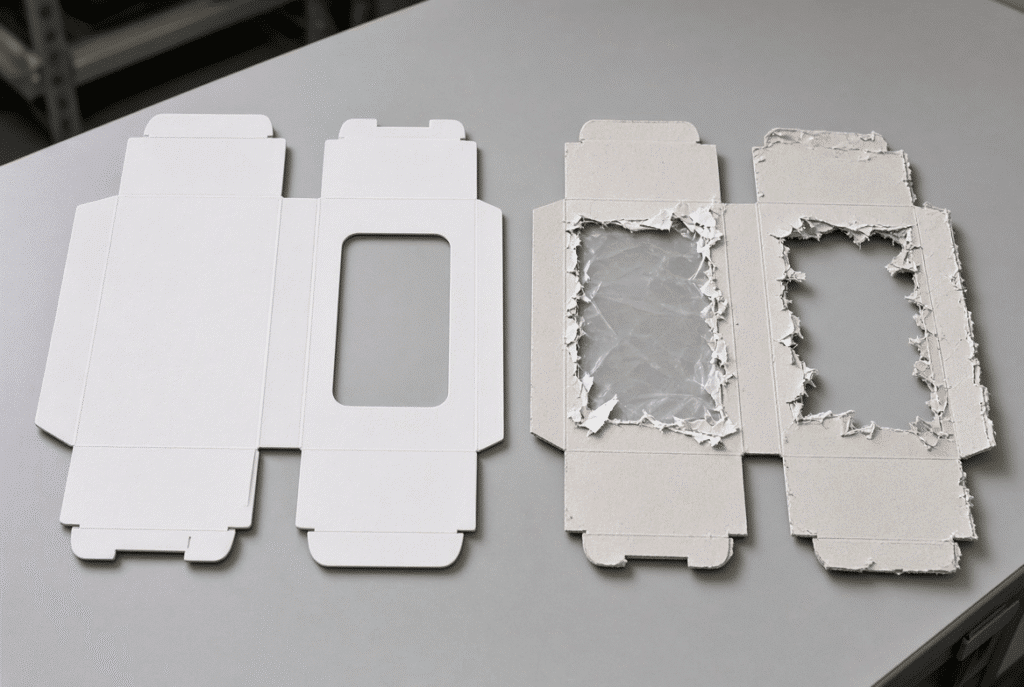
In cosmetic carton, pharmaceutical carton, retail pack, food carton, etc. with display windows, small openings or locking feature, handle cutouts and ventilation holes, there are internal waste remain and are trapped inside the blank after die cutting process. These pieces are more likely to be small and bumpy. Manual removal can be slow and will not guarantee that the fragments are removed – it is possible that fragments are left behind or parts of the surrounding board may be torn off. In automatic systems, it is important to have the correct contact points on the waste so that there is no marking of the end carton surface.
Outer Waste Skeletons and Waste Bridges
The outer waste skeleton: It is the continuous waste frame which surrounds the finished waste blanks. Waste bridges refer to the small pieces of material that are attached to products and waste to ensure that the products and waste remain stable during cutting and transporting. If the bridge is too strong, there are pieces that remain past the bridge, if the bridge is too weak, there is a movement or failure of the blanks. The position and quality of the bridge should match that of the stripper to be used later and the die layout. Bad bridge design makes clean cut a manual clean up issue.
Multi-Up Layouts and Repeated Manual Handling
Each pass on a sheet in the cartridge stacking method will add more processed finished blanks, internal openings and wasted areas. The work of a manual breakout goes up in direct proportion! With medium and high volumes a multi-up layout which is repeated, the repetitive work effort is a clear constraint. But that repeated handling is possible if Automatic stripping is used, when product spacing, tools access and the bridge design provide the ability to clean separate products without damage to the blanks.
How Waste Stripping Fits into Folding Carton Production
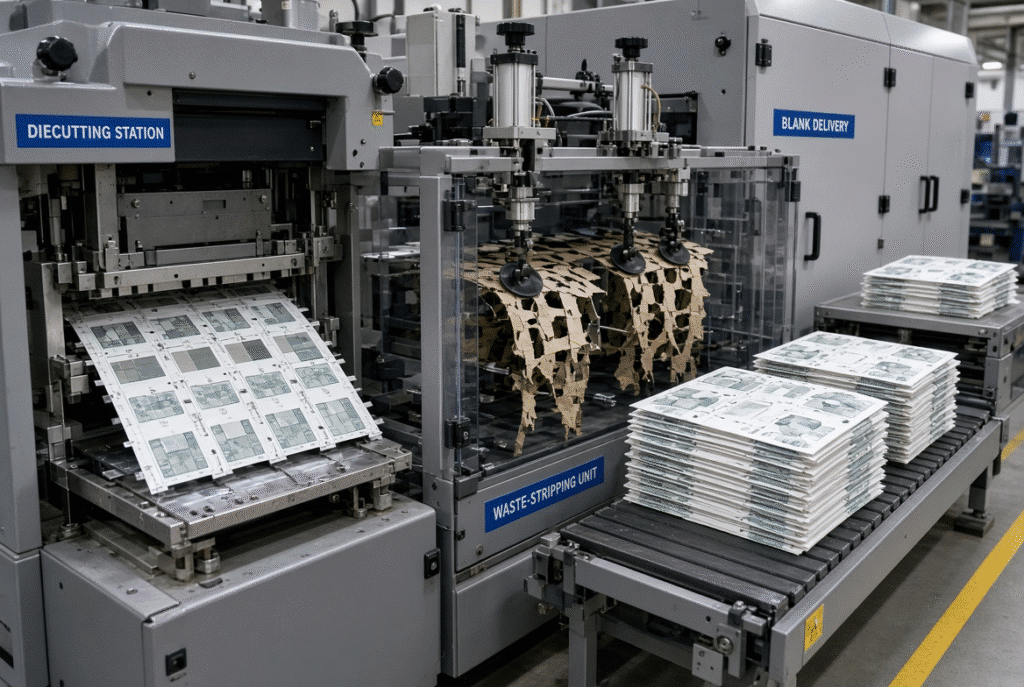
Waste stripping is but one step in a series of steps. It relies on feeding, cutting, stripping, delivery and downstream conversion efficiencies.
Sheet Feeding and Registration Before Die Cutting
All die lines, crease, window and bridge are kept in the correct position with stable feeding and accurate registration to the stripping tools. A slight skew or mis-register can lead to an internal opening that is not aligned to the stripping tool and to the process missing the waste or to a completed edge touched. Registration error means that it becomes apparent later, such as in cases of incomplete stripping or product damage.
Die Cutting and Creasing Create the Carton Blank
All openings and outer boundaries are cut based on rules. Creasing rules are used to mark the crease lines that will be used for the folding of the carton. At this point the sheet contains the shell, while waste materials inside. The blank is not ready for folding and gluing.
Waste Stripping Separates the Usable Blank
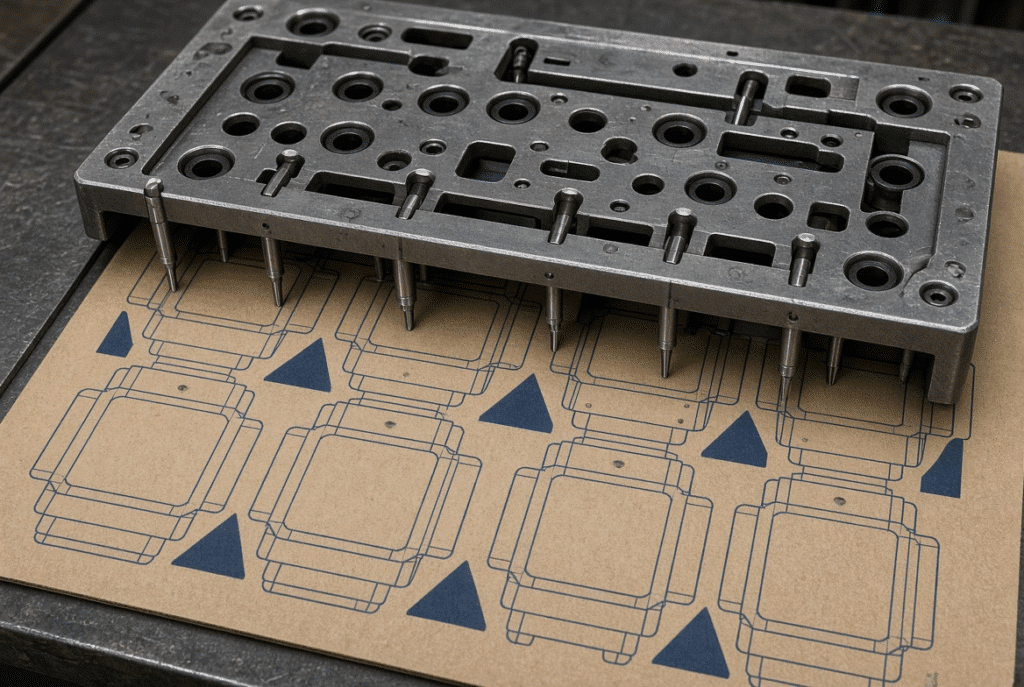
In the stripping unit, the outer skeleton and the inside wastes and sections between products are taken away. System can use either a plate type contact surface or stripping needles depending on the product geometry and system configuration. Cleanliness of the separation depends on the alignment of the tools and sample testing. Not all stripping is alike and using the wrong force or position will cause damage to the blanks which is meant to be removed!
Delivery Prepares Blanks for the Next Department
Organised delivery and stacking makes it easy to count, check and create bundles and put them to the folder gluer. Additional sorting, to offset previous benefits, is a result of mixed collection of blanks and leftover waste. Its effect is thus directly felt on the efficiency of the whole of the folding carton line.
How Waste Stripping Improves Folding Carton Efficiency
Improvements in labor utilization, the movement of clean blanks, less rework, consistent shifts and more reliable schedules are easily seen. It’s not a measure of machine speed.
Reducing Manual Breakout Labor
Automatic stripping saves a lot of the tedious hand work, especially when stripping cartons with windows, small openings, complicated cartons and multiple products per carton. The operators still have significant roles to play in set-up, inspection, waste handling, maintenance and troubleshooting. The power lies in the use of man power – not the total extermination of all men at the press.
Increasing the Flow of Clean Carton Blanks
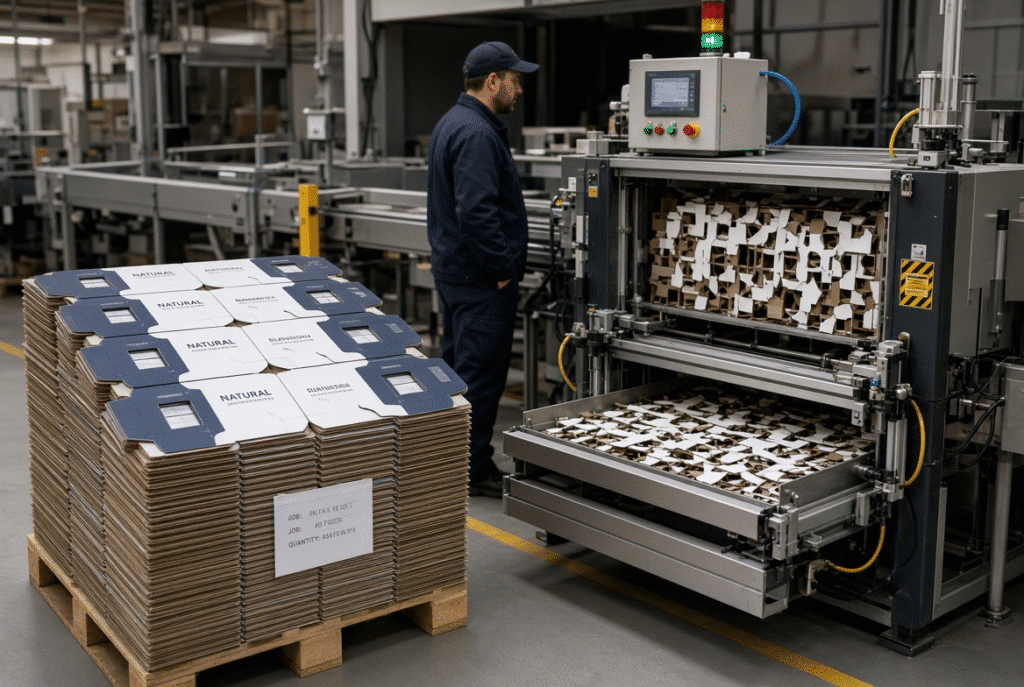
As blanks leave the press free of waste they have the potential to easily be transferred to the folding, gluing, inspection, bundling or packing process. No more waiting for operators to clear a queue of sheets at the downstream equipment. The real flow increase is still dependent on stability of feeders, quality of die cutting, stripping set up, delivery and capacity of next department.
Reducing Rework from Attached or Damaged Waste
Failure to remove it completely results in a lot more manual labour to cut it into shape, leaves sharp edges, can block windows, causes trash in finished piles and increases likelihood of being rejected before folding or gluing. Only automatic stripping can solve these problems if proper die matching, contact, pressure and registration of the die and substrate are used. Mismatched conditions can lead to the same defects which the system is supposed to prevent.
Improving Consistency Between Operators and Shifts
Manual breakout quality is dependent of technique, fatigue, shift and complexity of product. If the stripping system is properly set up, it will provide greater long-term repeatability of separation. Routine tool or setup inspection will be required though since systematic error of the tool or setup will affect all sheets.
Supporting More Predictable Scheduling
Reduced manual delays allow the production manager to optimize the co-ordination of the die cutting and folding, gluing, inspection and packing operations. When flow becomes more predictable it becomes more predictable, but not necessarily a decrease of lead time. Overall plant capacity and planning will continue to be crucial for actual results.
Which Folding Carton Jobs Benefit Most?
The suitability is determined by product geometry, repetitions, volume, labour costs and downstream requirements. It is not a requirement that all jobs be automatically stripped.
Cartons with Windows, Handles, and Internal Openings
Many more pieces of debris are generated in the interior openings that are hard to dislodge with your fingers. The most apparent examples of labour reduction are the repeated jobs that have the same window pattern, handle and/or ventilation. The final outcome is still dependent on opening size, opening position, die layout, and stripping-tool configuration and material type of the substrate.
Complex Carton Outlines and Narrow Waste Areas
Irregular shapes, narrow bridges, small tabs or near product to product areas provide waste which is hard to clean hands-on. In most designs a stripping method would be a better approach provided that the tool can reach all of the waste areas without contacting the finished surfaces. Testing the most challenging carton design as opposed to a simple sample provides the best indication of results.
Multi-Up Carton Production
The amount of blanks and waste areas per sheet is more. The fewer products that have to be handled, the fewer the number of products per sheet, the less of an increase there will be in handling, provided space, bridges and tools can provide a clean separation. All multi-up layouts are not appropriate; some may need re-designed bridges or other tooling.
Repeat Orders with Medium- or High-Volume Production
The setup time of a stripping tool can be repeated in multiple sheets if the same carton is repeated. Manual breakout is done individually on each sheet of run. The decision of whether or not the preparation is warranted should be made based on the labor, run length and order history of the plant. There is no common volume threshold.
The Role of Die Layout and Stripping Tool Design
The first two steps of stripping are die and product layout. If a machine is unable to correct a waste pattern because it is difficult to separate and/or a tool touches finished carton areas, the pattern is considered a waste pattern.
Waste Bridges Must Support Cutting and Separation
The bridge should be strong enough to keep the sheet stable when cutting and transporting it to the point where it is not strong enough to be easily separated by the stripping force. All three factors (bridge design, substrate and the stripping tool) have to be considered at the same time. The wrong pattern will result in waste on the material or blanks will move.
Plate and Needle Stripping Options
The plate system is based on the setting of the contact surfaces and the needle system is based on the choice of needles/pins. The carton folding is done in various ways and none is better than the other. The configuration of the job depends on product configuration, size of internal waste, run length, flexibility of the set-up and precision of contact. Some machines like the DAIS D1060Q can have the stripping of the waste from the plates and needles as optional, not mandatory, configurations on every machine. An actual list of configurations should be verified before buying.
Tool Alignment and Product Protection
Only the waste areas should be affected by the stripping frame. Glue flaps, creases, windows, printed faces, and finished edges can cause damage, and may result in a lack of carton formation or glue problems. Error can be due to misplacement of needles, misalignment or mis-registration of the plates or sheet.
Common Folding Carton Problems Related to Waste Stripping
The most common sources of most defects are: cutting quality, tool contact, registration, support and die layout. Increasing stripping pressure is not a common solution to the root cause.
Window Waste Remains Attached
It can be due to inadequate cutting, shifting or missing tool contact, support under the sheet was inadequate, the sheet was shifted, stripping force was inadequate, or the sheet was overpowered by the bridges. Check cutting condition, tool position, material condition and die layout before starting to increase the force.
Carton Edges or Glue Flaps Are Damaged
Excessive force or location of plates/needles or poor support or mis-registration can cause crushed or torn edges, and glue flaps. Damaged flaps can lead to poor carton formation, or an adhesive failure on the folder-gluer.
Cartons Are Difficult to Fold After Die Cutting
The causes of folding problem include, but are not limited to, the following: crease-rule selection, creasing pressure, board condition, print cracking, attached waste and damage of fold area during stripping. First look at the blank before showing it to a folder-gluer to find out where the trouble is.
Mixed Blanks and Waste Reach the Next Department
This may happen if the stripping is incomplete, blanks are not received at the proper location, stockpiles are not properly organized, or the blanks are not inspected. Next, the next department instead of converting, sorts and counts. Investigate stripper completeness and stack handling.
Measuring the Efficiency Improvement
Based on plant specific data, not assumed percentages, to determine waste stripping. Measure in representative designs of cartons.
Labor Hours and Manual Handling
Document the number of workers needed to break out the product, the number of hours worked per shift on manual stripping, the time spent on clearing internal windows, sorting time, inspection time and overtime worked, rework hours and time spent in moving unfinished stacks. It is only meaningful to have numbers for labour when they are related to the product mix in fact.
Good Cartons per Hour and Total Job Time
Differentiate machine cycles and saleable output. Count good carton blanks per hour, carton blanks rejected or reworked, carton blank set up time, carton blank changeover time, carton blank waste-removal time, carton blank folding and gluing interruptions, total time for completion of the order. One can’t assume a specific percentage.
Downstream Waiting and Rework
Record the time taken to fold, glue, check, bundle and pack. Be sure to note any deficiencies that are detected after blank is passed to next department. When considering these figures it is important to remember that they are only the benefits that can be gained if the use of stripping is included in the complete workflow or at one station, namely a die-cutting station.
How to Implement Automatic Waste Stripping Successfully
Efficiency is as much about implementation as it is about equipment purchase.
Test Real Carton Samples Before Purchase
Provide actual paperboard, product drawings, die layouts, sheet sizes, internal-opening specifications and desired run conditions. Assess the difficult carton design and review window waste, glue flaps, edges, creases and quality of finished stack in production.
Confirm Machine and Stripping Configuration
Verify if stripping plates or stripping needles is standard, optional, or not included with the configuration selected. Verify all frames, plates, needles, supports, accessories, delivery and sample testing arrangements in written form. Certain equipment do not include plate and needle waste stripping, such as DAIS D1060Q.
Train Operators and Document Setup
Provide train operator training for installing frames, aligning tools, squaring pressure, registering, starting up checks, waste management, and troubleshooting. Record successful settings for repeat carton jobs for subsequent runs, to minimise changeover time.
Coordinate Die Cutting with Folding and Gluing
The die-cutting department needs to share information with the folding and gluing operators regarding the blank quality, crease performance, condition of the glue flaps and feeding action downstream. Waste stripping is one of the many interdependent aspects of a carton production system.
Summary Guidance – Waste Stripping Supports a More Stable Carton Workflow
Waste stripping can improve carton folding efficiency, reduce repetitive manual break out, can provide a more uniform rate of separation, can minimise waste attached to the product that requires removal and can increase the flow of product into folding, gluing, inspection and packing. The real result is dependent on the product geometry, die layout, substrate, tool design, die registration, die set up, machine configuration and volume. Some jobs will not be suitable for automatic stripping, not all cartons or plants.
If you are thinking about stripping waste from your folding carton product, please send us your product samples, die prints, thickness of your substrates, sheet size, details of any internal openings, run length, and details about any current challenges you might have throughout the process of waste stripping to DAIS.