

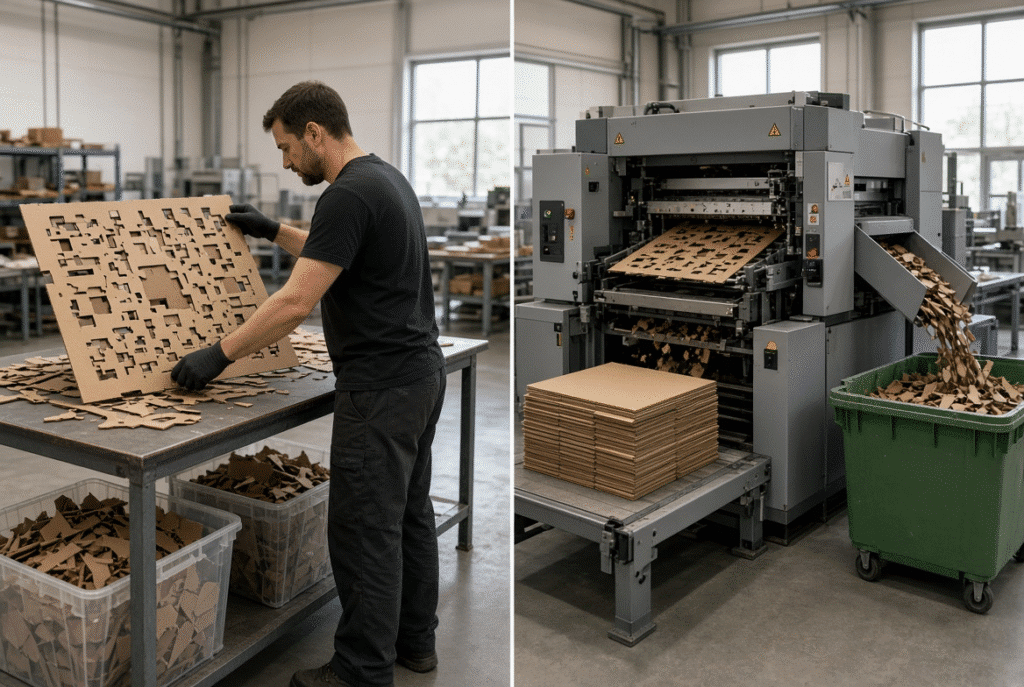
In most cases, stripping the waste automatically vs manually is not a clear-cut option. The best choice for packaging plants depends on the product geometry, quantity of order, frequency of changeovers, available manpower and requirement for the cleanliness of blanks required for the next operation. For appropriate jobs, automatic stripping is able to reduce repetitive breakout tasks, and ensure product quality stability; whereas manual stripping is still feasible for short production runs, simple form, prototype and new product changes.
Imagine that a flatbed die cutter is cutting the sheets faster than the operators can remove the waste skeleton & internal openings. Stacks accumulate by the press, floor space fills up and the folding-gluing line awaits. A short prototype order is run at the same plant on a different day, requiring a greater preparation time and alignment with the stripping tool, than the traditional method of simply breaking the waste by hand, which would also yield a lower quality of parts. These are both normal occurrences. Both are not the best methods in general. Only when all of the above values are taken into account can the right choice be made.
What Is Being Compared?
It’s not a people vs machines comparison. A comparison of two full production workflows. Manual waste removal is done by the operators following the die-cutting press. The automatic waste stripping is achieved by the use of special tooling attached to the machine, which is used to strip out selected waste areas during the production cycle. Each of these methods has different labor, tooling, set-up time, flexibility and process control requirements.
How Manual Waste Removal Works
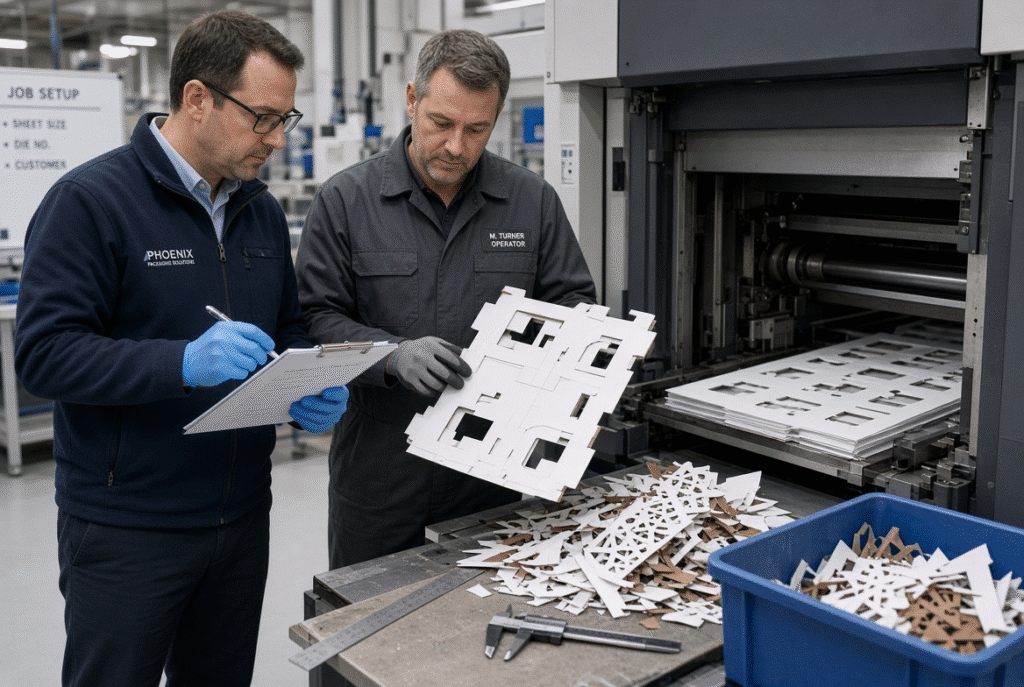
Die-cutting press unloads or takes in sheets, an operator removes the outer waste framework, cleans internal windows or openings, separates the finished blanks, checks edges and openings, and stacks or sorts product to be used. The order of the sequence is flexible. No special stripping frame is necessary for each new layout. Actual performance depends on the operator, fatigue, complexity of the product, sheet size, number of blanks per sheet and the speed of the shift. When a rectangular carton is simple, it can be turned around and out the door quickly, but when it’s multi-window folding or a dense multi-up carton it takes more time and attention per sheet.
How Automatic Waste Stripping Works
After cutting the die, aligned tools (frames, plates or needles) engage the sheet on a machine with a stripping unit. The tools push/pull selected waste areas free and the finished blanks remain supported and registered. All these aspects of sheet registration, tool position with respect to the die layout, and the separation of the blanks for delivery should be controlled. The use of automatic stripping still needs to be set up, inspected, handled with waste, cleaned, and watched over by an operator. It is a tool to automate the separation action, not eliminate the need for process discipline.
Labor Cost Comparison
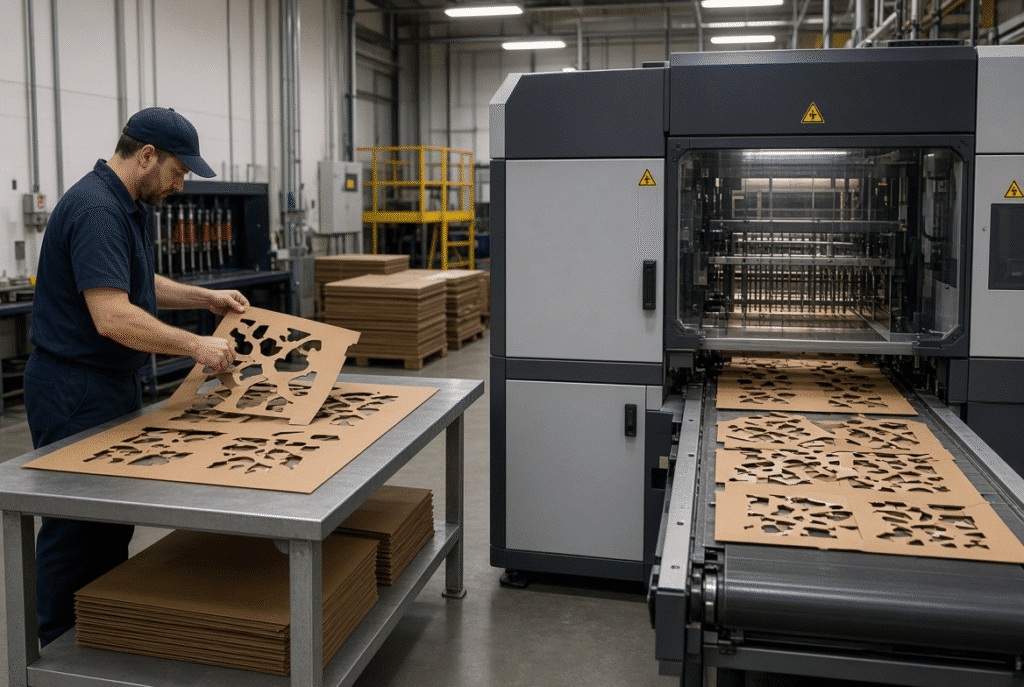
Labor cost isn’t just the number of people standing at a breakout table. It contains direct waste pick-up time, inspection, sorting, rework, overtime, supervision, and waiting cost of the downstream departments for clean blanks. The distinction can be sums up in a side by side comparison of the primary labour factors.
| Factor | Manual Waste Removal | Automatic Waste Stripping |
| Direct separation work | High and continuous | Reduced for suitable jobs |
| Setup and changeover labor | Low | Higher (tool prep, alignment, test) |
| Inspection and sorting | Often integrated with breakout | Still required; may be more systematic |
| Rework and secondary handling | Variable with fatigue and complexity | Lower when tooling is correct; higher if misaligned |
| Downstream waiting time | Can rise when press outruns operators | Can fall when continuous flow is achieved |
| Training and process control | Skill-based, shift-dependent | Requires machine and tooling knowledge |
Direct Labor in Manual Waste Removal
Operators continuously remove outer trash, remove inner trash, sort blanks and inspect. Labor demand increases as the number of internal openings increase, sheet size increase, number of products per sheet increase, substrate stiffness increase and daily volume increase. A simple single-up carton can be prepared in a short amount of time by one skilled operator, while a multi-window, multi-up will require a longer time from the same operator. Consistent output is further diminished by fatigue across a shift.
Labor Allocation with Automatic Waste Stripping
Automatic stripping decreases repetitive breakout work on work pieces that are appropriate for the tooling. Even so, operators prepare and assemble stripping frames or plates, check the registration and pressure, manage waste streams, conduct quality assurance inspections, clean the unit, and troubleshoot. The benefit is not so much to eliminate the separation, but rather to manage it and to protect quality, and to spend less time on the physical separation.
A Practical Labor-Cost Calculation
The basic approach is to compare the plants, so the comparison is plant specific:
Manual Waste-Removal Labor Cost = Number of Workers x Hours x Fully-Loaded Hourly Cost
If it is done automatically, the calculation expands to:
The remaining operator time and the setup and changeover time, tool preparation time, maintenance and cleaning time, inspection time, and waste handling time are added together.The remaining operator time, the setup and changeover time, the time to prepare tools, the time for maintenance and cleaning, the time for inspection, and the time spent on waste handling are added together.
These prices should be annualized over representative jobs and not just one order. If a longer time perspective is needed, the cost of equipment investment or any financing cost may be included. This will only be an estimate and not a guaranteed saving.
Speed and Production Flow Comparison
The speed to be judged should not be the press rated, but the total order run. The machine speed, operating speed, good sheets processed, successfully stripped blanks, rejected/reworked product, and the final saleable output are not the same numbers. The completion time for total order encompasses setup, production, waste removal, inspection, stacking and transfer to the next process.
Why Rated Machine Speed Is Not Saleable Output
A headline sheets per hour rating is based on the best possible scenario. The number of usable and clean blanks which actually come out of the line is affected by the condition of the sheet, the die layout, and the variation of substrate, tool alignment, pressure settings and operator adjustments. Stripping may be incomplete or blanks may need “secondary handling” to achieve a lower saleable output from a machine operating at a high cycle rate.
When Manual Removal Slows the Workflow
As the die-cutting press speeds out, unfinished sheets pile up in the machine. There is reduction in floor space, increase in material handling, waiting time at downstream folding or gluing stations and more possibility of overtime or delayed deliveries. This is a clear limitation on repetitive folding carton tasks: it is not the press that is limiting, but the manual breakout area.
When Automatic Stripping Improves Flow
Automatic stripping can be used for a more continuous flow of separated blanks when the geometry of the job is repeatable, the feeding is stable, it can be registered accurately and there is appropriate tooling and the same material. Minimizing waiting at the next process due to organized delivery of clean product. The improvement is dependent; it is not just related to having a stripping unit but rather to proper preparation and process control.
When Manual Removal May Be Faster Overall
If a prototype, one-off, short run or simple shape is required, then the time taken to prepare, install and adjust the stripping tool can be more than the time taken to breakout manually. In these instances manual method is preferred because the total job time is less. To be credible, you must recognise this fact, not compare every job to a theoretical speed of an automated section.
Quality and Consistency Comparison
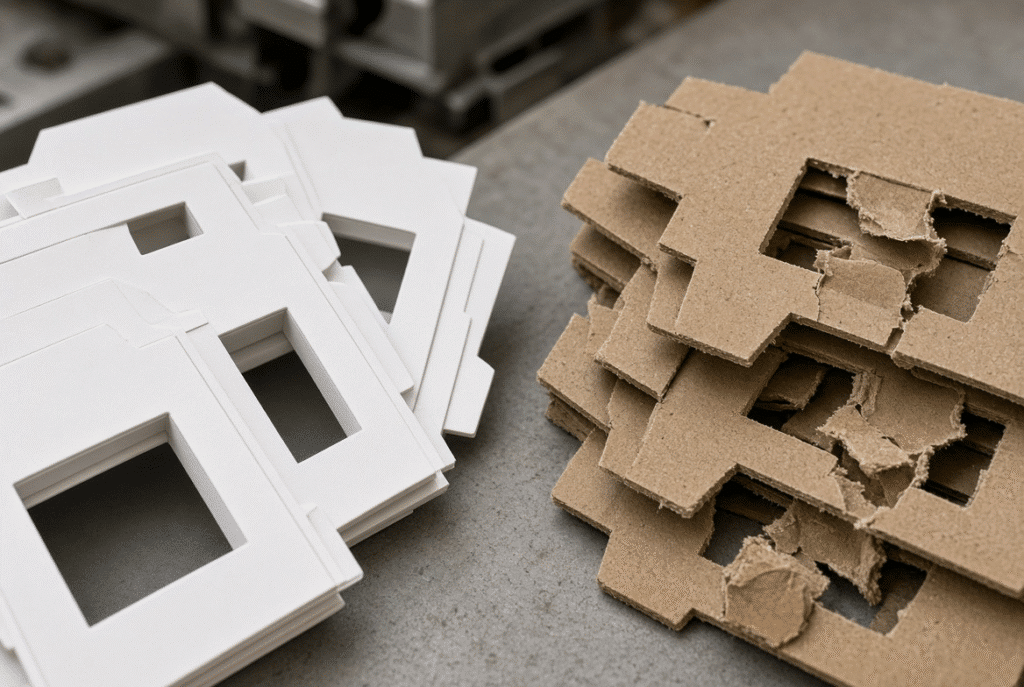
Quality here is indicated by providing clean, separated and usable blanks, with consistent results throughout the run. Neither of them gives you 100% precision if the die is not designed properly, the material is not controlled, the setup is not accurate, you are not paying attention to the die and the machine is not operated properly.
Variation in Manual Waste Removal
Manual quality can change over time, as people get tired, get better or worse at their work, or when shifts change. Common problems are pieces of waste attached, broken carton edges, missing internal openings, finished and waste being stacked together, or marks from aggressive handling on the surface. Great work is produced by experienced operators on simple or low volume products; but consistency gets more difficult as volume and complexity increase.
Repeatability with Automatic Waste Stripping
If the separation pattern is correct, the pattern will be applied in the same way on each successive sheet if the stripping tool is properly aligned. That pattern can change depending on the registration, tool position, pressure, support, die accuracy and/or condition of the substrate. Systematic defects can be produced by poorly designed tools or improperly set tools more rapidly than by manual operations. Repeatability, therefore, is dependent on correct configuration, rather than automatic properties of the equipment.
Common Quality Defects to Monitor
It is important to monitor for:
- What is left after blanks have been made
- Rips or cuts at edges, or at line openings.
- Opening(s) of the inside that are torn or do not fit fully into the opening
- An abnormal product from the process in which the product has been bent, marked or crushed.
- All finished blanks and mixed waste collected in the same stack
- A multi-up sheet in which the positions are not regularly separated.
- Deliveries of unbalanced stacks that impact downstream feeding
- Any defect that is only seen after folding and gluing.
Inspection points should be used to detect the issues early and avoid a massive defective batch.
Flexibility, Setup, and Changeover
The basic compromise is flexibility vs repeatability. Manual removal typically involves less specialized tooling, and can be easily adapted to new layouts. Stripping is more complex and requires more preparation; however, if you are repeating the same job, the automatic stripper can yield consistent results when correctly programmed for the job.
Why Manual Removal Is Flexible for Short Runs
New products, irregular shapes, prototypes and small quantities can be processed by the operator without special preparation of a dedicated stripping frame for each product. However, it can also generate larger demand for labor and less predictable cycle times when volumes grow or complexity of the product increases.
Automatic Stripping Setup Requirements
A stripping frame, plate or needle set should be prepared, set, aligned with the die layout and tested. The set up has to be identical to waste areas, product geometry, substrate and machine registration. Setup time should be incorporated into the total job calculation, particularly in the case of short runs and frequent changeovers.
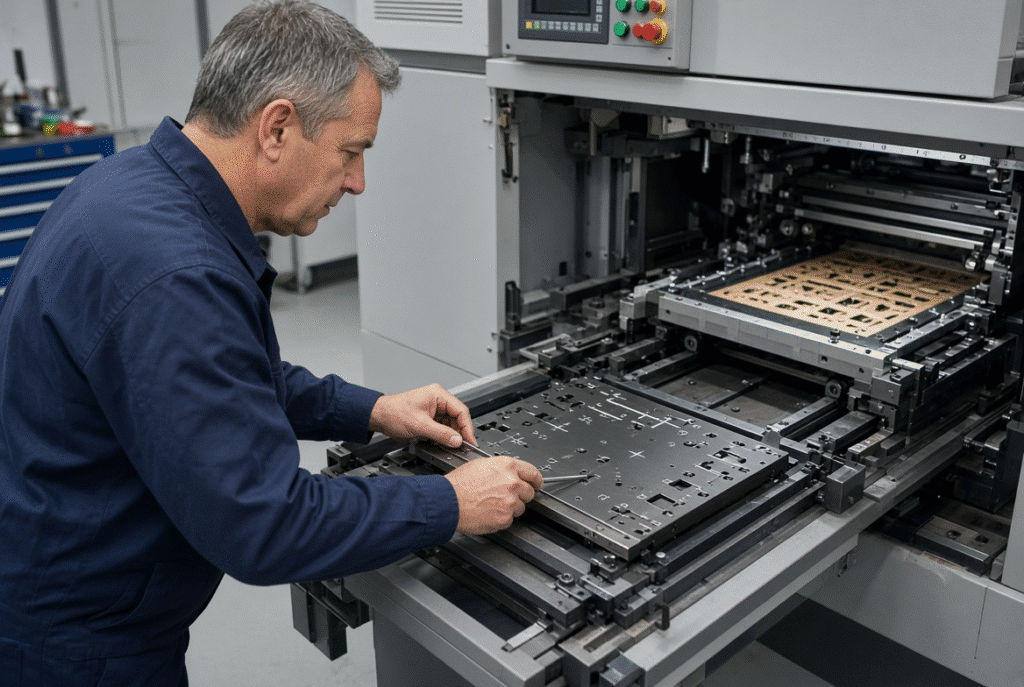
Changeover Time and Job Repetition
The more frequently the same product is produced or the more jobs have the same basic layouts and tooling concepts, the more appealing automatic stripping becomes. The amount of setup work is then distributed over more sheets. Manufacturers should determine their own PBE point based on their own production setup time, average production run, job frequency and manual labor requirement, instead of a generic value.
Which Packaging Jobs Suit Each Method?
Job profile has a more reliable value to determine suitability than any general claim.
| Job Type | Likely Suitable Method | Main Reasoning |
| Folding cartons with windows/openings | Automatic (if repeating) | High internal waste; labor-intensive manually |
| Simple shapes, short runs, prototypes | Manual | Setup time exceeds manual breakout time |
| Multi-up, high-volume repeating jobs | Automatic | Volume multiplies manual handling; flow stabilizes |
| Selected corrugated applications | Case-by-case | Depends on board, flatness, stiffness, die layout |
Folding Cartons with Windows and Internal Openings
There are several waste pieces inside because of the windows, handles, ventilation holes and decorative cutouts. It is difficult to remove them manually. However, if the product is used on a continuous basis and there is a proper design, that handling can be minimized by using automatic stripping. The actual results will still depend on the geometry of the stripping tool, waste bridges, and substrate used, all determined by the die layout.
Simple Shapes and Short-Run Products
Hand may be an efficient way to deal with product which has little waste and low repetition. It can take more time to set up a stripping tool for each short order than the time it would take to do the job by hand. Excessive over-selling of stripping automation leaves the credibility rating low.
Multi-Up and High-Volume Production
The more products that are in a sheet, and the more products that are produced each day, the more waste that needs to be removed. If layout and tooling allow for consistent separation, automatic stripping can help stabilize the flow and minimize repeated handling. Capacity increases are dependent on the job mix.
Selected Corrugated Board Applications
A small number of flatbed die-cutting machines are used for selected corrugated uses. It is suitable for the thickness, flatness, stiffness of the board, the flute structure, die layout, and the specific machine configuration. Experience with paperboard does not necessarily translate to all grades of corrugated.
Investment and Total Cost of Ownership
This should take into account the whole life cycle of the production process, and not just the purchase cost of a stripping unit.
Costs Often Missed in Manual Waste Removal
Annual cost is incurred due to repetitive labor, overtime, additional inspection, rework, product damage, delayed downstream process and unfinished stacks on the floor. Wages calculated on an hourly basis will underestimate the cost.
Costs Often Missed in Automatic Waste Stripping
Needs to include equipment investment, stripping frames or plates, set up time, training, maintenance, cleaning, replacement parts, technical support. Automation is only adding value when there is a production profile to support it.
Simple Payback Analysis Without Unsupported Claims
The general format is:
Estimated Annual Benefit = Labor Savings + Reduction in Rework + Recovery of production capacity − Additional operating costs
Rewards from this investment are the additional benefits or savings per year over the life of the investment.Rewards from this investment = Additional investment / Estimated Annual Benefit.
The calculation should be based on plant specific data. It is only an estimate and not a guarantee. The value of delivery reliability should also be taken into account, as should be the order of growth, labor availability.
How to Compare Automatic and Manual Waste Removal in a Real Plant
A practical assessment approach enables buyers to gather similar data before they make a purchase.
Record the Current Manual Process
Record the number of workers assigned, the hours worked per shift, the number of sheets processed per job, the time spent on internal waste, rework, rejected blanks, the time between folding or gluing, changeover time, overtime and delay of orders. Include a variety of representative jobs, not just the most difficult or the easiest.
Test the Automatic Process with Representative Samples
Provide the machine supplier with actual substrates, die drawings, product samples and waste removal requirements. Ask for trials on the most difficult openings, waste bridges & product geometry. Note setup time, completeness of stripping, finished quality, operating speed, the requirements of the operator and any limitations encountered.
Compare Saleable Output and Total Job Time
The final comparison covers the full order: from the set up, to the production, to the waste removal, to the inspection, to the reworking, to the stacking, to the transfer to the next process and to the change-over. It’s not a full story to compare press cycle speed to manual separation speed.
Questions to Ask Before Choosing a Waste-Removal Method
A structured checklist helps determine whether automatic stripping fits the plant and whether the quoted configuration matches actual needs.
Questions About the Product and Die Layout
- How many products are there on each product sheet?
- Is the product hollow or has openings?
- What are the size and width of the waste areas?
- What are the waste bridges being used?
- How many times is the job to be repeated?
- What are the proportions of the substrate and the thickness of it?
- Many times, the shape of the product is more important than the general industry classification.
- What questions do you have about machine configuration?
Product geometry often matters more than the broad industry category.
Questions About Machine Configuration
Check maximum and minimum sheet size, maximum die-cutting size, material range, working pressure, registration system, whether plate type or needle type (if available), number of stripping frames, whether tooling is included, delivery and stack function and whether it is standard or optional. The DAIS D1060Q is called a plate-type or needle-type waste stripping machine but this is not a strict requirement; the actual scope will be confirmed in writing.
Questions About Support and Operating Costs
Inquire about installation, training, maintenance schedule, spare parts and stripping replacement, warranties, response times, support with samples for testing, and expenses for overseas engineers. The period of service is dependent on the technical agreement and commercial contract to be read carefully.
Summary Guidance – Choose the Method That Fits the Production Profile
Manual waste removal works for low equipment commitment, simple waste removal jobs, short-run jobs or frequently changing jobs. Automated waste stripping is a better solution for repetitive, complicated, or large volume production for consistent waste separation and labor saving. It depends on the overall job time, product complexity, labour cost structure, quality requirements, set-up and tooling effort and requirements of downstream processes.
To make an accurate comparison for your plant, submit your typical sheet size, substrate and thickness, product drawing or die layout, average run length, daily volume, current waste removal process and quality targets to DAIS. Testing with the actual materials and layouts is still the best method to get from a general comparison to a production decision.