

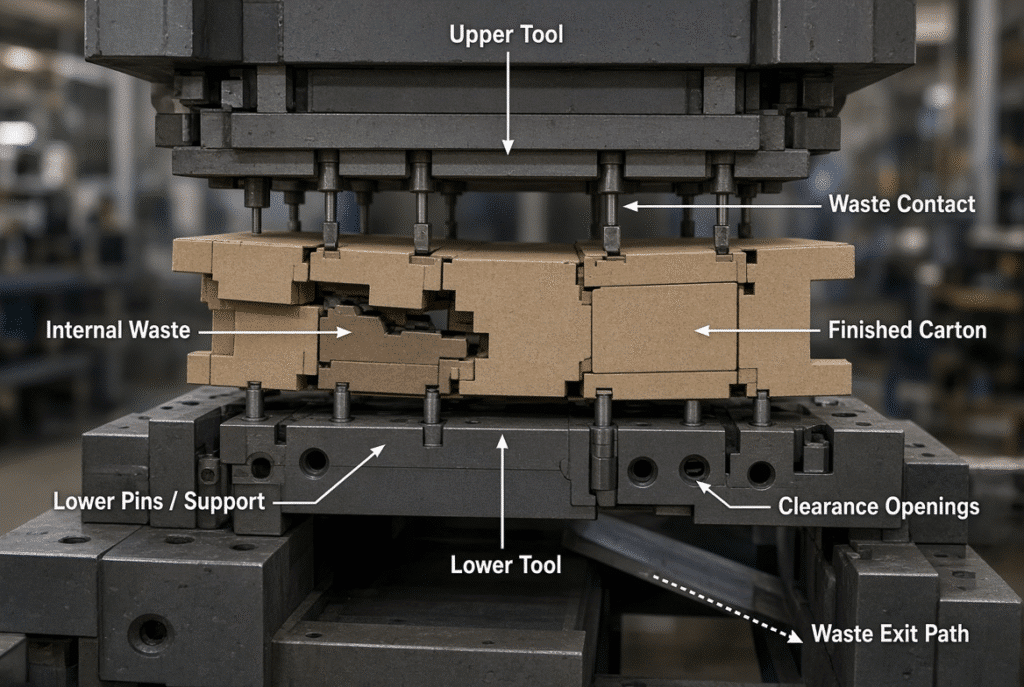
When die-cutting, automatic stripping tools will cut away the waste material from a die-cut sheet without destroying the carton blanks. The upper tool provides controlled contact to selected waste area; the lower tool provides support, clearance or exit path for waste. A good stripping is never achieved by a single layer. Both tools should be aligned with the carton layout, the geometry of the carton waste, the board characteristics, the quality of the die, the die-cut openings in the stripping board and the alignment of the machine. If they don’t, waste gets trapped within holes, carton edges may mark or bend, loose pieces may show up, or the sheet may shatter as it makes its way to delivery.
One of the most frequent mistakes is regarding the upper stripping tool as being responsible for the entire work, and the lower tool as merely a catcher. In fact, clearances are actively controlled by the lower set of tools, areas are supported to remain flat to hold carton, waste is driven through the area, and unwanted material is kept out of the delivery path.
What Happens in a Flatbed Die-Cutting Stripping Station?
Once die-cut and creased, a sheet goes to the stripping station. The machine brings the sheet between upper and lower tooling elements which are designed to reflect the actual carton layout. The sheet is delivered, strips are positioned in the designated waste fields, waste is ejected or driven through the designated openings and the rest of the carton blanks go to delivery or next blanking.
From Die-Cut Sheet to Waste-Removal Stage
This sheet that is going into the stripping station will have finished carton blanks, inner waste, outer waste, bridges, nicks and sometimes hangers in the sheet. Only material that is deemed as waste must be removed from the station.
Think of a standard folding carton with windows for displays and hanging holes and locking slots. The waste pieces within those openings must be removed from the sheet without disturbing the stacked cartons or their alignment throughout the run.
The Central Stripping Board and Waste Openings
The central stripping board (or equivalent central support structure) determines the openings for selected waste and provides support for the portions of the sheet which are to be kept together. Opening design matters. The openings that are too small may block waste or cause waste to stick inside, and support that is removed at the wrong time can cause carton blanks to bend, mark or lose stability during the stripping operation.
What the Upper Stripping Tool Does
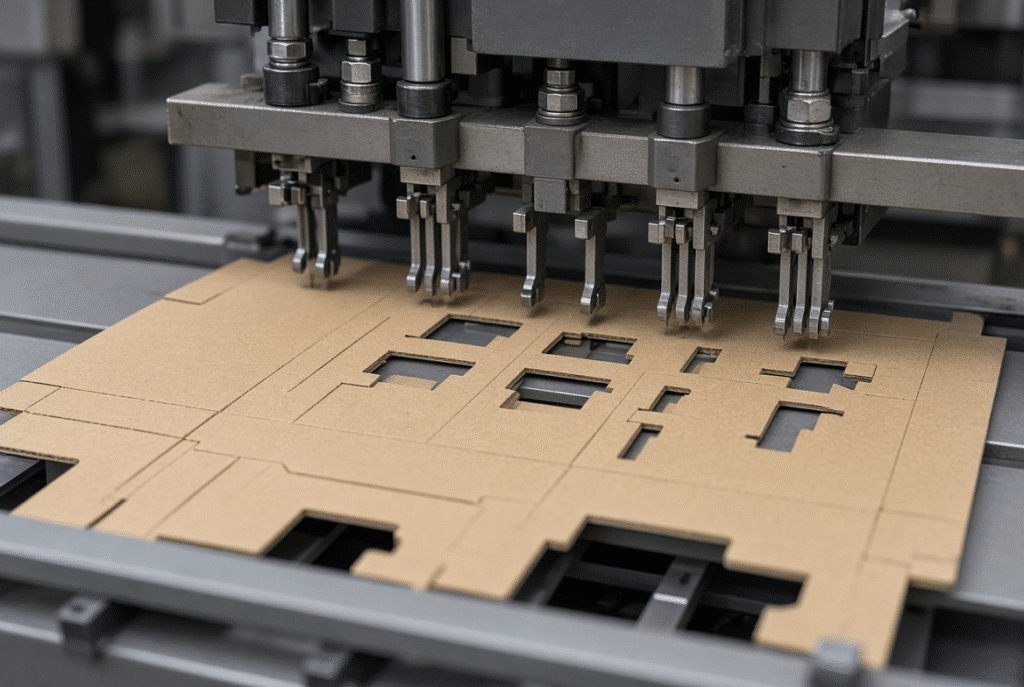
The upper stripping tool is in contact with selected waste areas from above. It can employ upper pins, stripping rules, claws, support parts, foam, sponge or something else that is able to keep the sheet and apply only controlled force to the unwanted material. The tool should be shaped to accommodate the waste pattern and should not be of the finished carton edge, crease lines, printed surfaces, foil surfaces, and embossing.
Applying Controlled Contact to Internal and Outer Waste
The upper parts are in contact with the waste areas like windows, slots, hanging holes and selected perimeter waste. The goal is to have the action be on the waste, not on the carton blank. An upper pin may touch the waste material in a carton window and nearby support elements may additional stabilize the surrounding sheet. It is important the placement is accurate: pins placed too close to a carton edge may leave a mark, warp a board or tear a crease.
Holding and Supporting the Sheet During Stripping
Upper tooling can also be used to control the sheet to ensure there isn’t any surrounding carton distortion during the stripping process. The need for sheet support is particularly critical for thin board, coated board, laminated, printed board, or board that is sensitive to surface. Support components minimise unnecessary movement in the vicinity of waste areas. Effectiveness still relies on the material condition, tooling design, alignment and the job setup.
Upper Tool Design Must Follow the Carton Layout
The top tool is not chosen from a typical pattern. It must conform to the carton dieline, imposed sheet, internal hole, bridge, internal waste shape, gripper edge, and desired stripping method. Drawings of the upper tool need to be checked with the actual production layout and a material sample. A seemingly simple carton design can cause problems when designing for access or clearance at the stripping station.
What the Lower Stripping Tool Does
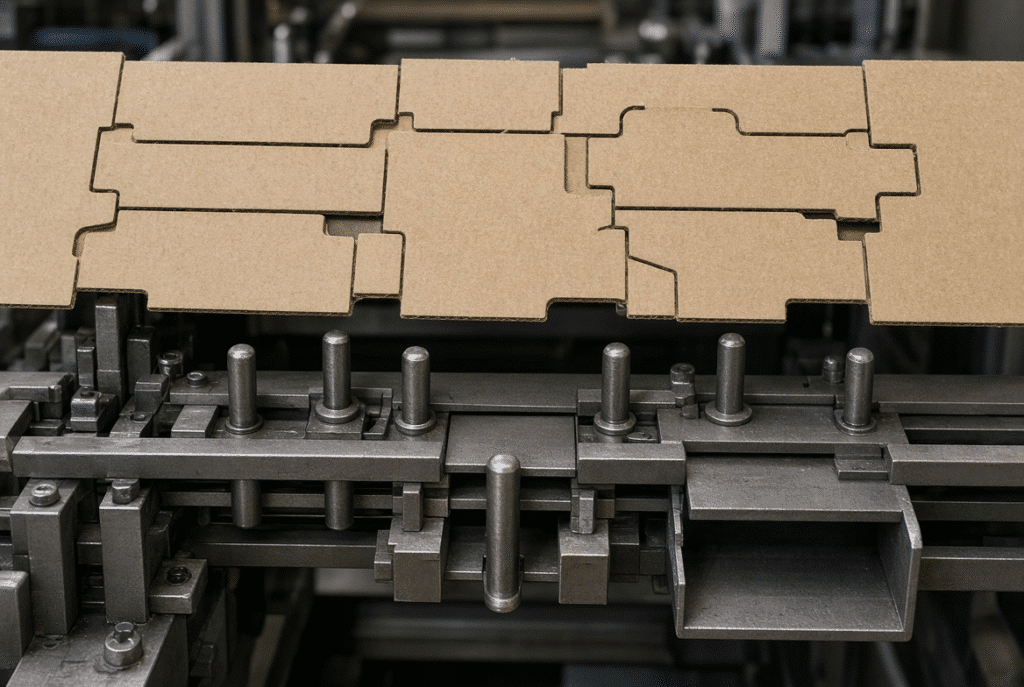
Lower stripping tooling offers the opposing system called for for controlled waste removal. It can contain lower pins, lower stripping boards, support blocks, clearance holes, guide elements or other elements that pick up or guide the waste after the upper tool provides contact. The lower tool is not just a space below the sheet. Assists in waste path definition, waste supporting selected areas, maintaining clearance, and can help to minimize risk of waste remaining in sheet or moving toward delivery.
Providing Clearance for Waste to Exit
There should be a path through or away from the stripping station for waste. To accommodate internal cut-outs, windows and outer waste inside the part to move out of the way, clearance areas are provided, aligned with the pattern of waste, from lower tooling. If a carton window waste piece is pushed down, there should be an equivalent opening and secure path downward to the bottom tooling. Waste can get stuck in the opening, bend or turn back to the sheet if the opening is misaligned, or if the opening is too small.
Supporting Finished Carton Areas Around the Waste
Lower tooling can hold pieces of the sheet over the waste areas. This assists in minimising carton flexing, edge damage and deformation during waste removal. Flexible thin coated or laminated board can differ from rigid carton board and the support pattern should be verified in tests with the actual substrate.
Lower Pins and Components Must Match the Upper Tool
Lower pins and support parts need to be positioned in line with the upper tool, central board and desired waste route. When the upper and lower parts do not match, the stripping force might be applied incorrectly, clearance provided may not be sufficient, or the carton may be damaged. It is dependent on machine design, frame geometry, board thickness, carton layout and approved tooling documentation.
How Upper and Lower Tools Work Together to Control Waste Removal
The movement of waste, the contact, support and clearance of the waste must be simultaneous to ensure reliable stripping. Selected waste is moved by the upper tool, while the lower tool receives, supports, guides, or clears the path; the central board opens the path; and the machine moves the sheet.
Tool Interaction Table: From Sheet Entry to Waste Exit
| Stripping Stage | Upper Tool Role | Lower Tool Role | Result to Verify |
| Sheet enters stripping station | Holds or stabilizes the sheet where needed | Provides support and prepared clearance | Sheet remains stable and correctly positioned |
| Tool alignment reaches waste area | Contacts selected waste zones | Aligns receiving/support zones with the upper tool | No contact with finished carton areas |
| Waste removal action | Applies controlled force to waste | Provides exit path, support, or guided release | Waste separates without tearing or bouncing |
| Waste clears the sheet | Maintains carton support where needed | Guides waste away from sheet travel route | No loose waste remains in the sheet path |
| Sheet moves to delivery or blanking | Releases or supports as required | Maintains clearance and avoids interference | Finished carton blanks remain clean and stable |
The table is a summary of a general process. Motion sequences and exact machine/tooling depends on machine and tooling.
Matching Contact, Support, and Clearance to the Waste Geometry
Tools should be constructed based on the size, shape and location of the waste materials. Some cut-outs, such as large perimeter waste, narrow slots, small holes, decorative windows and irregular cut-outs may need alternative modes of contact and support. A large display window may be more roomy for handling and easier to get out of, a small hanging hole will have limited space for handling and a greater chance of being attached or twisted out of place.
Controlling Waste Direction and Preventing Rebound
Movement of waste is a planned process. Unless it is guided in a clean path through the lower tooling, it can twist, shatter, ricocheat back to the sheet, end up in the delivery zone, or get caught in subsequent sheets. The stability of a waste exit route is not only dependent on force but also on tool alignment, clearance, waste bridges, board behavior, condition of stripping tools, and machine transport.
Carton Layout and Material Factors That Affect Tool Coordination
Only when the carton layout and material are conducive to stripping can the upper and lower stripping tools achieve good results. Tool design and alignment requirements are influenced by difficult waste structures, weak bridges, small holes, complex print surfaces and variable board conditions. The same tooling can differ in performance for various carton layouts and/or different grades of board.
Small Holes, NarrowSlots, and Complex Internal Waste
It’s difficult to manage small internal waste pieces. They provide small contact surface, need a precise clearance and can be placed near the edges of carton or near creases. These pieces must be removed without causing any damage to the finished carton and require upper and lower tools to be very accurately coordinated. Typical examples that require a technical evaluation prior to the release of final tooling include hanging holes, narrow locking slots, cosmetic-carton windows and detailed decorative apertures.
Waste Bridges, Nicks, and Die-Cut Quality
Bridges and nicks must be able to retain waste without compromising the predictable release until the stripping stage. If a stripping tool is set to cut material that is not ready to release, it can work against poor cut quality, dull cutting rules, make-ready issues and/or improper bridge setup. Adjusting the tools should not be the only answer. The team should check the die-cut sheet before stripping and correct up stream cutting problems if any.
Board Thickness, Coating, and Surface Sensitivity
Stripping behaviour is affected by board thickness, board stiffness, coating, lamination, print finish, static and moisture condition. What works for one grade of board may not work for another. Practical hazards are scuffing, carton marks, edge cracking, lack of waste release, or poor support of the sheet. The only real test would be a trial with real production material.
Common Problems When Upper and Lower Tools Are Not Properly Matched
Defects in stripping are usually a result of a contact mismatch between the tool and its lower clearance, carton support, waste geometry or the quality of the die-cutting upstream. Precise diagnosis is more effective than arbitrary pin adjustment.
Troubleshooting Table: Symptoms and Tooling Areas to Review
| Production Symptom | Possible Upper/Lower Tool Issue | Other Factors to Check |
| Internal waste remains in the hole | Upper contact and lower clearance may not align | Die-cut quality, bridges, board stiffness, static |
| Carton blank is marked or damaged | Contact or support may be too close to finished area | Tool alignment, coating, board condition, pressure sequence |
| Waste twists or returns toward the sheet | Waste path may be restricted or poorly directed | Waste geometry, lower opening, sheet transport |
| Waste breaks into fragments | Tool contact may be applied to a weak waste area | Bridge design, material brittleness, die-cut quality |
| Sheet becomes unstable in stripping | Support pattern or retained material may be insufficient | Gripper edge, board warp, transport settings |
| Problems increase at production speed | Tool coordination may not control waste consistently | Material variation, timing, machine condition, delivery setup |
The table is a diagnostic tool that serves as a starting point. Long-term problems should be discussed with the die maker, the supplier of the tooling, the machine manufacturer and experienced production staff.
Why More Force or More Pins Is Not Always the Answer
If the cause of a defect is not known and additional pins are added or additional stripping force is applied, it can create an additional defect, such as marks, crushed edges, wasted setup time, blocked clearance, increased loose waste, or increased tool complexity. A practical review sequence is: Check the die-cut sheet, determine the waste path, check upper/lower alignment, check clearance and support, check material condition, and make changes only according to approved machine and tooling changes.
How to Prepare an Application-Specific Stripping Tool Review
A plant should make the machine supplier or tooling provider more information about jobs when requesting a feasibility opinion on stripping. The ideal combination of upper and lower stripping tools is dependent on the specific carton type, and is not available in a standard spare parts catalog.
Information to Provide for Tooling Evaluation
- Internal holes, windows, slots and perimeter waste area
- Edge feed or gripper feed.
- The stripping mode required and condition expected in the output.
- Current cutting-die, stripping-board and pin-layout information where applicable.
- Examples of good and poor work.
- Pictures or videos of waste-removal issues.
- The amount of work, the number of repetitions and the desired production circumstances
- Blanking, inspection, folding-gluing and packing downstream requirements
The inputs assist the technical team to understand if the carton layout is suitable for the requested stripping method, and what tool coordination will be required.
Questions to Ask a Machine or Tooling Supplier
- What will the relationship be between upper and lower stripping tools for our carton layout?
- What type of waste is the most difficult to remove and why?
- Which of the two, above contact or below clearance, is the best approach?
- Is it possible to check our sample of die-cut sheets and boards?
- What is the placement, orientation and change-over of stripping tools on the suggested stripping machine?
- What should be done to check at the first trial run?
- What maintenance, spare parts and technical support would be available to strip tooling?
However, a purchaser should not assume that the machine has “upper and lower stripping tools”—it needs to be reviewed on a case-by-case basis.
Summary Guidance – Treat the Two Tool Layers as One Stripping System
The upper and lower stripping tools are designed as a single system: the upper stripping tool comes in contact with waste; the lower stripping tool supports the sheet and provides clearance; the centerboard controls the openings; the machine moves the sheet through a preprogrammed sequence of waste removal. Consider carton layout, die cut quality, material, waste bridges, pin placement, support zones, clearance, gripper edge, delivery requirements and trial results prior to finalizing a stripping setup.
Submit your Upper/Lower Stripping Tool Evaluation: Send Your Carton Dieline, Material Sample and Waste-Removal Requirement.
If you are considering die cutting and waste stripping for your packaging plant, check out the D1060SQ Automatic Flatbed Die Cutting Machine with Waste stripping and consult with the DAIS technical team regarding your carton layout and stripping needs.