

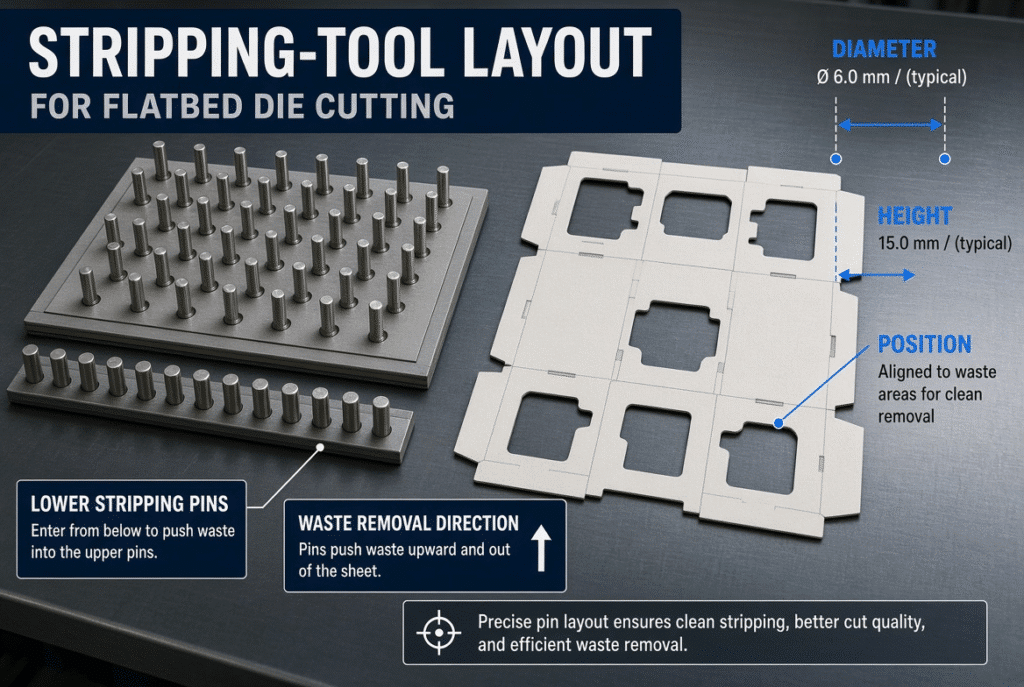
In flatbed die cutting, stripping pins separate the unwanted waste from die-cut paperboard and folding-carton sheets, but the successful removal of waste is never achieved by increasing the number of pins or by using a standard size pin. The effectiveness is a function of the compatibility with the actual carton layout, waste geometry, board properties, stripping-tool design and machine setup. The three variables which determine them are the location where the force is applied, the degree to which waste separates, whether finished blanks remain protected and the stability of the process throughout a production run.
The idea that it is always possible to compensate for an incomplete stripping is not correct. Excessive pins can cause interference, affect carton surfaces, limit waste flow, make set up difficult, or leave the true problem unaddressed: Poor die-cut quality, poor waste bridges, material variation, static, misaligned tools and/or carton layout. The appropriate sequence should be checked for each task, not copied from a different design.
What Stripping Pins Do in Flatbed Die Cutting
The automatic flatbed die cutting machine has the stripping station located behind the die cutting section. It is used to clear internal waste parts such as windows, hanging holes, locking slots, etc. out of the way to allow finished carton blanks to flow freely to the delivery or blanking step. The stripping and upper and lower stripping tools, defined waste paths, support elements and stripping boards are part of a coordinated tooling system which is also supplemented by stripping pins. The different configurations of tooling are not universal, but are made up of pins and rules, claws or other dynamic elements.
Upper Pins, Lower Pins, and Supporting Tool Components
In a typical upper stripping pin, or related unit, the force is generally applied downward on an area of waste. Lower pins or support elements guide, support or assist the flow of the waste through openings of the lower stripping unit. Both sides collaborate. An upper tool can compress a window waste piece while the lower tooling gives clearance and support to the waste piece to prevent the waste piece from tearing or marking the surrounding blank. Pins do not function alone, but rather in an upper and lower interplay involving the stripping-board setting and alignment of the machines.
How Waste Moves Through the Stripping Station
A sheet of paper is fed into the stripping station. Tools touch the set waste areas and either push or guide the waste out of the way and then continue to finished blanks. The waste must be channeled through a control system. Even if the pin is properly selected, the stripping becomes unstable if the piece removed from the board has nowhere to move, fragments, gets stuck on the sheet, or bounces back into the empty path. The direction of the pin contact is just as important as the direction of clearance and support.
How Stripping Pin Diameter Affects Waste Removal
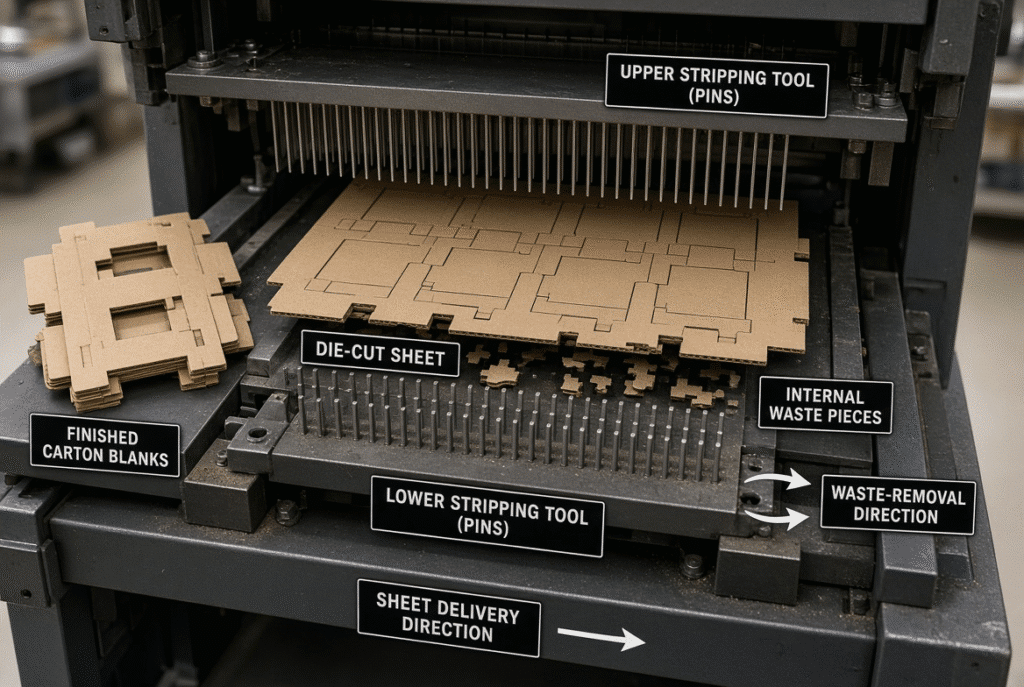
The size of the pin determines the amount of material that is in contact with the pin, the force concentration when loading the pin, the clearance around small pin holes, and the potential of marking the finished carton surfaces. A larger diameter will provide a larger area of contact and will stabilize a wider section of waste while a smaller diameter will provide better access to wide narrow openings and detailed cuts. Both options aren’t superior per se. The waste must be picked by size of waste, thickness of board, strength of material, coating, and the space between the waste and finished carton edges.
Large-Diameter Pins: Contact Area and Waste Support
Larger pins can be thought of in the wider sections of waste, large display windows or jobs requiring greater contact area to move a stable piece of waste. The restriction comes into play when the pin is not able to fit securely within close proximity of the narrow features of the carton, small windows, close cutting rules and/or fragile edges. If the tool is to be used in a large internal cut-out, it must rest in the waste securely; it should not penetrate the finished surface, or create creases and cuts near the object that would interfere with the cut-out.
Small-Diameter Pins: Detail Work and Clearance Limits
Smaller pins are useful when any waste areas are small, close to carton features, or inside of narrow areas. They need to be placed carefully and supported adequately, though. Proper die cutting and bridging preparation is essential to prevent small waste pieces from twisting, being partially attached, or being hard to control. While there are a variety of standard pin forms and systems of pin holders available from tool suppliers, final choice depends always on the specific die line and material sample and not on a set diameter chart.
How Pin Height Affects Contact Timing and Waste Release
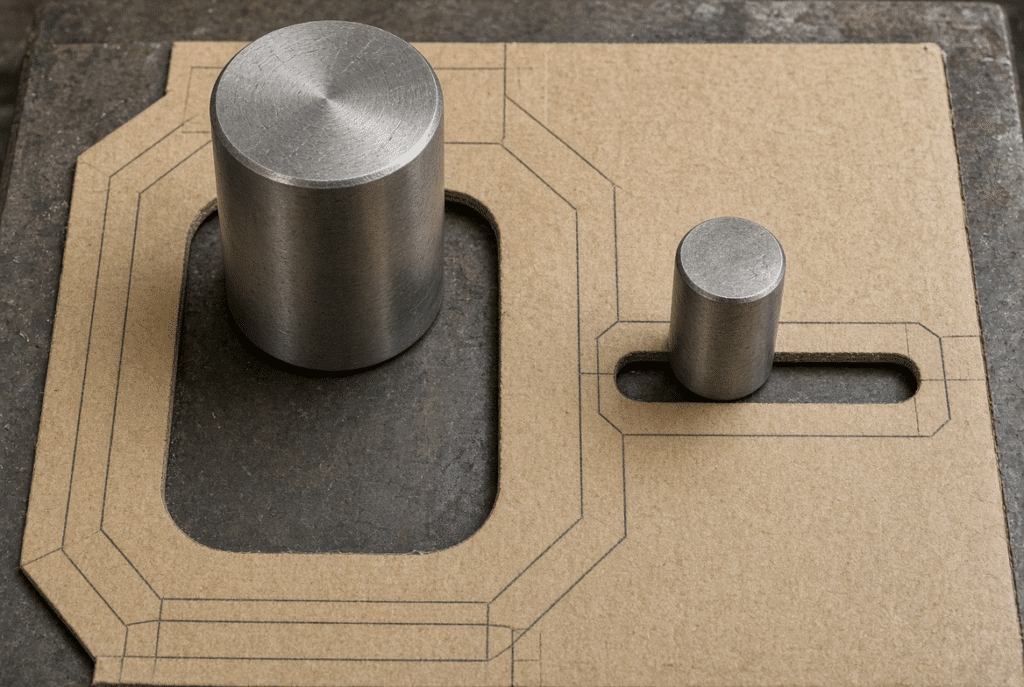
Pin height affects the moment of contact during the stripping stroke as well as the depth of the waste being pushed or supported and whether or not it contacts the sheet and lower tool without causing damage to the carton or creating an unstable release. Excessively high or low for specific tooling systems can result in contact before time, after time, too lightly or too aggressively. There are no universal adjustment values as the height can vary with the press design, stripping frame, board thickness, tooling system, or job layout.
Pin Height and the Stripping Stroke
The stripping stroke is based on the synchronization of upper and lower tooling. Pin height should be the same as the sequence to be attained to ensure that wastes are released at the right time and the completed carton is supported. If the pin doesn’t engage the waste, a small piece may remain in the waste inside a carton window. If the pin enters too forcefully or there is too little clearance, the edge of the carton or the surface of the print can be affected.
Material Thickness, Board Compression, and Tool Clearance
Paperboard, coated folding boxboard, laminated sheets and corrugated board react in different ways when subjected to stripping pressure. A system that is successful on one type of substrate could not be successful on a softer, thicker, harder or heavily coated board. Operators and buyers should verify the stripping arrangement with the production material, not a board grade layout.
How Pin Position Affects Stripping Stability
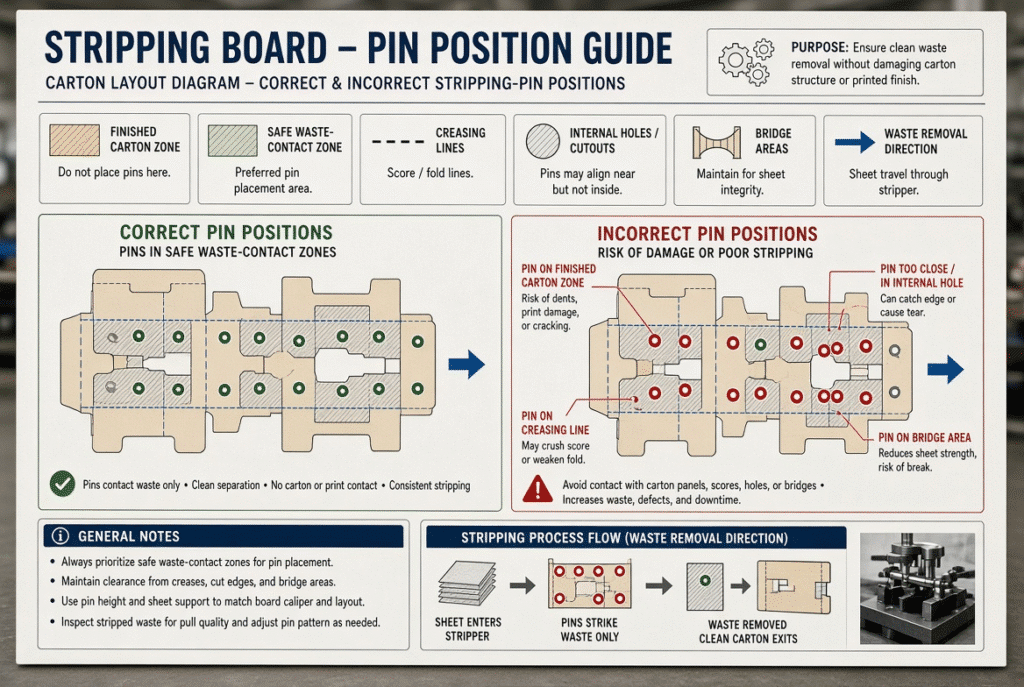
The location of the application of effort to the waste determines the location of effort on the waste and if the waste travels along a controlled path. Placement must comply with the following distance from cutting lines, creasing lines, carton edges, bridges, holes in the vicinity and direction of removal of waste. It’s not just about getting the waste in good contact; positioning also ensures that finished carton areas are not contacted, ensures waste doesn’t rotate or bounce, and ensures a consistent strip.
Positioning Pins on Stable Waste Areas
Pins should be applied to regions of the waste materials where they will not tear out randomly when subjected to force. Typically, a waste with enough support can be stripped more easily than a narrow, weak, or poorly supported portion of the waste. The internal hole can be large enough to provide sufficient area for controlled contact, and a narrow slotted waste section can be twisted or folded, requiring another type of tooling.
Avoiding Carton Damage, Marks, and Pin Interference
Excessive clearance between the pins and the finished edges of cartons, creases, print-critical areas, embossed details or narrow bridges can result in visible marks, distortion of edges, damage to the coatings and any other stripping components. Drawing and first sheet inspection continue to be critical: If a drawing looks right on paper, that doesn’t mean it will be the same in practice once the material is put to the test.
Pin Position and Waste-Removal Direction
The direction of waste movement is critical. Waste should flow away from the finished carton, not towards a crease, cut edge or delivery path, with the exception of Pins, Claws, Lower Tooling and surrounding clearance. Waste can bounce, twist, hang on the sheet or get stuck. The initial contact and final exit point of the waste is controlled by a stable layout.
Common Stripping Pin Problems and What They Usually Indicate
If stripping is unstable, the pin arrangement can be a factor, but is usually not the only factor. The table below associates some common production symptoms with potential pin-related causes, and with other areas that should be inspected. It provides a starting point for diagnosis, and is not a replacement for machine manuals, experienced tooling support, or job-specific testing.
Troubleshooting Table: Waste-Removal Symptoms and Possible Causes
| Production Symptom | Possible Pin-Related Cause | Other Factors to Check |
| Small waste remains in holes | Pin contact, position, height, or clearance may be unsuitable | Die-cut quality, bridge strength, static, board stiffness, tool alignment |
| Waste twists or bounces back | Pin position may not control waste movement | Waste path, tool clearance, lower support, sheet speed |
| Carton blank is marked or damaged | Pin may be too close to finished area or contacting too aggressively | Tool alignment, board surface, pressure sequence, material quality |
| Waste breaks into fragments | Contact may be applied to a weak area | Waste bridges, cut quality, material brittleness, waste geometry |
| Stripping becomes unstable at speed | Pin arrangement may not provide enough control | Sheet transport, machine timing, material variation, stripping-tool condition |
| Setup takes too long | Pin layout may be overly complex or poorly documented | Tooling standardization, job preparation, operator training |
Why Adding More Pins Does Not Always Solve the Problem
Excessive pin count can result in interference in waste flow, lower clearance, damage to the carton surfaces, increase time for set-up, and increase tool complexity and alignment error. Diagnosis should be the first step. Before changing the number of pins, it is necessary for the teams to figure out the following questions: What is the cause of the problem: Is it a problem with cutting quality, bridge design, board variation, static, tool alignment, pin contact or the layout of the carton?
Carton Layout and Material Factors That Influence Pin Selection
The beginning to the stripping-pin design is not a list of common pins but with the layout of the carton. The following factors determine whether it is suitable to use a pin-based approach and what the pin arrangement should be: die line, imposed sheet layout, internal holes, windows, waste bridges, gripper edge, print areas, material thickness, board stiffness. It’s not just tooling technicians who benefit from understanding these restrictions; packaging designers and buyers do as well.
Small Holes, Windows, and Detailed Internal Cut-Outs
It is problematic to strip small holes and narrow waste. They have a small pin-leading surface area, poor waste structure, limited clearance, and are very susceptible to die-cut accuracy. Cosmetic cartons that feature detailed windows, cartons with hanging holes, pharmaceutical cartons with narrow locking slots, retail packaging with decorative cut-outs, and others all require a technical review of the actual dieline and board sample prior to finalizing stripping tools.
Board Grade, Thickness, Coating, and Surface Sensitivity
The actual behavior of the material has an impact on stripping. The different types of board, such as stiff uncoated board, coated folding boxboard, laminated sheets and corrugated board are not equal in resistance to the applied force of pins and stripping. Risks that are visible are scuffing, cracking, edge damage, surface marking, fibre tearing, or waste not being completely released. Production-grade material must be used to test for stripping performance rather than unprinted material.
Waste Bridges, Nicks, and Die-Cut Quality
If the die cutting is poor or the waste bridges are not appropriate, the stripping pins will not fix the problem. The waste should be attached sufficiently to pass through the die cutter, but should release properly in the stripping station. The development of bridges, nicks, cutting rules and make-ready and stripping tools should be done in conjunction with each packaging job. Without referring to the specific material and layout, the dimensions or pin settings of a fixed bridge are of little practical value.
How Packaging Plants Should Specify Stripping Tooling Before Production
Plants should not only consider whether their die-cutting machine has “stripping pins.” They should supply the information needed for an application-specific stripping-tool evaluation. Clear inputs enable tooling and machine suppliers to figure out if they’ll need to use standard pins or consider other stripping elements, use more detailed lower tooling, or modify the carton and waste layout to achieve a desired result.
Information to Provide for a Stripping-Pin Evaluation
- This is a carton dieline and sheet layout imposed.
- The material type, board grade, thickness, coating and surface finish.
- Where possible, a production sample was printed or not printed to simulate the characteristics of the final product.
- Internal holes, windows, slots and complicated waste areas.
- Must have waste removed condition after stripping.
- Gripper-edge requirement and feed direction
- The volume of jobs, number of repeat jobs and the speed at which jobs are planned for production.
- Any issues with existing die-cutting or stripping.
- Photos or drawings of tools, as well as pin layout information if available, for current stripping tools
- Requirements for blanking, inspection, folding-gluing and packing will be carried out downstream.
These inputs will help define the best tooling method for the specific application.
Questions to Ask Tooling and Machine Suppliers
- What do we use as our stripping-tool system for our carton layout?
- What will happen if the upper and lower stripping tools cooperate in this work?
- Which waste areas are hard to get rid of and why?
- Are special pin placement or surface protection required for the material?
- Does the supplier provide physical exam of actual boards and test sheets?
- What are the stripping tools aligned and changed over on the new machine?
- What are the things operators look at in the first production run?
- What parts and support is available for the stripping after delivery?
A technical review should result NOT in a blanket statement that all waste can be stripped by a machine but rather a recommendation specific to the application.
Summary Guidance – Pin Design Should Follow the Waste Path
The effectiveness of stripping pins is affected by the case’s geometry, height, position and alignment, but their effectiveness depends on the complete system: carton layout, the geometry of the waste, die cut quality, the properties of the board, stripping boards, upper and lower toolings, machine set-up, and delivery conditions. Think of pin selection as an engineering problem. The question should not be “which pin size works best” but “how do you want to manage the disposal of waste for this specific carton and material?”
Provide your carton dieline, material sample and waste removal requirements for a stripping tooling evaluation. If you are considering a combination of die cutting and waste stripping for your packaging plant, please read about the D1060SQ Automatic Flatbed Die Cutting Machine with Waste Stripping and talk to your carton layout with the DAIS technical team.