

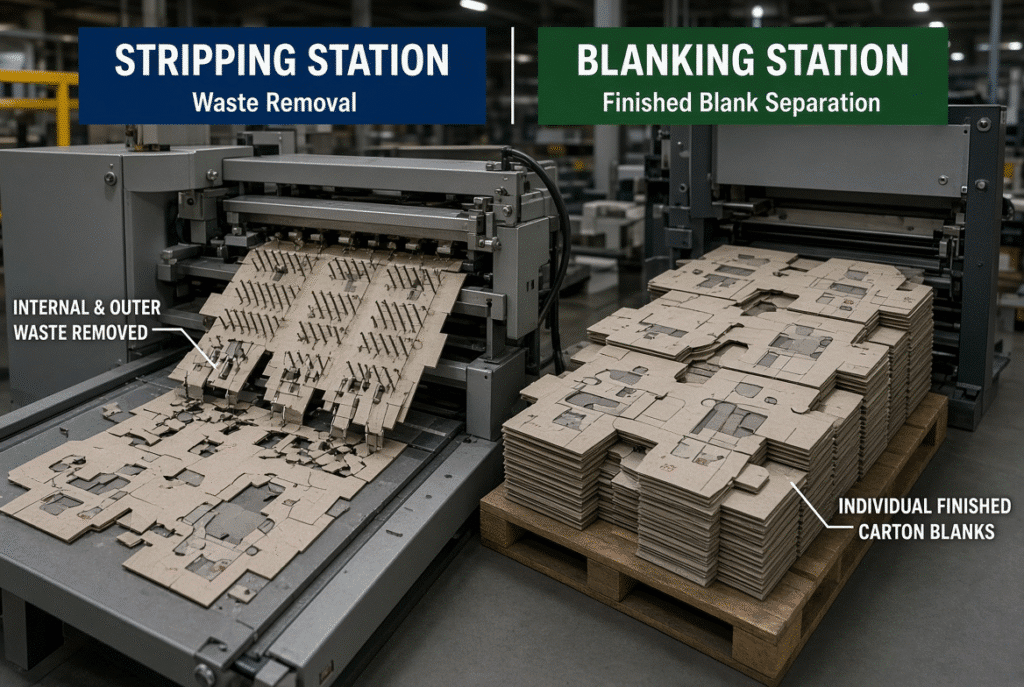
In flatbed die cutting for folding carton, there is not interchangeable term between stripping vs blanking in flatbed die cutting. The unwanted paperboard waste (internal cutouts, windows, hanging holes and perimeter skeleton) is removed from the die-cut sheet in the stripping process. Blanking is the next step: it further cleans the finished carton blanks from the other carton sheet structure or carrier, so that they can be stacked, counted or fed directly into the folding-gluing.
This is important on the plant floor. Although most waste picking can be done by a stripping station, if you must have clean separated blanks for the next operation, you still need blanking. There are many different machine configurations, which is why a “die cutter with stripping” does not necessarily provide blanked cartons. The packaging manufacturer needs to adjust the output condition of the machine to meet the actual requirement of the downstream machine.
What Is Stripping in Flatbed Die Cutting?
Stripping is a process used to remove unwanted material after die cutting and creasing. This can be inner voids within a carton blank or outers that surround or separate the blanks on the sheet. The cutting rules have formed the outlines, nicks and creases to the sheet, which is then transferred to the stripping station where different tools dependent on the job push, pull, or release the waste material from the useful areas of the carton. The rest of the sheet – with the carton blanks still secured in place – progresses to delivery or to a later blanking station.
Internal Waste, Outer Waste, and Perimeter Skeletons
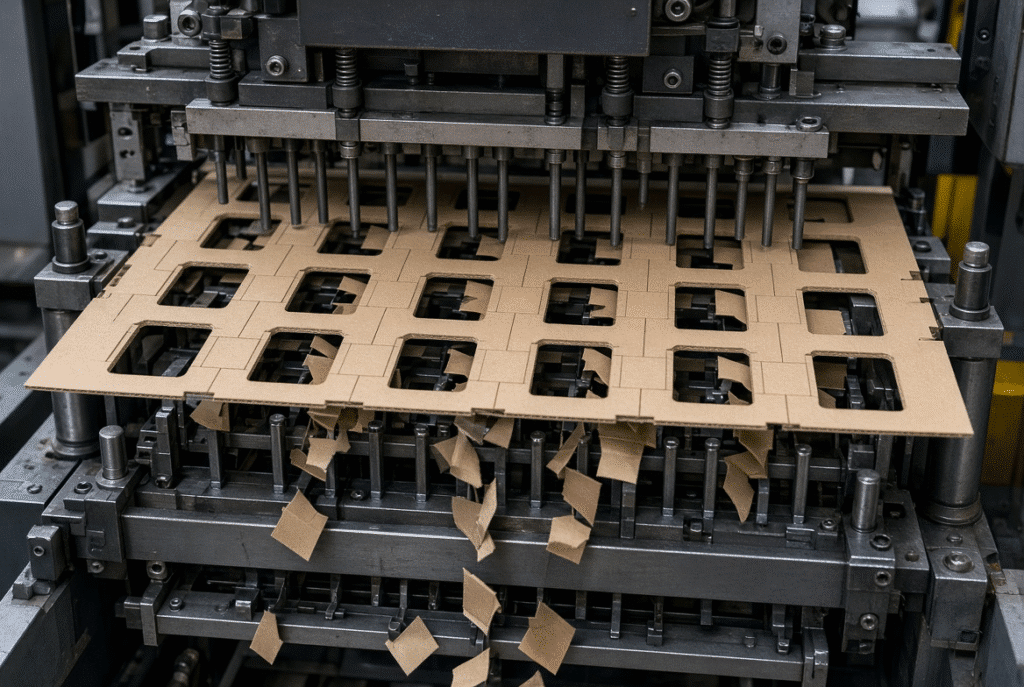
Any piece cut out of the carton, such as hanging holes, display windows, locking slots, finger holes and decorative apertures, is considered internal waste. Outer waste is waste around the outside skeleton and waste between spaces on a multi-up layout.
Consider a typical retail folding carton that has a hanging hole and a front display window. The stripping tools remove the small hanging-hole disc and the size window panel while leaving the carton blank in place and attached to the sheet. Any waste between the blanks is also removed at this stage and the perimeter skeleton is stripped before the sheet leaves the station to make it cleaner and lighter.
How Stripping Tools Remove Waste
These upper and lower stripping tools are used in conjunction with the sheet transport system. Stripping pins, claws, boards and support elements are arranged along the dieline to cause selected waste to be accelerated downwards and/or laterally into a waste conveyor or waste collection system. The type of pins and boards depends on the size and shape of each waste, the caliper of the board and the existence of a waste bridge to act as a barrier for small pieces until the right moment to release them.
The only thing that can be as good as the stripping performance is the quality of the die, the characteristics of the board, and the alignment of the tools. The critical design of a stripping station can not save a poorly made die or a layout that leaves unstable waste bridges.
What Is Blanking in Flatbed Die Cutting?
Blanking is separating the individual finished carton blanks from the die-cut sheet following the cutting and (if necessary) stripping process. The main function of its is not to remove waste – it is to remove complete carton blanks to allow them to exit the machine as separate items for stacking, counting, inspection and/or delivery to folding-gluing.
The blanking can take place in the same automatic line, following the stripping station or even manually, depending on the desired blanking output condition and on the plant’s workflow.
Separating Finished Carton Blanks from the Sheet
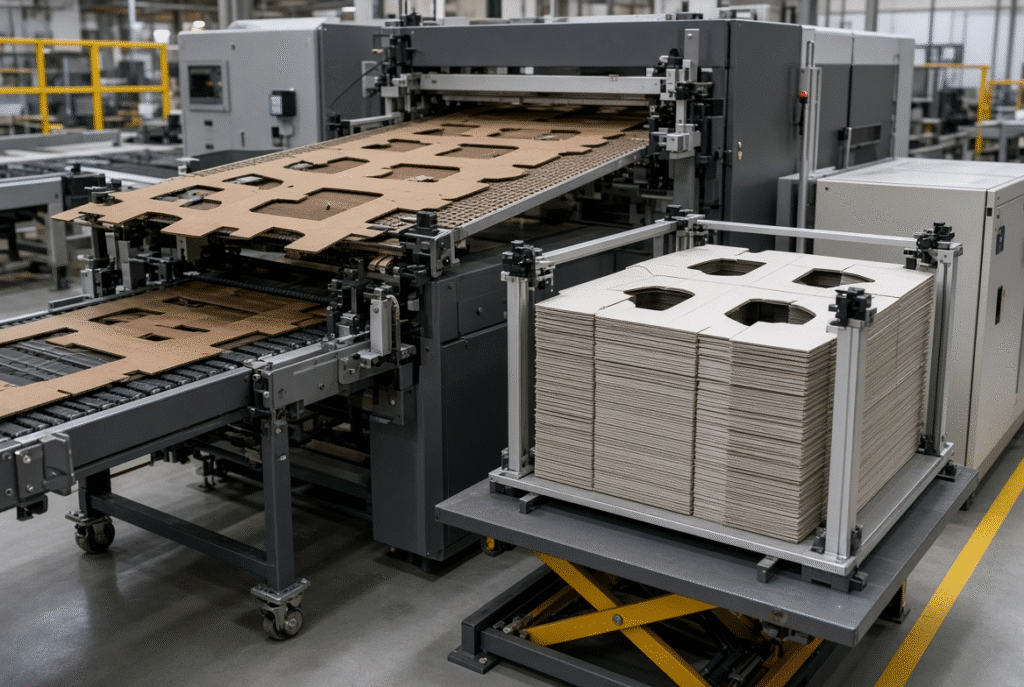
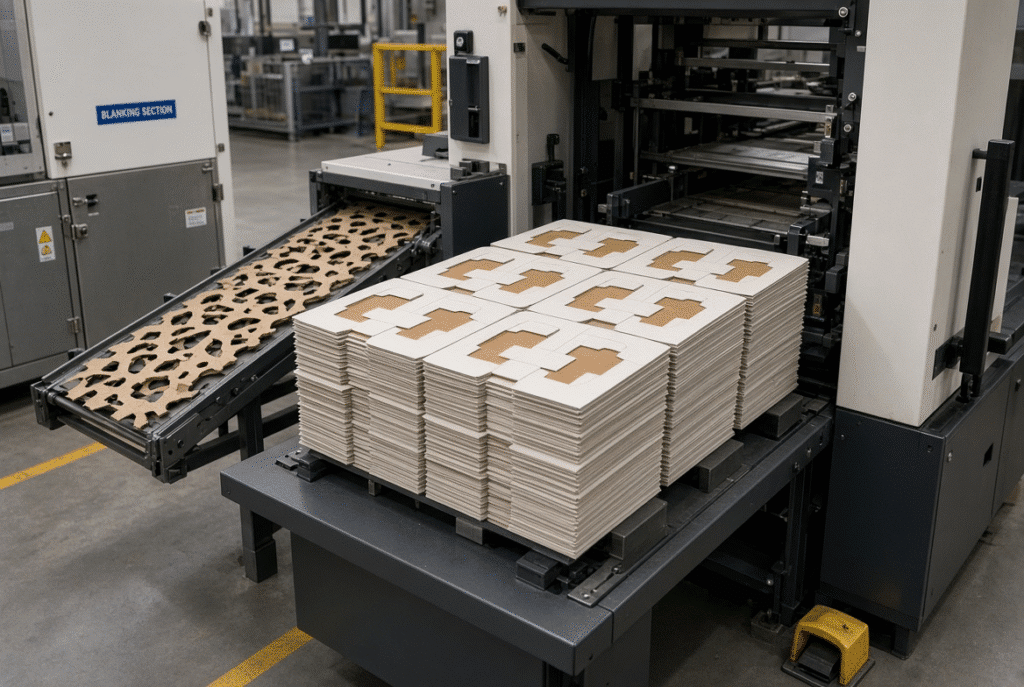
Most of the time, carton blanks will still be lightly adhered after stripping, with nicks, residual bridges or pieces of the carrier sheet. These remaining connections are broken and the individual blanks are pushed away from the skeleton through a combination of blanking tools, grids and delivery elements at the blanking station.
A multi-up folding carton job is when the strip sheet is fed to the blanking area and the blanks are gathered into a neat stack, counted and separated from the skeletons that are discharged separately. This gives a stack of separate cartons, instead of a sheet that is still connected to the other.
Why Blanking Changes Downstream Production Flow
The manual breaking and sorting prior to the folding-gluer has been reduced and/or eliminated thanks to separated blanks. Organized stacks make it easier to count, make feeding more consistent and reduce the number of handling operations between die cutting and next converting operation.
Not all jobs will need blanking. Adding a blanking station may be unnecessary and add complexity when the cartons will not be separated later in the process or if a dedicated offline separation method is already in place. The decision is based on the condition of the delivery that it is required for the next operation.
Stripping vs Blanking: The Key Differences Packaging Plants Must Understand
Stripping and blanking frequently are performed on the same machine, and they solve different production problems. Blanking is about separation of finished product and stripping is about reducing waste. Mixing them up results in waste on the sheet or connected blanks where they should be separate cartons.
Stripping vs Blanking Comparison Table
| Decision Factor | Stripping | Blanking |
| Main purpose | Remove unwanted internal and outer waste | Separate finished carton blanks from the sheet |
| Material removed or handled | Internal cut-outs, windows, holes, perimeter skeleton | Finished carton blanks and remaining sheet connections |
| Output after the process | Cleaner die-cut sheet with reduced waste | Individual blanks or organized blank stacks |
| Typical tooling | Stripping pins, boards, upper/lower tools | Blanking tools, grids, separation components, delivery arrangement |
| Effect on manual work | Reduces manual waste picking | Reduces manual blank separation and stacking |
| Role in workflow | Usually follows die cutting | Usually follows die cutting and, where needed, stripping |
| Suitable job condition | Jobs needing clean sheets but not separated blanks | Jobs requiring individual, stackable carton blanks |
| Main risk to evaluate | Incomplete waste removal or carton damage | Unstable separation, blank damage, or poor stack condition |
Many packaging positions require an employee to have both roles. Some require only stripping. A few do not require integrated station if the plant treats and separates wastes off line. The table is a tool for making decisions, it is not a hierarchy of the processes.
What Happens to the Sheet After Each Process
Even though the sheet is pure die cut, there are still carton blanks, inner waste, outer skeleton, nicks and bridges. Outer and inner waste pieces are removed and still some connections are left to form the finished blanks. Those connections are cut after which the person is paid for each separate carton.
A plant which requires only waste-free sheets will stop after stripping. If a plant has ready-to-feed blanks, it has to go through the blanking process or receive a later manual or offline separation process.
Why Machine Specifications Can Be Misleading Without Workflow Context
A machine can be referred to as “with stripping,” “with blanking,” “full stripping” or “automatic waste removal,” depending on the supplier’s description. There is no uniformity among these labels. One machine might be used to strip out just the big edges, another stripping out fine internal holes. A blanking station can provide neat stacks, or just drop blanks onto a conveyor.
Ask for process-flow diagrams, an actual output sample of your carton design, and a definite description of what will be delivered including details on the tools used, and confirmation in writing of what they say the machine will do.
When Stripping Is Enough for a Packaging Job
Only when the main purpose is only to remove the waste and the cartons can be left in connected sheet form for the subsequent process should they be stripped alone. This is not a less sophisticated solution, it is just the setup that achieves the desired results.
Jobs That Need Cleaner Sheets but Not Individual Blanks
When blanks are to be stripped for a separate blanking operation on an offline machine or for manual blanking of the whole sheet, or for batch transport to a subsequent blanking operation, the blanks remain connected after stripping. The question is always always: What does the next process really need? An integrated blanking station will increase the setup time and cost, but not provide operational benefit if it is an efficient process utilizing stripped sheets.
Jobs with Separate Downstream Blanking or Manual Separation
However, some plants make a deliberate effort to keep stripping and blanking apart. They might have a separate blanking machine or might like to control separation at a later station. A stripping-only configuration may reduce the initial investment and die-cutting line complexity, but the plant must have planned for the separate stripping step and have the required manpower, floor space and capacity.
When Blanking Becomes Important for Packaging Production
Blanking is useful when single carton blanks are required and have to be delivered in controlled stacks. The push for an integrated or offline blanking solution comes from the high volume of work, limited labor resources, and the requirement for consistent single blank feeding by folding-gluers.
High-Volume Folding Cartons Requiring Organized Blank Stacks
Typically, pharmaceutical cartons, food cartons, cosmetics packaging and other repeat consumer-goods work flows are transferred directly from the die cutting to the folding-gluing or automated packing. Blanking eliminates a significant handling problem when the next machine requires neat stacks of individual blanks. It is still subject to the current line set up of the plant, and blanking is not guaranteed for all high volume jobs.
Reducing Manual Blank Separation Before Folding-Gluing
The classic labour bottleneck occurs when blanks have to be manually broken out from a stripped sheet. Operators pick up cartons and separate them from others by hand, and then stack them up before the folding-gluer. A most of that work can be replaced by an integrated blanking station, and a more consistent feed condition can be achieved in suitable carton designs. Before the blanking station is specified, they must ensure that the blanking station is compatible with the specific folding-gluer used.
Carton Designs Suitable for Mechanical Separation
Not all dieline blanks are flat. The release of blanks is affected by their strength and location in the sheet, blank geometry, board stiffness, coating, and print surface. There is no substitute for the actual die-cut sheet and material sample for determining suitability for blanking.
Carton Layout, Material, and Tooling Factors That Affect Both Processes
The stripping and blanking quality starts before the machine gets the sheet. The stations can be made to perform cleanly by carton design, selection of carton materials, die making and tool preparation.
Internal Holes, Windows, and Waste-Removal Design
Stripper difficulties are most likely to occur in small holes, narrow slots, close windows and irregular apertures. Several factors such as board thickness, fiber orientation, coating, static, cut quality, and waste bridges in the board will affect whether internal waste can be removed without tearing the carton or leaving waste behind. Any internal waste that is complex should be discussed with the die maker and machine supplier prior to placing a tool order.
Nicks, Bridges, and Finished-Blank Separation
Nicks and bridges need to be tight enough to prevent blanks from getting lost when cutting and stripping, but let blanks go easily when blanking. Blanks that are too strong will not allow separation; blanks that are too weak could shift or become separated too soon and disrupt the registration or delivery. The dimensions of the exact nicks are job-specific and should be designed by trial and error, with a real board and carton configuration, and not by rule of thumb.
Gripper Edge, Perimeter Waste, and Sheet Control
The edge of the gripper is one of the sheet-control strategies for sheet control for the entire line. It is essential that the gripper system maintains positive control throughout all locations where the sheet goes through cutting, stripping and even blanking. The treatment of the gripper edge itself differs with different machine configuration and layout; it is not removed in same way in all machines. Combining the gripper margin and waste handling into the same plan eliminates unexpected sheet instability.
How to Specify the Right Die-Cutting Configuration Before You Buy
Before discussing maximum speed or sheet size, buyers should make sure they understand the desired output condition first (stripped sheets, connected blanks, individually blanked cartons, or counted sheets). Making sure that the machine is suitable for the actual post press job prevents over specification and expensive loss of facilities.
Production Information to Prepare for a Technical Evaluation
Before asking for a quote or trial, make the following preparations:
- A dieline is a line that is used to mark the edges of the carton and its layout prior to imposing.
- Material type, board grade, thickness, coating and stiffness
- In the case of sheets, it depends on the size of the sheet and the direction of feed.
- Taps, windows, slots and waste around the perimeter.
- Gripper-edge requirement
- Set condition after die cutting (stripped sheet, connected blanks, separated blanks or stacked blanks)
- Is there a need for blanking now or in the future?Do you require immediate or future blanking?
- Outcomes for production volume (AV), job-repeat frequency (AV) and target output (AV)
- Manual waste-removal or blank-separation bottle necks that are in place.
- Downstream process requirement – folding-gluing, inspection, counting, packing and palletizing.
- Samples of materials, cutting-die data and photographs of current problems.
It also enables the supplier to analyze stripping and blanking feasibility, tooling requirements and proper machine configuration.
Questions to Ask a Flatbed Die-Cutting Machine Supplier
- Is the quoted machine a diecutting machine, stripping and diecutting machine, or stripping and blanking machine?
- Which waste areas are available for our particular carton layout for the stripping station?
- Is it possible to get separated blanks of cartons from the machine and what should be the condition that we can expect in the stack?
- What stripping and blanking tools are needed for our work, and what is done for the procedure of changing tools?
- Is it possible to conduct a test using our material and dieline?
- What kinds of cartons and board thickness have been made using similar stripping and blanking?
- What installation/commissioning/operator training, spare parts and technical support services are included?
Nothing is more conclusive than application specific confirmation.
Summary Guidance – Plan Stripping and Blanking as One Packaging Workflow
Stripping eliminates unwanted waste and blanking separates finished carton blanks. Many carton packaging applications require both of these processes to be performed in succession, but the right combination to achieve the carton that fits the needs of the next process – stable handling, proper tooling and a viable labor/capacity schedule – is always the right package configuration.
Evaluate the entire path, from die cutting to folding-gluing/packing. State the desired output condition then choose stations that meet the condition.
Propose your carton dieline, material details and required output condition for a stripping and blanking evaluation.
If you are interested in packaging plants, which are considering integrated die cutting and waste stripping, read the D1060SQ Automatic Flatbed Die Cutting Machine with Stripping and consult the DAIS technical team to discuss your carton layout and the condition you need to deliver.