

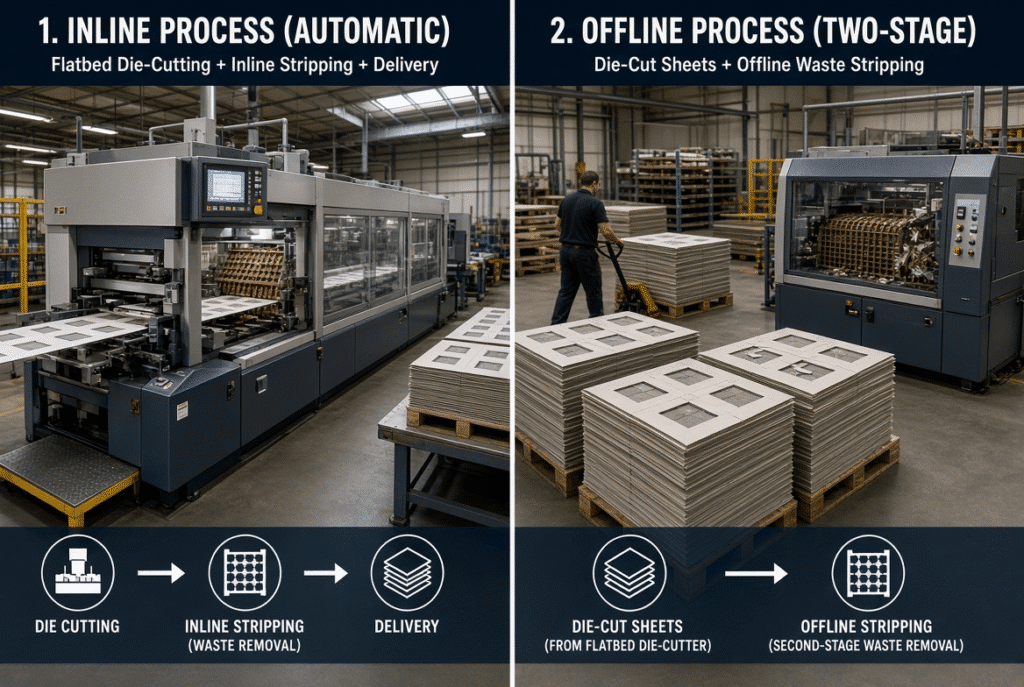
Integrated stripping station vs Offline waste stripping machine depends on the waste removal position in the actual production process. A flatbed diecutting machine with an integrated stripping station has the ability to perform the die cutting and waste removal processes in a single step, while working with sheet transfers in repeat production with stable layouts. With an offline waste stripping machine the waste stripping process is separated from the die cutting process and this allows plants with diverse carton configurations, existing die cutting presses or varying production schedules to have more die cutting scheduling flexibility. Both alternatives are not necessarily superior; it depends on the carton size, the amount of work to be done, the number of persons involved, the size of the floor space, and the way the sheets are to be handled to the subsequent operation.
What Is an Integrated Stripping Station?
An integrated stripping station is a Waste Removal Station that is constructed in an Automatic Flatbed Die-Cutting Machine. Sheets are fed, die-cut and creased, the waste is selected, and they are delivered in a single machine sequence. There are several different configurations – some just strip and some blank. The cutting of dies, stripping and blanking are related but separate operations, which buyers are required to specify precisely. The unwanted material is removed with stripping and the finished carton blanks are separated from the sheet with blanking. The combination of the two terms causes false expectations of output condition.
How Inline Die Cutting and Stripping Work as One Process
The sheet is then transferred through the controlled transport to the stripping part of the machine, without being removed. The upper and lower stripping tools remove the defined internal waste and outer perimeter (O.P) scrap in a defined manner without the sheet getting unregistered. If the die-cut quality, tool alignment, and waste bridges are identical and the ones to be removed from the station are display windows, hanging holes, locking slots, and outer waste, then it can be done in the same cycle. The sheet is then transferred to the next process
What an Integrated Stripping Station Can Improve
When the job profile is appropriate, integrated stripping minimizes the number of times that sheets are stacked, moved and rehandled. Sheets that would otherwise be waiting for stripping are left in the machine, which may help reduce floor congestion and help maintain a more consistent production process on repeat orders. These gains only occur in a stable carton layup, board and tooling. They are not given for each sheet that comes off a die cutter.
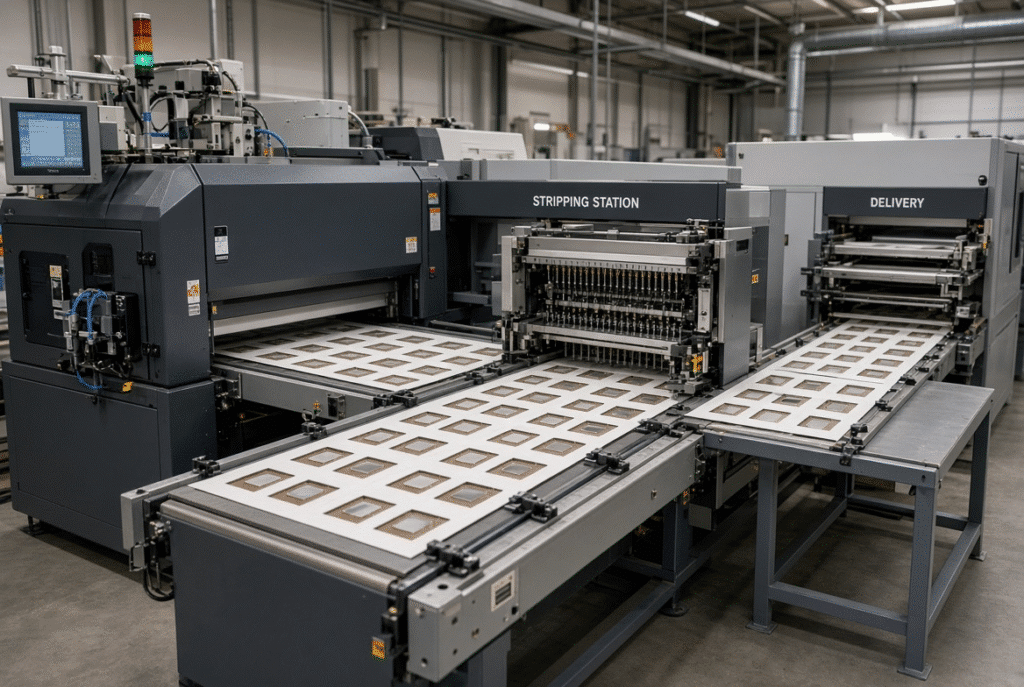
What Is an Offline Waste Stripping Machine?
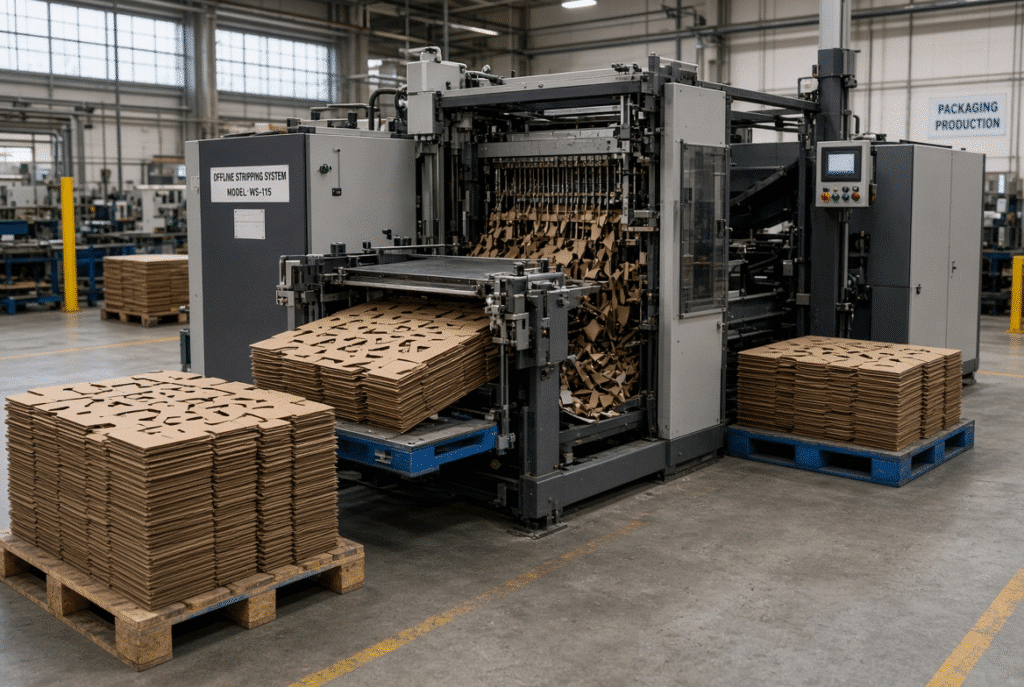
Online waste stripping machine is a work center separate from the die-cutting work center which cuts the waste after the sheets have been die cut. The die cutting and stripping operations are separated. These can be semi-automatic or completely automatic stations, using their own feeder, tooling and delivery systems. Each offline machine is different, output condition, waste types removed and handling methods will be different for each machine and must be matched to the actual condition of the sheets it will be processing.
The Two-Stage Workflow: Die Cutting First, Waste Removal Second
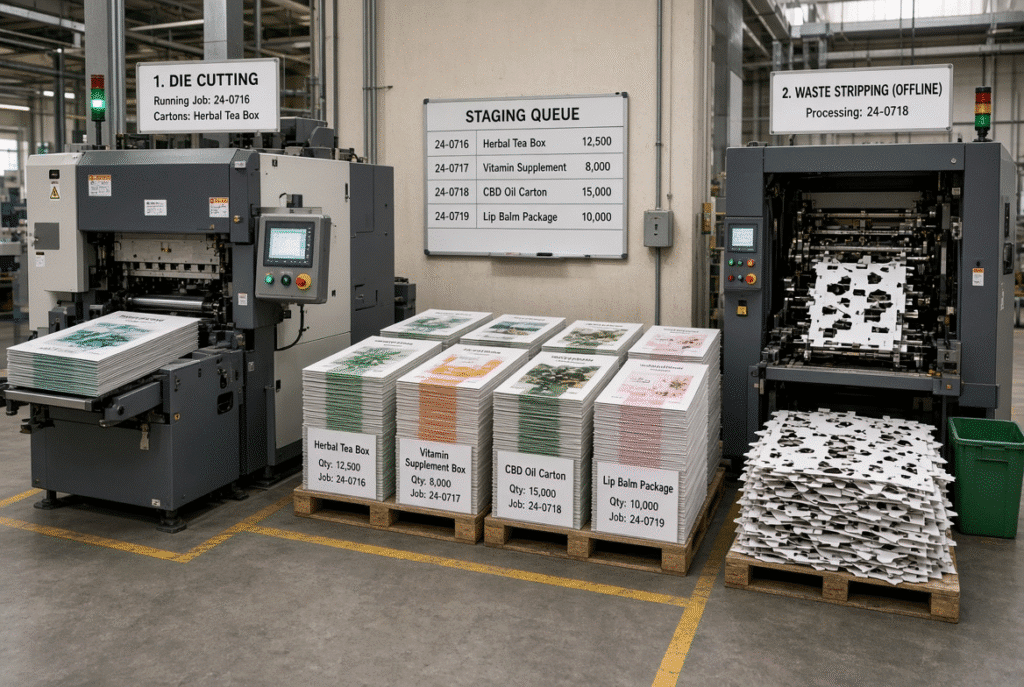
Sheets come out of the die cutter, get stacked/staged and transferred to the offline stripping station. The plant can examine, sort, label or retain the stacks on either of the two machines it is comparing. One typical scenario is a plant already has a proven die cutter without a stripping station and yet waste is still being picked up by hand for hours every day. If an offline waste stripping machine is able to process a specific amount of that work without requiring any immediate replacement of the main die cutter, then it can handle a portion of that work with little hassle, as long as it accommodates the plant’s size, grade of board, and waste pattern.
Where Offline Stripping Can Add Flexibility
By doing so, the die cutter can continue cutting while the previously cut sheets are being removed on another schedule. In high-mix plants, sometimes this method is used because there are jobs that don’t require stripping, and others that do require stripping, and still other ones that require different downstream handling. The price to be paid is additional stacking, transfer, staging space and job tracking. Flexibility is achievable, but it involves material handling and scheduling requirements which need to be planned.
Integrated Stripping Station vs Offline Waste Stripping Machine: Key Differences
Practical differences occur when it comes to the flow of materials, labor requirements after die cutting, setup, capacity balancing, floor space, job flexibility, and the state of the sheets given to the next processes. The cost of equipment is not often the determining factor. Below, a comparison is made at a plant level, not on marketing claims.
Production-Line Comparison Table
| Decision Factor | Integrated Stripping Station | Offline Waste Stripping Machine |
| Process location | Stripping occurs inside the die-cutting machine sequence | Stripping occurs in a separate work center after die cutting |
| Material handling | Fewer transfers between die cutting and waste removal for suitable jobs | Added stacking, staging, and transfer steps between machines |
| Die-cutter workflow | Stripping is tied to the die-cutting cycle and job setup | Die cutting and stripping can be scheduled independently |
| Labor after die cutting | Potential reduction in manual waste removal for matching jobs | Operator handling remains between stages; labor shifts to transfer and staging |
| Job flexibility | Strongest on repeat or stable carton layouts | Can support selected jobs and existing die-cutter capacity |
| Tooling and setup | Integrated tooling and changeover within the machine | Separate machine tooling and setup considerations |
| Floor space | Single-machine footprint plus access and waste collection | Extra work-center footprint plus staging and transfer space |
| Capacity balancing | Stripping capacity is linked directly to die-cutter output | Stripping capacity can be sized and scheduled separately |
| Output condition | Sheets leave the machine already stripped according to tool design | Output depends on the offline machine’s tooling and delivery method |
| Best-fit plant situation | Repeat folding-carton work and continuous flow goals | Existing die cutters, high-mix schedules, or independent stripping need |
| Main risk to evaluate | Job mix or tooling that does not support reliable inline stripping | Handling damage, mixed stacks, and queue delays between operations |
Labor, Sheet Handling, and Work-in-Process Inventory
Integrated stripping keeps the sheets contained in one machine, which helps with the jobs that would require it, eliminating the piles between die cutting and waste disposal. Offline stripping intentionally generates work in progress: work-in-process is created through labeling, moving, staging and tracking. Those stacks take up floor space, are potentially mixed and cause scheduling pressure. Meanwhile, the offline path can release the die cutter to keep cutting without any interruption of the stripping process.
Capacity Balancing and Production Scheduling
The integrated stripping station provides stripping power to the die-cutting cycle. Issues with the stripping section setup or tools can cause the entire machine to stall. Offline stripping separates the two capacities, which means that one team or machine can strip earlier jobs while the other is processing current jobs, using the die cutter. The plant will then have to deal with queues in between, transfer timing, and consistency of sheet condition from the two stages.
When an Integrated Stripping Station Is Usually the Better Fit
Integrated stripping is a preferred option for plants which perform repetitive carton production with a consistent and predictable waste pattern and wish to minimize handling between die cutting and the subsequent step. Even with the above said, carton suitability should still be evaluated based on the actual carton layout, board and tooling prior to making a decision.
Repeat Folding-Carton Jobs with Stable Waste Patterns
Perimeter and interior waste, holes, windows and slots occur repeatedly in many pharmaceutical and cosmetics cartons and also in standard retail cartons, and can be accommodated by an integrated workflow once the stripping tools are demonstrated. Board variation, die cut quality, and tool alignment remain issues for reliability and plants should verify with true samples and not assume that all repeat jobs will strip out.
Plants Trying to Reduce Manual Handling Between Operations
Many plants continue to die-cut sheets, stack them, transport the sheets to another table, strip them by hand and then transport them to a different table for inspection or folding-gluing. An Integrated Station can reduce that series of transfers for matching jobs. The evaluation should cover operator hours, in-house transport, congestion on the floor, damage caused by handling and the impact of delays on downstream schedules.
New Lines Designed Around Continuous Production Flow
If the installation is a new line and not patching a current one, it is possible to plan the feeder access, delivery space, waste collection, and position of the operator so that the works can be integrated into an integrated die-cutting and stripping machine. The machine footprint is not the only space requirement—plants must provide space for tool changes, access for maintenance, and material flow.
When an Offline Waste Stripping Machine May Be the Better Fit
Offline stripping is a viable production method for plants that want to enhance their ability to remove waste without the need to replace an active die-cutter, or in plants where job diversity and independent scheduling are more important than a single continuous machine cycle.
Existing Die Cutters Without a Stripping Section
A typical application is a plant that will still satisfy the tonnage and sheet size requirements, but will result in stacks that must be manually wasted. A waste stripping machine that operates off-line can do a portion of that work. This compatibility has to be determined for real sheet sizes, waste pattern, board types and output condition, not all of the offline machines are accepting all of the die-cut sheets.
High-Mix Production and Variable Job Schedules
With rapid changes in carton styles, some carton jobs will require no stripping, some will require selective stripping, and some will require a different downstream handling. One stripping work center should be used only for those jobs with clearly identified labor saving elements. Job tracking is more expensive, the material has to be moved around more and there are more opportunities for delay and mix-up of sheets.
Plants That Need Independent Capacity for Waste Removal
Several die cutters could feed a common stripping machine or sheets could be checked or staked before being fed to a stripping machine. For these situations, capacity that does not have to be “bound” to a single die-cut cycle may be helpful. The offline machine needs to be sized for peak demand, staging space and manpower – otherwise queues will start to be a new limiting factor.
Carton Layout, Material, and Tooling Factors That Affect Both Options
The following application requirements remain even if stripping is moved from one location to another. The same variables are important for both routes: carton geometry, internal holes, windows, perimeter waste, waste bridges, board thickness and coating, die-cut accuracy, stripping-pin arrangement and tool alignment.
Small Holes, Windows, and Complex Internal Waste
Narrow slots, small internal waste pieces, windows and irregular cut outs are still a challenge, regardless of if stripping is inline or offline. The stiffness of the material, coating, static, die-cut quality and pin placement all have an impact on the cleanliness of the waste. Before choosing either route, plants should provide actual carton drawings, imposed layouts and board samples.
Perimeter Waste, Gripper Edge, and Sheet Stability
The excess waste and gripper-edge waste should be kept in check during transport and delivery. If the sheet is integrated it must be registered on the whole machine. The sheet needs to be able to withstand restacking, transfer, re-feeding and the individual stripping cycle in an offline station. The feasible method relies on machine layout and the current plan for the removal of the waste from that layout.
Tooling Compatibility and Changeover Requirements
In both integrated and offline systems, there is a need for upper and lower stripping tools which are configured to match the carton geometry and waste structure. The positioner system, waste size, hole size, board thickness, cut quality and board positioning are all factors that should be taken into account when evaluating a tool. Change over time and tool storage is also added to the operating cost.
How to Compare the Total Cost of Each Stripping Route
The cost of equipment is just a single line item. There are many factors that go into a complete comparison, including tooling, installation, floor-space adjustments, labor, internal transport, work-in-process inventory, downtime risk, training and anticipated use for the length of the equipment’s service life.
Direct Costs: Equipment, Tooling, Installation, and Training
This includes machine costs, stripping tools, installation, power/air requirements, layout changes, operator training, commissioning, and spare parts. Commercial comparisons should be based on the actual size of the plant’s sheets, carton designs and verified machine settings—not on general catalog data.
Operating Costs: Labor, Handling, Scrap, and Downtime
On appropriate jobs, the integrated stripping can minimize some of the handling processes. Stripper labor may be required to be staged and transferred, but may allow the die cutter to keep running during the stripping process. The expected workflow is used to calculate scrap and rework costs, not theoretical machine speed, because these costs are caused by incomplete stripping, damaged cartons, mixed stacks and job tracking.
Questions to Ask Before Choosing an Integrated or Offline Stripping Solution
An unambiguous collection of production facts and supplier queries makes a general comparison a plant-specific decision.
Production Information to Prepare
- Carton dielines and imposed sheet layouts
- These are the typical maximum and minimum sizes of sheets.
- Type of material, grade of the board, thickness, coating and stiffness.
- Internal holes, window openings, slits and intricate waste pockets.
- The condition that must be met after stripping.
- Whether blanks must be left attached or blanked or separation has to be done by hand
- The number of jobs, both daily and monthly.The number of jobs per day and month.
- Frequency of repeat jobs and run lengths in expectation.
- Existing manual stripping labour and bottlenecks encountered.
- Outline existing die cutting equipment and limitations.
- Space for integrated equipment, staging and an offline work center on the floor.
- Downstream workflow is provided with inspection, blanking, folding-gluing, packing and palletizing.
- Technical staff, training requirements of operators, maintenance resources available
This information provides a supplier with the opportunity to consider workflow fit, not just machine ability.
Questions to Ask a Machine Supplier
- Will the automatic die-cutter be used for stripping alone or stripping and blanking?
- What can be done to eliminate waste from our real carton layout in the stripping configuration?
- May we show the carton drawing and material sample to the supplier before we give you a quotation?
- What stripping tools are needed and how are they changed over?
- What does the suggested system do for small holes in the interior, windows, or irregular waste?
- Which one of the following conditions should be present at the output after stripping?
- How much square footage, electrical, air and service clearance needed?
- What is covered with operator training, installation, commissioning and after sales support?
- Are there any similar packaging applications that the supplier can show reference or test results for?
- If a “Offline” solution is recommended, what sheet staging/feeding and output handling will be needed?
Answers should be specific to the application; don’t just say a machine can “strip waste.
Summary Guidance – Choose the Route That Fits Your Plant, Not Just the Machine
The integrated stripping station will allow for the continuous production of repeat folding-carton production with stable waste patterns. An offline waste stripping machine can provide a viable solution to existing die-cutting operations, high-mix schedules and plants which require independent stripping. It depends on carton layout, material, tooling feasibility, volume of the job, labor, handling, carton floor space, existing equipment, and the rest of the production line.
Submit Your Carton Layout, Material Info and Production Workflow for an Integrated vs Offline Stripping Evaluation.
If you are considering integrated die cutting and waste stripping, check out the D1060SQ Automatic Flatbed Die Cutting Machine with Stripping machine and talk to the DAIS technical team about your carton layout and production needs.