

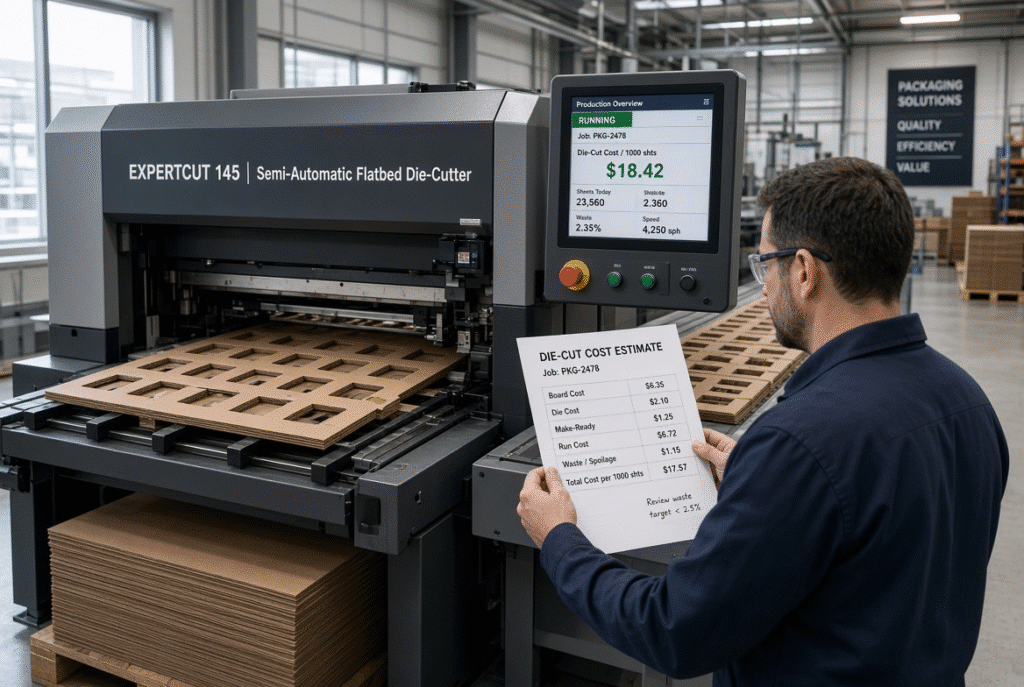
To calculate die-cutting cost per 1,000 sheets, add labor, tooling allocation, makeready, machine time, waste, maintenance, energy and relevant overhead, then divide the total job cost by the number of saleable sheets and multiply by 1,000. A machine’s rated speed is never enough. Setup, die changes, inspection, pile handling, rejects and product complexity change the real figure. The same flatbed die cutter can produce very different costs per 1,000 saleable sheets on a short carton run versus a long repeat order because fixed setup and tooling costs are spread over fewer sheets.
What Should Be Included in Die-Cutting Cost?
Before any formula is used, the plant must decide the cost boundary. Some teams track only direct machine-processing cost. Others build a broader production cost that includes tooling, labor, waste, overhead and depreciation. The model chosen should match the quoting purpose and the internal accounting system already in use.
Direct Job Costs
Direct costs are those clearly tied to one specific die-cutting job:
- Operator labor for setup, running, inspection and handling
- Steel-rule die and creasing-matrix allocation
- Makeready time and trial sheets
- Machine running time
- Setup waste and production rejects
- Special fixtures or stripping tools
- Manual waste stripping when required
These items are usually the easiest to assign accurately.
Shared and Indirect Costs
Supervision, maintenance staff, factory space, utilities, administration, depreciation and financing are normally shared across many jobs. Plants allocate them by machine hours, production volume or another consistent internal method. No single allocation rule is universally correct; the important point is consistency with the plant’s own accounting practice.
Gross Sheets, Saleable Sheets and Finished Units
Sheets processed (gross sheets) are not the same as saleable sheets. Saleable sheets are those that pass inspection and can be delivered or further processed. When one sheet carries multiple blanks, cost per 1,000 sheets can later be converted to cost per 1,000 blanks, but the calculation must begin with a clearly defined output unit. Quoting on gross sheets alone understates the true cost of usable product.
The Basic Die-Cutting Cost Formula
A practical starting formula that can be transferred directly into a spreadsheet is:
Total die-cutting job cost = labor + tooling allocation + makeready cost + running machine cost + waste and rejects + maintenance and energy + allocated overhead
Then:
Cost per 1,000 saleable sheets = total job cost ÷ saleable sheets × 1,000
All terms must use the same currency, time unit and quantity unit.
The Cost-per-1,000 Calculation
The numerator is the complete job cost. The denominator is the number of sheets that actually leave the department as acceptable product. Dividing by the machine’s rated hourly output produces an artificially low figure whenever setup, rejects or slower actual speed reduce saleable output.
Gross Cost Versus Saleable Cost
Cost per 1,000 gross sheets is almost always lower than cost per 1,000 saleable sheets. Setup waste, misregistration, cracked creases and handling damage remove sheets from the usable total. Customers buy usable product, so the saleable figure is the one that belongs in a quotation.
Cost per Sheet, Blank and Finished Product
When the layout yields several blanks per sheet, convert after the saleable-sheet cost is known:
Cost per blank = cost per saleable sheet ÷ blanks per sheet (adjusted for blank-level rejects)
Keep every unit clearly labeled so the numbers remain comparable.
Labor Cost: More Than the Operator’s Hourly Wage
Labor cost covers the time people spend preparing, running, checking and handling the job. Even a semi-automatic machine needs operators for pile preparation, monitoring, changeover, inspection and delivery.
Direct Operator Labor
A simple expression is:
Direct labor cost = number of operators × loaded hourly labor cost × job hours
Loaded labor cost may include wages, benefits, overtime and payroll taxes, according to the plant’s accounting rules. State the basis used in every calculation.
Setup, Running and Handling Labor
Separate the hours spent on makeready, steady running, sheet handling, inspection and waste removal. On short runs the setup and handling hours often dominate the labor total.
Labor Allocation in Semi-Automatic Production
Semi-automatic operation reduces repetitive feeding work but does not eliminate labor. Operators may be dedicated to one machine or shared across several tasks. Record the actual allocation rather than assuming an automatic headcount reduction.
Tooling Cost and How to Allocate It
Steel-rule dies, creasing matrices, die boards and stripping tools can form a large share of cost on short or complex jobs. Allocation must match the plant’s quoting policy.
Die and Creasing-Tool Cost
Typical items include the steel-rule die, creasing matrix, die board, stripping tools, replacement rules and special fixtures. Not every job needs the full list; check the quotation scope.
Amortizing Tooling Over Multiple Jobs
A reusable die may be charged fully to one order, spread across several repeat orders, or allocated over its expected production life. A generic expression is:
Tooling cost per sheet = allocated tooling cost ÷ expected usable production quantity
Do not invent a fixed die life; use the plant’s actual experience or the toolmaker’s guidance for that specific die.
Tooling Cost for Short Runs
The same die cost spread over 2,000 sheets produces a much higher cost per 1,000 sheets than when it is spread over 80,000 sheets. This is one reason minimum order quantities and repeat-order pricing exist.
Makeready and Changeover Cost
Makeready covers every minute from the moment the previous job ends until stable saleable production begins. Those minutes still consume labor, machine time and material.
What Makeready Time Includes
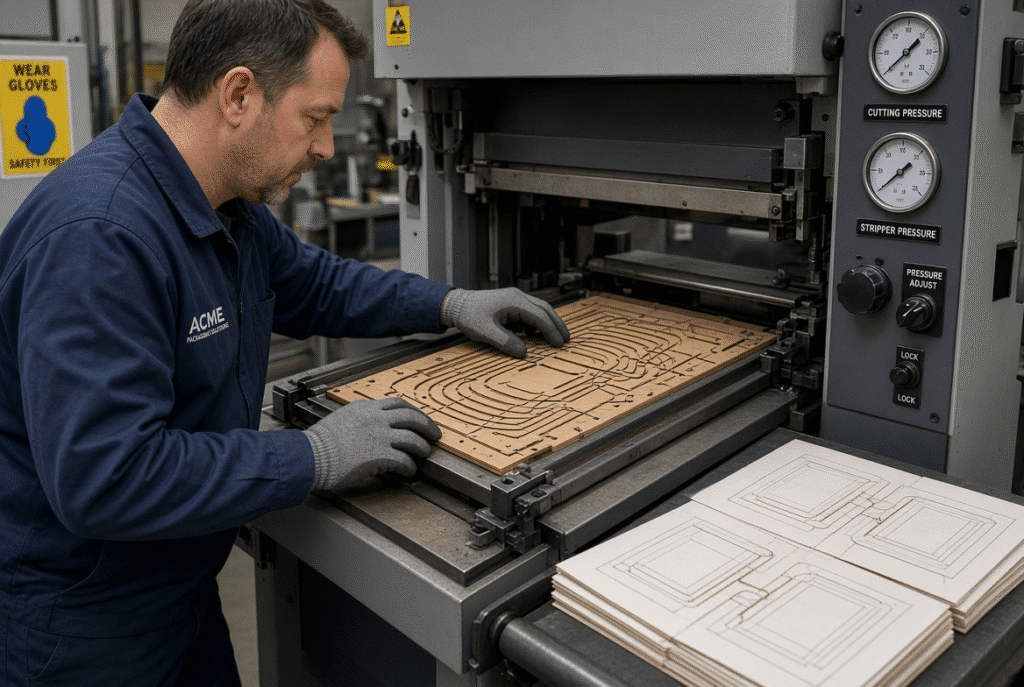
Typical activities include removing the previous die, installing the new die, setting position and pressure, adjusting gauges and transport, setting the creasing matrix, running trial sheets, correcting defects and obtaining first-article approval. The exact list depends on the machine and the tooling.
Makeready Cost Formula
Makeready cost = makeready hours × loaded labor rate + setup material waste + machine time during setup
Additional technical labor or tooling work is added when those resources are charged directly to the job.
Why Short Jobs Cost More per 1,000 Sheets
A 45-minute setup on a 2,000-sheet order carries far more weight per 1,000 sheets than the same setup on a 100,000-sheet order. Reducing makeready time, grouping similar jobs and improving setup documentation therefore lowers unit cost without any change in machine speed.
Machine-Time Cost and Actual Production Speed
Machine-time cost reflects the plant’s chosen internal rate applied to the hours the press is occupied by the job. It is not the same as the purchase price of the machine.
What Belongs in an Hourly Machine Rate
Possible components include depreciation or lease cost, maintenance, energy, lubricants, floor space, insurance, support labor and planned service. Some plants use a simplified rate; others use a fuller ownership-based rate. Consistency matters more than perfection.
Machine-Time Cost Formula
Machine-time cost = machine hourly rate × total machine hours used
Total hours normally include makeready, trial runs, productive running and job-related cleaning.
Rated Speed Versus Actual Running Speed
Catalogue maximum speed is rarely the speed used on the job. Board thickness, die complexity, sheet size and quality requirements determine the stable running speed. Measured job-cycle data is always preferable to the brochure figure.
Waste, Rejects and Quality Losses
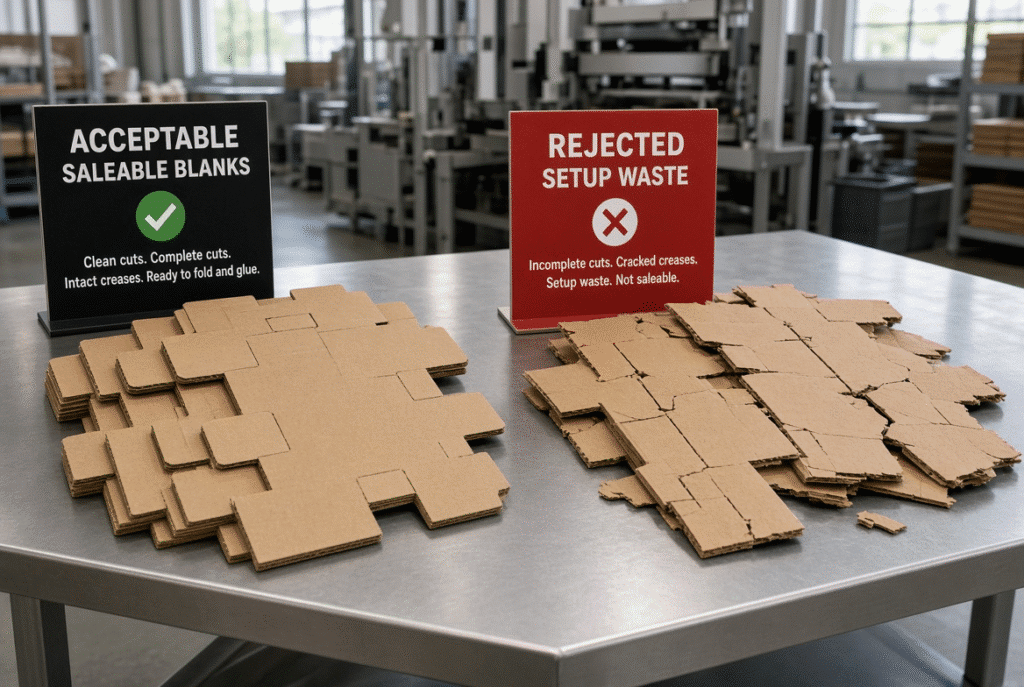
Waste is not limited to the trim removed by the die. Setup sheets, incomplete cuts, cracked creases, damaged edges and rework all raise the cost of every saleable sheet.
Setup Waste
Trial sheets used for pressure, registration and creasing adjustments belong in the job cost. They are distinct from the normal layout scrap built into the die design.
Production Rejects and Rework
Rejects caused by misregistration, incomplete cuts, uneven creasing or handling damage remove sheets from the saleable total. Rework consumes additional machine time, labor and inspection; it should not be counted merely as lost material.
Calculating Yield
Quality yield = saleable sheets ÷ total sheets processed
Lower yield directly increases cost per 1,000 saleable sheets.
Manual and Automatic Waste Stripping
Manual stripping adds labor and handling time. Automatic stripping adds tooling, capital and maintenance cost. The correct choice depends on product complexity, labor rates, order volume and machine utilization.
Maintenance, Energy and Other Operating Costs
Maintenance and energy are often omitted from simple models even though they affect long-term economics.
Preventive Maintenance and Spare Parts
Lubrication, gripper bars, chains, bearings, pneumatic components and planned service can be allocated by machine hours or production quantity. Use the plant’s own records rather than generic estimates.
Energy and Auxiliary Requirements
Actual energy consumption depends on load, duty cycle and auxiliary systems such as compressed air. Include only the items supported by machine documentation and plant metering.
Downtime and Unplanned Repair
Unplanned stops increase cost through lost hours, delayed deliveries, overtime and emergency service. Tracking these events improves both costing accuracy and equipment comparison.
Illustrative Cost-per-1,000-Sheet Example
The following numbers are purely illustrative. They do not represent DAIS pricing or any industry average. Currency is shown in USD for clarity; any consistent currency works.
Example Job Inputs
- Order quantity: 12,000 sheets
- Makeready time: 0.75 h
- Running time at stable speed: 3.2 h
- Operators: 2
- Loaded labor rate: $28 / h
- Machine hourly rate (includes depreciation and routine maintenance): $65 / h
- Tooling allocation for this order: $180
- Setup waste: 80 sheets
- Production rejects: 3 % of sheets after setup
- Maintenance & energy allocation: $0.45 per machine hour
- Material cost excluded (focus is on converting cost only)
Calculate Each Cost Component
Labor = 2 × $28 × (0.75 + 3.2) = $221.20
Tooling = $180
Makeready machine time = 0.75 × $65 = $48.75
Running machine time = 3.2 × $65 = $208.00
Maintenance & energy = 3.95 × $0.45 = $1.78
Total job cost (excluding material) = $221.20 + $180 + $48.75 + $208.00 + $1.78 = $659.73
Calculate Saleable Output and Unit Cost
Sheets after setup waste = 12,000 – 80 = 11,920
Saleable sheets after 3 % rejects = 11,920 × 0.97 ≈ 11,562
Cost per 1,000 saleable sheets = $659.73 ÷ 11,562 × 1,000 ≈ $57.06
Show How the Result Changes With Batch Size
If the same setup, tooling and rates are applied to a 60,000-sheet order with proportional running time and the same reject rate, the fixed setup and tooling costs are spread over five times more sheets. Cost per 1,000 saleable sheets falls noticeably. Batch size is one of the strongest variables in the calculation.
Building a Die-Cutting Cost Calculator or Spreadsheet
A simple spreadsheet turns the method into a repeatable tool.
Recommended Input Fields
- Job number and description
- Order quantity and sheet size
- Material type and blanks per sheet
- Tooling cost and allocation quantity
- Makeready hours and running hours
- Number of operators and loaded labor rate
- Machine hourly rate
- Setup waste and production reject percentage
- Maintenance, energy and overhead allocations
Pull values from actual production records whenever possible.
Separate Fixed and Variable Costs
Tooling and makeready are largely fixed per job. Labor, machine time, waste and energy vary with quantity and operating conditions. Separating them shows why larger orders usually produce lower unit cost.
Validate the Model Against Actual Jobs
Compare calculated cost with finished-job data. Update assumptions when measured speed, setup time, waste rate or labor allocation changes. Review the model regularly.
How Machine Choice Changes Die-Cutting Cost
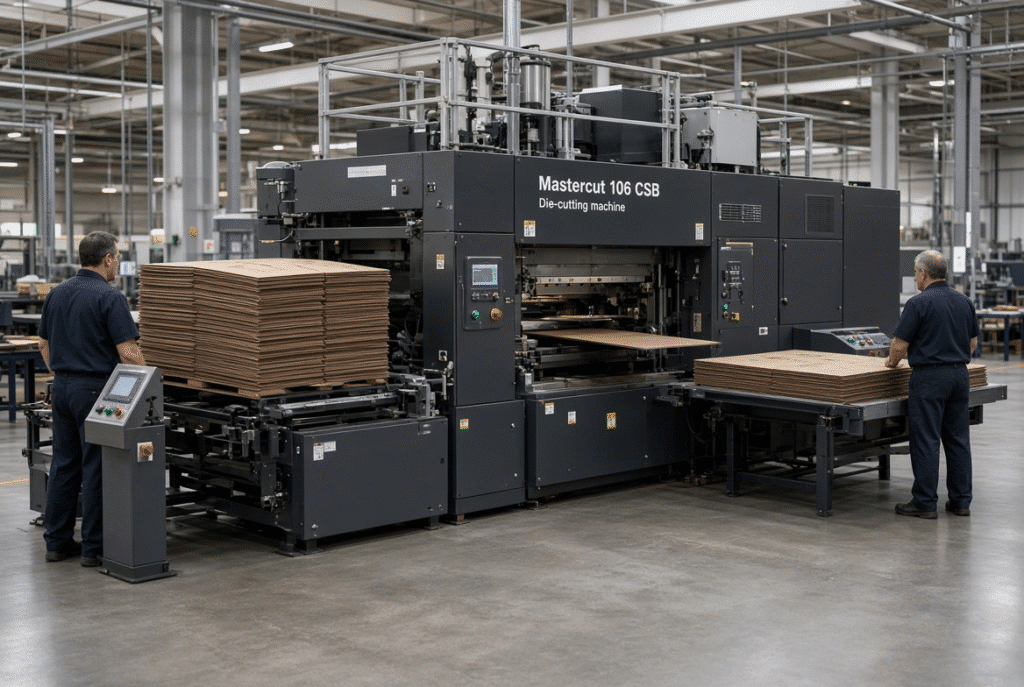
Machine format, feeding, delivery, stripping capability, speed stability and maintenance requirements all affect both fixed and variable cost. Comparisons should always use cost per saleable sheet or finished blank, not catalogue speed alone.
Manual Press Versus Semi-Automatic Die Cutter
A manual press may have lower capital cost but higher labor and handling cost. A semi-automatic machine reduces repetitive work and often improves consistency, yet still requires operators for setup and monitoring. The better choice depends on the plant’s product mix, labor rates and order profile.
Semi-Automatic Versus Automatic Stripping
Automatic stripping can remove a labor bottleneck but adds tooling, investment and maintenance. Job data, not assumption, should decide which route is cheaper for a given product.
Use Saleable Output for Equipment Comparison
A higher rated speed does not guarantee lower unit cost if setup is longer, rejects are higher or the machine cannot handle the plant’s actual board and layout mix.
Common Costing Mistakes to Avoid
Dividing the Machine Rate by Catalogue Speed
This method ignores setup, pile changes, actual running speed, rejects and downtime. The result is almost always too low.
Ignoring Tooling and Makeready
On short runs these items can dominate cost per 1,000 sheets. Treating them as negligible produces under-quotations.
Counting Gross Sheets Instead of Saleable Sheets
Customers pay for usable product. The denominator must match what is sold.
Mixing Cost Units
Hourly costs, per-sheet costs, per-job costs and percentages must be converted to a single consistent basis before they are added.
Treating Every Job as the Same
Material, layout, board thickness, batch size and waste rate change the numbers. Use job-specific data when the differences are material.
Final Guidance: Cost the Complete Job, Not Just the Machine Hour
Reliable die-cutting cost per 1,000 sheets is obtained by adding every relevant job cost and dividing by actual saleable output. Labor, tooling, makeready, machine time, waste, maintenance, energy and overhead must be measured consistently. Replace catalogue assumptions with measured job data and keep the model current.
Need help evaluating a die-cutting machine for your production costs? Send DAIS your sheet size, board type, order quantity, die layout, current output and automation requirements. Our team can help review the machine configuration and the production factors that affect your cost per 1,000 saleable sheets.