

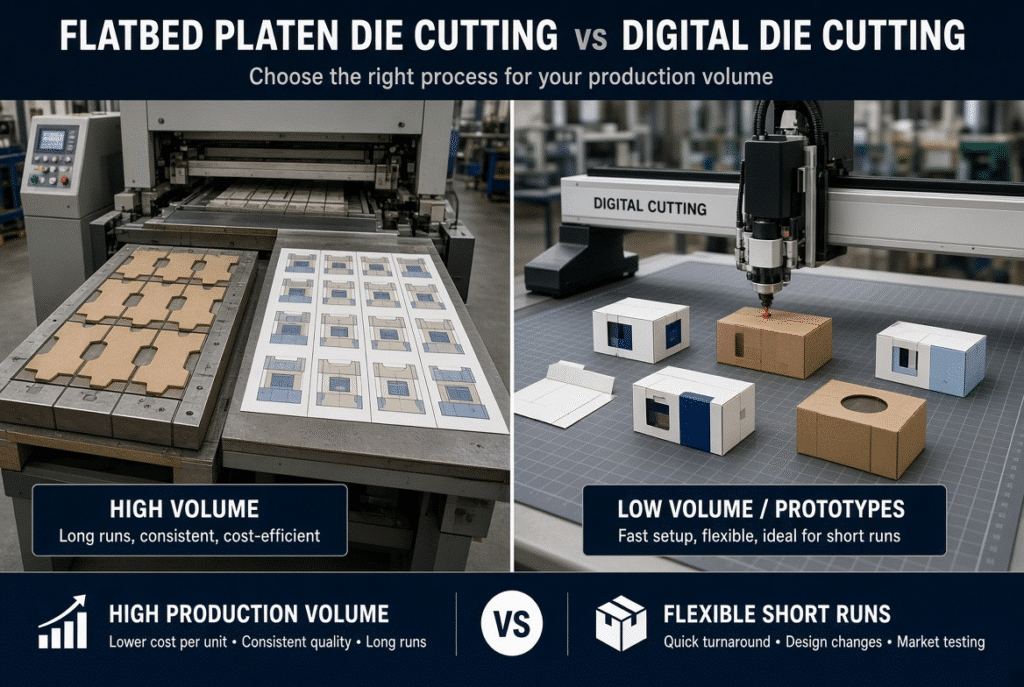
Flatbed platen die cutting is generally more suitable to packaging production of repeat volumes – a steel-rule die can be more economically utilized for medium to long runs of packaging, whereas digital die cutting is more suited to prototype, short runs, frequent design changes and variable packaging. The right one is based on the number of orders, the number of SKUs, tooling costs, material used, product complexity, turnaround time and downstream finishing requirements.
The process often is chosen simply for the machine speed or because there is no conventional die involved, but packaging teams miss the other factors such as total job cost, set-up time, crease quality and folding performance. Comparing the process to the actual job profile yields better results than assuming any of the technologies is superior.
What Is Flatbed Platen Die Cutting?
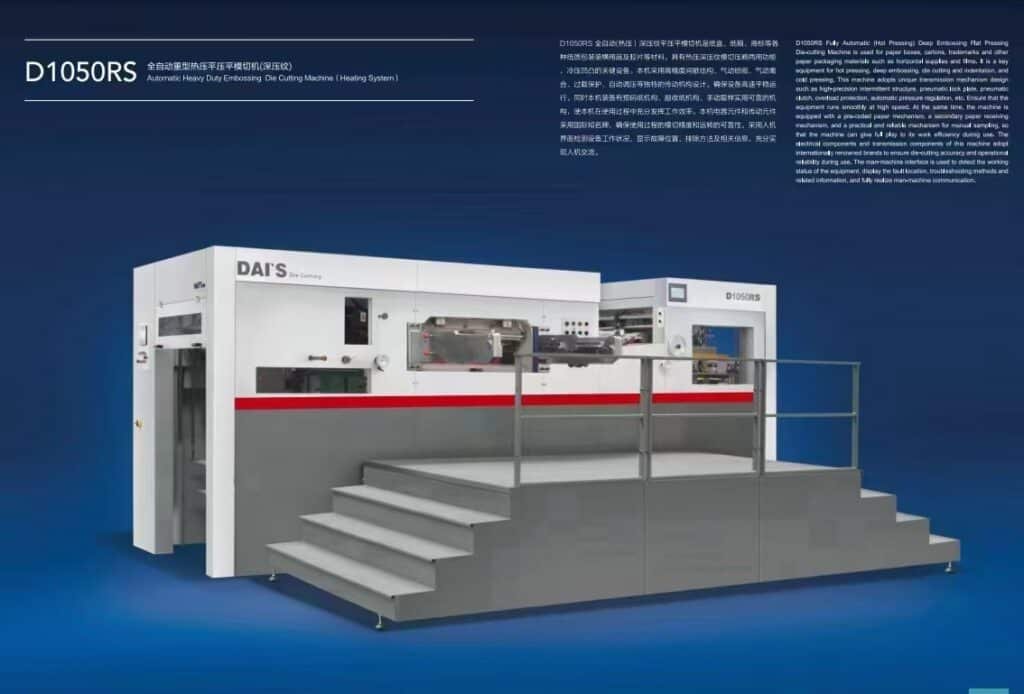
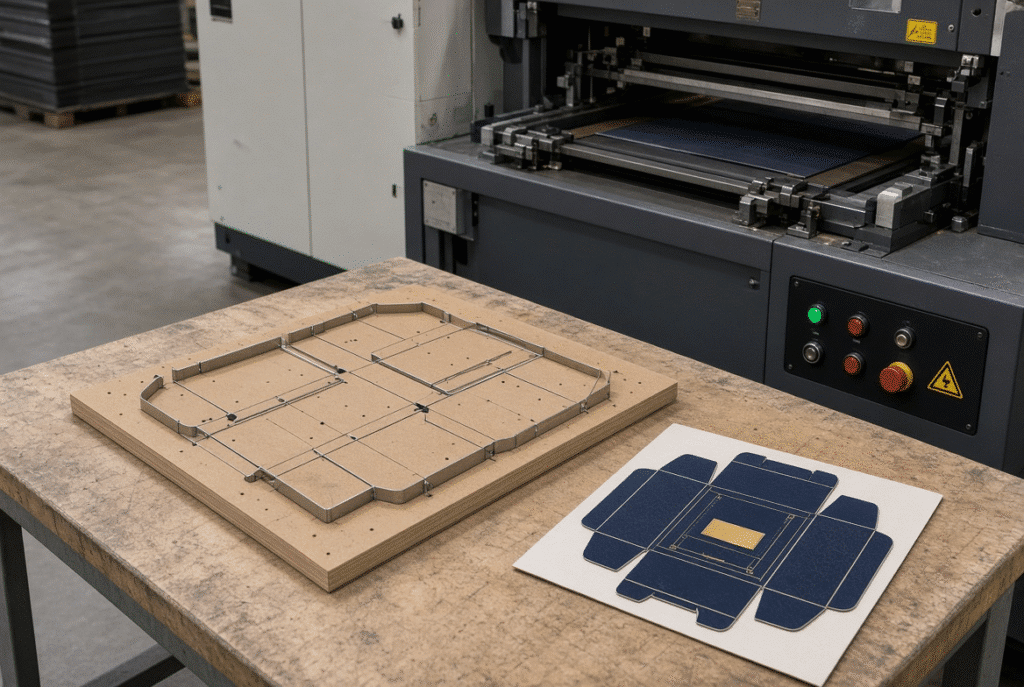
Flatbed platen die cutting is a sheet-fed process where a flat steel-rule die is applied to the substrate under controlled pressure to cut, crease, perforate or emboss the packaging blank in one cut. The automatic platen machines combine the functions of feeder, registration and platen pressure and delivery into one machine, ensuring the sheets move through the press at a consistent timing and positioning.
It is commonly used in carton folding and applications which require repeat fold and multi-up carton layouts.
How a Flatbed Platen Die Is Used
The most common sequence of production starts with the preparation or receipt of a steel-rule die. The sheets are loaded and registered at front and side gauges. Make-ready and pressure settings are adjusted, sample sheets are printed, and the operator insures the quality of the cutting, the depth of the crease printed and the registration with the die. If the machine is approved, it will execute the repeat job.
Where Flatbed Platen Die Cutting Is Strong
In areas where Flatbed Platen Die Cutting is strong.In areas where Flatbed Platen Die Cutting is strong.
Once it is set up, it can provide high production efficiency for medium and long production runs. High precision tool geometry enables complex carton layouts and multiple products per sheet. Output can easily be incorporated into folding and gluing lines, and will have a consistent look after re-use on repeat orders. Depending on machine setup, material, and die layout and operator experience, actual throughput will vary.
The Cost of Conventional Tooling
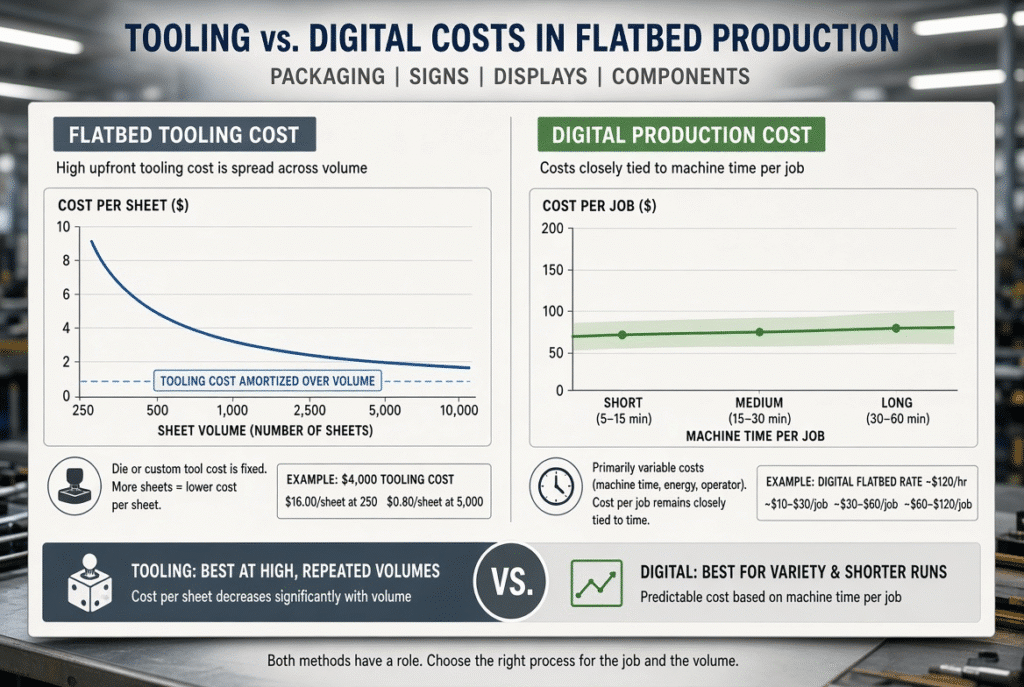
You have to pay for and wait for the steel-rule die. The variables are die size, types of rules, complexity of perforation, stripping needs, supplier and region. That cost is distributed across a number of saleable sheets if the job is repeated throughout the product life cycle. The investment in the tools is more difficult to recover for very short run or designs that frequently change.
What Is Digital Die Cutting?
Digital die cutting is a computer-controlled process that utilizes a digital file and a cutting head or tooling system, instead of the full format steel-rule die for each design. Oscillating, tangential, drag or rotary cutting may be used, depending on the equipment. The major difference is that for each new shape there is less need for traditional steel rule tooling.
How Digital Cutting Handles New Designs
Typically, an operator can load in a new digital file, choose the tools or parameters and start setting up – without waiting for a traditional die to be produced. This reduces prototype and short run lead times. Other operations such as file preparation, loading materials, selection of the tools, registration and machine calibration remain required.
Where Digital Die Cutting Is Strong
Digital cutting is often appealing for prototypes, samples, short-run packaging, frequent SKU changes, and customized or variable packaging, market testing and low-volume replacement orders. Depending on the machine, the thickness of the board, the size of the sheet and the desired crease quality and production speed must be determined and confirmed for each application.
Digital Does Not Mean Setup-Free
Material loading, cutting-head setup, creasing or scoring tools, file checking, registration, sample inspection and regular maintenance are still required for digital systems. The benefit is reduced reliance on conventional tooling – not no tooling.
Flatbed Platen vs Digital Die Cutting by Production Volume
The two processes are economically and operationally balanced depending on the production volume. Below is a table that provides a summary of normal fits for typical packaging situations.
| Scenario | Flatbed Platen Fit | Digital Die-Cutting Fit | Main Reason | Key Caution |
| Prototype / first samples | Limited | Strong | No die lead time | Crease behavior may differ from production die |
| Very short run | Weak | Strong | Avoids tooling cost | Machine time still applies |
| Short run, many versions | Weak | Strong | File change replaces die change | Confirm material and crease quality |
| Medium repeat run | Strong | Moderate | Tooling amortized | Die storage and maintenance |
| Long / high-volume repeat | Strong | Limited | Efficient multi-up production | Digital slower per sheet on large volumes |
| Frequent design changes | Weak | Strong | No new die for each revision | Quality control still required |
| Variable / personalized packs | Limited | Strong | Shape can change per file | Registration and downstream check needed |
Prototypes and First Samples
When the design is still under development and limited quantities of samples are required, digital cutting allows for the speedy iteration of the design without having to invest in a steel-rule die. But, while a digital version of a sample may be close to the crease compression and board behavior of a production die, it is still important to validate with the intended flatbed process.
Short Runs and Promotional Packaging
With small quantities, multiple versions, or promotional packs, digital cutting is not always the best option since a new die will not need to be created for each version. Job-costing must also incorporate digital machine time, machine operator labor and material handling.
Medium and Long Repeat Runs
Flatbed platen die cutting is usually more cost effective when the same layout is requested more than once. Tooling cost is spread over more sheets and multi-up production is supported by the automatic feeder–platen–delivery system. Each plant tooling cost, machine rates and order frequency establishes a break-even point.
High-Volume Standardized Packaging
Stable, high volume carton or compatible corrugated production is typical for conventional flatbed equipment to focus on consistent carton output, high utilization and seamless transfer to folding and gluing. Samples, test markets or low-volume variants can be accommodated with digital cutting even in the same plant.
Tooling, Setup and Changeover
Steel-Rule Die Tooling for Flatbed Production
The conventional die is composed of the die board, cutting rules, creasing rules, perforation rules and ejection rubber. The setup is finished with the make-ready materials and pressure settings. These must be stored properly and may need maintenance here and there, and must be re-mounted accordingly for repeat jobs. The die should give accurate geometry if used properly and can be used for many runs.
Digital Tools and Cutting Heads
Interchangeable blades/Scoring tools or creasing tools are used in digital systems. Control of tool wear, calibration, file parameters and material-specific settings remains to be controlled. Thus, digital cutting also has its tooling and maintenance costs.
Changeover and Design Revision
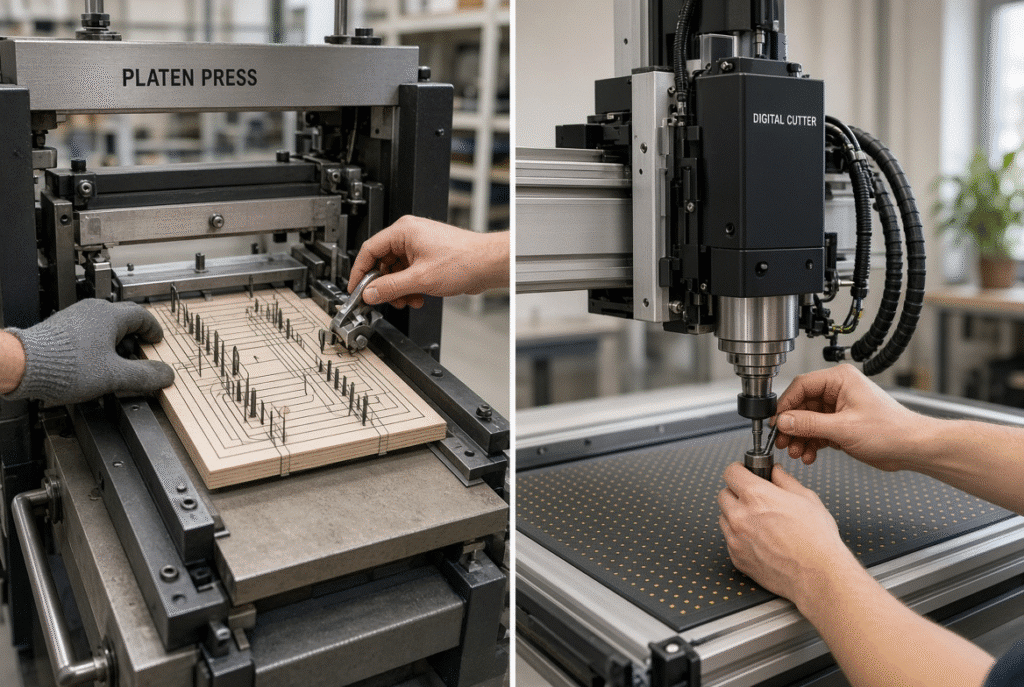
For flatbed changeover, normally die change, make ready, registration, pressure adjustment and sample approval are done. Digital changeover focuses on the loading of files, selection of tools, registration and parameter verification. Faster or slower will depend on the availability of the tooling and skill and complexity of the job.
Cost per Job and Total Cost of Ownership
Price of technology is not all you need to consider when comparing technologies. Total cost of an actual packaging job includes tooling or file preparation, setup, machine time, labor, waste, maintenance and downstream finishing.
Flatbed Cost Structure
Some of these factors include die manufacture, die maintenance, makeready, machine time, operator set up, material waste and tooling amortization. If the same die is used over more or larger numbers of times, the economics are better.
Digital Cost Structure
Key elements are file preparation, digital machine time, cutting-head wear, tool replacement, operator time, material waste and any additional finishing steps. Favorable for low volume production; not as favorable for high volume production that requires a lot of machine time.
A Practical Break-Even Framework
The flatbed job cost equals the tooling, setup, machine time, labor, material waste and finishing.
Digital Job Cost is the sum of four elements: file preparation, digital machine time, tools/wear, and labor time and material waste.
Enter local rates and production information. There is no universal break-even volume.
Material Compatibility and Finished-Product Quality
The selection of the process must also take into account whether the material can be cut, and whether it can be cut, creased, folded, glued and assembled to the required standard.
Paperboard and Folding Cartons
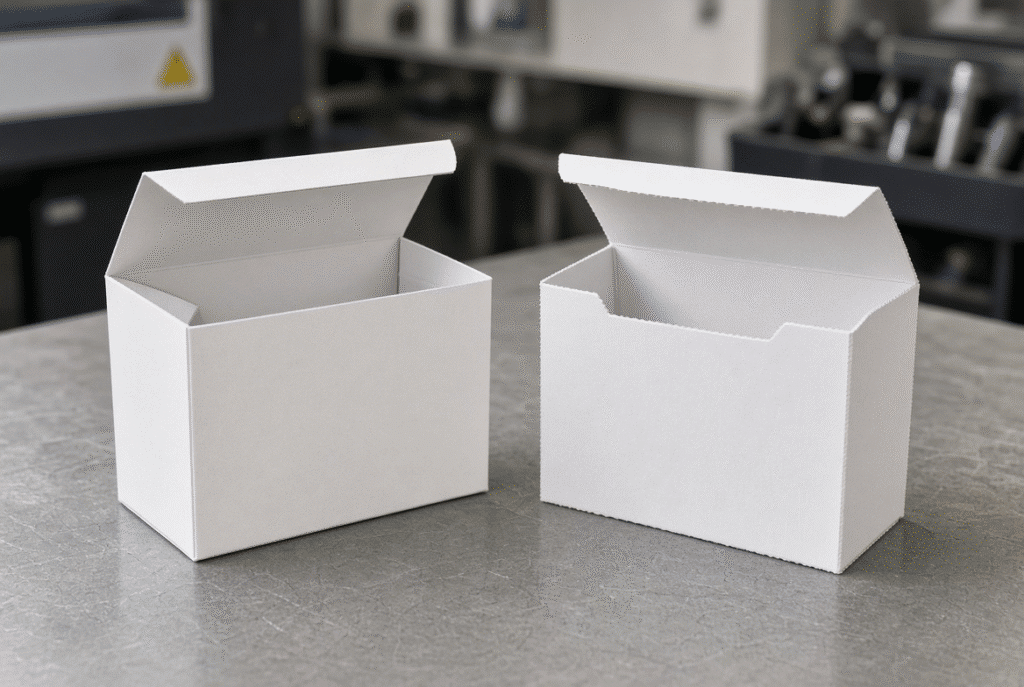
Key factors are clean cutting, consistent crease quality, print-to-die registration, folding behavior and carton squareness. Traditional dies using steel rule work well with proven layouts. Digital systems can create samples and small production of a carton, but the performance of creasing and folding needs to be checked against the production requirements.
Coated and Laminated Materials
Edge quality, crease cracking, scoring behavior and tool wear are affected by surface coatings and laminations. Both methods require specific testing for the material under test.
Corrugated Board
There are other variables introduced by thickness, flute type, stiffness and warp and feeding characteristics. Selected corrugated applications can be accommodated by a flatbed platen system and a digital system can be used for prototypes and short runs where board compatibility has been determined.
Downstream Folding, Gluing and Assembly
The blank should be able to carry out the following process. Inspect the crease recoverability and cut edge quality, geometry of glue flaps, locking features and package squareness. A good looking flat sample can cause trouble on the folder-gluer.
Registration, Repeatability and Personalization
Print-to-Die Registration in Flatbed Production
Variances in feeder timing, front and side gauges, sheet condition, die position and print registration affect accuracy. Mirror tight, repeatable registration can be achieved on established jobs using automatic platen machines with stable mechanical systems.
Digital Registration and File-Based Cutting
Cameras, registration marks or file coordinates can be used in digital systems. The final results are still subject to the problem of printed-sheet distortion, trimming, curl and material condition.
Variable Data and Versioned Packaging
Digital cutting allows for customised, serialized and regionally or often changed packaging without a new conventional die. There is still a need for quality control and print to cut alignment.
Repeatability in Long Runs
When the machine, die, material and set up are stable, conventional flatbed tooling can provide a high level of repeatability. Digital repeatability is calibration, tool condition, file settings and material handling. Both processes are not the best in general.
Speed, Throughput and Production Workflow
The rated speed is not necessarily the salesable speed. Total job completion time is affected by setup, changeover, tooling, sample approval, inspection, waste, and maintenance and downstream capacity.
Why Digital Can Be Faster for Small Jobs
With digital cutting, the manufacturing lead time for the dies can be eliminated and a short job could begin immediately following file preparation and setup. This is a good thing for samples, prototypes or for small run orders that must be delivered right away.
Why Flatbed Can Be Faster for Repeat Jobs
After the die and make-ready and machine settings are set up, automatic platen production can easily handle repeat orders, particularly with multiple-up plate designs and continuous feeding and delivery.
Effective Output Versus Rated Speed
Determine overall job completion time and number of acceptable finished units, not just sheets/hour or cutting speed (dps).
When to Use Both Processes in the Same Packaging Business
Flatbed and digital cutting work hand-in-hand.
Digital for Prototypes and Flatbed for Production
Many plants employ digital cutting to verify dimensions, test board action and then manufacture customer samples prior to investing in a traditional steel rule die for repeat production. Ensure the digital crease and cut is transferred to the flatbed process.
Flatbed for Core SKUs and Digital for Variants
The stable high-volume designs can be set up on flatbed equipment, while digital cutting can offer low volume or regional replacements or promotional packs. The Hybrid method offers the advantages of reduced tooling pressure and efficient repeat production.
Choosing Based on the Job Profile
Sort all jobs and/or product families by volume, design frequency, material, urgency, SKU count, personalization and finishing requirements. Make a plant-wide decision at the job level.
Buyer Checklist: Which Process Fits Your Production Volume?
Choose Flatbed Platen When These Conditions Apply
- Medium or long repeat runs
- Stable carton designs
- Several products per sheet
- Consistent creasing required
- Existing and affordable tooling, or tooling that can be amortized easily.
- Automatic feeding, delivery and downstream finishing included.
- Repeat orders products life.
Choose Digital Die Cutting When These Conditions Apply
- Samples and mock-ups.Prototypes and first samples.
- Very short runs
- Frequent design revisions
- Numerous SKUs in low volumes.High number of SKUs in low volume.
- Custom Packaging or Personalized Packaging
- When the time calls for testing the market or immediate samples are required.
- The desire to not have to use a new die for each variation
Ask These Questions Before Deciding
- How many sheets or finished packages needed?
- How often will the design have to be changed?
- Does there already exist a conventional die?
- What are the die cost and lead time?
- How many machine times does it take in total for the jobs to be completed?
- How many folds and what type of fold are necessary?
- What materials need to be treated?
- What is an allowable amount of trash?
- What is the time sensitivity of the delivery of the job?
- Will it be the same product in a month or year?
- To which downstream equipment will the blanks be connected?
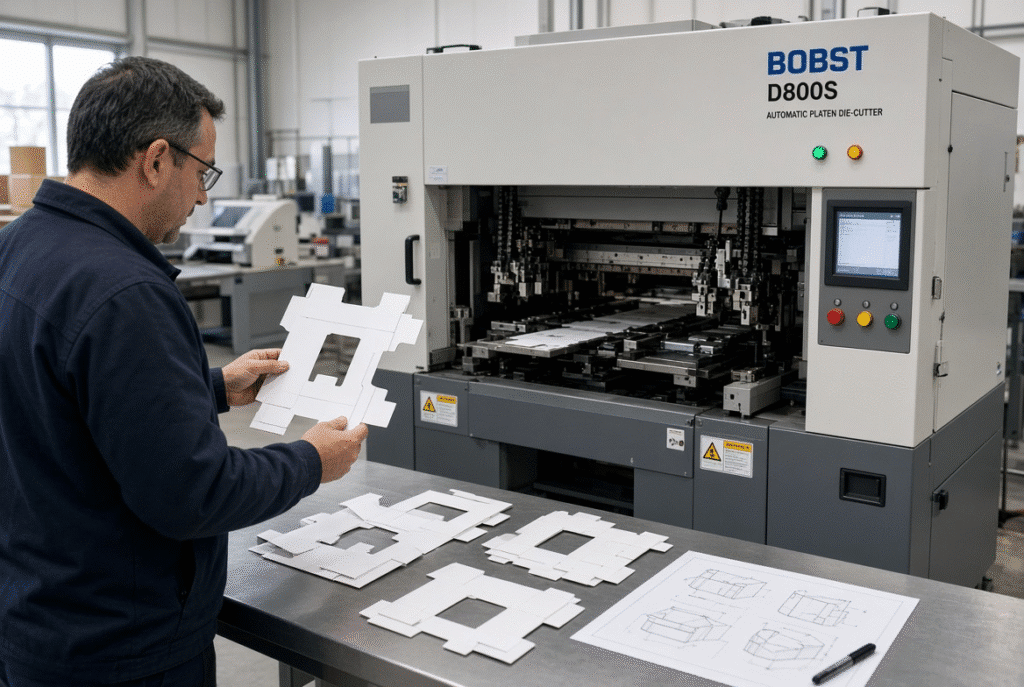
Using the D800S as a Flatbed Production Example
The D800S is an automatic platen die-cutting machine for paperboard and compatible corrugated paper cutting and creasing. It has a maximum sheet size of 800mm × 620mm, a maximum die cutting size of 800mm × 615mm, a maximum working pressure of 150 tons, a die cutting accuracy of ±0.25mm and a maximum working speed of 6,000 sheets per hour. It is not designed to be a one-size-fits-all solution for all digital platforms, but rather for repeat production environments.
Where a Machine Like the D800S May Fit
The situation, in which a plant requires regular sheet-fed die cutting, creasing or perforation for already existing product designs and production volumes, which are deemed as being high enough to warrant conventional die or punch tooling, is relevant for such a machine. The actual suitability will vary according to sheet size, material, layout and volume of sheets per year.
When Digital May Still Be Better for the Same Plant
Digital cutting can be used for prototypes, short-run variants, sample approval and designs that change frequently, in the same plant. Both the technologies cater to different job mix.
How DAIS Should Confirm Application Fit
Specify sheet size, material type and thickness, product drawings, die layout, number of products per sheet, monthly/annual volume requirements, SKU count, creasing and perforation requirements, expected speed, and quality standards for finished product. Before making any equipment selection, a machine trial and cost review should be carried out.
Final Checklist for Choosing Flatbed or Digital Die Cutting
- Predict reasonable employment levels
- Count the number of design versions / SKU changes
- Determine the cost and lead time of tools.
- Find machine time for digital machines.Work out the time required by a digital machine.
- Evaluate material compatibility
- Check cutting/creasing quality
- Think about set-up and changeover time.
- Measure expected waste
- Consider print-to-die registration requirements
- Assess downstream folding and gluing skills.
- Design separate prototypes and repeat production.
- Make comparisons between the total cost of the finished job.
- Run representative samples
- Think about a combination production plan
Final Guidance: Match Technology to Volume and Variation
Flatbed platen die cutting may be a better choice for repeat production using existing tooling, and digital die cutting may be beneficial for prototypes, short runs, high variation and custom packaging. Both processes can’t be said to be “best” overall. This should be based on production quantity, job mix, tooling economics, material, finished product requirements.
When you are focusing on repeat sheet-fed paperboard or compatible corrugated production, check out the D800S automatic platen die-cutting machine, or discuss whether conventional flatbed production is a better fit for your volume, materials and product mix with DAIS.