
Being a machinery expert and having more than twenty years of experience to assist the printing and packaging factories to optimize their lines, I have witnessed how the paper cutting machine can be relevant in making operations run straight and saving money. Paper cutting machines have been developed to cut stacks of paper, cardstock, or board to the exact size with clean edges, which is used in downstream processes, such as folding, binding or die-cutting. They are also needed in printing & packaging plants since wrong cuts cause waste, time wastage and production run-off.
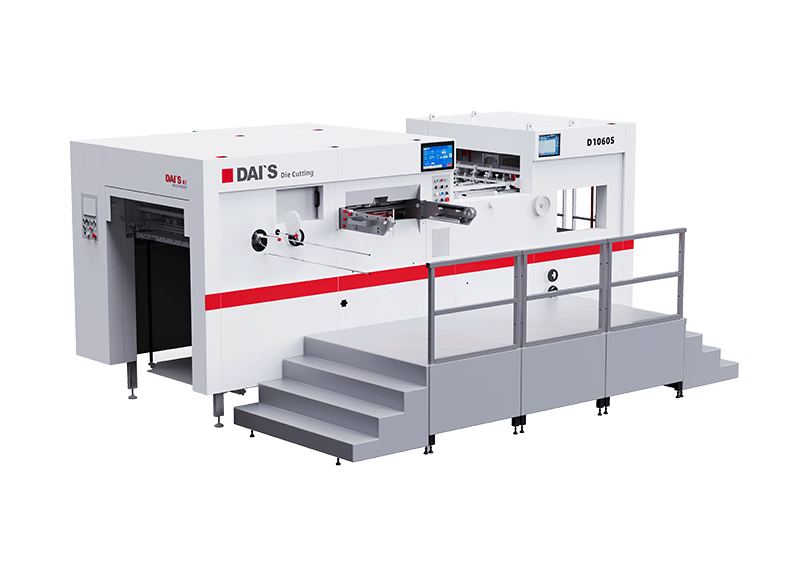
Selection criteria such as cutting precision (accuracy to 0.1mm) to avoid wastage, the level of automation, cutting width that fits your sheet size, and strong safety mechanisms to ensure that the operators are safe are the most important. The most important are cutting precision and automation because these factors directly affect the quality and throughput: poor precision will destroy print jobs, and automation will decrease the labor force by up to 50 percent. When seeking an industrial paper cutter or guillotine paper cutter, then give importance to servo control technology to get a faster and repeatable cutter. A high-speed paper cutting machine such as a servo-driven one can be used in high-volume plants with 45-55 processes per minute to turn the bottlenecks into flow processes.
Personally, I have worked in Dongguan plants, and the selection by these aspects guarantees a high ROI in the long run. Let’s break it down further.
What Is a Paper Cutting Machine?
A paper cutting machine, sometimes called an industrial paper cutter, or guillotine cutter, is a sturdy mechanical machine that is used to cut through stacks of material with great pressure with a sharp blade. The industrial use of it is to ready sheets to printing presses, packaging lines or finishing equipment by obtaining even quantities.
Cutting mechanism Usually a hydraulic or servo-driven clamp is used to hold the stack after which a descending blade is used to achieve a clean guillotine cut. It can be used in the printing/packaging process immediately after printing or immediately before die-cutting – imagine trimming over-sized pieces of paper down to box or book size. The issue of cutting accuracy and its impact on downstream processes is crucially important: A 0.2mm error can lead to misalignment of folds or jamming of automated lines and result in expensive downtime.
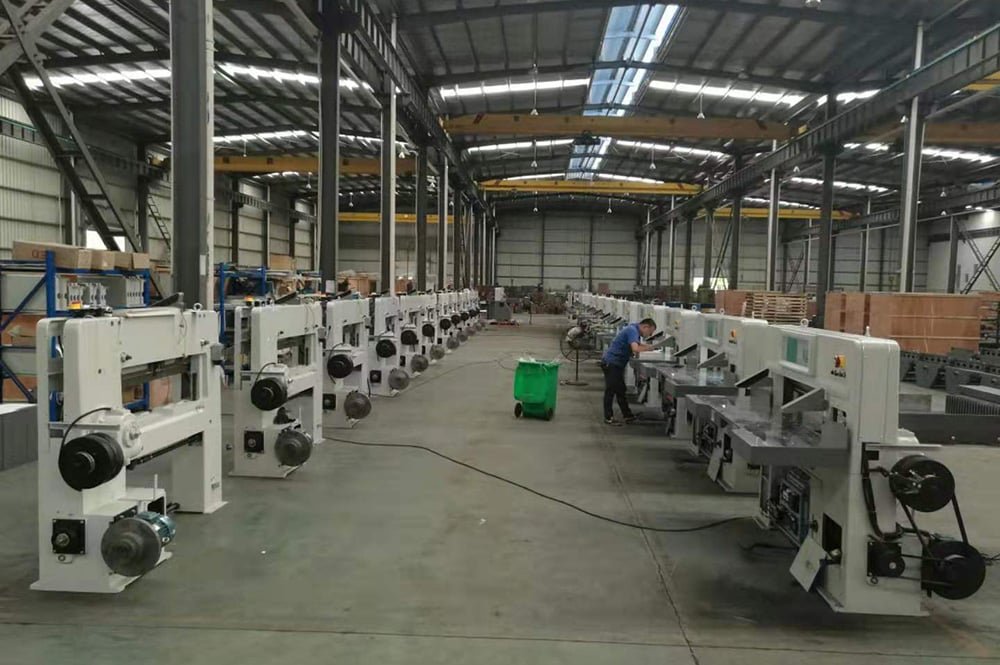
According to installations that I have managed, companies that do not follow this end up producing products that are not consistent and this is why it is unnecessary to compromise on the precision.
Types of Paper Cutting Machines
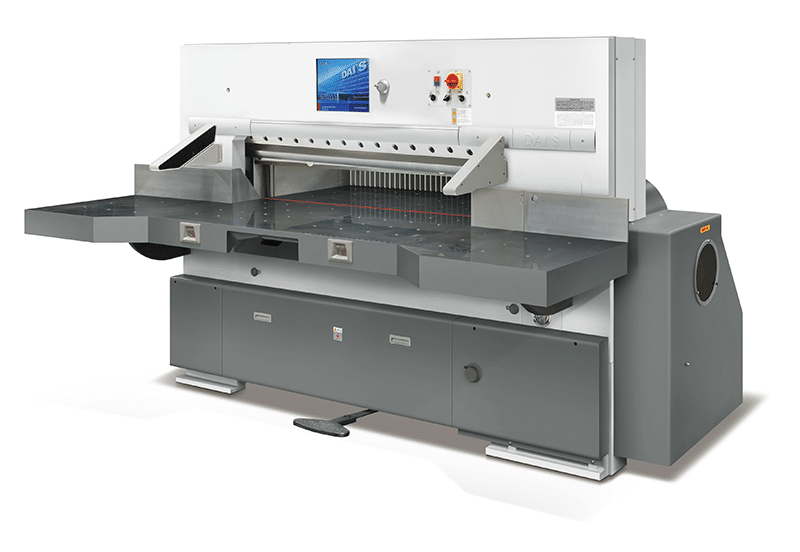
Knowledge of the paper cutting machine types assists to find the suitable one. Here’s a breakdown:
The Fully Automatic Paper Cutting Machine is characterized by automatic feeding, alignment and unloading. It works well in large-volume facilities and minimizes staff participation and increases pace.
A Semi-Automatic Paper Cutting Machine has to be loaded manually, but it cuts and clamps automatically. This makes it cost and efficiency balanced when it comes to medium scale operations.
Hydraulic Guillotine Paper Cutter is fluid powered to provide heavy, uniform pressure and is also effective when dealing with large stacks such as corrugated board.
Programmable Cutting Machine enables pre-arranged parameters of jobs through software, which is ideal to use in repetitive tasks of different sizes.
Last, the Servo-Driven High-Speed Paper Cutter uses electric servos to achieve high precision, high-speed positioning – imagine a model that is automatic paper cutters, such as 1450, 1750 or 1950 mm wide.
Differences are: Automation (full vs. partial), operator intervention (low in automatics), pressure system (hydraulic vs. servo) and speed (up to 55 cycles/min in servos vs. 30 in basics). Servos have cleaner operation and are more cost-efficient with respect to energy consumption in the case of industrial guillotine cutters.
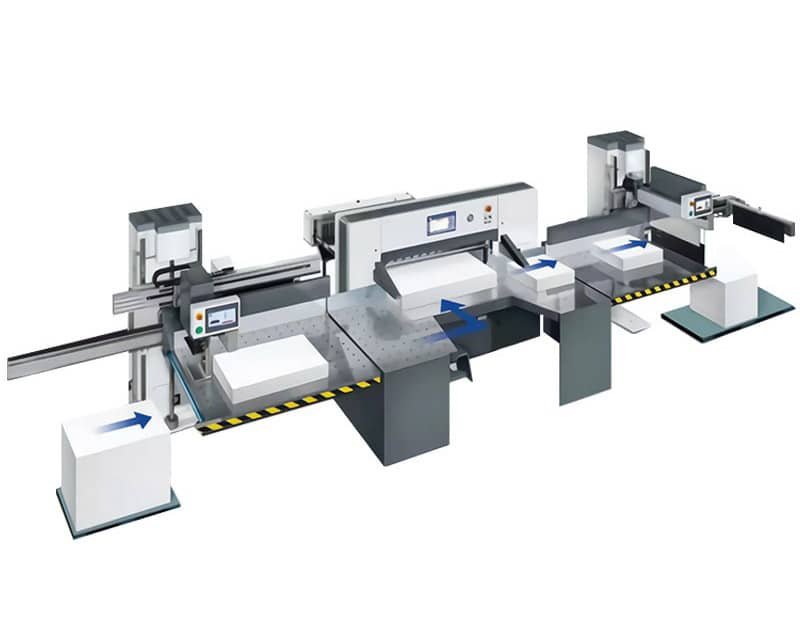
I have suggested servo-driven varieties to the growing factories as part of my advice so that they can be future-proof to the demands.
Key Specifications That Matter Most
To compare the performance of a paper cutting machine, pay attention to the following:
The width of cutting defines the capacity of the sheets – the standard printing sizes such as 1450 mm, 1750 mm, or 1950 mm are common.
Stack thickness is controlled by maximum cutting height, which is normally 80-165 mm used in industry.
The pressure system, hydraulic or servo, is a source of force; the servo is quicker and has greater control.
Blade material and sharpening: For high-carbon steel blades, sharpening needs to be done after 5,000-10,000 cuts, depending on the material.
No slippage is ensured by clamp pressure (up to 3,000 kg).
Positioning the back gauge- very important at 0.01-0.1 mm in the industrial cutters.
Speed is measured in cycles per minute with high-end models reaching 45-55.
The touch screen programming is used to set up several jobs in a short time.
To buyers of servo paper cutters, these features guarantee low wastage as I have observed that with the accuracy of back gauges in positioning, plants are saving scraps by 20 percent.
Applications in Printing & Packaging Plants
The paper cutting machinery is bright in a range of functions:
Raw paper is cut into sheets and made ready to press and the sizes are uniform.
Print jobs are trimmed finally to eliminate excess which is crucial in brochures or labels.
Board cutting used to produce boxes works with cardstock or corrugated used in order to package the blanks.
Pre-cutting die-cutting machine Pre-cutting is a method by which the material is shaped in advance before cutting.
Book binding and finishing binds the edges to perfect-bound books.
They can be used in workflows as they can be fed with post-print trimming and can lead to folding or laminating. Daringly, incompatibilities create inefficiencies and as in example a simple cutter on thick board will wear the blade.
On factory floors which I have paid visits to, such applications emphasize the way cutters serve the industries of paper printing and packaging, home furnishing, and electronics.
Automation & Intelligent Controls
The automation paper cutting machine of modern days has raised its efficiency:
Stacks are not handled manually, they are pulled automatically by automatic feeding.
Perfect positioning is done through sensors in automatic alignment.
Back gauge is rapidly adjusted by servo.
Rapid changes are stored on programmable job settings.
Auto-lubrication keeps components available.
Touch-screen controls include user friendly interfaces to operators.
These decrease the setup time by 30-50 in intelligent industrial cutters. I have applied them in those lines where they converted manual bottlenecks to automated processes and saved man hours a day.
Safety Features
High-pressure environments are primarily concerned with safety. Key safety features include:
Intrusions are detected by infrared safety curtain and the blade is stopped.
The control of operation of two hands demands the use of two hands hence accidents are avoided.
The machine is locked up with safety lock systems when it is undergoing maintenance.
Immediate halts in the form of emergency stop buttons.
When not used, the edges are shielded with blade.
Strain is eliminated on the motor by overload protection.
They are the main factors of decisions, at factories that I have audited, they are the priorities in order to comply with the world standards such as CE, preventing injuries and liabilities.
Maintenance & Durability Requirements
Proper care extends life. Frequency of sharpening of blades: 5,000 cuts with paper, more frequently with abrasives.
Lubrication specifications Daily inspections or auto-system.
Wear components and service life: Belts and clamps once in 121 year.
The design of cast-wall frame offers resistance to vibrations that are long lasting.
Why it will boost long-term ROI: Tough constructions have durability of 10-15 years, which decreases the number of replacements.
In my practice, the costs increase due to putting off maintenance since frequent checkups maintain ROI.
Cost, Budget & ROI
The cost of paper cutting machines ranges: simple at between 10,000-30,000, automatics between 50,000 and 150,000 and above.
The cost of labor effect: Automation reduces the requirements by half.
Automation profiteering: 30 percent on wages.
Potential life expectancy: 10 years under care.
Payback period of 1-3 years at the medium volume factories in terms of efficiency.
In the case of industrial cutter ROI, base the calculation on output-I have assisted clients to recover investments in a very short time through the lessening of waste.
Expert Checklist + Final Recommendation
Select this 10-item selection checklist:
- Size of required sheet: Equivalent to cutting width such as 1450 mm.
- Thickness and material type: Make sure that the cutting height is adequate to cardstock or board.
- Precision level required: 0.1 mm.
- Volume of output per day: This should be highly automated.
- Skill level of operators: The low skills prefer the programmables.
- Level of automation: Semi to full.
- Safety needs: Focus on infrared curtains.
- Maintenance requirements: Auto-lubrication.
- Budget range: Trade off with ROI.
- Available factory space: Smaller-sized plants.
The right paper cutting machine is the machine that best fits your volume of production, sheet size, and accuracy needs and enhances efficiency and lowers the point of labor cost. Scaling your plant, invest in servo-driven models in the long run.