

The best paper cutting machine for packaging is not determined by the size and cost of the machine, but the machine that matches cutting accuracy, material handling, production volume and efficiency with packaging needs.
Paper cutting for packaging has unique requirements. Packaging production demands the high-speed cutting of a range of substrates – from lightweight folding carton to heavy-duty corrugated – with close tolerances for the downstream packaging processes of folding, gluing and printing registration. Often, customers assume any industrial paper cutter will work just as well for packaging production, but packaging production can have different speed, accuracy, substrate handling and productivity needs.
The ideal paper cutting machine for packaging is the one that meets packaging-specific material, volume, accuracy and production efficiency requirements.
What Makes Packaging Industry Cutting Requirements Different?
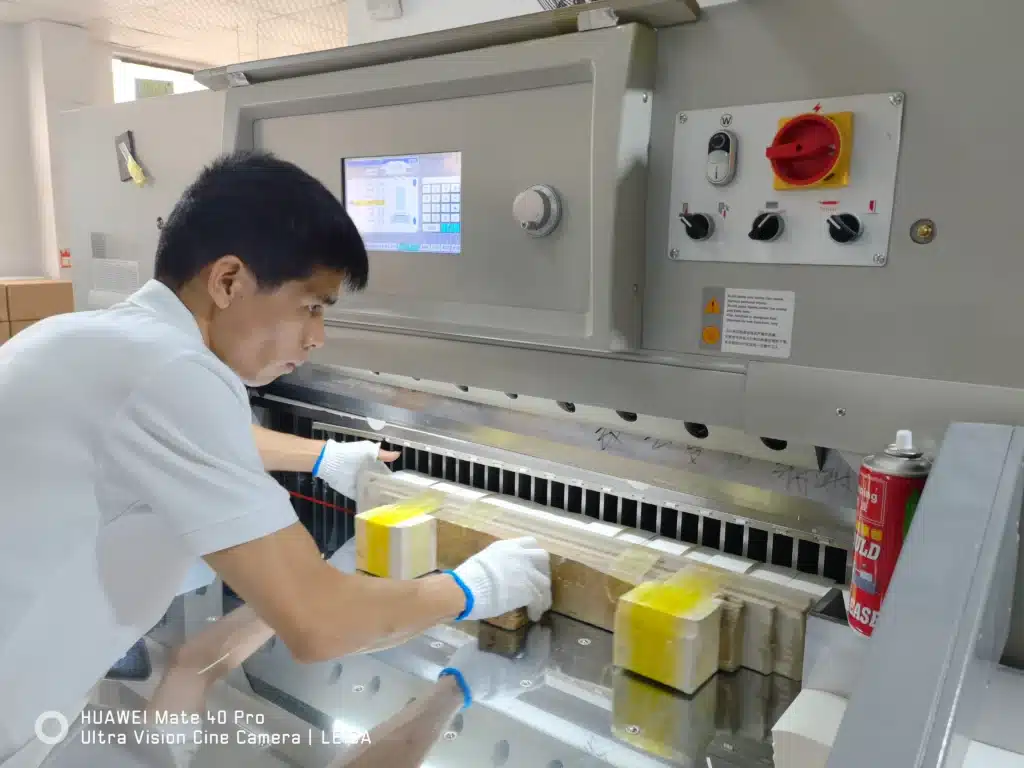
Packaging manufacturing environments are different to regular paper cutting environments in ways that impact machine choice and operation.
Packaging stocks can be thin, thick, dense, porous, smooth or rough. A cutting machine that performs well with 80-250 gsm paper may not cut as efficiently with 600 gsm board or multi-layer corrugated. Throughput requirements may increase with some plants operating multiple shifts, with limited allowable downtime. Accuracy and consistency are essential as a slight misalignment may result in registration issues in downstream processing. Lastly, integration is important – the cutter must seamlessly integrate with automated feeding to folding, die-cut or laminating machines.
| Packaging Requirement | Why It Matters |
| High throughput | Directly impacts daily output and profitability |
| Precision cutting | Ensures consistent quality and reduces waste |
| Material variability | Allows reliable handling of diverse substrates |
| Workflow integration | Supports end-to-end automated production |
That’s why a universal cutter is not an ideal fit for a packaging facility.
What Defines the Best Paper Cutting Machine for Packaging?
The best paper cutting machine for packaging is one whose key characteristics align to your specific manufacturing environment.
The focus of the evaluation should be on the production benefits offered by each factor, not on the specifications themselves.
| Evaluation Factor | Why It Matters | Production Impact |
| Precision | Maintains tight tolerances | Product quality, less waste |
| Capacity | Handles required stack heights and speeds | Higher output support |
| Automation | Reduces manual intervention | Workflow efficiency, labor reduction |
| Durability | Withstands continuous operation | Reliability, lower downtime |
| Safety | Protects operators in high-volume settings | Risk reduction, stable operation |
Production managers assess machines on total cost, and contribution to overall equipment effectiveness (OEE), not just cutting speed.
Best Types of Paper Cutting Machines for Packaging Applications
There is no one machine type that works for all. Your preferred substrates, run sizes and automation level determine what’s right for you.
Servo-Driven High-Speed Paper Cutting Machines
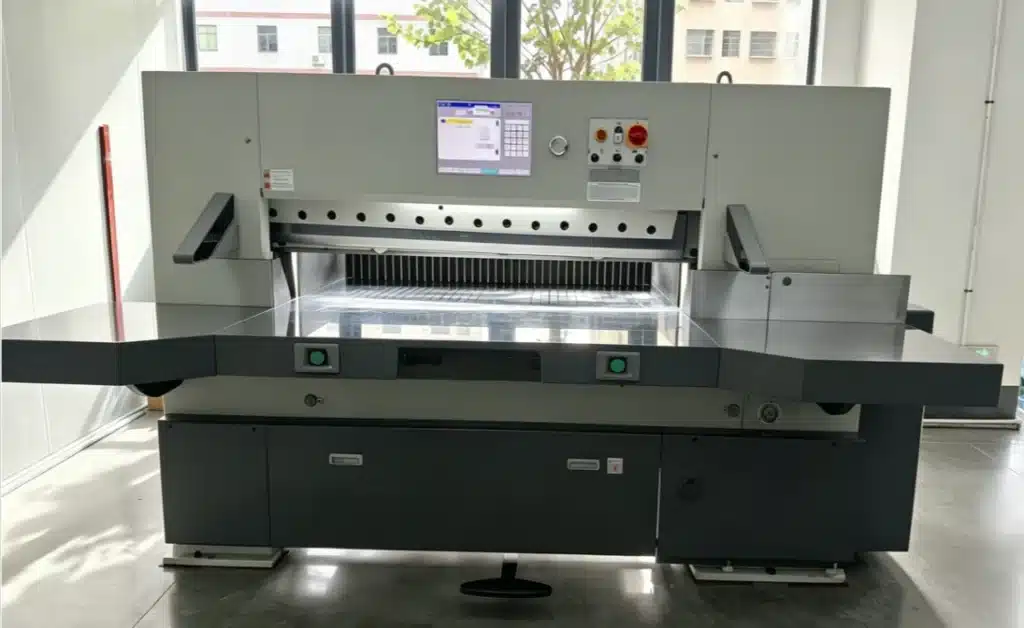
Servo-driven machines are ideal for high-throughput packaging operations with large sheets or multiple formats. These machines feature closed-loop servo systems that provide high accuracy and fast backgauge travel (often less than two seconds between cuts). These cutters are ideal for high-speed carton production with thousands of sheets offset each shift.
Programmable Hydraulic Paper Cutters
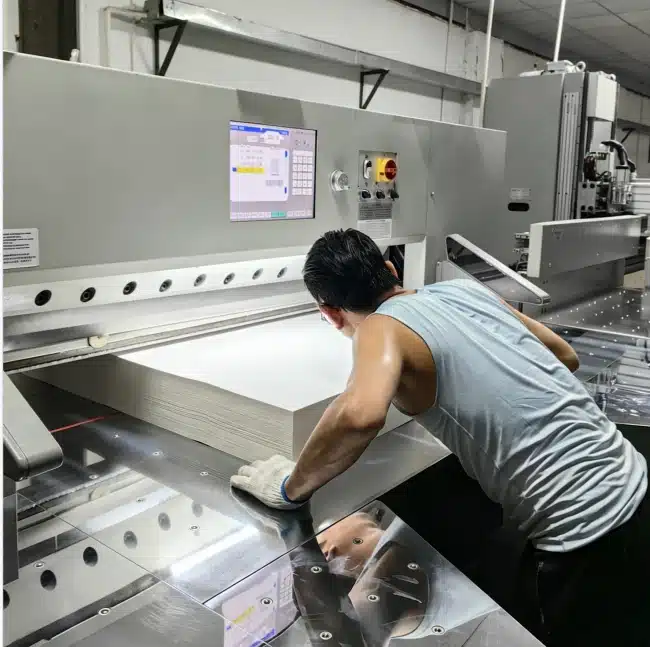
Programmable hydraulic cutters are the mainstay of mid- to high-speed packaging production. They have good holding power and can handle a variety of board types. Newer models feature touch-screen control, cut optimization, and air tables to make it easier on the operators. They offer many converters a great combination of function and value.
Heavy-Duty Guillotine Paper Cutters
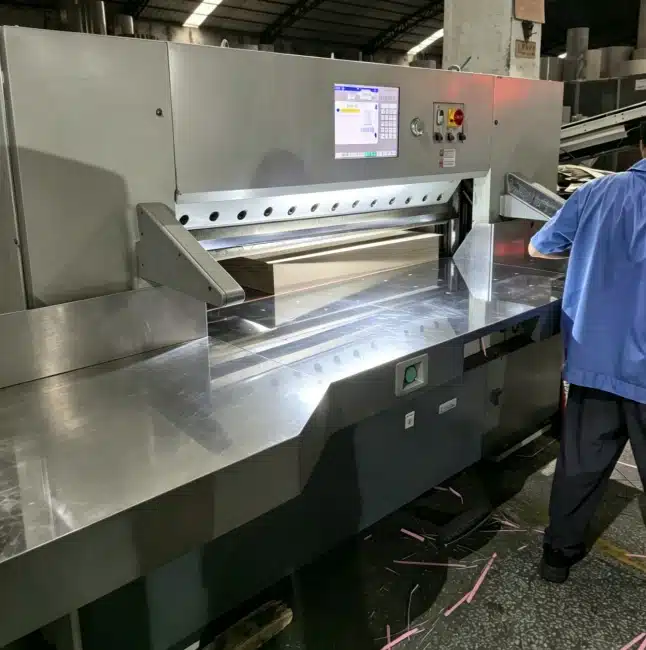
Guillotine cutters are suitable for cutting thick stock, multiple-ply materials and packaging applications. With their rugged design and high-pressure hydraulics, these heavy-duty systems are designed for heavy-duty applications that would bend and wear out the thinner, lighter systems.
Fully Automatic Paper Cutting Systems
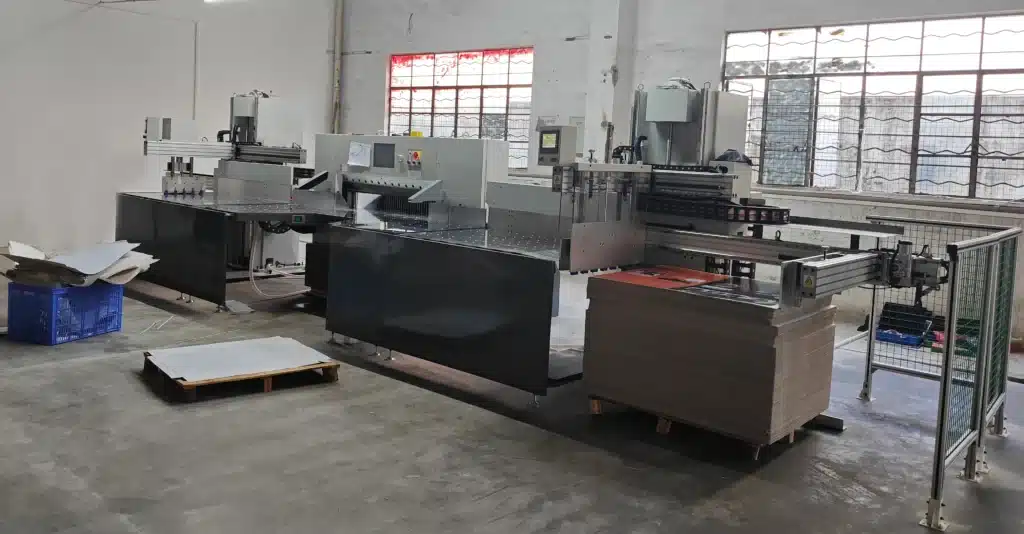
Automatic systems feature automatic loading, cutting, and unloading. These are perfect for smart packaging lines seeking to increase capacity and reduce human intervention. Automatic stack lifting, alignment and waste removal are usually included, making these systems ideal for factories transitioning to Industry 4.0.
| Machine Type | Best For | Key Strength | Consideration |
| Servo-Driven High-Speed | Large-volume plants | Speed & repeatability | Higher initial investment |
| Programmable Hydraulic | Mid-to-high production | Versatility & reliability | Operator skill still required |
| Heavy-Duty Guillotine | Thick stock & industrial | Power & durability | Slower for frequent format changes |
| Fully Automatic Systems | Smart/high-volume lines | Labor reduction & integration | Requires strong workflow planning |
Matching Machine Types to Packaging Applications
Fit is more important than rankings. Matching machine type to product type ensures high performance and eliminates the need for retrofits.
| Packaging Application | Recommended Machine Type |
| Folding Cartons | Programmable or Servo-Driven |
| Corrugated Packaging | Heavy-Duty Cutters |
| High-Speed Carton Production | Automatic Systems |
| Specialty Packaging | Precision-Focused Servo Machines |
Knowing these matches will help buyers avoid mismatches that cause bottlenecks.
Key Specifications Packaging Buyers Should Prioritize
Look for specifications to affect packaging productivity and quality.
- Cutting width: Should be wide enough for your largest sheet size with trim. Packaging sizes typically range between 115-185 cm.
- Stack height: How many sheets are cut per pass, impacting productivity.
- Accuracy tolerances: ±0.1 mm repeatability or better on critical jobs.
- Automation controls: Programmable logic with job memory and optimization software.
- Material handling capability: Air flotation tables, side tables and pile loaders are a must at higher throughputs.
| Specification | Why It Matters |
| Cutting width | Format compatibility |
| Capacity | Throughput |
| Accuracy | Packaging quality |
| Automation | Efficiency |
| Material handling | Application fit |
Features That Matter Most in Packaging Production
Some features are more valuable than others.
- Servo motor control for accurate, consistent positioning at high speed.
- Intelligent controls that recall jobs and offer optimization software shorten setup times.
- Features to reduce waste including nesting patterns and offcut management.
- Safety features such as light curtains, two-hand control and emergency stops.
- Preparation to connect with upstream printers and downstream die-cutters.
| Feature | Benefit |
| Servo control | Precision |
| Smart controls | Efficiency |
| Safety systems | Risk reduction |
| Automation integration | Workflow improvement |
How to Choose Based on Production Volume and Business Size
Volume and business size are most important for choosing your machine.
| Business Type | Recommended Machine Category |
| Small Packaging Converter | Programmable Hydraulic |
| Medium Packaging Plant | Servo-Driven |
| Large Industrial Producer | Fully Automatic Systems |
| Specialty Packaging Producer | Precision-Focused Machines |
Smaller plants can benefit from more cost-effective, flexible packaging machines, while larger plants will benefit from automation.
Cost vs Value: What Packaging Buyers Should Evaluate
Cheaper machines don’t always provide the “best” packaging value. Instead, consider total cost of ownership.
Consider the purchase price, productivity return on investment (ROI), risk of downtime, maintenance costs and whether it can grow with your business.
| Evaluation Factor | Why It Matters |
| Purchase price | Initial budget |
| Productivity ROI | Revenue generation |
| Reliability | Downtime reduction |
| Maintenance | Ownership cost |
| Scalability | Growth support |
Seasoned buyers look to payback time in terms of higher yield and lower scrap, not price.
Common Mistakes When Choosing a Paper Cutting Machine for Packaging
Experienced buyers sometimes make these mistakes:
- Selecting based on size rather than process needs
- Overlooking accuracy needs of folding and gluing lines
- Underestimating the variability of the packaging material and how it affects blade life and quality of cut
- Concentrating on the price of the machine and not its total cost over time
- Ignoring future scalability issues when current production is likely to increase
- Assuming general cutting machines can be used for packaging
By avoiding these common pitfalls, implementation time and costs are minimised.
Future Trends in Packaging Paper Cutting Equipment
The future of packaging manufacturing is increasingly connected and efficient.
Smart factory connectivity, increased automation, control precision, energy efficiency and predictive maintenance are features that are increasingly expected. Future-paced plants are considering machines not just on their immediate capabilities, but on how they can accommodate these technologies.
Conclusion — The Best Machine Depends on Packaging Production Fit
The best paper cutting machine for packaging is not a specific model but the one the matches packaging-specific production needs, efficiency targets and long-term production needs.
By selecting equipment that’s tailored to your production’s materials, throughput and production setup, packaging manufacturers can increase productivity, quality and return on investment. The key to making the right choice is to understand your production needs, not blindly follow industry trends.
This makes your cutting process an asset, not a liability.